
01Summary
In a paragraph
If you only have 30 seconds.
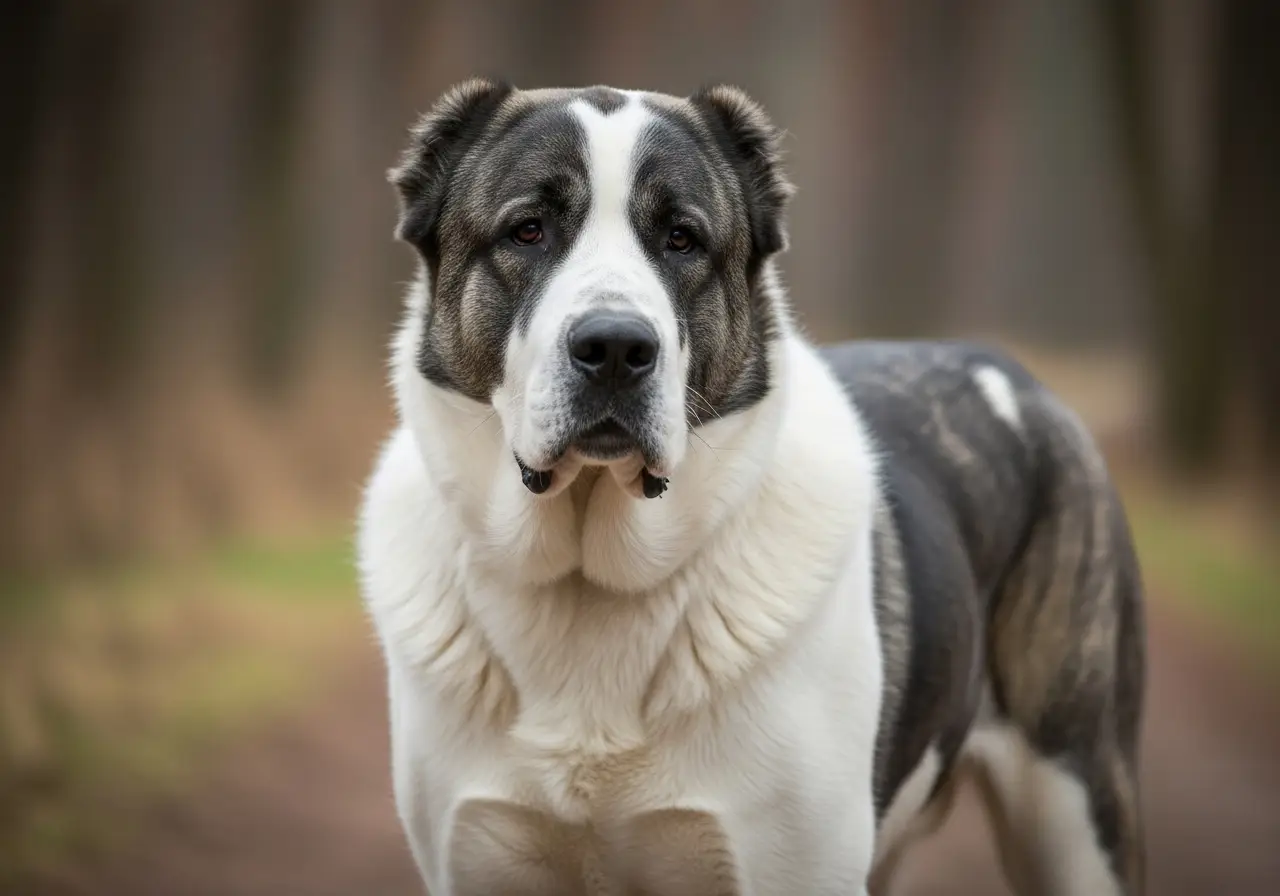
The Central Asian Shepherd Dog, also known as the Alabai, is a livestock guardian dog with millennia of selection for independence and territoriality. It appears calm and confident in everyday life until it perceives a threat. Then it acts without hesitation. This breed demands experienced owners with large, secure grounds, a clear leadership structure, and a deep understanding of livestock guardian behaviour.
02Introduction
What makes the Central Asian Shepherd Dog special
Central Asian Shepherd Dog (Alabai): massive herd guardian from the steppes of Central Asia, independently dominant and to be kept with care in Switzerland
03Profile
Key facts and suitability
- Origin
- Zentralasien
- Original purpose
- Livestock protection guard dog
- FCI
- No. 335 · Group 2 · Section 2.2
- height at the withers
- 65–78 cm
- Weight
- 40–80 kg
- Life expectancy
- 12–15 Years
- Coat type
- Doppel
- Minimum exercise
- 90 min/day
- Puppy price
- 1'500–2'500 CHF
- Waiting period
- 6 months
- Sports
- Hiking
04Temperament
How the Central Asian Shepherd Dog shows up in everyday life
When a stranger enters the property, the Alabai does not react with barking and withdrawal; it positions itself between the threat and its territory. This is not learned behaviour, but a genetically programmed reflex. This reaction also occurs when the owner assesses the situation as harmless.
In everyday family life, the internal axis becomes clearly apparent: the Alabai's need for social contact is moderate. It does not seek constant closeness, but appreciates clear belonging. At dinner, it does not lie at your feet, but observes the entrance. On a walk, it does not run ahead joyfully, but scans the surroundings. This calmness is not indifference; it is concentration.
The external axis, i.e. how the dog reacts to stimuli, deviates considerably from the internal one. It shows pronounced reserve towards strangers, up to active defensive behaviour. These two poles must not be confused: a close family bond does not mean that the dog tolerates visitors. Anyone who does not understand this will experience situations they cannot control.
With other dogs, particularly those of the same sex, it acts dominantly. Keeping multiple dogs is possible but requires careful introduction and clear hierarchies. In urban environments with high stimulus density (pedestrians, cyclists, prams), it is permanently overwhelmed. This does not always manifest as obvious aggression, but also in chronic stress and increased readiness to react.
An Alabai that knows its territory, respects its key people and has a clear task is a predictable dog. Without this structure, it is not.
05Needs
What this breed needs daily
The Central Asian Shepherd Dog requires 60 to 90 minutes of controlled exercise daily. This is not about sporting peak performance, but rather structured activity with a clear framework. Off-lead running without secured terrain is not an option; its territorial behaviour makes uncontrolled off-lead access in public areas a safety risk.
The most important thing is the territory. A large, securely fenced property with a fence of at least 1.80 metres in height is not a recommendation, but a basic prerequisite. The dog needs a clearly defined territory that it can monitor. This need is functional; it corresponds to its original purpose and significantly reduces frustration.
Mental stimulation does not occur through classic obedience exercises, but through meaningful tasks within the scope of its guarding function. Structured territorial control, clear boundaries and predictable routines in everyday life are more effective than agility or fetch training. Mental work in the classical sense (search games, nose work) can be used as a supplement, but does not replace the basic territorial structure.
Socialisation starts early and never ends. Puppies need targeted encounters with people, noises and situations from the eighth week of life onwards, not to train out the guarding instinct, but to calibrate the threshold for stimuli. An Alabai that grows up exclusively on the property as a puppy develops an excessively tight territorial bond that is hardly correctable later.
Being left alone within its own territory is less problematic for this breed than for many other dogs; up to six hours are possible with adult, well-structured animals. Outside the territory, however, tension increases considerably.
Exercise
Medium
mental work
Medium
Social needs
Low
training
Experts
07Quick Check
08Suitability
Who this breed is suitable for – and who it isn't
✓Matches
The Central Asian Shepherd Dog suits owners with proven experience in handling livestock guardian dogs or comparable independent breeds. Anyone who has successfully kept a Kangal, Caucasian Ovcharka or Pyrenean Mountain Dog already brings the necessary foundation.
The breed is suitable for owners with a large, securely fenced property of at least 1,000 m² with a stable fence of at least 1.80 metres in height. Rural or suburban locations with low stimulus density are a prerequisite, not a preference.
A structured everyday life with a clear distribution of tasks for the dog is decisive. Owners who are prepared to offer 60 to 90 minutes of controlled exercise daily and simultaneously shape a clearly defined territory create the basis for a predictable dog.
Families with children are possible if the children are older than ten years, respect the dog and never interact with it unsupervised. Visitors must be actively introduced by the owner; the dog does not accept strangers independently.
Owners who are prepared to use a dog training school with experience in livestock guardian dogs and who clarify the legal situation in their federal state or canton in advance are well-prepared. In several German federal states, the breed is subject to special regulations.
×Doesn't match
The Central Asian Shepherd Dog is unsuitable for owners keeping a dog for the first time, or for those whose previous experience is limited to gentle, people-oriented breeds. The independence of the Alabai requires an understanding of leadership that cannot be acquired from books alone.
Keeping in an apartment is out of the question, regardless of the size of the apartment. Even a large city garden of 200 m² is not sufficient. Anyone living in an urban environment with a high density of stimuli puts the dog under permanent stress.
Owners who frequently receive visitors, have children under ten years old in the household, or live in a residential complex with shared areas underestimate the external axis of the Alabai: Its reserve towards strangers is not an upbringing problem, but a breed characteristic. Anyone who interprets this as a "cuddly dog with protective function" will sooner or later encounter a situation they cannot control.
Owners who can devote little time to structured leadership or expect keeping the dog to be passively comfortable are overwhelmed by this breed. Anyone who acquires the dog primarily as a status symbol or because of its impressive appearance is acting neither in the interest of the animal nor in their own.
10Line reality
Show line, working line, breeder market
The Central Asian Shepherd Dog does not have clearly defined breeding lines in the sense of show and working lines, as are known for example in the German Shepherd Dog. Instead, there are pronounced regional types that differ in body structure, temperament and guarding behaviour.
The Turkmen Alabai is considered the most well-known type: massive, broad-headed, with a pronounced guarding instinct and high independence. It corresponds most closely to the image disseminated on social media. The Kazakh type tends to be lighter and more agile, with a stronger prey drive. Russian breeding lines, developed for state purposes during the Soviet era, often show higher trainability but also a lower threshold for irritation.
In Europe, breeding lines aligned with the FCI standard dominate. These dogs are on average calmer and more easily socialised than direct imports from Central Asia, although quality varies considerably. Reputable breeders in Germany and Switzerland place value on health examinations (HD, ED) and temperament tests.
Breeding lines that select exclusively for size and massiveness are problematic. Very heavy types with excessive body weight show increased joint stress and shorter life expectancy. Anyone looking for an Alabai should consciously choose the breeding type and not be guided by impressive appearance; the functional differences between the types are considerable in everyday life.
11Health · Reality
What you need to plan for medically with your Central Asian Shepherd Dog
The Central Asian Shepherd Dog is considered a robust breed with a life expectancy of 10 to 13 years. This range is realistic; very heavy types with excessive body weight reach the upper end less frequently.
Hip dysplasia (HD) and elbow dysplasia (ED) are the most common orthopaedic conditions. Reliable breed-specific prevalence figures for the Alabai are limited in German-language literature. The Orthopedic Foundation for Animals (OFA) records HD rates of 20 to 35 % for related molossoid breeds, with reputable breeding lines achieving significantly lower values through consistent selection of parent dogs (OFA database, status 2023). X-ray examinations of both parent dogs before mating are therefore essential.
As a large, deep-chested dog, there is an increased risk of gastric torsion (gastric dilatation-volvulus, GDV). Studies show that deep-chested breeds over 35 kg have up to five times the risk of GDV compared to smaller dogs (Glickman et al., Journal of the American Veterinary Medical Association, 2000). Meals should be divided into two to three portions daily; intense exercise immediately after eating is to be avoided.
Overweight is a relevant risk, particularly for dogs without sufficient exercise. Body weight should be monitored regularly; the ribs must remain palpable.
Preventive examinations: annual veterinary check-up from the fifth year of life, HD/ED screening at 12 to 18 months of age, eye examination for puppies. In cases of lameness, a distended abdomen, or sudden restlessness, immediate veterinary assessment is required.
12Structured data
Health by the numbers
Prone to diseases
Hip dysplasia Elbow problems
Recommended health tests
Hip X-ray Elbow X-ray
13Myths ↔ Reality
What is often said incorrectly about this breed
Five myths, five realities, five sources.
"The Alabai is like a large, calm family dog; it is simply just big.
The Alabai's calmness is not gentleness, but self-assurance. It observes, assesses and acts independently. Its guarding behaviour towards strangers is deeply ingrained genetically and can be mitigated through socialisation, but not trained away. Anyone who keeps it as a large cuddle dog significantly underestimates its reaction potential.
"With consistent training, it will obey reliably like a shepherd dog.
The Central Asian Shepherd Dog was not selected for obedience, but for independent decision-making. It questions instructions if it deems them unnecessary. Classic working dog training methods only have limited effect on this breed. Experience with livestock guardian dogs is a prerequisite, not a bonus.
"It is aggressive and unpredictable.
A well-socialised Alabai with an experienced owner does not show arbitrary aggressive behaviour. It reacts to perceived threats to its territory or its key people; this is guarding behaviour, not unpredictability. The threshold for irritation is high in correctly kept dogs. Problems almost always arise from keeping errors or lack of socialisation.
"Large dogs require little mental stimulation; exercise is sufficient.
The Alabai requires mental enrichment corresponding to its original task: monitoring territory, making decisions and taking responsibility. Pure physical exercise without a structured framework leads to frustration and uncontrolled guarding behaviour. A clearly defined area with a meaningful task is crucial.
"Puppy purchases from Central Asia are more authentic and healthier.
Imports from countries of origin often do not undergo health examinations according to European standards. HD/ED screenings, eye examinations and genetic tests are not mandatory in many regions of origin. The risk of acquiring a dog with an unknown health status is considerably higher with uncontrolled imports than with VDH-tested breeding lines.
14animal welfare
The animal welfare perspective
Breeder market, designer versions, animal shelter reality — what no one writes in the puppy ad.
The Central Asian Shepherd Dog ends up in animal welfare organisations disproportionately often. The most common reasons for surrender are underestimated territoriality, aggression incidents towards other dogs or people, and unsuitable housing conditions in urban areas. Many dogs are surrendered after biting incidents or when owners become overwhelmed, often in the second or third year of life, when the guarding instinct is fully developed.
The backyard breeder market for Alabais increased in the 2010s, fuelled by social media appearances of large, imposing dogs. Puppies are sold without health certificates, without temperament tests of the parent dogs, and without buyer screening, partly imported directly from Central Asia, partly from domestic backyard breeding operations. These dogs carry an increased risk of health problems and behavioural difficulties.
Breeding-related problems arise when selection is based solely on body mass and head size. Very heavy types show increased joint stress, shorter life expectancy, and more frequent orthopaedic conditions. Selection that neglects function and health harms the breed in the long term.
Housing-related problems almost always arise from misjudgement: The Alabai is acquired as a large, calm dog, and turns out to be an independent guardian with pronounced territorial behaviour. Those who do not anticipate this become overwhelmed, as does the dog.
Adopting an adult Alabai from animal welfare is a serious and equally valid alternative to buying a puppy. Specialised organisations and KOC e.V. accompany the adoption process with breed-specific expertise. An adult dog comes with a known temperament, which is a genuine advantage for a breed with this profile. Choosing an Alabai from rescue is not a compromise solution, but an informed choice.
15Costs · Transparency
What this breed realistically costs
The purchase price for a puppy from a reputable VDH breeding line ranges between 1,200 and 2,500 euros. Imports from Central Asia are sometimes offered at lower prices, but the lack of health certificates and the increased risk of subsequent costs make this saving illusory.
The annual keeping costs for an adult Alabai (40–79 kg) realistically amount to 2,500 to 4,500 euros. High-quality food costs 80 to 150 euros monthly at this body size. Additional costs include grooming (coat care, nail trimming), accessories, and training.
Veterinary costs average 600 to 1,200 euros annually for routine care, vaccinations, and preventive examinations. Orthopaedic surgeries for HD or ED can cost 2,000 to 6,000 euros. Treatment for gastric torsion (GDV) ranges between 2,500 and 5,000 euros depending on severity.
Dog liability insurance is legally mandatory for this breed in several German federal states and costs 150 to 400 euros annually depending on coverage limits and provider. Pet health insurance or a health budget of at least 1,500 euros per year is recommended.
Total lifetime costs (10–13 years) realistically amount to 30,000 to 60,000 euros, excluding extraordinary veterinary expenses.
16Puppy search
What you need to consider when choosing a breeder
- A reputable breeder of Central Asian Shepherd Dogs is a member of a recognised breeding association, in Germany for example the Kaukasischen Owtscharka-Club e.V.
- (KOC) or an association affiliated with the VDH.
- They provide health certificates for both parent animals: HD and ED examinations are the minimum standard.
- Temperament tests of the parent animals are another quality feature.
- Puppy mills and commercial breeding operations can be identified by missing papers, very low prices under 800 euros, several litters available simultaneously, and refusal to show the mother.
- Imports from Central Asia without European health documentation are associated with considerable risk.
- A reputable breeder asks counter-questions: about experience, the property, and the living situation.
- Anyone who accepts every buyer protects neither the puppies nor the future owners.
- Placement through animal welfare organisations is an equally valid option.
- Alabais end up in animal welfare disproportionately often, often due to underestimated territoriality or unsuitable keeping conditions.
- An adult dog from a rescue organisation comes with a known temperament.
- Organisations such as the KOC e.V.
- or specialised Molosser animal welfare associations facilitate placement accompanied by breed-specific expertise.
- The waiting time for a suitable dog may be longer, but the precision of fit is worth it.
FAQ
Frequently asked questions about the Central Asian Shepherd Dog
Is Central Asian Shepherd Dog a family dog?
Central Asian Shepherd Dog is considered suitable for families with good socialisation and species-appropriate care.
How much exercise does Central Asian Shepherd Dog need?
At least around 90 minutes of exercise per day.
What is the size and weight of Central Asian Shepherd Dog?
Fully grown, Central Asian Shepherd Dog reaches about 65–78 cm at the withers and weighs around 40–80 kg.
What is the life expectancy of Central Asian Shepherd Dog?
The life expectancy of Central Asian Shepherd Dog is approximately 12–15 years.
Which diseases are common in Central Asian Shepherd Dog?
Hip dysplasia Elbow problems
17Breed clubs
Official breed clubs in DACH
19Related
Similar breeds – and their differences
You might also be interested in

Participate
Do you have a good photo of your Central Asian Shepherd Dog?
We are looking for expressive images for our breed profiles. Submit yours; the editorial team reviews every submission before publication.
Does this breed suit you?
Extremely independent livestock protection breed – very territorial and only for very experienced owners