
01Summary
In a paragraph
If you only have 30 seconds.
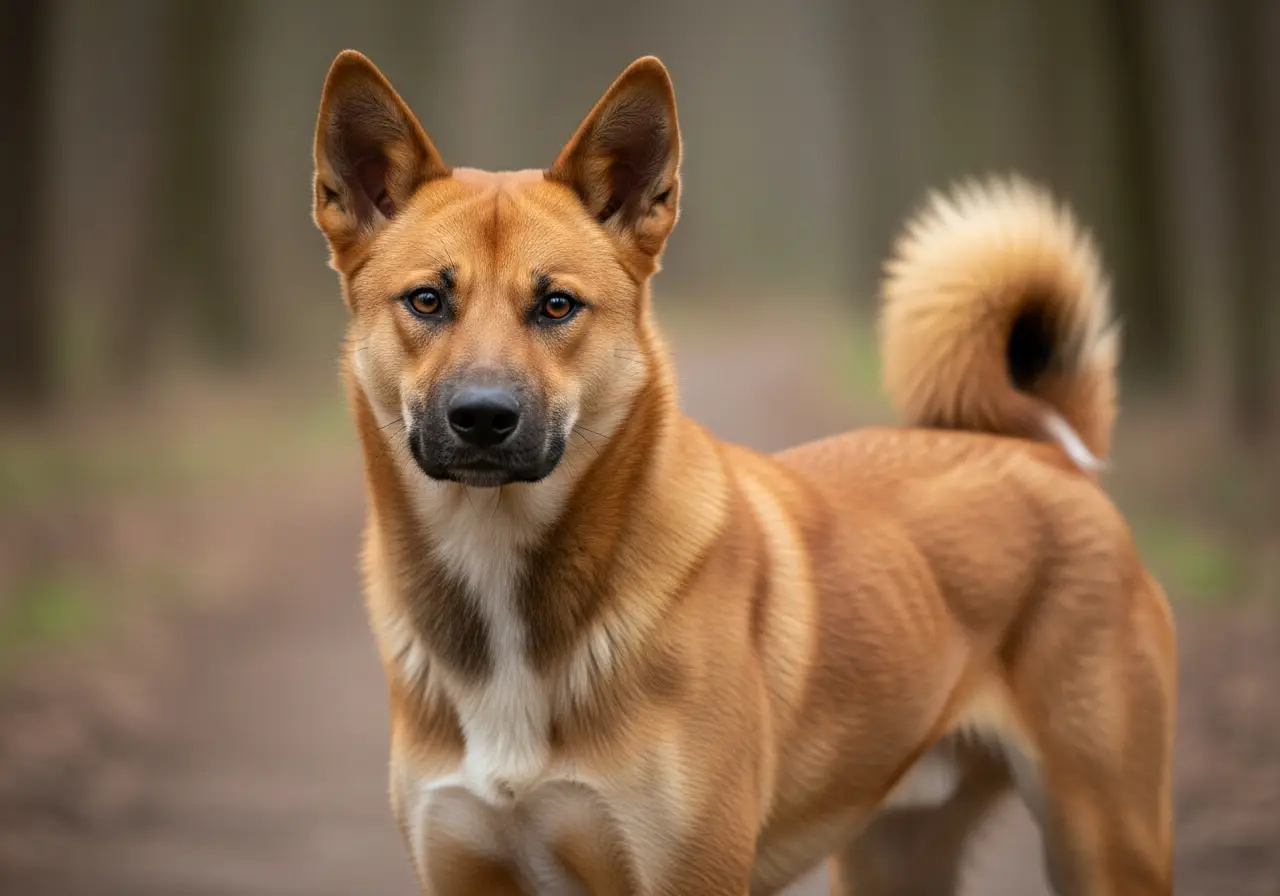
The Carolina Dog is not a dog that becomes a cuddle partner through socialisation. It is a primitive pariah dog with millennia of independence in its background, watchful, intelligent, and selective in its bonding. Anyone who keeps it invests daily in trust, structure, and sufficient space for movement. The result is a partnership on equal footing, not an accommodation.
02Introduction
What makes the Carolina Dog special
The Carolina Dog (American Dingo) is a primitive pariah dog from the south-eastern USA, not FCI-recognised, with Asian roots, and a withers height of 45–60 cm.
03Profile
Key facts and suitability
- Origin
- USA (Urform, asiatische Abstammung)
- Original purpose
- Semi-nomadic hunting and farm dog
- height at the withers
- 45–60 cm
- Weight
- 15–20 kg
- Life expectancy
- 12–15 Years
- Coat type
- Short-haired
- Minimum exercise
- 60 min/day
- Puppy price
- 500–1'200 CHF
- Waiting period
- 6 months
- Sports
- Agility · Mantrailing · Lure Coursing
04Temperament
How the Carolina Dog shows up in everyday life
When you come home, no stormy greeting ritual awaits you. The Carolina Dog first observes; it registers your arrival, approaches at its own pace, and signals joy through subtle body language: a quiet wag, a brief nuzzle, then retreating to its spot. This restraint is not disinterest. It is the communication pattern of a dog that builds bonds through trust, not impulsivity.
Internally (i.e., in what the dog needs based on its genetics), the Carolina Dog shows a high need for mental work (axis value 4 out of 5) and an equally high need for movement. Nose work, search games, and structured freedom training on secure terrain are not extras, but basic care. Anyone who does not open these channels will experience a dog that seeks its own enrichment, rarely to the owner’s delight.
Externally, i.e., in its reaction to stimuli from the environment, the Carolina Dog behaves quite differently than its need for social contact might suggest. It shows pronounced reserve towards strangers (axis value 2 out of 5). Visitors who want to immediately address or touch it will be ignored or avoided. This is not a training deficit; it is breed-typical. Anyone with guests who do not understand this must actively manage the situation.
The Carolina Dog often communicates in a differentiated and clear manner with other dogs. It reads body language precisely and reacts accordingly. Hectic, overbearing dogs overwhelm it. Calm, structured encounters work well.
Prey drive is present in everyday life: movement in the periphery, smells in the undergrowth, small animals—all of this reliably activates its prey schema. Off-lead exercise without secure terrain is not a calculable risk with this dog.
05Needs
What this breed needs daily
The Carolina Dog requires at least 90 minutes of active exercise daily, divided into several sessions rather than a single walk. Monotonous walks on the same routes are insufficient. The dog needs olfactory variety: new areas, changing surfaces, and structured terrain. Sniffing rounds in natural surroundings simultaneously meet its high need for mental work.
Nose work is not a leisure activity for the Carolina Dog but a primary tool for exertion. Mantrailing, search games with hidden objects, or hiding food in the garden efficiently activate its cognitive capacities. At least one structured mental work session per day is recommended.
Being left alone must be introduced carefully and gradually. The Carolina Dog tolerates being alone for up to about four hours if the bond is stable and the environment provides security. Longer absences without preparation cause stress, which can manifest as destructiveness or withdrawal.
A secure outdoor area, whether your own garden with an escape-proof fence or regular access to a fenced exercise area, is not a matter of comfort but a prerequisite for keeping the dog. The pronounced prey drive makes off-leash freedom in open areas permanently risky.
Retreat options in the house are just as important as activity. The Carolina Dog needs a fixed, low-stimulus retreat where it can recover undisturbed. Overstimulation (noisy households, frequent visitors, unpredictable routines) places a permanent burden on it and shows itself in increased tension or withdrawal behaviour.
Exercise
High
mental work
A lot
Social needs
Medium
training
Demanding
06Sport & Mental and Physical Stimulation
What sports the Carolina Dog is suited for
Realistic in terms of physiology and genetics – not every breed suits every sport.
Structurally and physiologically suitable: Suitable for mantrailing, dummy work and tracking · CaniCross / bikejoring possible.
07Quick Check
08Suitability
Who this breed is suitable for – and who it isn't
✓Matches
The Carolina Dog suits owners with proven experience in handling independent or primitive dog breeds. Anyone who has already kept a Basenji, Podenco, or Shiba Inu brings a realistic set of expectations.
A calm, structured household with predictable daily routines is a basic requirement. The owner needs at least 90 minutes daily for active exercise plus time for mental work; realistically, two to three hours of enrichment per day should be planned.
This dog is accessible to people who understand bonding as a long-term process and do not expect quick results. Anyone who enjoys calm, observant interaction and does not rely on demonstrative affection will experience the Carolina Dog as an exceptionally loyal companion.
A household with a secure garden or regular access to fenced outdoor areas is necessary. Rural or quiet suburban locations are preferable to urban environments with high stimulus frequency.
Families with older children from about ten years of age, who handle animals calmly and respectfully, may be suitable, provided the adults take on the leadership role and children do not interact with the dog unsupervised. Owners who wish to develop nose work or tracking as a shared hobby will find an enduring partner in the Carolina Dog.
×Doesn't match
The Carolina Dog is not suitable for owners without prior experience with independent dog breeds. Anyone who expects a dog to become a cooperative everyday companion through consistent training underestimates the genetic depth of this breed.
Households with frequent visitors, noisy routines, or unpredictable daily structures permanently overwhelm the dog. The pronounced reserve towards strangers is not a trait that completely dissolves through habituation; anyone expecting guests who wish unrestricted contact with the dog will have to manage this situation permanently.
Anyone who is away from home for more than four hours daily and has no reliable care solution regularly exceeds the tolerance for being left alone of this breed. This generates chronic stress.
Toddlers under six years of age and the Carolina Dog are a combination that requires increased supervision and a high level of experience, as the dog reacts sensitively to unpredictable movements and loud noises.
Anyone who has no access to secure outdoor areas and relies on off-leash freedom in open areas permanently underestimates the prey drive. Anyone looking for the Carolina Dog as a dog with an exotic appearance but an uncomplicated nature confuses appearance with character; this is the most common misjudgement regarding this breed.
10Line reality
Show line, working line, breeder market
The Carolina Dog does not have a classic line differentiation in the sense of working lines versus show lines, as established with retriever or herding breeds. The breed was not shaped by targeted performance breeding, but by natural selection over millennia.
Within existing breeding, which is almost exclusively concentrated in the USA, two informal groups can however be distinguished: dogs that come from documented wild-catch lines and are genetically closely related to the original populations from South Carolina, and dogs from subsequent litters where genetic purity is less clearly documented. Reputable breeders place value on DNA documentation and proof of origin.
In Europe, the situation is more unclear. Dogs whose ancestry is not documented are occasionally offered under the name Carolina Dog or American Dingo. Morphological similarity to a pariah dog is not proof of origin. Anyone looking for a genetically genuine Carolina Dog should insist on DNA certificates and pedigree entries with the UKC or AKC FSS.
A field trial or Schutzhund line does not exist. The Carolina Dog is not bred for sporting competitions. Its strengths lie in nose work, endurance, and sure-footedness in terrain, traits that stem from its survival history, not from breeding programmes.
11Health · Reality
What you need to plan for medically with your Carolina Dog
The Carolina Dog is considered a robust breed with a life expectancy of 12 to 15 years, a value that lies in the upper range for medium-sized dogs and is attributed to the genetic diversity of primitive populations. However, reliable breed-specific health studies are largely lacking, as the breeding population is small and scarcely documented scientifically.
Reliable HD/ED statistics are not available for the Carolina Dog, neither from the FCI nor from national breeding associations, as there is no mandatory standardised X-ray screening. Nevertheless, reputable breeders carry out X-ray examinations of the parent animals. As an interested party, you should request this documentation.
Known health risks include primarily parasite infestation: as a primitive dog with an outdoor focus and pronounced prey drive, the risk of tick-borne diseases (Lyme disease, TBE, ehrlichiosis) and heartworms (in warmer regions) is increased. Consistent parasite prophylaxis is mandatory, not optional.
Overweight is rarely a primary problem in this breed; the high need for exercise and slender constitution counteract it. Nevertheless, weight control during reduced activity (e.g., after injuries) is necessary.
Recommended preventive examinations: annual veterinary check-up including dental assessment, parasite screening twice a year, eye check in case of unusual behaviour. As no breed-specific hereditary diseases are systematically documented, the focus lies on general health monitoring and early investigation of behavioural changes.
12Structured data
Health by the numbers
Prone to diseases
No known breed-typical hereditary diseases, generally very robust
Recommended health tests
No specific mandatory examinations
13Myths ↔ Reality
What is often said incorrectly about this breed
Five myths, five realities, five sources.
The Carolina Dog is a tame wild dog that can be handled like any other breed through consistent training.
The Carolina Dog is a primitive pariah dog with genetically ingrained independence. Its behaviour is based on millennia-old survival strategies, not on selective breeding for willingness to cooperate. Consistency alone does not change this basic structure; it requires a deep understanding of primal dog behaviour and patient, pressure-free relationship building.
Because the Carolina Dog is so primitive, it is particularly healthy and requires little veterinary care.
The relative robustness of primitive dog breeds is not a free pass for neglecting preventive care. Parasite prophylaxis, dental health, and regular examinations are also necessary for the Carolina Dog. Furthermore, reliable long-term epidemiological studies on hereditary diseases are lacking for this breed, making careful observation by the owner all the more important.
The Carolina Dog is shy and therefore hardly suitable for living with humans.
The Carolina Dog is reserved to distant towards strangers; this is a trait of its pariah ancestry, not a sign of pathology. Within its reference group, it develops close, loyal bonds. Distinguishing between shyness as a behavioural disorder and distance as a breed-typical trait is crucial for accurate assessment.
Every dog that roams the southern states of the USA and is slender with pointed ears is a genuine Carolina Dog.
The outward appearance of a pariah dog is the result of convergent evolution and occurs in many mixed-breed populations. A genetically genuine Carolina Dog can only be reliably identified through DNA analysis. In Europe, mixed breeds with unclear origins are often offered under this name.
The pronounced prey drive of the Carolina Dog can be reliably suppressed through early socialisation with small animals.
The prey drive of the Carolina Dog is a deeply ingrained genetic trait that can be mitigated but not eliminated through socialisation. A securely enclosed area and consistent lead management in open areas remain permanently necessary, regardless of how early and intensive the socialisation began.
14animal welfare
The animal welfare perspective
Breeder market, designer versions, animal shelter reality — what no one writes in the puppy ad.
The market surrounding the Carolina Dog is small in Europe, but not free from problems. Because the breed is considered rare and exotic, incentives arise for backyard breeders to sell morphologically similar crossbreeds under the label Carolina Dog or American Dingo without genetic proof, without pedigree registration, and without veterinary documentation. The buyer receives a dog with an unknown health history and unclear temperament, which may bring entirely different care requirements than expected.
A specific problem of this breed is the discrepancy between appearance and actual character. The Carolina Dog often appears calm and uncomplicated in photos, with upright ears, a slender figure, and an alert gaze. This image attracts interested parties looking for a low-maintenance companion. The reality of a primitive pariah dog with high mental stimulation needs, pronounced prey drive, and reserve towards strangers catches these owners unprepared. The result: returns, re-homing, or living conditions that do not meet the dog’s needs.
Designer versions or deliberate crosses with the Carolina Dog are not established in Europe, which is an advantage compared to breeds altered by trend breeding. The breed has so far been largely protected from extreme breeding because the breeding population is small and specialised.
Adoption through animal welfare organisations is a realistic option for the Carolina Dog, even though availability in Europe is low. Specialised rescue networks exist in the USA. Adult dogs from adoption have the advantage that their temperament can already be assessed, a factor not to be underestimated in a breed whose character only fully reveals itself with time and trust. Those open to this path make an informed decision, not a stopgap measure.
15Costs · Transparency
What this breed realistically costs
A puppy from a reputable breeder costs between 800 and 1,500 USD in the USA. In Europe, if available at all, prices between 1,200 and 2,000 EUR are realistic, due to import costs, quarantine requirements, and low availability. Offers significantly below this range without genetic proof are a warning sign.
Annual living costs for a medium-sized dog of this size class (18–30 kg) typically lie between 1,800 and 3,000 EUR per year. Included are: high-quality food (600–1,000 EUR/year), basic equipment and care (200–400 EUR/year), annual veterinary preventive care including vaccinations and parasite screening (300–600 EUR/year).
Unforeseen veterinary costs can quickly reach 1,000 to 3,000 EUR per incident. Pet insurance for a dog of this size costs between 50 and 120 EUR per month (600–1,440 EUR/year) depending on provider and coverage, an insurance that makes sense for a breed without extensive health data.
Additional costs for nose work courses, dog training school, or specialised behavioural advice are not uncommon in this breed and should be budgeted at 300–600 EUR per year. Dog liability insurance is mandatory in Germany and costs 50–100 EUR/year.
16Puppy search
What you need to consider when choosing a breeder
- Reputable breeders of Carolina Dogs are rare worldwide and extremely scarce in Europe.
- Waiting times of a year or more are not an exception but the norm with responsible breeders.
- Anyone who receives a puppy without a waiting period and without questions from the breeder should regard this as a warning signal.
- Characteristics of reputable breeding: The breeder provides DNA evidence proving the lineage of the parent animals.
- The dogs are registered with the UKC or AKC FSS.
- The breeder asks counter-questions regarding the living situation, experience, and daily routine of the interested party.
- Puppies do not leave the mother before the ninth week of life.
- Initial veterinary examinations and vaccination records are available.
- Caution is advised with offers selling Carolina Dogs or American Dingos without genetic proof; morphological similarity to a pariah dog is not evidence of origin.
- Adoption through animal welfare organisations is an equally valid option.
- In the USA, specialised rescue organisations for Carolina Dogs exist.
- In Europe, availability is low but not zero; enquiring with specialised pariah dog networks is worthwhile.
- Adult dogs from adoption have the advantage that their temperament is already assessable.
FAQ
Frequently asked questions about the Carolina Dog
Is Carolina Dog a family dog?
Carolina Dog is considered suitable for families with good socialisation and species-appropriate care.
How much exercise does Carolina Dog need?
At least around 60 minutes of exercise per day. As an active breed, more so — plus mental stimulation.
What is the size and weight of Carolina Dog?
Fully grown, Carolina Dog reaches about 45–60 cm at the withers and weighs around 15–20 kg.
What is the life expectancy of Carolina Dog?
The life expectancy of Carolina Dog is approximately 12–15 years.
Which diseases are common in Carolina Dog?
No known breed-typical hereditary diseases, generally very robust
17Breed clubs
Official breed clubs in DACH
19Related
Similar breeds – and their differences
You might also be interested in
Participate
Do you have a good photo of your Carolina Dog?
We are looking for expressive images for our breed profiles. Submit yours; the editorial team reviews every submission before publication.
Does this breed suit you?
Primitive, semi-domesticated US dog with Asian roots. Shy towards strangers. Requires a lot of patience during socialisation.