

01Summary
In a paragraph
If you only have 30 seconds.
The Brittany Spaniel is the most compact pointing dog in FCI Group 7, and one of the most demanding in everyday life. Its genetic profile as a versatile hunting dog has been fully preserved to this day: pronounced nose work, high willingness to cooperate, strong prey drive. Anyone who keeps this dog purely as a companion dog systematically underestimates it. Anyone who challenges it receives an enduring, eager-to-learn partner with a life expectancy of 12 to 15 years.
02Introduction
What makes the Brittany Spaniel special
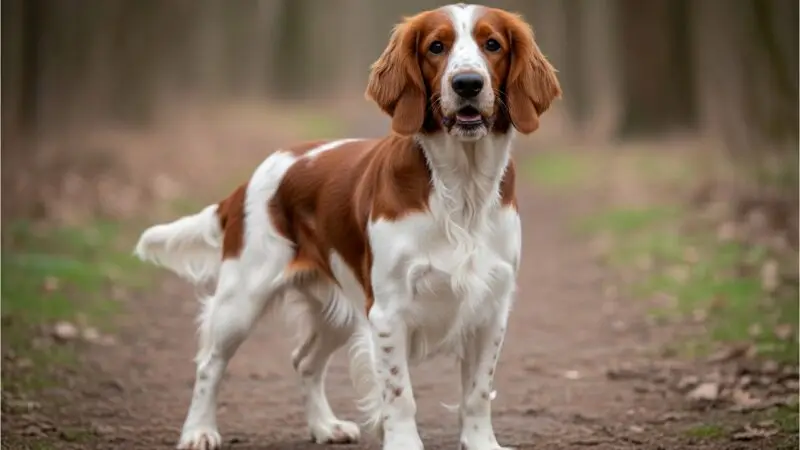
The Brittany Spaniel (Épagneul Breton) is the most popular pointing dog in France, FCI Group 7, compact and versatile, withers height 47–51 cm.
03Profile
Key facts and suitability
- Origin
- Frankreich
- Original purpose
- Pointing dog, retrieving
- FCI
- No. 95 · Group 7 · Section 1.2
- height at the withers
- 47–51 cm
- Weight
- 13–18 kg
- Life expectancy
- 12–14 Years
- Coat type
- Long-haired
- Minimum exercise
- 90 min/day
- Puppy price
- 1'000–1'800 CHF
- Waiting period
- 9 months
- Sports
- Hunting · Agility · Retrieving · Field trials
04Temperament
How the Brittany Spaniel shows up in everyday life
The morning run reveals what defines the Brittany Spaniel: as soon as the leash is dropped, it switches to a systematic search mode. The nose goes down, the body swings in wide arcs; this is not play behaviour, this is work. Anyone experiencing this for the first time understands why the FCI standard describes it as a "passionate hunter with a large radius of action".
Internally, this dog requires daily mental and physical stimulation at a high level (need for mental work: 4/5, need for movement: 4/5). A walk without training stimuli is equivalent to an office day with no tasks. Nose work, retrieving sequences or structured search exercises are not extras; they are basic care.
Externally, it behaves openly and affectionately towards strangers (friendliness towards strangers: 4/5). When guests visit, it shows interest, not reserve. However, this external openness must not be confused with a low internal need for social contact: the Brittany Spaniel bonds closely with its primary caregiver (need for social contact: 4/5) and actively seeks cooperation. Left alone in the garden, it does not occupy itself; it waits for the human or invents a task that the owner will not like.
With conspecifics, it is compatible given good socialisation. In a pack of hunting-led dogs, it shows pronounced willingness to cooperate. It reacts to inconsistency in training with uncertainty, not stubbornness. Those who give clear signals get a dog that thinks along.
05Needs
What this breed needs daily
The Brittany Spaniel requires at least 90 minutes of active exercise daily, a significant portion of which should consist of structured nose work, retrieving training or hunting work. Pure running rounds without mental stimuli do not fully meet its needs.
Forms of movement that match its profile:
- Dummy work (retrieving by sight and scent)
- Scent tracking or Mantrailing
- Hunting guidance (pointing, searching, retrieving from water)
- Nose work courses as structured compensation for non-hunting owners
The need for mental work is 4 out of 5, meaning pure physical exercise is not enough. A dog that is physically tired but mentally under-stimulated shows the same problem behaviour as a completely unstimulated dog.
Being left alone is possible but should be built up gradually. More than four hours daily without a primary caregiver or dog sitter constitutes a burden for this breed, manifesting as restlessness or vocalisation.
The need for social contact is high: the Brittany Spaniel requires regular, active contact with its primary caregiver, not just presence but shared activity. A dog training school offering nose work or basic hunting exercises is not a recommendation in the first two years of life, but a sensible investment in the dog's suitability for everyday life.
A garden increases quality of life but does not replace shared work. Keeping in an apartment is possible if exercise and enrichment are implemented consistently and daily.
Exercise
High
mental work
A lot
Social needs
High
training
Easy
06Sport & Mental and Physical Stimulation
What sports the Brittany Spaniel is suited for
Realistic in terms of physiology and genetics – not every breed suits every sport.
Structurally and physiologically suitable: Suitable for mantrailing, dummy work and tracking · CaniCross / bikejoring possible.
07Quick Check
08Suitability
Who this breed is suitable for – and who it isn't
✓Matches
The Brittany Spaniel suits owners who can plan at least 90 minutes of active time with the dog daily, a relevant portion of which in the form of nose work, dummy training or hunting guidance. Hunters looking for a versatile pointing dog for field, forest and water will find a genetically predestined partner in it.
Active non-hunters are also suitable if they are willing to channel the prey drive through dog sports: Mantrailing, scent tracking or structured nose work courses offer adequate compensation. Families with children from about 8 years old, in which at least one person actively works with the dog daily, are suitable owners, provided everyday life allows enough room for training and exercise.
First-time owners are not excluded in principle but require a supporting dog training school with experience in pointing breeds from the start. The high willingness to learn of the Brittany Spaniel only comes into play if training is clear, positive and regular. People living in rural environments or with access to open spaces additionally benefit from the fact that the dog can live out its radius of action.
×Doesn't match
The Brittany Spaniel does not suit owners who are away from home for more than four hours daily and cannot organise a reliable dog sitter. Anyone looking for a calm companion dog without pronounced training requirements will be permanently overwhelmed by this breed, not due to lack of friendliness, but due to the high internal need for stimulation and cooperation.
A common misunderstanding: the external openness of the Brittany Spaniel towards strangers is interpreted as a sign of low demands. This is a fallacy. Friendliness outwards says nothing about internal needs. Anyone keeping this dog as a social accessory that occupies itself will get a frustrated, vocally active or destructive dog within a few months.
City dwellers without access to open spaces or structured dog sports should critically assess ownership. Households in which no one is willing to engage with nose work or retrieving training are also not suitable environments. The prey drive does not disappear through ignoring; it seeks another expression.
10Line reality
Show line, working line, breeder market
In the Brittany Spaniel, the separation between working and show lines is less pronounced than in other pointing breeds such as the German Shorthaired Pointer. The FCI standard requires a working test, meaning that even dogs from show breeding should fundamentally be tested for working suitability. In practice, the implementation of this requirement varies depending on the breeding club and country.
In France, the breed's country of origin, performance-oriented breeding dominates. Field trials have a long tradition there, and many breeders actively use their dogs for hunting. The Club de l'Épagneul Breton in France places great emphasis on the unity of exterior and performance.
In Switzerland and Germany, specialised clubs — the Club Suisse de l'Épagneul Breton (CsEB) and the Club für Bretonische Vorstehhunde e.V. — oversee breeding with a similar focus. Dogs from these breedings generally exhibit a distinctly noticeable drive to work, even if they are not used for hunting.
Anyone acquiring a Brittany Spaniel from a line with proven field trial performance should factor in an even more pronounced prey drive and higher stimulation needs. Dogs from pure show lines, if available, may be somewhat calmer in their drive in individual cases, but they are no guarantee of an "easier" daily life.
11Health · Reality
What you need to plan for medically with your Brittany Spaniel
The Brittany Spaniel is considered a robust working breed with a life expectancy of 12 to 15 years. This places it in the upper range for dogs of its size class.
Hip dysplasia (HD) occurs in the breed, but is documented less frequently compared to larger pointing dog breeds. Reputable breeding lines carry out HD X-ray examinations; proof of an HD-free or HD A/B result for both parent dogs should be requested when buying a puppy. Elbow dysplasia (ED) is less common, but also relevant.
Epilepsy is another breed-specific peculiarity that can occur more frequently in certain lines. Anyone acquiring a puppy should ask about neurological abnormalities in the pedigree.
The medium-length drop ears of the Brittany Spaniel predispose them to otitis externa (ear canal inflammation), especially in dogs with regular water contact. A weekly ear check and regular cleaning with a suitable ear cleaner significantly reduce the risk.
Overweight is an underestimated risk for this breed: A dog that is sufficiently occupied usually regulates its weight itself. If the exercise requirement is not met, the risk of obesity increases, with consequential strain on joints and the cardiovascular system.
Recommended preventive examinations: HD/ED screening before breeding, annual ear check at the vet, eye examination in puppyhood. In cases of lameness, seizures or recurring ear infections, veterinary clarification without delay is indicated.
12Structured data
Health by the numbers
Prone to diseases
Hip dysplasia, epilepsy
Recommended health tests
Hip X-ray
13Myths ↔ Reality
What is often said incorrectly about this breed
Five myths, five realities, five sources.
"The Brittany Spaniel is an uncomplicated family dog that is content with little exercise.
The FCI standard explicitly describes it as a passionate hunter with a large range of action and excellent sense of smell. Its exercise requirement is at least 90 minutes of active stimulation daily; simple walks without nose work or training stimuli do not meet this need. Under-stimulation often manifests as restlessness, destructive behaviour or excessive barking.
"Because he is so friendly, he gets along with any owner.
High friendliness towards strangers (external axis) says nothing about internal needs. The Brittany Spaniel requires a primary caregiver who works regularly with him and provides clear training structures. Without this guidance, he reacts with frustration, not indifference. Friendliness is no substitute for stimulation.
"His short tail is the result of breeding for harmful traits (Qualzucht).
The short or absent tail in the Épagneul Breton is a natural, genetically anchored trait, not the result of surgical intervention or selective faulty breeding. The FCI standard from 2003 explicitly describes it as a breed with a natural, short tail. This trait was already recorded in the first breed standard of 1908.
"As a small pointing dog, city life without hunting contact is completely sufficient for him.
According to the FCI standard, the Brittany Spaniel is the smallest pointing dog of all, but size and drive strength do not correlate. Its prey drive, particularly pointing and retrieving, is genetically hard-wired. City owners who do not channel this drive through dummy work, tracking or hunting-related guidance report return problems disproportionately frequently.
"The Épagneul Breton is only suitable for hunters.
The breed is polyvalent; the FCI standard explicitly describes it as usable for all game and all terrain conditions. Non-hunting owners can adequately channel the drive through dog sports (e.g. Mantrailing, dummy training, nose work), provided intensity and frequency match the genetic profile. What matters is stimulation, not a hunting licence.
14animal welfare
The animal welfare perspective
Breeder market, designer versions, animal shelter reality — what no one writes in the puppy ad.
The Brittany Spaniel belongs to the breeds most frequently rehomed due to underestimated exercise needs. The pattern is known: An owner looks for a friendly, medium-sized dog and chooses the Brittany Spaniel because of its open nature and compact size. What they fail to calculate: the genetically anchored prey drive, the daily exercise requirement of 90+ minutes and the close bond with the primary caregiver, which demands genuine presence.
Backyard breeder market: Brittany Spaniel puppies are regularly offered on classifieds platforms without proof of HD screening, working tests or breeding book entry. Prices under 800 euros are a warning signal. Reputable breeding lines with club membership, health certificates and working test proof usually cost between 1,200 and 1,800 euros; this price reflects the effort involved, not profit maximisation.
Designer versions: The Brittany Spaniel is so far less affected by designer crosses than Retriever breeds. Nevertheless, crosses with Labrador or Poodle occasionally appear under fantasy names. These dogs carry the working drive of the Spaniel without buyers being prepared for it.
Breeding and husbandry-related problems: Obesity in under-exercised dogs is the most common husbandry-related problem. Dogs that cannot meet their exercise needs develop overweight with consequential strain on joints and the cardiovascular system. Epilepsy in certain lines is a breeding-related problem that can be reduced through consistent pedigree checks.
Adoption as an equally valid option: Animal welfare organisations and breed rescues regularly rehome Brittany Spaniels that have been given up due to being overwhelmed. These dogs are often well-socialised and trainable; they simply need an owner who knows and takes their needs seriously. The Club für Bretonische Vorstehhunde e.V. and the CsEB can assist with adoption or establish relevant contacts.
15Costs · Transparency
What this breed realistically costs
A puppy from a reputable breeding line with club membership, HD screening of both parent dogs and proof of working tests costs between 1,200 and 1,800 euros in the DACH region. Offers significantly below this often come from backyard breeders without health screening.
Ongoing costs per year (guideline values):
- Food (quality dry food or BARF): 600–1,000 CHF/EUR
- Basic vet care (vaccinations, parasite prophylaxis, annual check-up): 300–500 CHF/EUR
- Dog training school / training (first year): 400–800 CHF/EUR
- Care (ear cleaning, occasional trimming): 100–200 CHF/EUR
Vet average: An HD X-ray examination costs 150–300 CHF/EUR depending on the practice. Epilepsy clarification with neurological examination and MRI can reach 800–2,000 CHF/EUR. Pet insurance for a Brittany Spaniel costs 50–120 CHF/EUR monthly depending on provider and coverage scope and is a sensible safeguard against unforeseen costs for this breed.
The total costs in the first year (including puppy price, basic equipment and vet) realistically lie between 3,500 and 5,500 CHF/EUR.
16Puppy search
What you need to consider when choosing a breeder
- A reputable breeder of Brittany Spaniels is a member of a recognised breed club, in Germany the Club für Bretonische Vorstehhunde e.V.
- (der-bretone.de), in Switzerland the Club Suisse de l'Épagneul Breton (epagneul-breton.ch).
- Both associations maintain stud books and require health certificates and working tests before breeding approval.
- Concrete criteria for reputable breeding: hip dysplasia X-ray results of both parent animals (at least HD-B), proof of a working test, puppies are handed over no earlier than 8 weeks of age, the breeder asks questions about the living conditions and refuses a sale if the conditions do not match.
- Warning signs: Not a club member, no pedigree certificate, puppies available at any time, price under 800 euros, no personal conversation before purchase.
- Adoption through animal welfare organisations or breed rescues is an equally valid option.
- Rehomed Brittany Spaniels are often well-socialised, trainable dogs that simply need an owner who understands their needs.
- The Club für Bretonische Vorstehhunde e.V.
- and the CsEB can assist with adoption or provide relevant contacts.
- rundum.dog does not give named breeder recommendations; club websites list current breeding kennels.
FAQ
Frequently asked questions about the Brittany Spaniel
Is Brittany Spaniel suitable for beginners?
Brittany Spaniel is considered suitable for first-time dog owners.
Is Brittany Spaniel a family dog?
Brittany Spaniel is considered suitable for families with good socialisation and species-appropriate care.
How much exercise does Brittany Spaniel need?
At least around 90 minutes of exercise per day. As an active breed, more so — plus mental stimulation.
What is the size and weight of Brittany Spaniel?
Fully grown, Brittany Spaniel reaches about 47–51 cm at the withers and weighs around 13–18 kg.
What is the life expectancy of Brittany Spaniel?
The life expectancy of Brittany Spaniel is approximately 12–14 years.
Which diseases are common in Brittany Spaniel?
Hip dysplasia, epilepsy
17Breed clubs
Official breed clubs in DACH
19Related
Similar breeds – and their differences
You might also be interested in


Participate
Do you have a good photo of your Brittany Spaniel?
We are looking for expressive images for our breed profiles. Submit yours; the editorial team reviews every submission before publication.
Does this breed suit you?
Compact, versatile hunting spaniel. One of the most popular pointing dogs in France. Suitable as a family dog when provided with sufficient hunting-related activity.