
01Summary
In a paragraph
If you only have 30 seconds.
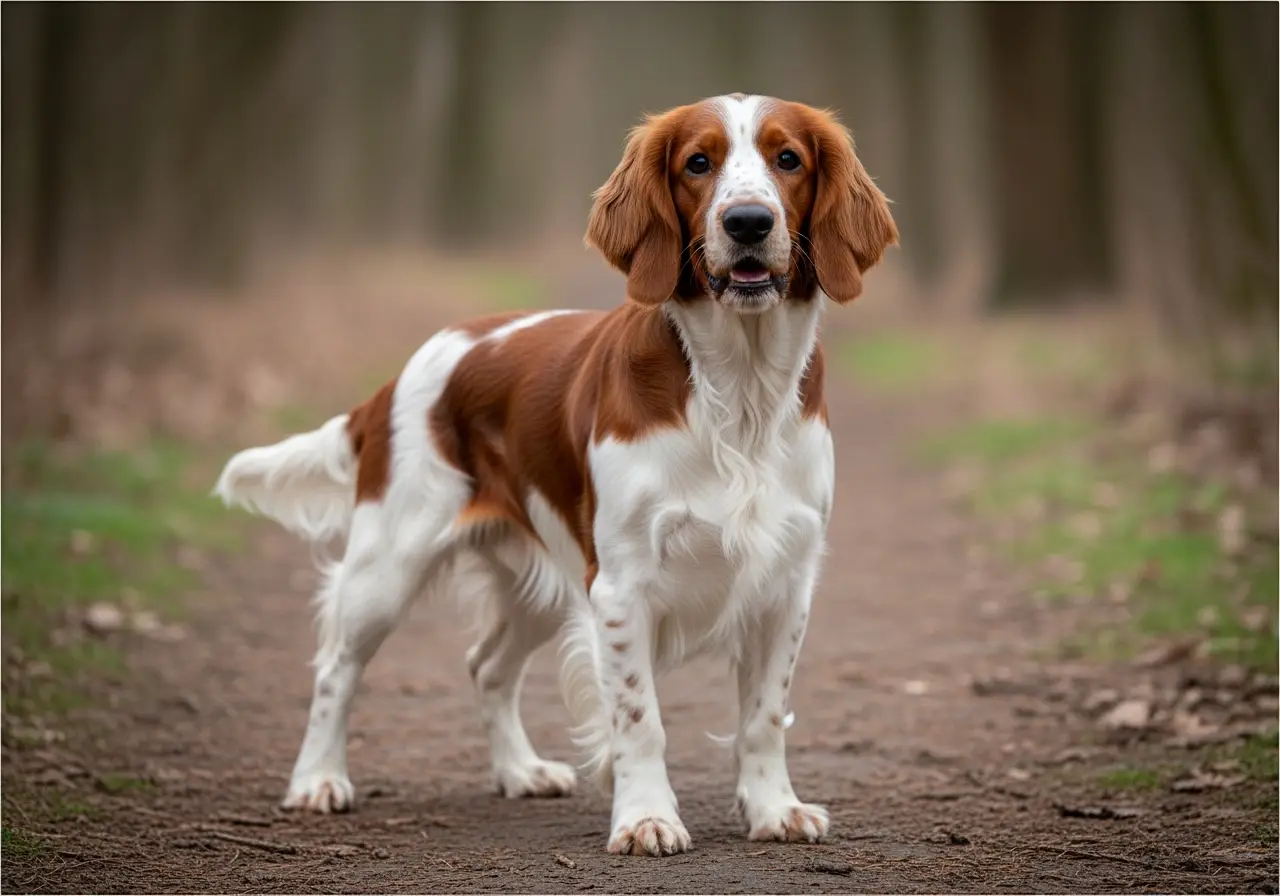
The Welsh Springer Spaniel is an enduring, red-and-white flushing dog from Wales with a pronounced prey drive and a close bond to its primary caregiver. Anyone keeping one plans at least 90 to 120 minutes of active exercise daily, plus structured nose work. Reserved towards strangers, loyal and cooperative within the family unit: this breed demands leadership, time, and a clear concept for hunting-related stimulation.
02Introduction
What makes the Welsh Springer Spaniel special
Welsh Springer Spaniel: red-coated, elegant and enduring, Welsh hunting spaniel with a close bond to its family
03Profile
Key facts and suitability
- Origin
- Wales
- Original purpose
- Flushing and retrieving
- FCI
- No. 126 · Group 8 · Section 2
- height at the withers
- 46–48 cm
- Weight
- 16–20 kg
- Life expectancy
- 12–15 Years
- Coat type
- Doppel
- Minimum exercise
- 90 min/day
- Puppy price
- 1'500–2'500 CHF
- Waiting period
- 5 months
- Sports
- Retrieving Swimming Agility
04Temperament
How the Welsh Springer Spaniel shows up in everyday life
During the morning run in the forest, the Welsh Springer Spaniel alternates between close contact with its primary caregiver and short, intense sniffing sequences in the undergrowth. It regularly returns, not because it has to, but because the bond with the owner is a central character trait of this breed. This internal axis (high need for social contact, close obedience) distinguishes it from more independent hunting dog breeds.
The external axis looks different: when visitors come to the house, the Welsh Springer Spaniel initially withdraws or observes from a distance. It shows no aggression, but also no exuberant greeting. This reserve towards strangers is typical for the breed and not a sign of insufficient socialisation; anyone who confuses this expects a different dog.
In everyday family life, it actively seeks closeness. It follows its primary caregiver through the apartment, lies down within sight, and reacts sensitively to changes in mood. It tolerates long periods of being left alone poorly; four hours are considered the upper limit, and even this only after carefully built-up training.
When the owner's working day ends and the evening session is missing, the dog shows it: it becomes restless, seeks enrichment, starts sniffing or chewing. This is not defiance; this is a dog communicating its needs. Anyone who reads these signals and reacts to them has a cooperative, attentive partner. Anyone who ignores them gets a frustrated dog with behavioural issues.
05Needs
What this breed needs daily
The Welsh Springer Spaniel requires at least 90 to 120 minutes of active exercise daily, not a walk at a walking pace, but movement with a task. Free running in secure terrain, sniffing work in the undergrowth, or structured dummy training cover its needs significantly better than leash rounds in the city park.
Mental stimulation is not a bonus, but a mandatory component. Nose work, Mantrailing sessions, or hunting exercises such as retrieving from water directly address its genetic programming. A dog that is physically exercised but mentally under-stimulated develops substitute activities, usually at the expense of the apartment furnishings or loose-leash walking.
The need for social contact is high. The Welsh Springer Spaniel requires daily intensive interaction with its primary caregiver, not just passive presence. Joint training, even short sessions of ten to fifteen minutes, strengthens the bond and keeps the dog mentally stable.
Being left alone must be built up systematically. Four hours are a realistic upper limit for a well-conditioned adult; puppies and young dogs require significantly shorter intervals. A dog that is alone for eight hours daily suffers, regardless of how much exercise it receives in the morning and evening.
The coat requires regular care: weekly brushing, checking the feathering for tangles, and after every field use, a check for ticks and burrs. The ears require weekly cleaning to prevent inflammation.
Exercise
High
mental work
A lot
Social needs
High
training
Medium
06Sport & Mental and Physical Stimulation
What sports the Welsh Springer Spaniel is suited for
Realistic in terms of physiology and genetics – not every breed suits every sport.
Structurally and physiologically suitable: Suitable for mantrailing, dummy work and tracking · CaniCross / bikejoring possible.
07Quick Check
08Suitability
Who this breed is suitable for – and who it isn't
✓Matches
The Welsh Springer Spaniel suits owners who can plan at least two hours daily for active exercise and structured enrichment, not as an exception, but as everyday routine. Access to forest, field, or secure open space is not optional, but a prerequisite.
Owners with a hunting background or serious interest in dog sports are well suited: dummy training, nose work, Mantrailing, or water work cover the needs of this breed in a structured way. Families with children from about eight years old are also suitable if both parents are actively involved in dog management and everyday life offers enough exercise time.
Anyone who already has experience with hunting-motivated dogs and knows how to build up impulse control and recall training will find a cooperative, eager-to-learn partner in the Welsh Springer Spaniel. The breed reacts sensitively to clear, calm guidance, and rewards consistency with close cooperation.
Owners who spend a lot of time at home or work from home benefit from the pronounced bond orientation of this breed. The dog actively seeks closeness and integrates well into a structured daily routine with fixed exercise and rest phases.
×Doesn't match
The Welsh Springer Spaniel does not suit owners who are away from home for more than four hours daily and do not have a reliable dog care plan. Its depth of bonding is not a marketing feature; it means that isolation burdens it.
Anyone who interprets the reserve towards strangers as an upbringing problem and expects an openly friendly all-weather social dog will not be happy with this breed. The external axis, waiting towards unknowns, cannot be trained away; it belongs to the core character.
Owners without experience with hunting-motivated dogs should not underestimate the effort for recall training and impulse control. Anyone who believes that the drive can be controlled by strictness or consistency alone risks a permanently overtaxed dog. A supporting dog training school with experience in scenting dogs is not an option but mandatory for first-time owners of this breed.
City dwellers without regular access to open space, people with a very low time budget, and households where the dog is primarily kept as a calm companion dog without hunting-related stimulation do not meet the requirements profile of this breed.
10Line reality
Show line, working line, breeder market
The Welsh Springer Spaniel exists in the German-speaking region in two recognisable lines, even though the differences are less pronounced than, for example, with the English Springer Spaniel.
Working line dogs, originating from active hunting utility breeding, show a more pronounced flushing drive, higher endurance in the field and stronger focus on hunting tasks. They are generally built slimmer and react more intensely to game scent. For owners without hunting use, these dogs present significantly higher demands.
Show-oriented lines focus on the FCI standard in appearance and movement. These dogs are not necessarily weaker in drive, but selection for hunting performance takes a back seat. In everyday life, they often show somewhat more flexibility in stimulation; nose work and dummy training are usually sufficient without mandatory practical hunting experience.
As the breed is very rare in the DACH region, pure line separations are not always clearly documented. A conversation with the breeder about the working trial history of the parent dogs provides more reliable information than the external appearance alone. Anyone looking for a dog for active hunting work should explicitly ask about parent dogs with working trials.
11Health · Reality
What you need to plan for medically with your Welsh Springer Spaniel
According to figures from the Kennel Club (UK), the life expectancy of the Welsh Springer Spaniel is an average of 12 to 15 years, an above-average range for medium-sized dogs, which however depends on breeding quality and keeping conditions.
Hip dysplasia (HD) is documented in the breed. The Jagdspaniel-Klub e.V. recommends an HD X-ray examination according to the OFA or BVA scheme for breeding animals. Concrete population-wide HD quotas for the Welsh Springer Spaniel in the DACH region are statistically difficult to ascertain due to the low number of litters; reputable breeders provide X-ray findings for both parent dogs, which is a minimum standard that prospective buyers should demand.
Hereditary eye diseases, particularly primary glaucoma, are known in the breed. The Kennel Club (UK) lists the Welsh Springer Spaniel on its list of breeds with recommended eye examinations. Breeding animals should present a current eye certificate from a recognised ophthalmologist, no older than twelve months at the time of mating.
The floppy ear flaps predispose to ear inflammation (otitis externa). Weekly ear checks and regular cleaning demonstrably reduce the risk. Dogs with frequent bathing sessions or field work in damp undergrowth require more frequent monitoring.
Overweight poses a real risk for this breed as soon as the exercise requirement is not met. A body condition score of 4–5 on the 9-point scale (according to WSAVA standard) is considered the target range. Regular weight checks at the vet, at least once a year, are advisable.
12Structured data
Health by the numbers
Prone to diseases
Hip dysplasia Eye problems Ear infections
Recommended health tests
Hip X-ray Eye examination
13Myths ↔ Reality
What is often said incorrectly about this breed
Five myths, five realities, five sources.
“The Welsh Springer Spaniel is like a Cocker, a calm family dog for the living room.
The Welsh Springer Spaniel was bred as a working dog for enduring hunting in difficult terrain. Its exercise needs are at least 90 to 120 minutes daily, plus structured nose work. Anyone keeping it purely as a companion dog without hunting-related stimulation risks behavioural issues due to chronic under-stimulation.
“Spaniels are naturally open and friendly towards every person.
The FCI standard describes the Welsh Springer Spaniel as friendly but independent. Towards strangers, it typically shows reserve or a waiting attitude; this is not a training error but breed-typical behaviour. Effusive greetings towards unknown people are not characteristic for this breed.
“The prey drive can be completely eliminated through consistent training.”
The flushing and retrieving instinct is genetically deeply rooted. Training can improve impulse control and recall, but cannot eliminate the drive itself. Without targeted stimulation, such as dummy training or nose work, the dog seeks occupation independently, leading to uncontrolled flushing and poor recall in everyday life.
“Welsh Springer Spaniels are robust and require little veterinary preventive care.
The breed shows a genetic predisposition for hip dysplasia, hereditary eye diseases (including glaucoma) and ear inflammation due to the floppy, poorly ventilated ears. Reputable breeders provide X-ray findings for HD and current eye certificates. Regular ear checks are part of basic care.
“As a rare breed, the Welsh Springer Spaniel is free from breeding problems.
Small population sizes increase the risk of inbreeding depression and limited genetic diversity. Reputable breeding associations conduct breeding value estimations and mandate health testing precisely because the breed is rare. Rarity alone is not a quality indicator.
14animal welfare
The animal welfare perspective
Breeder market, designer versions, animal shelter reality — what no one writes in the puppy ad.
The Welsh Springer Spaniel is an absolute rarity in the German-speaking region. This rarity partly protects the breed from the pressure of the mass market, but not completely. Anyone specifically looking for a Welsh Springer Spaniel and encountering dubious offers can recognise these by missing health certificates, very young handover ages under eight weeks, and prices that are significantly below the level of reputable breeders.
Breeding operations responding to demand for "rare" breeds produce puppies without health checks of the parent dogs. The risk of HD, eye diseases, and temperament instability increases considerably in such cases. A puppy from such sources costs more in the long term, in vet bills, training effort, and emotional strain.
Designer variants of the Welsh Springer Spaniel hardly exist as yet. This could change if the breed gains popularity through social media presence. The red-and-white appearance and the temperament described as "gentle" are characteristics that attract trends, without the keeping requirements being communicated alongside them.
Breeding-related problems in the Welsh Springer Spaniel arise less from extreme morphology than from the small population size. Inbreeding coefficients should be actively discussed when choosing a breeder. Reputable breeders know the inbreeding level of their matings and communicate it openly.
Animal welfare placement plays a subordinate, but not non-existent role for this breed. According to animal welfare organisations, surrenders occur predominantly due to underestimated exercise needs and hunting drive. Anyone open to an adult dog will occasionally find dogs available for placement via the Jagdspaniel-Klub e.V. or the Spaniel Club of Switzerland, with the advantage that temperament and health status are already assessable.
15Costs · Transparency
What this breed realistically costs
A puppy from reputable breeding costs between 1,500 and 2,200 EUR in the German-speaking region. Offers significantly below this signal missing health examinations or breeding not recognised by VDH/SKG. The rarity of the breed makes price comparisons more difficult, making verification of the stud book number and health certificates all the more important.
The annual living costs for a Welsh Springer Spaniel realistically lie between 2,000 and 3,500 CHF/EUR. Included are: high-quality food (approx. 600–900 EUR/year for an 18-kg dog), care requirements including grooming scissors and brushes, tick protection, deworming, and basic vaccinations. In addition come costs for dog training school and nose work courses, which are not a luxury expense for this breed.
Average annual vet costs without illness: 300–500 EUR for preventive care and vaccinations. Costs rise quickly to 500–1,500 EUR per incident in cases of ear infections or HD screening. Pet insurance with surgical cover costs 40–80 EUR/month depending on the provider and excess, significantly reducing financial risk during operations.
16Puppy search
What you need to consider when choosing a breeder
- Reputable breeders of the Welsh Springer Spaniel are affiliated with the Jagdspaniel-Klub e.V.
- (Germany) or the Spaniel Club of Switzerland.
- These associations stipulate minimum standards for health examinations; hip dysplasia (HD) X-rays and eye certificates for the parent dogs are mandatory, not optional.
- Specific criteria for reputable breeding: puppies handed over no earlier than eight weeks of age, vaccination passport with first vaccination, microchip, pedigree from a recognised stud book (VDH/SKG/ÖKV), and the opportunity to inspect the mother with the puppy.
- Breeders who sell puppies without a personal conversation and without asking questions about the living environment are a warning sign.
- Waiting periods of six to twelve months are normal for this rare breed.
- Anyone who can buy a puppy immediately should scrutinise the origin particularly critically.
- Placement via the Jagdspaniel-Klub e.V.
- or animal welfare organisations is an equally valid option.
- Adult dogs come with an assessable temperament and known health history, which reduces surprises.
- No platform recommends individual breeders by name; the stud book lists of the associations are the most reliable starting point for your search.
FAQ
Frequently asked questions about the Welsh Springer Spaniel
Is Welsh Springer Spaniel suitable for beginners?
Welsh Springer Spaniel is considered suitable for first-time dog owners.
Is Welsh Springer Spaniel a family dog?
Welsh Springer Spaniel is considered suitable for families with good socialisation and species-appropriate care.
How much exercise does Welsh Springer Spaniel need?
At least around 90 minutes of exercise per day. As an active breed, more so — plus mental stimulation.
Does Welsh Springer Spaniel suit an apartment?
With enough exercise and enrichment, Welsh Springer Spaniel can also be kept in an apartment.
What is the size and weight of Welsh Springer Spaniel?
Fully grown, Welsh Springer Spaniel reaches about 46–48 cm at the withers and weighs around 16–20 kg.
What is the life expectancy of Welsh Springer Spaniel?
The life expectancy of Welsh Springer Spaniel is approximately 12–15 years.
Which diseases are common in Welsh Springer Spaniel?
Hip dysplasia Eye problems Ear infections
17Breed clubs
Official breed clubs in DACH
19Related
Similar breeds – and their differences
You might also be interested in
Participate
Do you have a good photo of your Welsh Springer Spaniel?
We are looking for expressive images for our breed profiles. Submit yours; the editorial team reviews every submission before publication.
Does this breed suit you?
Gentler Spaniel type – more family-friendly and somewhat calmer than the English Springer