
01Summary
In a paragraph
If you only have 30 seconds.
The Holstein Hound is an extinct Northern German hound breed that today has exclusively cynological-historical significance. No active breeding, no FCI recognition, no living representatives. Anyone looking for the working profile of a trailing hound will find it in related breeds that still exist today, such as the German Hound or the Westphalian Dachsbracke. Offers under the name Holstein Hound should be viewed with the greatest scepticism.
02Introduction
What makes the Holsteiner Hound special
The Holsteiner Bracke is an extinct German scent hound breed from Schleswig-Holstein, not FCI-recognised, formerly 45–55 cm tall and used for bay-sounding hunting of small game.
03Profile
Key facts and suitability
- Origin
- Deutschland (Schleswig-Holstein)
- Original purpose
- Bay-sounding Bracke hunting of small game (hare, fox) in northern Germany
- height at the withers
- 45–60 cm
- Weight
- 18–25 kg
- Life expectancy
- 10–13 Years
- Coat type
- Short-haired
- Minimum exercise
- 120 min/day
- Sports
- Scent work · Mantrailing · Blood tracking
04Temperament
How the Holsteiner Hound shows up in everyday life
A reliable character description of the Holsteiner Bracke based on personal observation is not possible, as no living breeding population exists. What historical sources describe can nevertheless be contextualised, with the express note that this constitutes a historical reconstruction, not current behavioural data.
Internal axis, what the dog needed: Historical reports describe a dog with high exercise needs, pronounced nose work and the will to work independently on a scent trail. The need for mental stimulation was high, not in the sense of obedience exercises, but in the sense of olfactory workload. The need for social contact was moderate to high; in the pack the Holsteiner Bracke worked cooperatively, in everyday life it was considered people-oriented. Being left alone for several hours would likely have been difficult for this type.
External axis, how the dog reacted to stimuli: The prey drive was strongly pronounced. On the trail the Holsteiner Bracke worked vocally; vocal tracking is a defining characteristic of all German hounds. According to historical sources, it was considered steady in character towards strangers, without a pronounced guarding instinct tendency. The reaction to other dogs was cooperative in pack use, which suggests basic social compatibility.
Those looking for the described working profile (vocal tracking hound, independent, nose-oriented, enduring) will find it in existing hound breeds such as the German Hound or the Westphalian Dachsbracke, for which current behavioural data and breeding standards are available.
05Needs
What this breed needs daily
Since the Holsteiner Bracke, as an extinct breed, has no living breeding population, specific keeping recommendations are not possible. The following information is based on historical records and comparison with related hound breeds that still exist today, such as the German Hound (FCI No. 299).
Exercise: Historical hounds of this type were used for multi-hour hunting operations in difficult terrain. A daily exercise need of at least two hours, a considerable part of which in free or secure terrain with nose work, is documented for comparable breeds. Loose-leash walking alone does not suffice for this type.
Mental stimulation: The need for mental work was high. Scent work, mantrailing or nose work correspond to the genetic profile of this hound type. Pure obedience exercises without an olfactory component do not meet the need.
Social environment: The need for social contact was moderate to high. Pack keeping was historically common. Long periods of being left alone, more than four hours daily, would likely be problematic for this type.
Prey drive management: The pronounced prey drive requires consistent drive management. Off-leash running without a secure environment is not recommended for hounds of this type. Those looking for this profile today should contact breeding associations for the German Hound or Westphalian Dachsbracke, where current keeping recommendations and experience values are available.
Exercise
High
mental work
A lot
Social needs
Medium
training
Demanding
06Sport & Mental and Physical Stimulation
What sports the Holsteiner Hound is suited for
Realistic in terms of physiology and genetics – not every breed suits every sport.
Structurally and physiologically suitable: Suitable for mantrailing, dummy work and tracking · CaniCross / bikejoring possible.
07Quick Check
08Suitability
Who this breed is suitable for – and who it isn't
✓Matches
Since the Holsteiner Bracke no longer exists, a direct owner recommendation is not applicable. The historical profile can nevertheless be outlined, as guidance for those interested in finding this working profile in related breeds.
The profile suits people with a hunting background or the willingness to keep a strong-driven hound busy with alternative activities such as mantrailing or nose work. Suitable for owners who can provide at least two hours of active exercise daily in open or secure terrain. Experience with dogs that work independently is a prerequisite; this is not a profile for first-time owners without dog experience. Owners with access to rural surroundings, forests, or hunting grounds best match the historical context of use. Those who understand pack structures and keep a second dog are closer to the original framework of keeping. People interested in the history of German hounds and looking for this profile in an currently recognised breed such as the German Hound or Westphalian Dachsbracke will find current breeding standards and contacts there.
×Doesn't match
The historical profile of the Holstein Hound, and that of comparable hound breeds, does not suit owners looking for a calm companion dog for the city. The pronounced prey drive and need for exercise are not characteristics that can be fully compensated for through training.
Not suitable for owners who can provide less than two hours of active exercise daily. Not suitable for people looking for a dog that reliably runs freely; the prey drive makes free running without a secure environment a real risk. Not suitable for owners expecting a dog to respond on command like a retriever: hounds work independently, obedience on the scent trail is genetically secondary. Not suitable for households where the dog is regularly left alone for more than four hours. Anyone who finds the name Holstein Hound in an advertisement or with a provider and believes they are acquiring an authentic breed misunderstands the cynological reality; the breed no longer exists, and no reputable breeding association mediates it.
09Character
Character and editorial background
The Holsteiner Hound is a historical German scent hound breed from Schleswig-Holstein. It is considered extinct today. In cynology, it is counted among the historical predecessors of various Northern German and Scandinavian scent hound types. Active breeding no longer exists, and there is no FCI recognition.
Origin and History
The Holsteiner Bracke originated in northern Germany, primarily in the area of present-day Schleswig-Holstein. It belonged to the group of German hounds (Bracken), a collective term for regional scent hound types that were used from the Middle Ages onwards for trailing game such as hare and fox. In the 18th and 19th centuries, it was widespread in farming and hunting circles in northern Germany. With the decline of traditional Bracke hunting, the unification of hunting laws in the German Empire, and the growing popularity of internationally recognised breeds, it lost its economic basis. By the early 20th century, the distinct type had disappeared. Genetic components are likely to persist in the German Hound (FCI 299) as well as related Bracke and Dachshund hound breeds. No reconstruction breeding exists.
Appearance
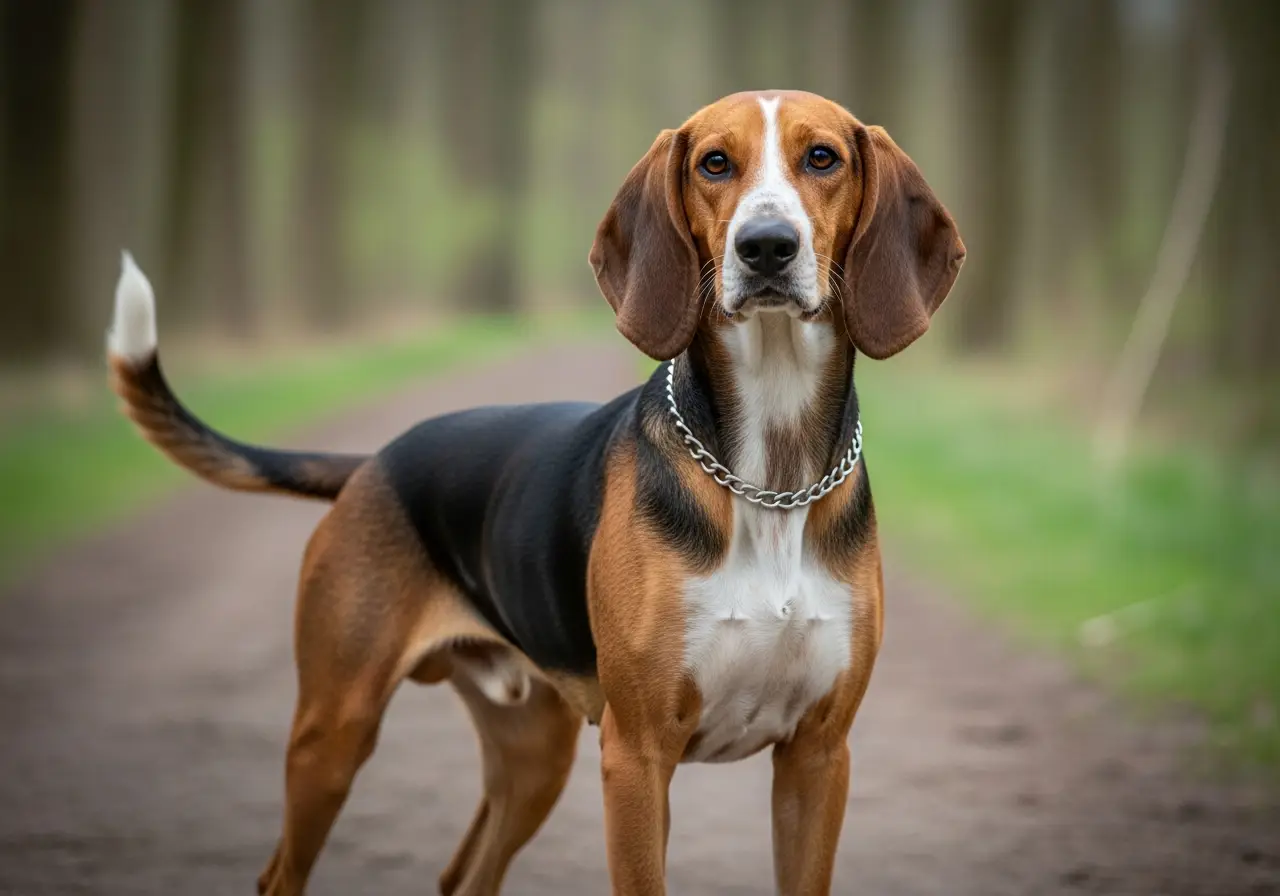
Historical descriptions show a medium-sized scent hound with a sturdy, slightly elongated build. According to inconsistent historical records, the withers height ranged from 45 to 60 cm. It is considered one of the larger northern German Bracken. The weight is stated as 18 to 25 kg. The coat was short, dense and weather-resistant. Typical was a tri-colour pattern with reddish-brown markings, a black saddle and white markings on the chest, legs and tip of the tail. The ears were of medium length and hanging, the tail sturdy and sabre-shaped.
Nature and Character
Handed-down sources describe the Holsteiner Bracke as an enduring, bay-sounding hunting dog with a pronounced nose instinct and independent working style. In the pack it worked cooperatively; in everyday life it was regarded as temperamentally stable and human-oriented. The prey drive was strong, as was the willingness for independent trailing work. Due to the lack of a living breeding population, classification according to current temperament criteria is only possible to a limited extent.
Keeping and Training
No keeping recommendation applies, as no living representatives exist. Anyone looking for the working profile of this breed will find it in the German Hound, the Westphalian Dachsbracke or other FCI-recognised Bracke breeds.
Care
The short, dense coat of historical Holsteiner Bracken was easy to care for. Weekly brushing and regular ear checks are considered typical requirements for this breed type.
Health
Reliable health data on the Holsteiner Bracke do not exist, as no modern breeding documentation is available. In related Bracken, ear infections due to the drop ears and hip dysplasia are known.
Suitable for whom
The Holsteiner Bracke is not available as a living breed. This profile serves exclusively for cynological documentation. Anyone looking for a trailing, bay-sounding scent hound should familiarise themselves with the existing German Bracke breeds.
10Line reality
Show line, working line, breeder market
Since the Holsteiner Bracke has no active breeding population, there is no line differentiation in the sense of working, show or field trial lines. Such a distinction is not applicable to this breed.
Historically, the Holsteiner Bracke was used exclusively as a utility dog for tracking game on small game in the field. A separation into working and show lines, as is relevant with today's actively bred breeds such as the Labrador Retriever or the German Shepherd Dog, never developed, as the breed disappeared before the emergence of modern dog shows.
Those looking for the working profile of a northern German hound will find in the German Hound (FCI No. 299) a breed with active breeding and documented line structure. There exist dogs with hunting test performance that come closest to the historical use profile of the Holsteiner Bracke. The Westphalian Dachsbracke (FCI No. 100) offers a similar profile in a more compact size.
11Health · Reality
What you need to plan for medically with your Holsteiner Hound
Reliable health data for the Holstein Hound do not exist. No modern breeding documentation, no health database and no veterinary medical study are available for this extinct breed. All following information is based on comparison with related hound breeds that are still bred today.
For the German Hound (FCI No. 299), breeding association evaluations point to hip dysplasia (HD) as a relevant hereditary disease, a finding typical for medium-sized hounds with high exercise requirements. Specific HD rates for the German Hound are available from the VDH on request, but are not published centrally (as of 2024).
Ear inflammation (otitis externa) is structurally favoured in drop-eared breeds. Hounds with long, close-fitting ears show increased presentation rates for ear problems in small animal practice; a weekly ear check is considered the minimum standard.
The life expectancy of comparable medium-sized hound breeds is typically between 12 and 14 years, with overweight being a common risk factor: hounds with pronounced food motivation tend towards obesity with insufficient exercise, which puts strain on joints and the cardiovascular system.
Preventive examinations for related breeds include: annual ear check by the vet, HD X-rays before breeding (for active breeds), weight control every six months, and tartar prophylaxis from the third year of life.
12Structured data
Health by the numbers
Prone to diseases
No reliable data (breed extinct)
Recommended health tests
No reliable data (breed extinct)
13Myths ↔ Reality
What is often said incorrectly about this breed
Five myths, five realities, five sources.
Occasionally it is claimed that the Holsteiner Bracke is merely rare but still available as a living breed.
The Holsteiner Bracke is considered extinct. No recognised breeding population exists, no breeding association manages it, and the FCI does not list it. Offers under this breed name indicate incorrect designation, marketing of crossbreeds or dubious origin.
It is often assumed that the Holsteiner Bracke is a direct ancestor breed of the German Hound and thus clearly documented.
The genetic influence of the Holsteiner Bracke on modern hound breeds is likely, but not scientifically proven. The German Hound (FCI No. 299) has its own studbooks and an independent breed history. A direct line of descent is not proven in cynology.
Sometimes the Holsteiner Bracke is described as a problem-free beginner breed for those interested in hunting, as hounds are considered gentle.
Since no living representatives exist, any keeping recommendation is speculative. Related hound breeds such as the German Hound have a strongly pronounced prey drive and require experienced owners with a hunting background or intensive alternative activity.
Occasionally it is claimed that retro-breeding programmes are already successfully reconstructing the Holsteiner Bracke.
A recognised reconstruction programme for the Holsteiner Bracke does not exist. Neither the VDH nor the FCI nor a national breeding association runs a corresponding project. Claims of this kind are unsubstantiated.
14animal welfare
The animal welfare perspective
Breeder market, designer versions, animal shelter reality — what no one writes in the puppy ad.
The Holstein Hound is extinct. This fact creates a specific animal welfare problem that differs fundamentally from that of other breeds: it is not overproduction or breeding for harmful traits (Qualzucht) trends that are in the foreground, but the risk of false marketing under a historical breed name.
Backyard breeder market and false designation: Since no recognised breeding association lists the Holstein Hound, there is no controlling authority. Anyone offering an animal under this name operates outside any cynological structure. This can mean: a mixed-breed dog is marketed with a sounding historical name, an animal from uncontrolled multiplication receives a breed designation that suggests seriousness, or an imported animal from abroad is falsely declared. In all cases, health certificates, stud book entries and proof of origin are missing.
Designer versions and trend risk: The romanticisation of extinct breeds is a well-known pattern in the animal welfare context. Historically sounding names create demand, and demand creates supply, regardless of its seriousness. Anyone buying an animal described as a Holsteiner Bracke is usually funding a structure lacking transparency.
Rehoming as an equivalent option: Anyone looking for the profile of a North German scenthound (enduring, nose-oriented, bay loudly) will find it in hounds from animal welfare organisations. Scenthounds are regularly rehomed from Spain, France and Eastern Europe that closely match the historical usage profile. Serious rehoming organisations check health and social behaviour before release. This is not a stopgap solution; it is an informed decision for an animal with a documented history.
15Costs · Transparency
What this breed realistically costs
As the Holsteiner Bracke no longer exists and there is no recognised breeding association providing puppies, regular acquisition costs from a serious source are completely eliminated. Offers under this breed name cannot be classified as serious; in this context, a purchase price would not be an indicator of quality.
For orientation: Puppies of comparable FCI-recognised hound breeds such as the German Hound cost between 800 and 1,400 EUR from serious VDH breeders (as of 2024). Offers significantly below this indicate back-breeding without health screening.
Ongoing costs for a medium-sized scenthound (18–25 kg) are typically between 1,200 and 1,800 EUR per year: high-quality food amounts to 600–900 EUR, basic care (ears, claws, coat) to 100–200 EUR, and routine vet care (vaccinations, parasite protection, annual check-up) to 300–500 EUR.
Pet insurance for a dog of this size class costs between 40 and 90 EUR monthly in Germany, depending on the scope of benefits and provider. For hounds with an increased risk to their ears, surgical cost insurance is recommended. Anyone looking for this profile in a related breed should plan these cost items realistically.
16Puppy search
What you need to consider when choosing a breeder
- The Holstein Hound is extinct.
- No recognised breeding association, neither the VDH in Germany nor the FCI internationally, lists this breed in its nomenclature or mediates puppies.
- Anyone who finds an advertisement or offer under the name Holstein Hound should exercise extreme caution: it is highly likely to be a false breed designation, a mixed-breed dog, or an offer from an unreliable source.
- Anyone looking for the working profile of a trailing, Northern German hound will find reputable contacts with the breeding associations for the German Hound (FCI No.
- 299) or the Westphalian Dachsbracke (FCI No.
- Both breeds are VDH-recognised, have active stud books and organised breeding associations.
- Animal welfare organisations and hound rescue initiatives occasionally mediate adult hounds from abroad, an equivalent option that experienced owners should seriously consider.
- On rundum.dog you can find further information on reputable breeding associations and mediation centres for related hound breeds under the entry CPT.
FAQ
Frequently asked questions about the Holsteiner Hound
Is Holsteiner Hound suitable for beginners?
Holsteiner Hound is only suitable for first-time dog owners to a limited extent and is better suited to people with dog experience.
Is Holsteiner Hound a family dog?
Holsteiner Hound is only recommended as a family dog to a limited extent and is better suited to a household without small children.
How much exercise does Holsteiner Hound need?
At least around 120 minutes of exercise per day. As an active breed, more so — plus mental stimulation.
Does Holsteiner Hound suit an apartment?
Holsteiner Hound needs more space and plenty of exercise and feels less comfortable in an apartment.
What is the size and weight of Holsteiner Hound?
Fully grown, Holsteiner Hound reaches about 45–60 cm at the withers and weighs around 18–25 kg.
What is the life expectancy of Holsteiner Hound?
The life expectancy of Holsteiner Hound is approximately 10–13 years.
Which diseases are common in Holsteiner Hound?
No reliable data (breed extinct)
17Breed clubs
Official breed clubs in DACH
19Related
Similar breeds – and their differences
You might also be interested in
Participate
Do you have a good photo of your Holsteiner Hound?
We are looking for expressive images for our breed profiles. Submit yours; the editorial team reviews every submission before publication.
Does this breed suit you?
The Holsteiner Bracke is considered extinct and is not available via the FCI or national breeding associations. The profile serves as a cynological reference; the breed is not selectable as a companion or hunting dog.