
01Summary
In a paragraph
If you only have 30 seconds.
The Perdigueiro Português is a focused hunting working dog from Portugal with a pronounced pointing instinct and a close bond to its primary caregiver. It requires at least 90 minutes of intensive exercise daily, as well as demanding mental work. Anyone unable to offer it either hunting guidance or an equivalent alternative activity will be confronted with an under-stimulated, disoriented dog; it is not a breed for passive keeping.
02Introduction
What makes the Portuguese Pointer (Perdigueiro Português) special
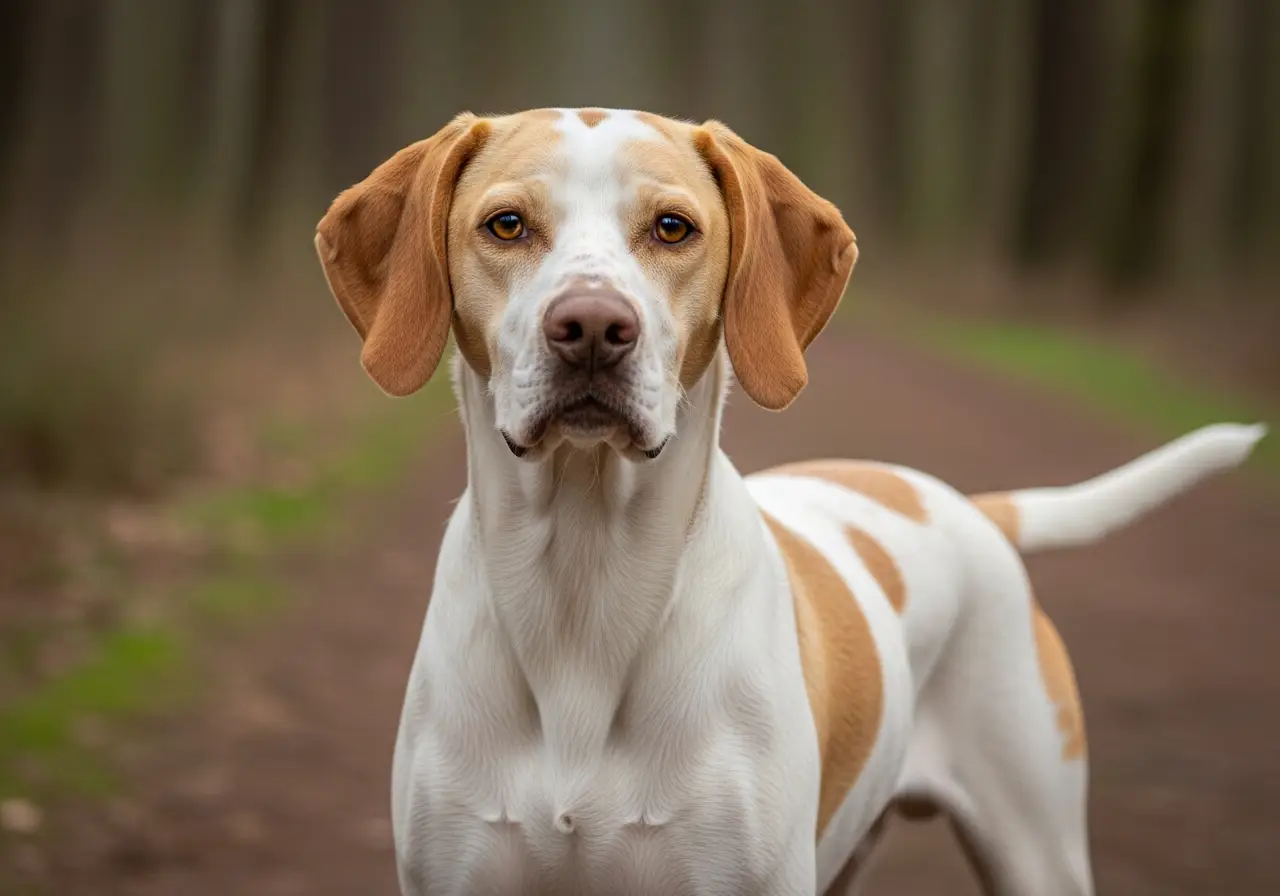
Portuguese Pointer (Perdigueiro Português): elegant Portuguese gundog, heat-tolerant endurance and rare outside Portugal
03Profile
Key facts and suitability
- Origin
- Portugal
- Original purpose
- Hunting fur game and feather game
- FCI
- No. 187 · Group 7 · Section 1.1
- height at the withers
- 48–60 cm
- Weight
- 16–27 kg
- Life expectancy
- 12–14 Years
- Coat type
- Short-haired
- Minimum exercise
- 90 min/day
- Puppy price
- 1'500–2'500 CHF
- Waiting period
- 5 months
- Sports
- Retrieving Scent work Agility
04Temperament
How the Portuguese Pointer (Perdigueiro Português) shows up in everyday life
The Perdigueiro Português shows two levels in everyday life that an owner must clearly distinguish: its internal needs and its external behaviour towards the environment.
Internally, it demands a lot. The need for social contact is high; it seeks close proximity to its primary caregiver, wants to be included and reacts to exclusion with restlessness. On the morning run, it does not simply walk alongside you: it works, sniffs, searches for trails, changes pace. Anyone who only takes it for walks does not tap into its potential. Mental work in the form of nose work, dummy training or trail finding belongs to the daily routine, not as an exception.
Externally, it behaves neutrally to reservedly towards strangers, friendliness score 3 out of 5. This means: it does not greet visitors enthusiastically, but also shows no aggression. It observes, categorises and remains calm when the situation is clear. Anyone expecting a dog that joyfully greets every guest will be disappointed. This reserve is not a deficiency; it is typical of the breed.
Towards other dogs, it shows a certain haughtiness according to the FCI standard. In everyday life, this means: encounters with unknown dogs do not always run smoothly. Early and consistent socialisation reduces tensions but does not eliminate them.
At home, it is calm and balanced as long as its stimulation is adequate. An under-stimulated Perdigueiro, however, becomes restless, seeks enrichment on its own initiative and develops behaviours that are difficult to correct.
05Needs
What this breed needs daily
The Perdigueiro Português requires at least 90 minutes of intense exercise daily, not a walk, but active work. Free running in secure terrain, trail work, retrieving exercises or hunting guidance cover its need for exercise most effectively.
Mental work is not an optional addition. The dog was selected over centuries for concentrated, independent work in the field. Its need for mental work is 4 out of 5. Nose work, mantrailing, dummy training or structured terrain training are suitable formats. Simple playing in the garden is not sufficient.
The need for social contact is also high (4 out of 5). The Perdigueiro requires a fixed primary caregiver who includes it in everyday life. Long periods alone, more than four hours daily, are stressful for this breed. Anyone who is regularly absent for longer must organise reliable care.
A garden is helpful but does not replace active stimulation. The dog requires structured tasks, not merely an area to stay in.
Training works best with calm, consistent handling. The Perdigueiro reacts sensitively to the tone and mood of its primary caregiver. Loud, pressure-based training methods lead to withdrawal or refusal. Positive reinforcement combined with clear structures shows the best results. An accompanying dog training school with experience in hunting dogs is particularly recommended during the puppy phase.
Exercise
High
mental work
A lot
Social needs
High
training
Medium
06Sport & Mental and Physical Stimulation
What sports the Portuguese Pointer (Perdigueiro Português) is suited for
Realistic in terms of physiology and genetics – not every breed suits every sport.
Structurally and physiologically suitable: Suitable for mantrailing, dummy work and tracking · CaniCross / bikejoring possible.
07Quick Check
08Suitability
Who this breed is suitable for – and who it isn't
✓Matches
The Perdigueiro Português suits hunters looking for a cooperative pointing dog with a close bond to the handler. The breed works in close contact with the hunter; this is its genetic programme and its strongest argument for hunting households.
The breed is also suitable for very active people without a hunting licence who are prepared to provide at least 90 minutes of structured exercise plus scent work or dummy training daily. Those with experience in pointing dogs or other high-drive breeds will find a willing, cooperative partner in the Perdigueiro.
Families with children from around 8 years of age are suitable if everyday life provides sufficient exercise and tasks, and at least one adult takes primary responsibility for training and handling. A house with a garden and access to open land is advantageous.
People who value a calm, observant dog and are not looking for an intrusive greeter will find its reserved attitude towards strangers to be a suitable trait. Those who understand this reserve as a character quality and do not attempt to correct it as a problem will be rewarded with a reliable, stable dog.
×Doesn't match
The Perdigueiro Português is not suitable for owners who are away from home for more than four hours daily and cannot organise reliable dog care. Its high need for social contact is incompatible with permanent isolation.
Those living exclusively in a city apartment without regular access to open land underestimate the exercise and stimulation needs of this breed. A short city walk twice daily does not come close to meeting its requirements.
Anyone looking for a dog that enthusiastically greets strangers and acts openly and carefree in every social situation will be disappointed by its neutral to reserved attitude. This trait cannot be trained away; it is typical of the breed, not a gap in training.
First-time owners without experience with high-drive dogs should only choose this breed if they ensure professional training support from a dog training school with hunting dog experience from the outset. Those unable to maintain consistency and structure in training permanently will be confronted with an under-stimulated dog whose behavioural problems are difficult to correct.
Households with very young children under 6 years of age and without experience in handling active working dogs are also unsuitable, not due to aggression, but because of the high activity level and training effort required.
10Line reality
Show line, working line, breeder market
The Perdigueiro Português is still bred primarily as a hunting utility dog in Portugal today. A pronounced separation into working and show lines, such as exists for example with the German Shorthaired Pointer or the Labrador Retriever, is less pronounced in this breed, which is mainly due to the fact that the total population outside Portugal is very small.
In Portugal itself, breeding is oriented towards the FCI standard with a working test. This means: breeding animals must prove their suitability for hunting. This mechanism prevents a complete decoupling of exterior and function, as is frequently observed in more popular breeds.
Outside Portugal (particularly in Germany, Austria and Switzerland), Perdigueiros are so rare that it is hardly possible to speak of independent line development. The few dogs come almost without exception from Portuguese hunting kennels or their direct descendants. Anyone looking for a Perdigueiro in the DACH region will generally be referred to Portuguese breeders or their international contacts.
Anyone who wishes to keep the breed purely as a companion dog without hunting use should be aware that the entire breeding history is oriented towards working function. The predisposition for hunting is not a by-product; it is the breeding goal.
11Health · Reality
What you need to plan for medically with your Portuguese Pointer (Perdigueiro Português)
The Perdigueiro Português is considered a robust breed with a life expectancy of approximately 12 to 14 years. Reliable breed-specific health statistics are hardly available due to the small population size outside Portugal, a circumstance that prospective owners should actively take into account.
Hip dysplasia (HD) occurs occasionally. As no publicly accessible HD rates specifically for the Perdigueiro exist, the minimum standard is: both parent dogs should have been X-rayed and officially assessed before breeding. The same applies to elbow dysplasia (ED). A reputable breeder provides these reports without being asked.
Eye diseases are another area deserving attention. Genetically determined eye problems can occur; an ophthalmological examination of the parent dogs by a specialist vet is recommended. The European College of Veterinary Ophthalmologists (ECVO) recommends regular screenings for hunting dogs with a known risk of eye disease.
The risk of overweight is low in sufficiently exercised individuals. However, if the dog is permanently under-stimulated and simultaneously fed a calorie-rich diet, the risk of obesity and associated joint problems increases. A weight-controlled nutrition plan and regular weight checks with the vet, at least once a year, are sensible.
Preventive examinations: annual general check-up, dental check, parasite management (ticks, heartworm when travelling to Southern Europe), and HD/ED screening before breeding.
12Structured data
Health by the numbers
Prone to diseases
Hip dysplasia Eye problems
Recommended health tests
Hip X-ray Eye examination
13Myths ↔ Reality
What is often said incorrectly about this breed
Five myths, five realities, five sources.
„The Perdigueiro is a calm dog; it also suits city apartments.
The FCI standard describes it as a dog with great stamina and persistent work motivation. Its need for exercise amounts to at least 90 minutes of intense activity daily. Keeping it purely in a city without structured stimulation leads to behavioural problems such as excessive barking, destructive behaviour or restlessness.
„As a pointing dog, it is automatically compatible with other dogs.
The FCI standard explicitly states that the Perdigueiro can be somewhat haughty towards other dogs. Social compatibility with conspecifics is not guaranteed and depends heavily on early socialisation and consistent handling.
„The prey drive can be completely eliminated through training.
Pointing and tracking are genetically ingrained behaviours of this breed. Training can channel and control the drive, not eliminate it. Anyone who does not provide compensation through hunting or nose-work-based enrichment is working permanently against the dog’s genetics.
„Because it is rare, it comes from reputable breeders; there are hardly any quality issues.
Rarity does not protect against disreputable breeding. Especially with lesser-known breeds, publicly accessible health data is often lacking. A reputable breeder provides evidence of hip X-rays, eye examinations and working tests, regardless of how rare the breed is.
14animal welfare
The animal welfare perspective
Breeder market, designer versions, animal shelter reality — what no one writes in the puppy ad.
The Perdigueiro Português is a pronounced rarity in Germany and Switzerland. This has consequences for the animal welfare context, both positive and critical.
Backyard breeder market: Because the breed is hardly known, there is no significant backyard breeder market in the DACH region. This reduces the risk of coming across dubious providers but does not eliminate it. Anyone searching online for Perdigueiro puppies and encountering very cheap offers without supporting documents should be suspicious. Imported puppies from Eastern European backyard breeding operations without proof of working tests for the parent dogs are also possible with rare breeds.
Designer versions: There are no established designer crosses for the Perdigueiro. This is an advantage compared to more popular breeds, where trend crosses worsen the health situation.
Breeding and keeping-related problems: The greatest danger with this breed lies not in breeding but in keeping. A Perdigueiro kept without hunting guidance or equivalent alternative enrichment suffers from chronic under-stimulation. This is not an abstract animal welfare problem; it manifests concretely in behavioural disorders, restlessness, and a permanently stressed dog. Anyone who chooses the breed for aesthetic reasons without taking its working disposition seriously does neither themselves nor the dog any favours.
Adoption as an equivalent option: Since Perdigueiros rarely end up in shelters in the DACH region, the adoption option is limited. However, specialised gundog rehoming organisations and Portuguese breed protection organisations can rehome dogs that have been given up by hunting households, for example because the owner can no longer hunt. This option deserves the same seriousness as buying a puppy.
15Costs · Transparency
What this breed realistically costs
A Perdigueiro puppy from a reputable hunting breeding programme with proof of working tests for the parent dogs costs between 1,200 and 2,000 EUR in the DACH region. Offers significantly below this, particularly without supporting documents, indicate dubious origins.
The annual living costs consist of: food (high-quality dry food or BARF) approx. 600–1,000 EUR/year depending on body weight and food quality; care (short coat, low effort) approx. 100–200 EUR/year; basic vet care (vaccinations, parasite protection, annual check-up) approx. 300–500 EUR/year. In addition, there are costs for nose work courses, dummy training or hunting training: 300–800 EUR/year depending on intensity.
Pet health insurance costs between 40 and 100 EUR/month depending on the provider and scope of cover (as of 2025). For a rare breed with limited data on hereditary diseases, surgery cost insurance is recommended as minimum cover.
Total costs in the first year including getting a dog, basic equipment and initial vaccinations: realistically 3,500–5,000 EUR. From the second year: 1,500–2,800 EUR/year ongoing costs, excluding unforeseen vet costs.
16Puppy search
What you need to consider when choosing a breeder
- A reputable breeder of the Perdigueiro Português exhibits the following characteristics: The parent dogs have completed a working test in accordance with the FCI standard.
- Hip dysplasia (HD) and elbow dysplasia (ED) X-ray reports, as well as ophthalmological examinations, are available in writing.
- The breeder allows a visit to the litter and shows the mother dog in direct contact with the puppies.
- Questions regarding keeping, everyday life, and hunting use are answered openly and concretely.
- As the breed is very rare in the DACH region (Germany, Austria, Switzerland), the search often leads to Portugal or to a few specialised breeders in Western Europe.
- Long waiting times of a year or more are normal with reputable breeding operations.
- The rehoming of an adult Perdigueiro from hunting households is an equally valid alternative to buying a puppy.
- Specialised hunting dog rehoming services or contact with Portuguese breed clubs can assist here.
- An adult dog has the advantage that its character and health status are already easier to assess.
- No reputable recommendation of named breeders by this platform; the entry database on rundum.dog lists tested breeding facilities with current information.
FAQ
Frequently asked questions about the Portuguese Pointer (Perdigueiro Português)
Is Portuguese Pointer (Perdigueiro Português) a family dog?
Portuguese Pointer (Perdigueiro Português) is considered suitable for families with good socialisation and species-appropriate care.
How much exercise does Portuguese Pointer (Perdigueiro Português) need?
At least around 90 minutes of exercise per day. As an active breed, more so — plus mental stimulation.
Does Portuguese Pointer (Perdigueiro Português) suit an apartment?
With enough exercise and enrichment, Portuguese Pointer (Perdigueiro Português) can also be kept in an apartment.
What is the size and weight of Portuguese Pointer (Perdigueiro Português)?
Fully grown, Portuguese Pointer (Perdigueiro Português) reaches about 48–60 cm at the withers and weighs around 16–27 kg.
What is the life expectancy of Portuguese Pointer (Perdigueiro Português)?
The life expectancy of Portuguese Pointer (Perdigueiro Português) is approximately 12–14 years.
Which diseases are common in Portuguese Pointer (Perdigueiro Português)?
Hip dysplasia Eye problems
17Breed clubs
Official breed clubs in DACH
19Related
Similar breeds – and their differences
You might also be interested in



Participate
Do you have a good photo of your Portuguese Pointer (Perdigueiro Português)?
We are looking for expressive images for our breed profiles. Submit yours; the editorial team reviews every submission before publication.
Does this breed suit you?
Rare Iberian pointer – robust and close to hunting less suitable as a family dog