
01Summary
In a paragraph
If you only have 30 seconds.
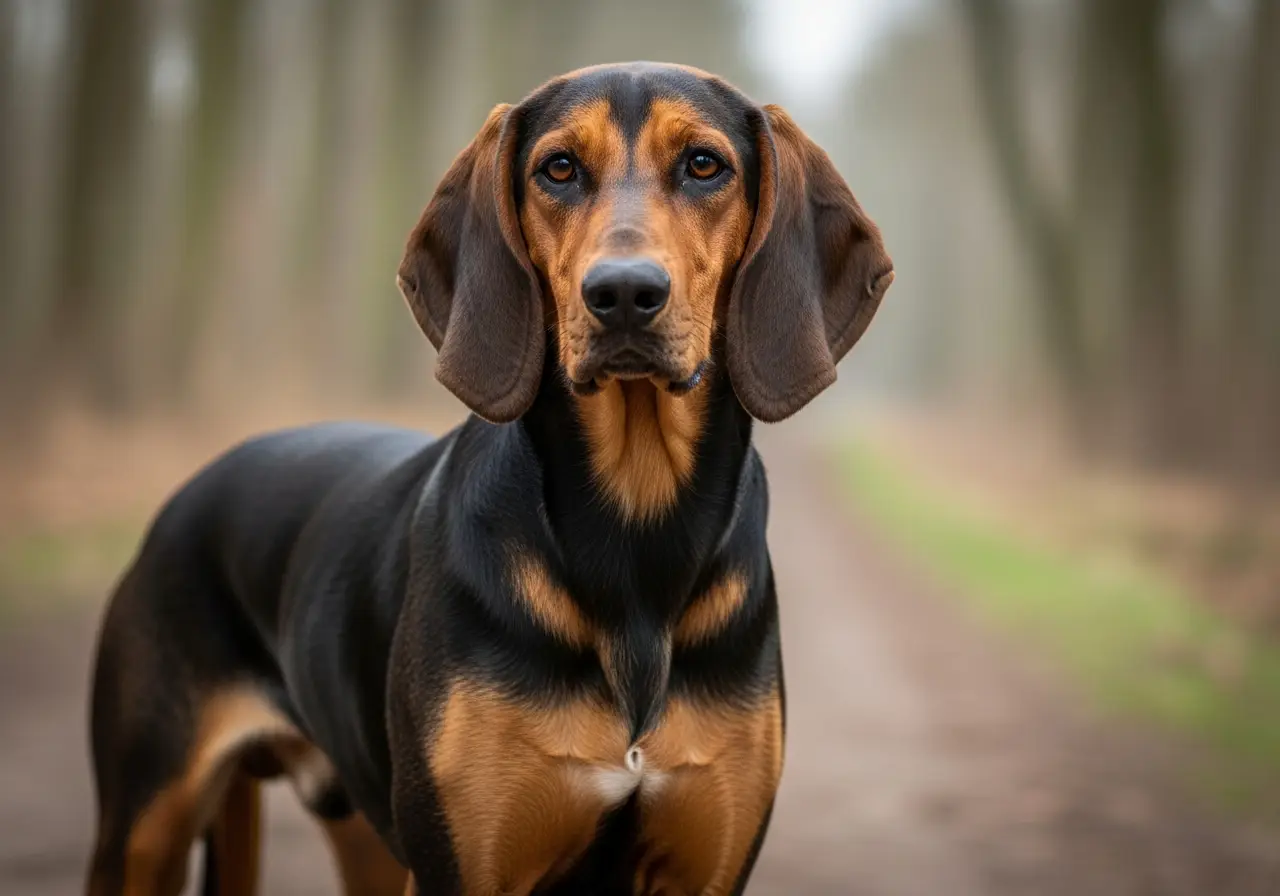
The Gończy Polski is a medium-sized Polish hound bred for enduring hunting of wild boar and red deer in mountainous terrain. In everyday life, it appears calm and loyal; in the field, it switches to an independent, drive-driven working style. This breed demands daily nose work, consistent handling and an owner who knows the difference between a companion dog and a working dog.
02Introduction
What makes the Polish Hunting Dog (Gończy Polski) special
Polish Hunting Dog: rare Eastern European scent hound, bred robust for field and forest
03Profile
Key facts and suitability
- Origin
- Polen
- Original purpose
- Small game hunting tracking work
- FCI
- No. 354 · Group 6 · Section 1.2
- height at the withers
- 50–59 cm
- Weight
- 25–32 kg
- Life expectancy
- 10–13 Years
- Coat type
- Short-haired
- Minimum exercise
- 90 min/day
- Puppy price
- 900–1'500 CHF
- Waiting period
- 4 months
- Sports
- Scent work Mantrailing
04Temperament
How the Polish Hunting Dog (Gończy Polski) shows up in everyday life
At home, the Gończy Polski shows a calm, balanced side. When you come home after a long day, it greets you attentively but without excessive drama. It seeks closeness to its primary caregiver without being intrusive – a dog that appreciates presence without demanding constant interaction.
This calm impression conceals the internal requirements profile. The need for social contact is moderate to high: the Gończy Polski requires regular contact and a reliable daily structure. If left alone for more than four hours, it reacts with restlessness that can manifest as vocalisation or destructive behaviour. The need for mental work is high; nose work is not an optional addition but a daily basic need.
It behaves with reserve towards strangers. This is not a training deficit but a characteristic trait explicitly described in the FCI standard. When unknown people visit, it initially withdraws and observes. It is not aggressive, but it does not open up spontaneously. Anyone expecting the dog to warmly welcome every visitor will be disappointed.
In the field, the Gończy Polski switches to a completely different mode of operation. As soon as it picks up a scent trail, it focuses entirely on the track; external stimuli recede into the background and recall loses its effectiveness. This trait is valuable for hunting but poses a serious risk in everyday life without a secured area. It generally shows social compatibility with other dogs, especially if socialisation has taken place early and consistently.
05Needs
What this breed needs daily
The Gończy Polski needs at least 90 to 120 minutes of active exercise daily, and this does not mean a leisurely walk. Endurance activities such as jogging, cycling or extended runs in rough terrain correspond much better to its basic needs than short city walks.
Nose work is on par with physical exercise. Scent trail work, mantrailing or structured search games activate the dog on a level that pure physical stimulation cannot reach. A Gończy Polski that runs for two hours daily but receives no nose work is not sufficiently stimulated; it is merely tired.
The need for mental work is high. This means structured training sessions that incorporate its independent way of thinking rather than suppressing it. Obedience training alone is insufficient. A more sensible approach is to combine recall training under real conditions with nose work and, where possible, hunting use or alternative activities such as bloodtracking.
Being left alone is limited to a maximum of four hours. Longer periods without the primary caregiver lead to stress, which manifests as vocalisation or restlessness. A securely fenced area is not a comfort solution but a safety necessity: the pronounced prey drive makes uncontrolled off-leash walking permanently risky.
Keeping the dog in an apartment is possible if mental and physical stimulation is consistently ensured. A house with a garden significantly facilitates daily organisation but does not replace active enrichment. The Gończy Polski requires an owner who understands exercise and nose work as a daily obligation, not as an occasional offer.
Exercise
High
mental work
A lot
Social needs
Medium
training
Demanding
06Sport & Mental and Physical Stimulation
What sports the Polish Hunting Dog (Gończy Polski) is suited for
Realistic in terms of physiology and genetics – not every breed suits every sport.
Structurally and physiologically suitable: Suitable for mantrailing, dummy work and tracking · CaniCross / bikejoring possible.
07Quick Check
08Suitability
Who this breed is suitable for – and who it isn't
✓Matches
The Gończy Polski suits hunters looking for an enduring scent hound with a stable nose and independent working style. Hunting use corresponds to the genetic profile of the breed and offers the most sensible form of mental and physical stimulation.
The breed is also suitable for experienced owners who have already worked with hunting-motivated dogs and know the difference between a drive-driven working dog and a companion dog. Anyone planning blood tracking, man trailing or comparable nose work as a fixed part of everyday life creates a viable foundation.
Specific prerequisites: at least 90 to 120 minutes of active exercise daily, access to a securely fenced area, willingness for consistent recall training and structured nose work. Families with children from about ten years of age, in which at least one person brings dog experience and actively shapes everyday life, can keep the breed provided that mental and physical stimulation is ensured.
Anyone living in a rural or semi-urban environment, having access to forest and terrain and bringing an appreciation for an independently thinking breed, will find a loyal, enduring companion with a clear working profile in the Gończy Polski.
×Doesn't match
The Gończy Polski is not suitable for owners keeping a dog for the first time. The independent working style and pronounced prey drive require experience in dealing with high-drive dogs; anyone who does not bring this experience regularly underestimates the demands of the breed.
The breed is not suitable for people who are away from home for more than four hours daily and do not have a reliable dog care plan. The need for social contact is too high to permanently compensate for longer periods of being left alone.
Anyone who considers the reserve towards strangers as temporary and expects the dog to open up over time like a sociable companion dog will be permanently disappointed. This characteristic is typical of the breed, not situation-dependent.
Urban living situations without daily access to terrain, forest or secured off-leash areas are difficult to reconcile with this breed. Anyone who restricts exercise to city walks and understands nose work as occasional variety permanently falls short of the minimum requirements. Owners who expect uncomplicated recall in off-leash situations should also not choose the breed; the prey drive remains a permanent factor even with good training.
10Line reality
Show line, working line, breeder market
In Poland, the Gończy Polski is traditionally kept as a working hunting dog. A pronounced differentiation into show and working lines, as is known for other breeds, does not exist for this breed in a comparable form. The FCI requires a working test for the Gończy Polski, which means that its value as a working hunting dog is enshrined in the breeding standard.
In practice, however, differences still emerge between dogs from breeds actively used for hunting and those kept primarily as companion dogs. Dogs from actively hunting breeds generally exhibit a stronger drive to follow scent trails, greater stamina and more intense vocalisation. These traits are desirable in hunting use but are more demanding to manage in everyday life as a pure companion dog.
Because the breed is extremely rare outside Poland, interested parties face a limited choice of breeders. Long waiting times are the norm. Anyone looking for a Gończy Polski should specifically ask about breeds in which the parent dogs have undergone hunting tests; this provides insight into whether the breed’s hunting character is preserved. Breeding focused purely on appearance without working tests contradicts the FCI standard and can lead to a dilution of the breed profile in the long term.
11Health · Reality
What you need to plan for medically with your Polish Hunting Dog (Gończy Polski)
The Gończy Polski is considered a robust, resilient breed with a life expectancy of about 12 to 14 years. Breed-typical diseases with high prevalence have not yet been systematically documented, which is partly due to the limited distribution of the breed outside Poland and the resulting sparse data.
Hip dysplasia (HD) is fundamentally relevant in medium-sized hounds. Reliable breed statistics for the Gończy Polski are not publicly available in sufficient quantity; reputable breeders should be able to provide HD X-ray reports of the parent animals. The OFA (Orthopedic Foundation for Animals) recommends a hip examination before breeding for hounds of this size class.
Overweight is an underestimated risk in this breed. The Gończy Polski is designed for enduring exercise; if it is permanently under-stimulated and simultaneously overfed calorically, the weight increases quickly. Overweight puts strain on joints and shortens the active life phase. Weight-controlled feeding and regular body condition assessment (Body Condition Score) are recommended.
When used for hunting, injuries from undergrowth, thorns or contact with game are more common than in pure companion dogs. Regular checks of paws, ears and coat after field work are mandatory. The Gończy Polski has drop ears, which increases the risk of ear infections, especially in damp conditions. Veterinary check-ups should take place at least once a year, and more frequently if used for hunting.
12Structured data
Health by the numbers
Prone to diseases
Hip dysplasia Ear infections
Recommended health tests
Hip X-ray Ear check
13Myths ↔ Reality
What is often said incorrectly about this breed
Five myths, five realities, five sources.
The Gończy Polski is a calm family dog that can be kept without problems without hunting-related stimulation.
The Gończy Polski does indeed show a calm temperament in everyday household life. However, this image deceives about its genetically anchored desire to track. Without controlled nose work and sufficient exercise of at least 90 to 120 minutes daily, it develops independent behaviours, including independently picking up scents, which leads to significant control problems when off-leash. The FCI explicitly classifies it as a working dog with a working test.
Scent hounds like the Gończy Polski are unsuitable for apartment keeping due to their size.
Body size alone is not an exclusion criterion for keeping a dog in an apartment. What matters is the daily workload. A Gończy Polski that receives sufficient exercise, nose work and mental enrichment can also be kept in an apartment, provided that a securely fenced area is available for off-leash exercise. Without these prerequisites, keeping the dog is problematic regardless of the type of housing.
The pronounced prey drive can be completely eliminated through consistent training.
The Gończy Polski’s drive to follow a scent trail is genetically anchored and not a deficit in training. Training can improve recall and make the dog controllable in certain situations, but it does not eliminate the instinct itself. Experienced owners report that when the dog picks up a scent trail, it switches into a focused working mode in which external signals penetrate much less easily. Off-leash exercise without a secured area or hunting-related control remains a permanent risk.
The Gończy Polski is aggressive towards strangers because it is used as a guard dog.
The FCI standard explicitly describes the Gończy Polski as non-aggressive. It behaves with reserve and restraint towards strangers; this is a characteristic trait, not aggression. Its vigilance makes it alert, not overbearing. A clear distinction between reserve and aggressiveness is crucial for socialisation and for assessing the dog in everyday life.
Polish hunting dogs are difficult to train because they are stubborn and independent.
The FCI standard describes the Gończy Polski as intelligent and easy to train. The challenge does not lie in a lack of willingness to learn, but in the independent working style that was bred for hunting. The dog makes its own decisions in the field; this is a strength in hunting use, but it requires an owner who can deal with this independence in a structured way in everyday life.
14animal welfare
The animal welfare perspective
Breeder market, designer versions, animal shelter reality — what no one writes in the puppy ad.
In Germany, Austria and Switzerland, the Gończy Polski is one of the rarest dog breeds. This has a direct consequence for the market: anyone looking for a Gończy Polski will quickly come across offers from abroad that are hardly verifiable. Backyard breeders who exploit the rarity of the breed and demand correspondingly high prices without providing evidence of working tests for the parent animals or health examinations are a real problem, particularly for breeds where buyers have few benchmarks.
A reputable breeder provides X-ray reports for the parent animals, is a member of a recognised breeding association and allows a visit before purchase. Long waiting times for this breed are not a sign of exclusivity, but of responsible breeding with limited litters.
Designer versions or crosses marketed under the name Gończy Polski or Polish hunting dog exist in isolated cases. Without FCI papers and traceable pedigree, the breed profile cannot be assessed, neither in terms of health nor character.
Adoption via animal welfare organisations is a realistic option for this breed, even if it occurs rarely. Occasionally, Gończy Polski from Poland or other Eastern European countries arrive in the DACH region and are rehomed. Anyone open to an adult dog has the advantage of being able to assess the animal's character already, an aspect that should not be underestimated in a strong-drive working breed. Animal welfare adoption is not a compromise solution, but an equally valid alternative to buying a puppy.
15Costs · Transparency
What this breed realistically costs
A puppy from a reputable breeder with FCI papers and health examinations of the parent animals costs between 1,200 and 2,000 EUR in the DACH region based on experience. Offers significantly below this without traceable pedigree and health documentation carry increased risk.
Annual living costs consist of food (approx. 600–900 EUR/year for a medium-sized dog with high activity levels), basic equipment, care and accessories. In addition, there are annual veterinary costs for routine examinations, vaccinations and parasite prevention; realistically, these amount to 300–600 EUR/year without illness.
Hunting use incurs additional costs for a hunting licence, equipment and hunting tests. Dog liability insurance is mandatory in several federal states and costs between 50 and 120 EUR/year depending on the provider and coverage amount. Pet health insurance should be considered for this breed; monthly premiums range from 40 to 90 EUR depending on the scope of benefits. Over the entire life expectancy of 12 to 14 years, total costs add up to a five-figure sum.
16Puppy search
What you need to consider when choosing a breeder
- Starting the search for a puppy of the Gończy Polski requires patience.
- The breed is extremely rare in the DACH region, and waiting times of one year or more should be expected.
- Anyone who can buy a puppy immediately should regard this as a warning signal, not as a stroke of luck.
- Reputable breeders are members of a recognised breeding association (e.g.
- VDH, ÖKV or SKG) and breed according to the FCI standard with working tests.
- They provide HD X-ray reports of the parent animals, allow a personal visit to the litter and ask questions about the planned keeping; a breeder who does not ask questions does not select.
- Do not buy a puppy without access to the papers of both parent animals.
- Photos and video promises from abroad do not replace personal contact.
- Puppy mills deliberately exploit the rarity of the breed.
- Adopting an adult Gończy Polski through animal welfare organisations or breed rescues is an equally valid option.
- An adult dog already shows how it reacts to strangers, other dogs and everyday situations; this is a real advantage over a puppy with unknown development potential in a high-drive working breed.
FAQ
Frequently asked questions about the Polish Hunting Dog (Gończy Polski)
Is Polish Hunting Dog (Gończy Polski) a family dog?
Polish Hunting Dog (Gończy Polski) is considered suitable for families with good socialisation and species-appropriate care.
How much exercise does Polish Hunting Dog (Gończy Polski) need?
At least around 90 minutes of exercise per day. As an active breed, more so — plus mental stimulation.
What is the size and weight of Polish Hunting Dog (Gończy Polski)?
Fully grown, Polish Hunting Dog (Gończy Polski) reaches about 50–59 cm at the withers and weighs around 25–32 kg.
What is the life expectancy of Polish Hunting Dog (Gończy Polski)?
The life expectancy of Polish Hunting Dog (Gończy Polski) is approximately 10–13 years.
Which diseases are common in Polish Hunting Dog (Gończy Polski)?
Hip dysplasia Ear infections
17Breed clubs
Official breed clubs in DACH
19Related
Similar breeds – and their differences
You might also be interested in
Participate
Do you have a good photo of your Polish Hunting Dog (Gończy Polski)?
We are looking for expressive images for our breed profiles. Submit yours; the editorial team reviews every submission before publication.
Does this breed suit you?
Enduring Polish Hunting Dog – little widespread requires consistent handling