
01Summary
In a paragraph
If you only have 30 seconds.
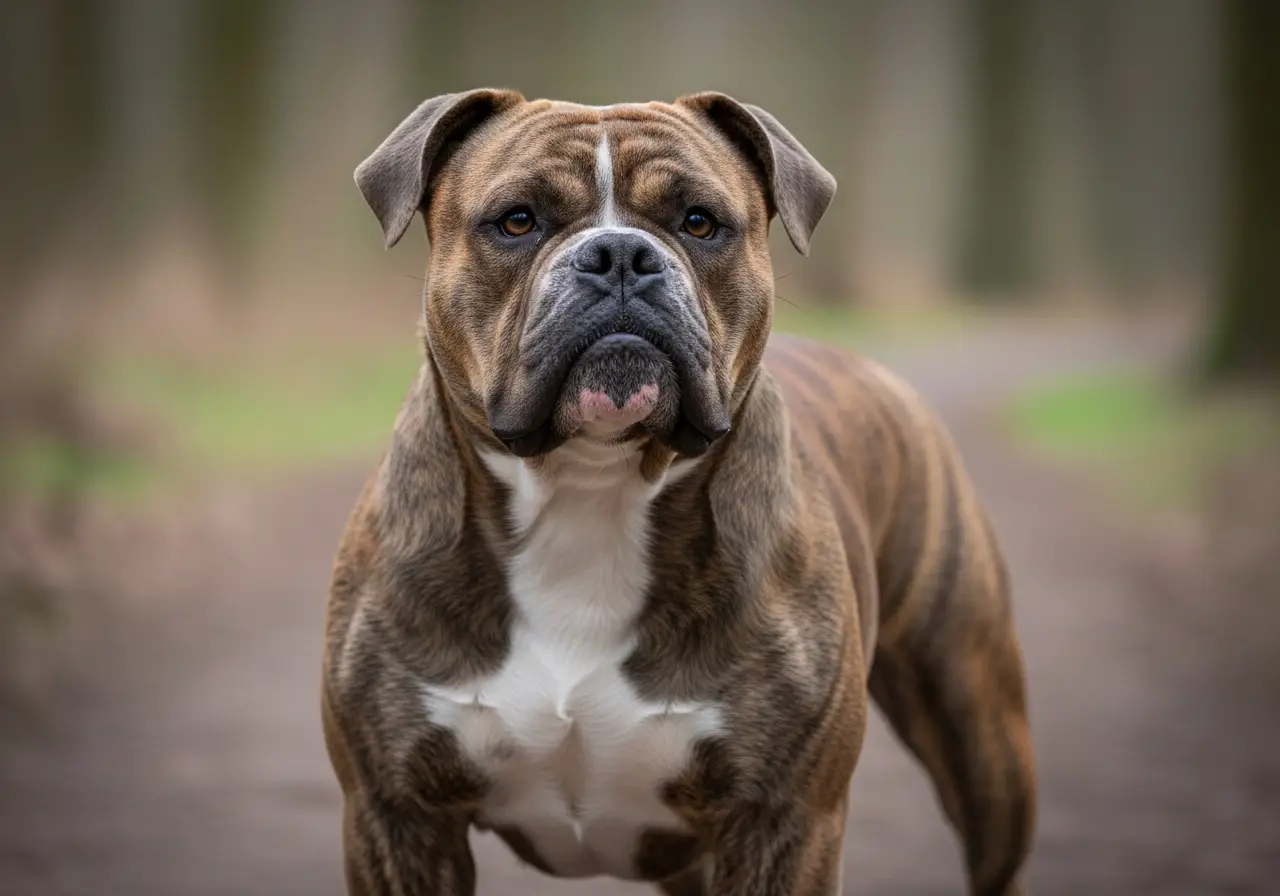
The Olde English Bulldogge is a US American new breed from the 1970s, not a historical original but a targeted breeding project for more functionality and breathing freedom. The dog is people-oriented, self-confident and has a pronounced protective instinct. Anyone who keeps one needs experience with assertive breeds, consistent everyday structure and time for at least 60 to 90 minutes of exercise daily.
02Introduction
What makes the Olde English Bulldogge special
The Olde English Bulldogge is an FCI-unrecognised American new breed that restores the historical bulldog type, withers height 45–55 cm.
03Profile
Key facts and suitability
- Origin
- USA
- Original purpose
- Revival of the pre-Victorian bulldog type, companion dog
- height at the withers
- 45–55 cm
- Weight
- 22–36 kg
- Life expectancy
- 10–14 Years
- Coat type
- Short-haired
- Minimum exercise
- 45 min/day
- Puppy price
- 1'500–3'000 CHF
- Waiting period
- 6 months
- Sports
- Obedience · Weight pulling
04Temperament
How the Olde English Bulldogge shows up in everyday life
When returning home, the Olde English Bulldogge shows an intense greeting reaction; the bond with the primary caregiver is close. This is the internal axis: high need for social contact, desire for closeness and inclusion in everyday life. Anyone who regularly leaves the dog alone without building up and training this need beforehand risks separation stress.
The external axis looks different. Towards strangers, the dog behaves reservedly to watchfully. This is not a sign of insecurity but an expression of the guarding instinct. A visitor who enters the apartment unannounced will initially be observed and assessed, not greeted joyfully. These two poles, close family bond and reserve towards unknown people, must not be confused.
In everyday life on a walk, the dog reacts to stimuli with attention and body tension. Encounters with other dogs proceed calmly if socialisation took place early and broadly; in same-sex encounters, particularly between males, increased attention is appropriate.
Mentally, the dog needs structure, not enrichment for the sake of enrichment. Short, clear training sessions with positive reinforcement principles show effect. Pressure or physical correction leads to resistance; the dog switches off or reacts with counter-pressure. An owner with calm, consistent body language achieves significantly more than one who acts loudly or frantically.
Hot days require special attention. Even if the respiratory function in this breed is supposed to be better than in the classic English Bulldogge, the dog needs shade, water and reduced exertion on warm days.
05Needs
What this breed needs daily
The Olde English Bulldogge requires 60 to 90 minutes of structured exercise daily, divided into at least two sessions. Pure off-leash areas without guidance are not sufficient. The dog benefits from walks with clear rules, loose-leash walking and targeted exercises that train concentration and impulse control.
Mental stimulation is most effective through short training sequences of 10 to 15 minutes, in which new commands or behavioural rules are consolidated. Nose work and search games are suitable as supplements but do not replace structured leadership work.
The need for social contact is high. The dog needs inclusion in family everyday life, not as decoration but as an active part of the daily structure. Long periods of solitude exceeding four hours are problematic and should remain the exception. Anyone who is regularly absent for more than four hours needs a reliable care solution.
Early socialisation is not an option but a prerequisite. From the eighth week of life, the puppy requires systematic contact with various people, environments, noises and dogs. Omissions in this phase can only be corrected later with considerable effort.
The breed tolerates heat less well than athletic breeds without brachycephalic features. On days above 25 degrees Celsius, intensive activities should be moved to the early morning or late evening hours. Water and shade are not comfort measures but a medical necessity.
Exercise
Medium
mental work
Medium
Social needs
High
training
Demanding
06Sport & Mental and Physical Stimulation
What sports the Olde English Bulldogge is suited for
Realistic in terms of physiology and genetics – not every breed suits every sport.
Structurally and physiologically suitable: not an endurance sport (brachycephaly / BOAS).
07Quick Check
08Suitability
Who this breed is suitable for – and who it isn't
✓Matches
The Olde English Bulldogge suits owners with proven experience in handling assertive or protection-drive-oriented breeds. Anyone who has already handled a dog with a similar profile and understands how setting boundaries works without pressure brings the basic prerequisite.
Households are suitable where at least one person spends 60 to 90 minutes daily on structured exercise and there is a willingness to use accompanying dog training school beyond the first year of life. Families with children from about eight years old, who are trained in dealing with large dogs and respect boundaries, come into question, provided that encounters are actively accompanied.
Keeping in an apartment is possible if the exercise requirements are met daily and the dog does not remain alone permanently. A garden facilitates everyday life but does not replace a leadership structure. Owners with calm, consistent body language and the willingness to actively shape everyday situations rather than observe passively create the basis for a stable human-dog relationship.
×Doesn't match
The Olde English Bulldogge is not suitable for owners who are keeping a dog for the first time and do not wish to avail themselves of accompanying professional support. Anyone who expects a dog with protective instincts to regulate itself underestimates the risk potential of this breed considerably.
Households are not suitable where the dog regularly remains alone for more than four hours daily without a care solution existing. The high need for social contact and the dog's readiness for close bonding lead to behavioural problems in case of permanent isolation.
Anyone who interprets reserve towards strangers as indifference or gentleness and therefore dispenses with early socialisation obtains a dog whose protective behaviour becomes uncontrollable. Also, owners who underestimate the physical strength of the dog and do not train loose-leash walking quickly reach their limits in everyday situations. Households with very small children under six years old or with small animals that cannot be safely separated should critically examine the breed.
10Line reality
Show line, working line, breeder market
Since the Olde English Bulldogge is not an FCI-recognised breed, there is no binding breed standard that defines or regulates lines. In practice, however, different breeding orientations can still be observed.
Some breeders align closely with the original Leavitt programme and value an athletic build, free airways and documented health tests. This line produces dogs with a higher need for exercise and more pronounced work motivation.
A second orientation tends more towards companion and show dog with a more compact build. Here, the risk is higher that exterior features (broad head, pronounced folds) are weighted more heavily than respiratory function and mobility.
Furthermore, there is a grey area in which dogs whose breeding background is unclear or undocumented are marketed under the term “Olde English Bulldogge”. Interested parties should explicitly ask about the kennel club, parent animal health tests and breathing assessment, and consistently exclude offers without this evidence.
11Health · Reality
What you need to plan for medically with your Olde English Bulldogge
The life expectancy of the Olde English Bulldogge is stated in the specialist literature as 10 to 12 years, comparable with similarly large breeds, but dependent on breeding line and housing conditions.
Hip dysplasia (HD) and elbow dysplasia (ED) are documented diseases in bulldog types. According to an evaluation by the OFA (Orthopedic Foundation for Animals, status 2022), related bulldog breeds show HD rates of over 70 per cent in certain populations. No population-wide studies exist specifically for the Olde English Bulldogge, which makes examining the parent animal X-ray findings all the more important.
Breathing restrictions can occur despite the breeding goal of freer airways if brachycephalic features are present in the line. A standardised breathing test (BOAS grading) at the breeder is a minimum criterion when choosing a puppy.
Skin fold problems arise in dogs with pronounced facial folds: moisture and friction promote dermatitis. Regular cleaning of the folds is part of basic care.
Overweight poses an increased risk in this breed, as the drive for movement is moderate and the dogs tend to consume food. Already two kilograms of overweight measurably increase the load on the joints. Weight control at the vet, at least twice a year, belongs to preventive care. Preventive examinations should include HD/ED screening, breathing assessment and eye examination.
12Structured data
Health by the numbers
Prone to diseases
Hip dysplasia, elbow dysplasia, heart problems, skin fold infections, breathing problems (less pronounced than English Bulldog)
Recommended health tests
Hip and elbow X-rays, heart examination
13Myths ↔ Reality
What is often said incorrectly about this breed
Five myths, five realities, five sources.
“The Olde English Bulldogge is simply a healthier English Bulldogge.
The Olde English Bulldogge is an independent new breed with different genetic material, not a direct descendant of the English Bulldogge. Depending on the breeding line, respiratory problems, hip dysplasia and skin diseases can still occur. Without health tests (HD, ED, BAER, breathing test), no general statement about health can be made.
“Its guarding instinct makes it a reliable family watchdog without training.
Guarding instinct without a leadership structure is uncontrolled territorial behaviour. A dog with a pronounced guarding instinct needs clear boundaries, early socialisation and an owner with experience in handling assertive breeds; otherwise, situations arise that are difficult to correct.
“It gets along easily with other dogs because it appears so calm.
The calm demeanour in everyday life says little about compatibility with conspecifics. Same-sex conflicts are documented in this breed, particularly between males. Early and broad socialisation reduces the risk but does not replace consistent leadership in encounter situations.
“As a new breed, it is free from hereditary diseases.
New breeds are not automatically healthier. Hip and elbow dysplasia, skin fold problems and respiratory restrictions occur depending on the line. Without mandatory health tests at kennel club level, which are absent for non-FCI recognised breeds, the responsibility lies entirely with the buyer to demand the test results of the parent animals.
“Keeping it in an apartment is no problem because it has little energy.
The Olde English Bulldogge requires 60 to 90 minutes of structured exercise daily. Keeping it in an apartment is possible but presupposes that this exercise takes place consistently. A dog that is physically under-stimulated develops behavioural issues, regardless of the living situation.
14animal welfare
The animal welfare perspective
Breeder market, designer versions, animal shelter reality — what no one writes in the puppy ad.
The Olde English Bulldogge is a rare breed in the German-speaking area; accordingly, it rarely appears in animal shelters or rehoming portals. This does not mean, however, that the animal welfare aspect is irrelevant.
The backyard breeder market surrounding Bulldog types is active. Under the term "Old English Bulldog", dogs are offered on the internet whose breeding basis is not documented, partly brachycephalic mixed-breed dogs, partly dogs from backyard breeder lines without health tests. The price alone says nothing about the quality of the breeding: Both excessively high and very low prices can indicate dubious origins.
A specific problem with this breed is the lack of FCI recognition: Without mandatory affiliation to a governing body, there are no binding minimum standards for health tests. This shifts responsibility entirely onto the buyer. Anyone who does not find radiological reports of the parent dogs, a breathing test, and membership of the breeder in a breeding association should not take up the offer, regardless of how sympathetic the dog appears.
Designer versions with an excessively broad head, deep wrinkles or extremely compact body structure contradict the original breeding goal of David Leavitt. Such dogs carry the risk of traits associated with breeding for harmful traits (Qualzucht), which the breed should actually overcome.
Anyone who takes in an adult dog of this breed from rehoming receives a dog with a known character and documented health history, which is a real advantage over a puppy from unknown breeding. Rehoming organisations such as BVBH or specialised Bulldog rescue stations are contact points worth researching.
15Costs · Transparency
What this breed realistically costs
A puppy from reputable breeding with documented health tests costs between 1,800 and 3,500 euros in the German-speaking region. Offers significantly below this, under 1,000 euros, indicate missing health tests or backyard breeding and are associated with an increased risk of follow-up costs.
The annual living costs consist of: food (high-quality, size-appropriate) approx. 600 to 900 euros, basic care (wrinkle cleaning, nail care, dental care) approx. 150 to 300 euros, basic vet care (vaccinations, deworming, prevention) approx. 300 to 500 euros annually.
Orthopaedic treatments for HD or ED can cost 1,500 to 4,000 euros as a one-off. A pet insurance policy with surgical cover costs between 50 and 120 euros monthly depending on the provider and tariff; for a breed with documented dysplasia risk, this is sensible protection. The total costs over the dog's lifespan (10–12 years) realistically lie between 25,000 and 45,000 euros including vet and insurance.
16Puppy search
What you need to consider when choosing a breeder
- A reputable breeder of the Olde English Bulldogge provides proof of health tests for both parent animals: hip dysplasia (HD) and elbow dysplasia (ED) X-ray findings, breathing assessment (BOAS grading or comparable procedure) as well as eye examination.
- These documents should be requested before the visit, not only when collecting the puppy.
- The breeder asks questions about everyday life, experience and housing situation.
- Anyone who does not ask questions is selling; they are not breeding responsibly.
- Puppies should be handed over at the earliest at eight weeks of age, with vaccination record, deworming certificate and chip.
- As the breed is not FCI-recognised, there is no central studbook.
- Breeding associations such as the IOEBA (International Olde English Bulldogge Association) or national associations offer guidance but do not replace your own examination of the documents.
- The rehoming of an adult dog via specialised rescue stations or animal welfare organisations is an equally valid option.
- Adult dogs have the advantage that character and health status are already known.
- An enquiry with bulldog-specific rehoming centres is worthwhile before any puppy search.
FAQ
Frequently asked questions about the Olde English Bulldogge
Is Olde English Bulldogge a family dog?
Olde English Bulldogge is considered suitable for families with good socialisation and species-appropriate care.
How much exercise does Olde English Bulldogge need?
At least around 45 minutes of exercise per day.
What is the size and weight of Olde English Bulldogge?
Fully grown, Olde English Bulldogge reaches about 45–55 cm at the withers and weighs around 22–36 kg.
What is the life expectancy of Olde English Bulldogge?
The life expectancy of Olde English Bulldogge is approximately 10–14 years.
Which diseases are common in Olde English Bulldogge?
Hip dysplasia, elbow dysplasia, heart problems, skin fold infections, breathing problems (less pronounced than English Bulldog)
17Breed clubs
Official breed clubs in DACH
19Related
Similar breeds – and their differences
You might also be interested in
Participate
Do you have a good photo of your Olde English Bulldogge?
We are looking for expressive images for our breed profiles. Submit yours; the editorial team reviews every submission before publication.
Does this breed suit you?
Muscular, healthier alternative type to the English Bulldog. Not FCI-recognised. Fewer breathing problems, but health screening remains important.