
01Summary
In a paragraph
If you only have 30 seconds.
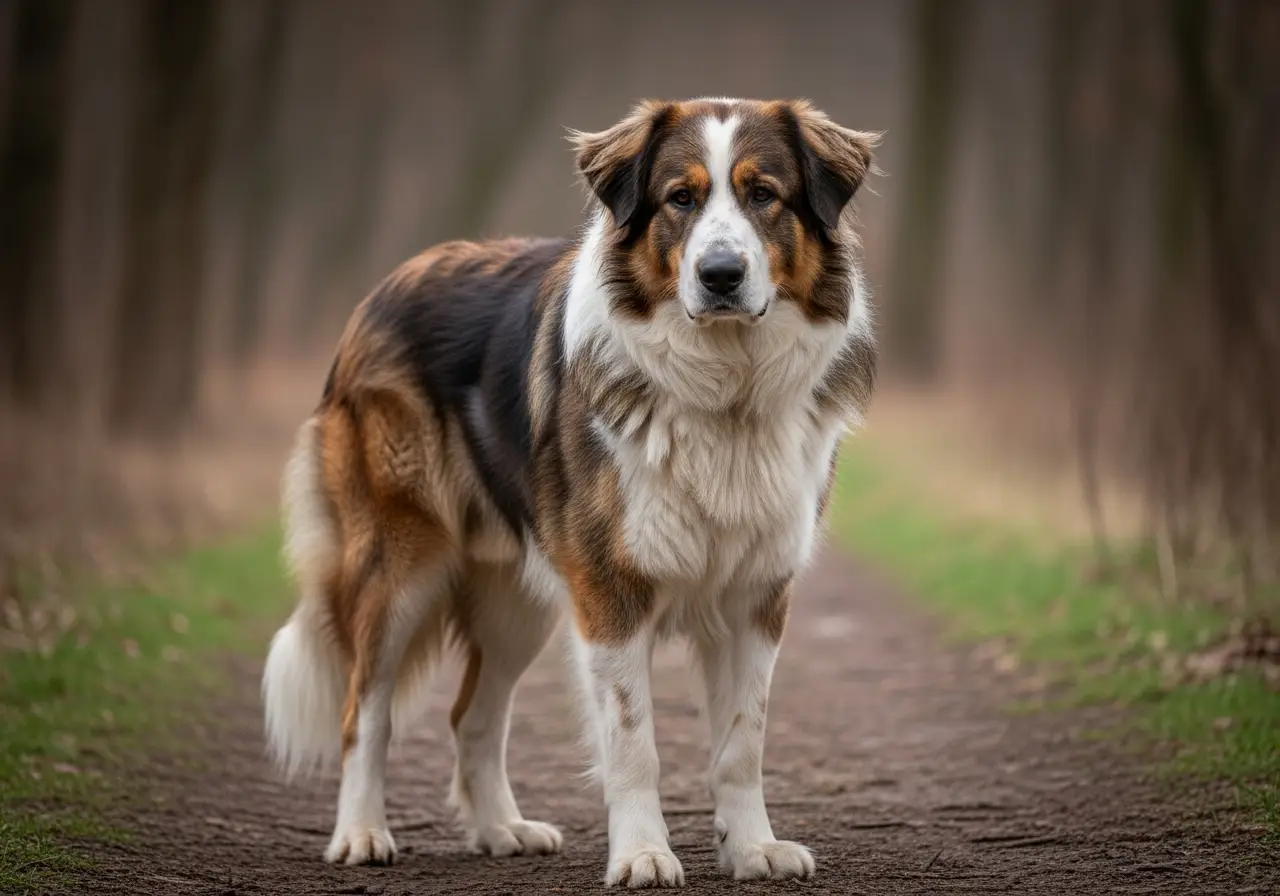
The Karakachan is a Bulgarian livestock guardian dog with centuries of independent work behind it. It decides independently, defends its territory consistently and shows deep mistrust towards strangers. These characteristics are not training errors; they are the genetic profile. Anyone who keeps this dog must know, respect and be able to deal with this profile daily.
02Introduction
What makes the Karakachan special
The Karakachan is a Bulgarian livestock guardian dog, robust and extremely hostile towards strangers, with a withers height of 62–72 cm.
03Profile
Key facts and suitability
- Origin
- Bulgarien
- Original purpose
- Livestock guarding on the Balkans
- height at the withers
- 62–72 cm
- Weight
- 30–55 kg
- Life expectancy
- 12–14 Years
- Coat type
- Long-haired
- Minimum exercise
- 60 min/day
- Puppy price
- 800–1'500 CHF
- Waiting period
- 12 months
- Sports
- Schutzhund
04Temperament
How the Karakachan shows up in everyday life
When a stranger enters the property, the Karakachan positions itself between the intruder and the family, without command, without hesitation. This is not learned behaviour, but a genetically anchored reflex. Anyone who experiences this for the first time understands what "livestock guardian dog" means.
In everyday family life, another side shows itself: The Karakachan observes, registers changes and keeps its distance, even from its own family, when it needs rest. It does not seek constant physical closeness, but shows a deep, stable bond with its primary caregivers. At dinner, it does not lie on the sofa, but by the door, from where it overlooks the room.
Internally, it needs a clearly defined territory, a structured daily routine and a primary caregiver who acts with authority and calmness. Mental work in the classic sense (fetching, search games, agility) interests it little. Its mental stimulation arises from vigilance, space control and the perception of its surroundings.
Externally, it reacts to strangers with immediate distrust. Children it does not know are observed and assessed, not greeted. Towards other dogs, it shows dominant behaviour, especially towards animals of the same sex. This external reaction is independent of its internal need for social contact: It is not a distant loner, but it opens up exclusively to people and animals it knows and has assessed.
Anyone who confuses these two axes, and equates family bonding with general openness, fundamentally underestimates the breed.
05Needs
What this breed needs daily
The Karakachan needs 60 to 90 minutes of controlled exercise daily. Free running without secured terrain is not justifiable due to its territorial behaviour and reaction to strangers. A securely fenced property (fence height at least 180 cm, with no possibility of digging under) is not an option, but a basic requirement.
Mental stimulation for this breed does not arise from classic activity games, but from tasks and structure. A Karakachan that guards a clearly defined territory and has an authoritative primary caregiver is balanced. One without a task develops independent solutions, with unpredictable consequences for neighbours and visitors.
Bonding work requires time and consistency. The Karakachan builds trust slowly and tests primary caregivers for steadfastness. It registers uncertainty, inconsistent behaviour or loss of authority immediately and independently exploits the resulting leeway.
Being left alone within its territory is possible for up to six hours, provided the environment is familiar and secure. Outside its territory, for example in unfamiliar surroundings or during transport, it reacts much more tensely and needs more guidance.
Socialisation must start early and be continued consistently: regular, controlled contact with strangers, various environments and other animals. This reduces overreactions, but does not change the basic protection pattern. An accompanying dog training school with experience in livestock guardian dogs is recommended, not for obedience training, but for impulse control.
Exercise
Medium
mental work
Medium
Social needs
Low
training
Experts
06Sport & Mental and Physical Stimulation
What sports the Karakachan is suited for
Realistic in terms of physiology and genetics – not every breed suits every sport.
Structurally and physiologically suitable: CaniCross / bikejoring possible.
07Quick Check
08Suitability
Who this breed is suitable for – and who it isn't
✓Matches
The Karakachan suits owners with proven experience in handling livestock guardian dogs or comparable independent breeds. A large, securely fenced property, ideally in a rural area, is structurally necessary.
The breed is suitable for owners who can give the dog a clear task: livestock guarding, terrain monitoring on a farm or similar contexts in which the territorial behaviour is functionally embedded. Anyone who spends several hours daily on relationship work, exercise and structured guidance creates the basis for stable ownership.
Families with older children from about twelve years of age, who are trained in dealing with large, independent dogs, come into question, provided all household members implement the leadership structure consistently. Visitors must be introduced to the dog systematically; spontaneous visitor traffic is permanently manageable.
Owners who are willing to check legal framework conditions, as the Karakachan is subject to notification requirements or breed lists in some cantons, and prepare ownership accordingly, act responsibly. Close cooperation with a vet and an experienced dog trainer with livestock guardian dog competence is recommended.
×Doesn't match
The Karakachan is unsuitable for owners without prior experience with independent or strongly protection-driven breeds. Anyone who has previously kept only social, biddable dogs underestimates the structural demands of this breed.
Urban keeping (apartment, terraced house, dense residential area) is not compatible with the profile of the Karakachan. The nocturnal barking behaviour, space requirements and territorial behaviour regularly lead to conflicts in such environments.
Owners who are looking for an open, stranger-friendly family dog choose the wrong breed. Anyone who equates the Karakachan's family bonding with general sociability will experience disappointment, and possibly a dangerous situation with visitors or children from the surroundings.
Households with frequently changing personnel, many visitors or small children under ten years of age are structurally unsuitable. The Karakachan requires stability, clear hierarchies and predictable routines; the opposite overwhelms it and increases the risk of protective reactions.
Anyone who can devote less than two hours a day to exercise, guidance and relationship work or does not have a securely fenced outdoor area should not choose this breed.
10Line reality
Show line, working line, breeder market
The Karakachan does not have an established line differentiation in the sense of show and working lines, as exists for example with the German Shepherd Dog or Labrador Retriever. Breeding is still primarily functionally oriented; use as a livestock guardian dog takes precedence.
In Bulgaria, breeders and nature conservation organisations distinguish between dogs actively used in livestock guarding and those kept as companion dogs in private households. However, this distinction is not a formal line differentiation, but a keeping category.
Dogs from active livestock guarding work generally show more pronounced territorial behaviour and greater independence than dogs that have been bred over generations for household keeping. Anyone who acquires a Karakachan from Bulgarian working lines is getting an animal with a different set of requirements than one from European hobby breeding, even if both meet the same breed standard.
For interested parties, this means: The origin of the dog and the working context of the parent animals are relevant pieces of information that should be asked about before purchase. A breeder who cannot or will not answer these questions is not a serious contact.
11Health · Reality
What you need to plan for medically with your Karakachan
The life expectancy of the Karakachan is 10 to 12 years, a solid value for a breed of this size, which is due to robust selection over centuries.
Hip dysplasia (HD) is a known risk in large livestock guardian dogs. Reliable breed-specific HD rates for the Karakachan are not available due to the small population size and lack of systematic recording. Reference value: In comparable large livestock guardian dogs (e.g. Kangal, Pyrenean Mountain Dog), HD prevalences in breeding populations range between 15 and 30 % depending on the study (OFA database, status 2023). An HD X-ray examination of the parent animals before purchase is therefore mandatory.
The risk of gastric torsion (gastric dilatation-volvulus, GDV) exists in general for large, deep-chested dogs. As a preventive measure, feeding in several small meals and avoiding intense exercise directly after feeding is recommended. In the event of a distended abdomen, retching without vomiting and severe restlessness, immediate veterinary intervention is required; GDV is life-threatening.
Overweight represents an underestimated risk in this breed. The Karakachan is designed for physical work; in pure household keeping without sufficient exercise, it tends to gain weight, which puts strain on joints and the cardiovascular system.
Preventive examinations include annual weight control, HD screening in breeding, dental checks and cardiac auscultation in older animals. Eye diseases are not systematically documented for the breed but should not be neglected in routine examinations.
12Structured data
Health by the numbers
Prone to diseases
Hip dysplasia, generally robust
Recommended health tests
Hip X-ray
13Myths ↔ Reality
What is often said incorrectly about this breed
Five myths, five realities, five sources.
“The Karakachan is like any other large dog; with consistency, it can be trained without problems.”
The Karakachan was selected over centuries for independent decision-making, not for obedience towards a human handler. It questions instructions that do not seem situationally sensible to it. Classical obedience work only has limited effect with this breed; anyone who leads it like a Retriever or Shepherd Dog will fail.
“Livestock guardian dogs are aggressive and dangerous.”
Livestock guardian dogs like the Karakachan do not show uncontrolled aggressive behaviour, but highly specialised guarding behaviour with a clear function. They generally escalate in stages: observing, warning, positioning, and only then intervening. This behaviour is genetically anchored and context-dependent, not random or impulsive. The difference from real aggression is recognisable to experienced owners, but difficult for inexperienced ones to assess.
“A large plot of land is sufficient; the Karakachan keeps itself occupied.”
A fenced plot of land is a necessary prerequisite, but not a sufficient keeping condition. The Karakachan needs a clearly defined task, a confident primary caregiver and regular, controlled interaction. Without structure, it develops independent solutions for its guarding task, which can lead to problems with neighbours, visitors and other animals.
“The Karakachan is a quiet dog; it hardly barks.”
The Karakachan is an active barker, especially at night. Livestock guardian dogs communicate their presence acoustically; barking serves to deter predators and intruders. In residential areas, this behaviour regularly leads to conflicts with neighbours. Keeping in densely built-up areas is structurally unsuitable for this reason.
“Socialised as a puppy, it becomes open and friendly towards strangers.”
Early socialisation reduces overreactions and promotes impulse control, but it does not change the genetically anchored distrust of strangers. A well-socialised Karakachan tolerates strangers in a defined context, but remains reserved and vigilant. Anyone looking for an open, stranger-friendly dog chooses the wrong breed.
14animal welfare
The animal welfare perspective
Breeder market, designer versions, animal shelter reality — what no one writes in the puppy ad.
The Karakachan belongs to the breeds that are surrendered above average frequently in Germany and Austria. The reasons are consistent: underestimated territorial behaviour, conflicts with neighbours due to barking behaviour, being overwhelmed by the dog's independence and lack of infrastructure, no suitable property, no experience with livestock guardian dogs.
The backyard breeder market for Karakachans is manageable but not without risks. Because the breed is rare, there is a lack of established quality standards in amateur breeding. Dogs from dubious sources (without HD screening of parent animals, without socialisation, without documentation of origin) end up disproportionately often in animal shelters or rescue stations for livestock guardian dogs.
Designer versions or hybridisations are not a widespread phenomenon with the Karakachan. The risk lies less in breeding trends than in the misjudgement of keeping effort by buyers who are attracted by the rarity and imposing appearance without knowing the behavioural and keeping profile.
Livestock guardian dogs in animal shelters and rescue stations are a reality. Organisations such as the Verein für Deutsche Schäferhunde or specialised livestock guardian dog rehoming organisations regularly care for surrendered Karakachans and similar breeds. Rehoming an adult dog from such a source is an equivalent option, with the advantage that the behaviour of the animal is already assessable and experienced rehoming staff check the match to the owner.
Anyone who takes on a Karakachan from rehoming assumes responsibility for an animal with a history, and in return often receives a dog whose behaviour is already known and classified. This is not a compromise but an informed decision.
15Costs · Transparency
What this breed realistically costs
The purchase price for a Karakachan puppy from reputable breeding ranges between 800 and 1,800 EUR in Germany and Austria, depending on the breeding operation and origin of the parent animals. Offers significantly below this range should be critically examined.
Annual living costs consist of food (for a dog of this size approx. 600–1,000 EUR/year depending on food quality), basic care (brushing, occasional bathing, nail trimming: approx. 100–200 EUR/year) and veterinary costs. Routine examinations, vaccinations and parasite prevention amount to approx. 300–500 EUR/year. Unforeseen treatments, such as for GDV or orthopaedic problems, can quickly reach 2,000–5,000 EUR.
Dog liability insurance is strongly recommended for this breed and mandatory in some federal states due to its restricted breed status. The annual premium ranges between 80 and 200 EUR depending on the provider and coverage amount. Pet health insurance is optional but significantly reduces financial risk in the event of major treatments.
One-off acquisition costs for infrastructure (fencing, dog house, transport crate) can amount to an additional 1,000–3,000 EUR depending on the property and should be planned for before purchase.
16Puppy search
What you need to consider when choosing a breeder
- A reputable Karakachan breeder will not allow puppies to leave before the ninth week of life, provides proof of HD screening for the parent animals and allows several visits to the litter.
- The puppies grow up in an environment that corresponds to their later use context, on a farm, with contact to various stimuli, not isolated in kennel keeping.
- Questions that should be asked before purchase: What task did the parent animals have?
- Are HD X-ray reports available?
- How was the socialisation of the puppies designed?
- A breeder who cannot answer these questions or hands over puppies without a personal conversation and suitability assessment is not a suitable contact.
- Be cautious with offers without documentation of origin, without the possibility to inspect the mother dog and at unusually low prices.
- The Karakachan is a rare breed; offers from abroad without transparent breeding documentation carry increased risks.
- The rehoming of an adult Karakachan from a rescue station or an animal shelter is a fully valid alternative.
- Specialised livestock guardian dog rehoming organisations know the behaviour of the animals and assess the suitability of the owner, which considerably increases the probability of stable keeping.
FAQ
Frequently asked questions about the Karakachan
How much exercise does Karakachan need?
At least around 60 minutes of exercise per day.
What is the size and weight of Karakachan?
Fully grown, Karakachan reaches about 62–72 cm at the withers and weighs around 30–55 kg.
What is the life expectancy of Karakachan?
The life expectancy of Karakachan is approximately 12–14 years.
Which diseases are common in Karakachan?
Hip dysplasia, generally robust
17Breed clubs
Official breed clubs in DACH
19Related
Similar breeds – and their differences
You might also be interested in
Participate
Do you have a good photo of your Karakachan?
We are looking for expressive images for our breed profiles. Submit yours; the editorial team reviews every submission before publication.
Does this breed suit you?
Rare Bulgarian livestock guardian dog. Traditionally kept by nomads. Only for specialists.