
01Summary
In a paragraph
If you only have 30 seconds.
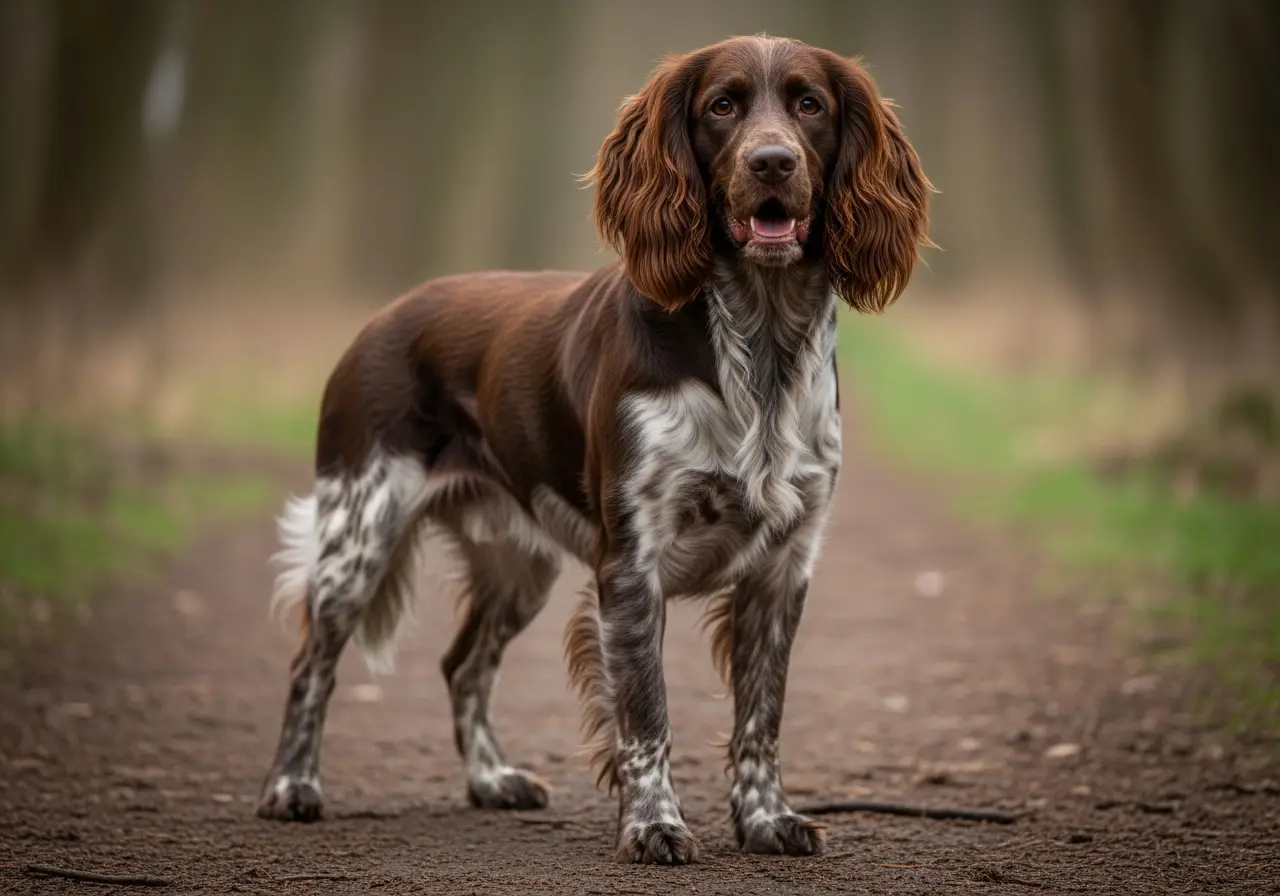
The German Spaniel is a medium-sized, long-haired flushing hound that has been bred exclusively for hunting work since the 19th century. Its tracking drive, retrieving instinct, and stamina are deeply rooted in its genetics. Anyone who keeps this dog without hunting guidance or equivalent workload underestimates its profile and will feel the consequences in everyday life.
02Introduction
What makes the German Spaniel special
The German Spaniel is a versatile German flushing dog, FCI Group 8, with long coat and strong prey drive, shoulder height 45–54 cm.
03Profile
Key facts and suitability
- Origin
- Deutschland
- Original purpose
- Flushing and retrieving, tracking wounded game
- FCI
- No. 104 · Group 8 · Section 2
- height at the withers
- 45–54 cm
- Weight
- 18–25 kg
- Life expectancy
- 12–14 Years
- Coat type
- Long-haired
- Minimum exercise
- 90 min/day
- Puppy price
- 1'000–1'800 CHF
- Waiting period
- 9 months
- Sports
- Hunting · Tracking · Retrieving · Swimming
04Temperament
How the German Spaniel shows up in everyday life
On the morning walk in the forest, what distinguishes the German Wachtelhund from a companion dog becomes apparent: the nose goes straight to the ground, the body tenses, and the dog pulls towards a scent trail, independently, concentrated, without questioning. This is not misbehaviour. This is its profile.
Internally, what the dog needs: The need for mental work is at the highest level. Nose work, searching exercises, scent tracking or hunting deployments are not a supplement to everyday life, but its core. The need for movement is equally high: A minimum of 120 minutes of active exercise daily is the lower limit, not a guideline. It tolerates being left alone for up to four hours if sufficiently stimulated; beyond that, stability noticeably suffers. Its need for social contact with its primary caregiver is pronounced: the Pointing Dog works for and with its owner, not alongside them.
Externally, how the dog reacts: According to the FCI standard, it behaves friendly and environmentally safe towards strangers, neither fearful nor aggressive. In practice, this means: A visit to a café or a meeting with unknown people is no problem, provided the dog is sufficiently stimulated. An under-stimulated Pointing Dog and relaxed city life are mutually exclusive. It is generally compatible with other dogs; its prey drive is directed at game, not at other dogs.
Important: A high need for social contact with the primary caregiver does not mean it is open to everyone. The Pointing Dog bonds closely with its owner and works for them; this is a working relationship, not general sociability. Anyone who does not understand this difference will be surprised by its reserve in new situations.
05Needs
What this breed needs daily
The German Pointing Dog needs at least 120 minutes of active exercise daily, and specifically exercise with purpose. A walk on a lead does not meet its needs. It requires freedom, terrain and a task for its nose.
Time per day: At least two hours of active stimulation, with a significant portion as nose or searching work. Hunting deployments, trailing wounded game or tracking do not replace daily basic exercise; they complement it.
Mental stimulation: The need for mental work in this breed is maximally pronounced. Scent tracking, Mantrailing, structured search games or hunting trial work are suitable formats. Without regular cognitive challenges, many dogs develop avoidance behaviour: excessive barking, destruction, restlessness in the house.
Forms of exercise: Searching in the woods, water work (the FCI standard explicitly describes it as fond of water), retrieving exercises and terrain runs correspond to its genetic profile. Agility or city walks are no substitute.
Being left alone: Up to four hours are possible for a sufficiently stimulated dog. Anyone who is regularly away from home for longer than four hours needs a reliable care solution, such as a dog sitter, day care or a second primary caregiver in the household.
Social structure: The Pointing Dog needs a confident, consistent primary caregiver with hunting experience or comparable expertise. It reacts sensitively to inconsistency. Clear structures and calm, decisive leadership are a prerequisite, not an option.
Exercise
Very high
mental work
A lot
Social needs
High
training
Demanding
06Sport & Mental and Physical Stimulation
What sports the German Spaniel is suited for
Realistic in terms of physiology and genetics – not every breed suits every sport.
Structurally and physiologically suitable: Suitable for mantrailing, dummy work and tracking · CaniCross / bikejoring possible.
07Quick Check
08Suitability
Who this breed is suitable for – and who it isn't
✓Matches
The German Pointing Dog suits owners who actively hunt and are looking for a versatile hunting utility dog for searching, tracking wounded game and water work. A hunting licence and experience in the hunting ground are not just a formality, but a basic requirement for species-appropriate keeping.
It also suits very active people with experience in handling high-drive dogs, who are prepared to offer at least two hours of structured stimulation daily, including nose work, scent tracking or comparable enrichment at a high level.
A rural or at least suburban environment with direct access to woods and terrain is advantageous. Anyone living in the city needs a realistic plan for daily terrain work, not just occasional outings.
Families with children from about ten years old are possible if the hunting-related stimulation of the dog is fully ensured by the adult owner and the children are guided in dealing with a high-drive working dog. The Pointing Dog is not a playmate; it is a working dog that needs respect and structure.
Owners who already have experience with pointing dogs, retrievers or other hunting utility dogs will find in the German Pointing Dog an eager-to-learn, enduring partner, provided expectations are realistic.
×Doesn't match
The German Spaniel is not suitable for owners looking for a calm companion dog that is content with daily walks. Its desire to flush and track is genetically ingrained; no training method will turn it into a relaxed leisure companion.
It does not suit people without a hunting licence or comparable experience with high-drive working dogs. Anyone who has never handled a dog with a pronounced prey drive regularly underestimates what this drive means in everyday life, especially in situations involving contact with game.
It does not fit into households where the dog is regularly left alone for more than four hours without a care solution existing. Under-stimulation and isolation reliably lead to behavioural issues in this breed.
Anyone who confuses the Pointing Dog’s high need for social contact with general sociability (i.e., expects that a closely bonding working dog is automatically an uncomplicated family dog for every day-to-day situation) will be corrected by reality.
City dwellers without a concrete plan for daily terrain work, owners with very young children without hunting infrastructure and first-time owners without dog experience should not choose this breed, not because the dog is difficult, but because the fit is missing.
10Line reality
Show line, working line, breeder market
The German Quail Pointing Dog does not have a classic division into show and working lines, as exists for example with the Labrador Retriever or the German Shepherd Dog. The breed is bred exclusively by hunters for hunters; a show line without hunting test requirements does not exist. The FCI standard mandates the working test; without passing the test, entry into the stud book is not possible.
However, within the breed there is a relevant differentiation by colour variety: Brown Quail Pointing Dogs were historically regarded as short-range hunters that are easier to handle within range. Liver-roans were described as particularly scent-driven long-range hunters. The FCI standard notes that this distinction is no longer considered a reliable indicator today, as crossings between both varieties have been made on several occasions. Nevertheless, experienced hunters and breeders report individual differences in hunting style and activity radius that should be considered when choosing a puppy.
Anyone looking for a German Wachtelhund should specifically ask the breeder about the hunting performance of the parent animals, not just titles, but concrete areas of use: searching work, tracking work, water work, trailing. This information provides a more realistic indication of the expected profile of the puppy than colour variety or pedigree alone.
11Health · Reality
What you need to plan for medically with your German Spaniel
Compared to many other working gundogs, the German Spaniel is considered a robust breed without pronounced breed-specific hereditary diseases. The life expectancy is 12 to 14 years, a value that is realistic for medium-sized working dogs of this category.
Specific health risks arise primarily from the intensity of work: injuries to paws, eyes and ears are common during pointing work in dense undergrowth. Thorns, branches and water in the ear increase the risk of inflammation. Regular ear checks after field operations are mandatory, not optional.
Hip dysplasia (HD) is documented in isolated cases. Reputable breeders have parent dogs examined radiologically for HD and transparently share the results. When buying a puppy, proof of HD results for both parent dogs should be requested. Eye diseases also occur in isolated cases; an eye screening of the parent dogs is recommended.
Overweight is rarely a problem for sufficiently exercised German Pointing Dogs, but the risk increases for dogs that are not used for hunting yet are fed calorie-rich food. Working dog food with a high protein content makes sense for actively used animals; for less active dogs, the ration must be adjusted accordingly.
Preventive examinations: annual vet check-up, dental status, joint assessment from the fifth year of life onwards, as well as eye and ear checks after intensive operations. In case of lameness, performance decline or behavioural changes, a veterinary investigation must be initiated without delay.
12Structured data
Health by the numbers
Prone to diseases
Hip dysplasia, generally robust
Recommended health tests
Hip X-ray
13Myths ↔ Reality
What is often said incorrectly about this breed
Five myths, five realities, five sources.
"The German Quail Pointing Dog is a friendly family dog that can be kept well even without hunting.
The FCI standard describes it as very passionate in the field with strong retrieving drive, scent drive and independence. These traits are genetically selected and cannot be trained out. Without hunting or equivalent workload, many dogs of this breed develop destructive behaviour or uncontrollable hunting passion in daily life. The Verein für Deutsche Wachtelhunde e.V. explicitly points out that the breed is bred for hunters.
"Its strong prey drive can be reliably suppressed through consistent training.
Impulse control and management can channel the prey drive, not eliminate it. According to the FCI standard, the German Quail Pointing Dog is designed for independent, wide-ranging hunting, a behaviour that can become dominant even in well-handled dogs upon contact with game. Recall reliability upon game contact is not a realistic training goal without hunting guidance and years of conditioning.
"Brown and brown-roan Wachtelhunde are identical in character.
The FCI standard notes that the separation of colour varieties was originally also justified by different dispositions: brown as short-range hunters, liver-roan as scent-driven long-range hunters. Due to later crossings between both varieties, this distinction is no longer considered a reliable indicator today; nevertheless, individual differences in hunting style and range may occur within the breed, which are relevant when selecting a puppy.
"The Wachtelhund is robust and requires little veterinary preventive care.
Although the breed is considered relatively healthy, intensive field work significantly increases the risk of injury. Furthermore, hip dysplasia and eye diseases are documented in isolated cases. Regular preventive examinations, particularly eye and joint screening, are sensible even for robust working dogs and are required by reputable breeders.
"A Quail Pointing Dog can be easily kept in an apartment if it gets enough walks.
Exercise alone does not meet the needs of this breed. According to breeding standards, the German Quail Pointing Dog requires nose work, flushing work and mental stimulation at a hunting level. Walks, even long ones, do not replace tracking blood trails, searching for wounded game or flushing in the hunting ground. Pure apartment keeping without a working task regularly leads to under-stimulation.
14animal welfare
The animal welfare perspective
Breeder market, designer versions, animal shelter reality — what no one writes in the puppy ad.
The German Spaniel belongs to the breeds that are surrendered disproportionately often, not because the dog is problematic, but because its owners have underestimated its profile. Typical reasons for surrender: destructive behaviour due to under-stimulation, uncontrollable prey drive in everyday life, poor recall in open country. These problems do not arise from poor training; they arise from a mismatch between the dog and its living conditions.
Backyard breeder market: As the German Pointing Dog does not enjoy broad popularity as a fashion breed, the backyard breeder market is manageable. Nevertheless, offers exist outside the recognised breeding associations where neither hunting aptitude tests of the parent dogs nor health screenings are documented. Puppies from such sources are cheaper, but the risk of health and character surprises is correspondingly higher.
Designer versions: Crossbreeds with the German Pointing Dog as a base are rare, but not non-existent. Such dogs often carry the same prey drive without the breeding documentation that allows an assessment of the profile.
Breeding and keeping-related problems: The greatest challenge with this breed is not breeding, but keeping. A German Pointing Dog that is not used for hunting requires a full-fledged alternative programme, structured nose work, tracking work, mantrailing. Anyone who cannot or will not provide this does the dog no favour.
Adoption as an equivalent option: Surrendered German Spaniels end up in animal shelters or with breed protection organisations. These dogs are not defective; they were placed incorrectly. Anyone who meets the requirements for a German Spaniel should actively consider adoption. The Verein für Deutsche Wachtelhunde e.V. and the Schweizer Klub für Deutsche Wachtelhunde S.K.D.W. can assist in finding dogs available for adoption.
15Costs · Transparency
What this breed realistically costs
A puppy from a reputable breeder with studbook entry, hunting aptitude test documentation for the parent dogs and health screening costs between 1,200 and 1,800 EUR in Germany and Austria, and between 1,500 and 2,200 CHF in Switzerland. Offers significantly below this (without association membership, without test documentation) are a warning sign.
Ongoing costs per year (guideline values):
- Food (working dog food, high quality): 600–1,000 EUR/year depending on activity level
- Care (coat, ears, paws): low with self-care, 200–400 EUR with professional support
- Vet basic care (vaccinations, parasite prevention, annual check-up): 300–500 EUR
- Hunting equipment and test fees: variable, 200–600 EUR/year
Average vet costs: For injuries from field work (paw wounds, eye injuries, ear infections), individual treatments of 80–300 EUR are realistic. Pet insurance with surgical cover costs 40–80 EUR/month depending on the provider and tariff and is recommended for an actively working dog.
Total costs Year 1 (incl. getting a dog, basic equipment, initial vaccinations, neutering/spaying optional): realistically 3,000–4,500 EUR.
16Puppy search
What you need to consider when choosing a breeder
- Reputable breeders of the German Pointing Dog are members of the Verein für Deutsche Wachtelhunde e.V.
- (Germany/Austria) or the Schweizer Klub für Deutsche Wachtelhunde S.K.D.W.
- Both associations maintain studbooks and require proof of hunting aptitude tests for breeding dogs.
- A puppy from a breeder without association membership is not an automatic exclusion criterion, but missing test documentation for the parent dogs is.
- Specific criteria for reputable breeders: both parent dogs with hunting aptitude tests (field trial, association test or comparable), hip dysplasia (HD) X-ray results for both parent dogs, opportunity to view the puppies at the breeder’s premises in their environment, no handover before the eighth week of life.
- For those not looking for a puppy but an adult dog: surrendered German Pointing Dogs can be found through breed protection organisations and occasionally in animal shelters.
- The breeding associations also facilitate rehoming dogs from surrenders.
- An adult dog with a known hunting profile may be the better choice for experienced owners, as the profile is already evident and training can be targeted accordingly.
- No reputable platform recommends individual breeders by name.
- The breeding associations maintain current litter lists and are the most reliable starting point for your search.
FAQ
Frequently asked questions about the German Spaniel
Is German Spaniel suitable for beginners?
German Spaniel is considered suitable for first-time dog owners.
Is German Spaniel a family dog?
German Spaniel is considered suitable for families with good socialisation and species-appropriate care.
How much exercise does German Spaniel need?
At least around 90 minutes of exercise per day. As an active breed, more so — plus mental stimulation.
What is the size and weight of German Spaniel?
Fully grown, German Spaniel reaches about 45–54 cm at the withers and weighs around 18–25 kg.
What is the life expectancy of German Spaniel?
The life expectancy of German Spaniel is approximately 12–14 years.
Which diseases are common in German Spaniel?
Hip dysplasia, generally robust
17Breed clubs
Official breed clubs in DACH
19Related
Similar breeds – and their differences
You might also be interested in

Participate
Do you have a good photo of your German Spaniel?
We are looking for expressive images for our breed profiles. Submit yours; the editorial team reviews every submission before publication.
Does this breed suit you?
Rare – hardly known outside of hunting. Versatile hunting flusher, also suitable as a family dog if sufficiently stimulated through hunting.