
01Summary
In a paragraph
If you only have 30 seconds.
The Hygen Hound is an enduring Norwegian scent hound with a strong prey drive and independent working style. It was developed for hunting fox and hare in Nordic terrain and requires intensive nose work daily as well as a rural environment. Even in Norway, it counts among the rare breeds, with the annual puppy population in the low double digits. Choosing this breed means deciding on a specialised, demanding animal.
02Introduction
What makes the Hygen Hound special
The Hygen Hound is a rare Norwegian scenthound of FCI Group 6 with a strong prey drive and high cold tolerance, withers height 47–58 cm.
03Profile
Key facts and suitability
- Origin
- Norwegen
- Original purpose
- Scent hound for hunting fox and hare in Nordic terrain
- FCI
- No. 266 · Group 6 · Section 1.2
- height at the withers
- 47–58 cm
- Weight
- 20–24 kg
- Life expectancy
- 10–12 Years
- Coat type
- Short-haired
- Minimum exercise
- 90 min/day
- Puppy price
- 1'200–1'800 CHF
- Waiting period
- 24 months
- Sports
- Tracking · Mantrailing · Drag hunting · Dog pulling sports
04Temperament
How the Hygen Hound shows up in everyday life
The Hygen Hound shows two clearly distinct sides to the morning walker: as soon as it picks up an interesting scent trail, it switches into a focused working mode. The owner takes a back seat at this moment. This is not defiance; it is the result of over 150 years of selective breeding for independent tracking behaviour.
Internally, the breed requires intensive mental stimulation every day. The need for mental work is high: tracking, mantrailing or controlled nose work are not extras but a basic prerequisite for a balanced dog. Anyone who offers only walks will get a dog that remains internally restless, even if it appears calm on the outside.
Externally, the Hygen Hound is strikingly open towards strangers. It shows no pronounced shyness and usually reacts to unknown people in a friendly and curious manner. However, this openness must not be confused with obedience: the bond with the owner exists but is situation-dependent; on the trail, it counts for little.
In the household, the breed shows a calm, pleasant demeanour, provided that its need for movement and nose work is met. It seeks contact with the family without being intrusive. Thanks to its pack background, it is usually compatible with other dogs, especially if socialisation took place early on.
Daily life with a Hygen Hound demands predictability: two to three hours of active enrichment per day, a considerable part of which involves nose work, are not exceptional days; they are the standard.
05Needs
What this breed needs daily
The Hygen Hound requires at least 90 to 120 minutes of exercise daily, going beyond mere walking. Tracking, mantrailing or structured nose work meet the genetically anchored workload of this breed. Anyone who offers only walks significantly underestimates the need for mental work.
The need for exercise is not synonymous with pure mileage. An hour of tracking in the forest taxes the Hygen Hound mentally more than two hours of jogging. Both forms of stimulation complement each other; neither fully replaces the other.
The breed tolerates being left alone for up to about four hours, provided it has been sufficiently stimulated beforehand. Longer phases without enrichment and social interaction lead to restlessness and can result in undesirable behaviours. The need for social contact is moderate but genuinely present.
The living environment plays a decisive role. A house with direct access to forest and fields corresponds to the needs of this breed. A pure city apartment without regular access to natural terrain constitutes a structural lack of provision.
Training requires patience, consistency and a realistic view of the prey drive. Positive reinforcement through food and play works well; pressure methods lead to withdrawal and reduce willingness to cooperate. Recall in off-leash situations remains a long-term training goal that stays situation-dependent, especially when a scent trail is present.
Exercise
High
mental work
A lot
Social needs
Medium
training
Demanding
06Sport & Mental and Physical Stimulation
What sports the Hygen Hound is suited for
Realistic in terms of physiology and genetics – not every breed suits every sport.
Structurally and physiologically suitable: Suitable for mantrailing, dummy work and tracking · CaniCross / bikejoring possible.
07Quick Check
08Suitability
Who this breed is suitable for – and who it isn't
✓Matches
The Hygen Hound suits owners with a hunting background or proven interest in nose work and tracking. Anyone who actively hunts or regularly participates in mantrailing or tracking courses offers this breed meaningful stimulation.
A rural living environment with direct access to forest and fields is not a recommendation but a basic prerequisite. Owners who can plan two to three hours for active enrichment daily meet the needs of this breed.
Experienced dog owners who are familiar with independently working dogs and bring realistic expectations regarding recall in off-leash situations will find an enduring, friendly companion in the Hygen Hound. The breed is also suitable for owners willing to engage intensively with dog training and nose work, even without a hunting background, provided the environment is right.
Households with older children from about ten years of age, where an active lifestyle is maintained and sufficient space as well as access to natural terrain is available, can also provide a suitable environment, provided that stimulation through nose work is ensured and expectations regarding obedience in off-leash situations are realistic.
×Doesn't match
The Hygen Hound does not suit owners who expect a dog with reliable recall in off-leash situations without intensive, long-term training. Anyone who assumes that a friendly, balanced dog automatically brings obedience in open terrain fundamentally underestimates the prey drive of this breed.
City owners without regular access to forest and fields are structurally overwhelmed by this breed, not due to lack of engagement, but because the living environment does not correspond to the genetic needs.
Owners who can offer less than 90 minutes of active enrichment daily or whose daily routine allows little predictability will not be able to sufficiently stimulate the breed. Anyone who is away from home for eight hours and has no dog care plan should not choose this breed.
First-time owners without experience with high-drive, independently working dogs face a steep learning curve. The Hygen Hound forgives training errors less than socially oriented breeds because its behaviour is strongly drive-controlled. Anyone who also keeps small animals or cats in the household and has no experience with integrating high-prey-drive dogs should assess the risks realistically.
09Character
Character and editorial background
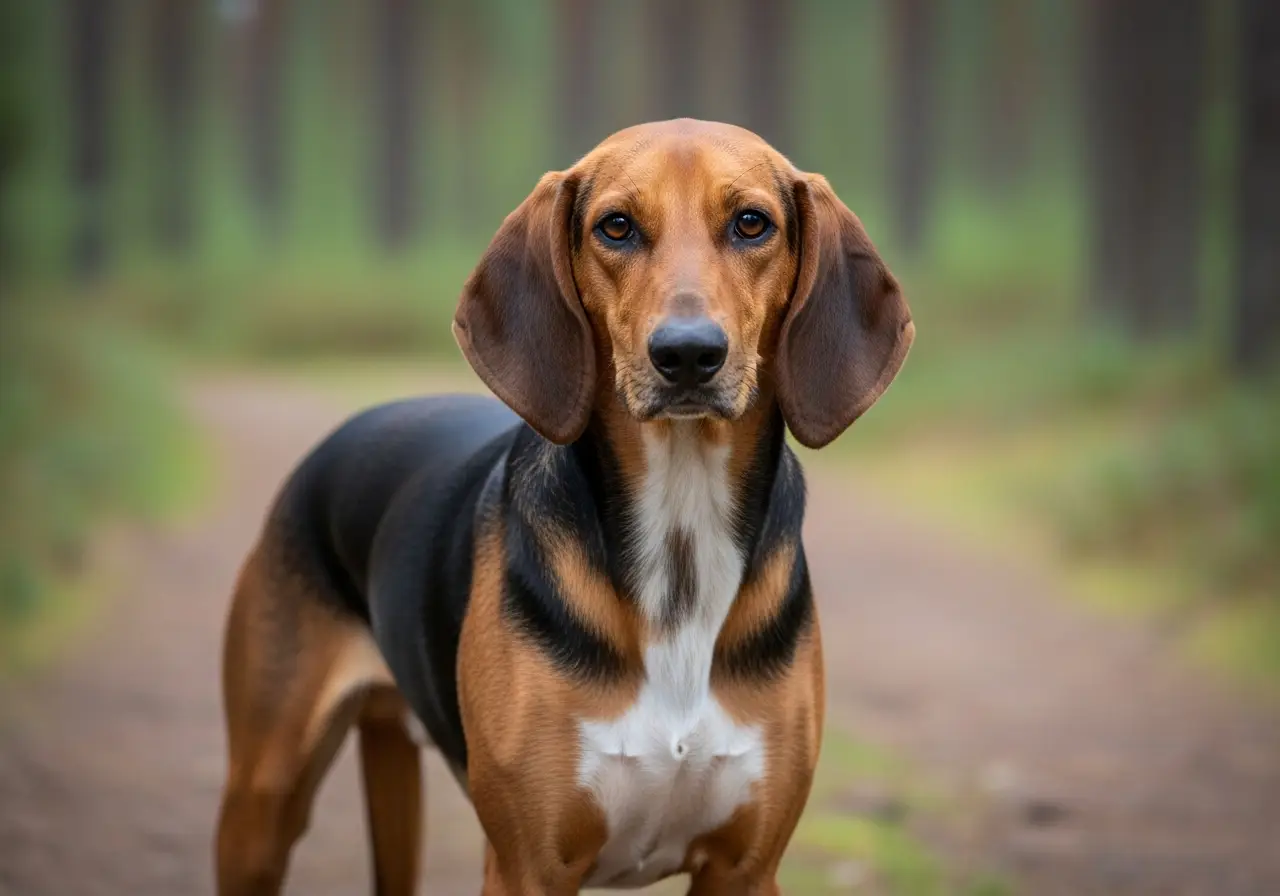
The Hygen Hound is a medium-sized Norwegian scenthound with a pronounced nose, high endurance and a calm temperament. It was bred for hunting in Nordic terrain; outside Scandinavia it is hardly widespread. Anyone interested in this breed should consider its hunting character, its need for exercise and the very limited availability.
Origin and History
The Hygen Hound was developed in the 19th century by Hans Fredrik Hygen in Norway. The aim was a robust scenthound that could work with endurance in difficult Scandinavian terrain with snow, cold and dense vegetation. Danish and Norwegian scenthound types as well as Holstein hounds were used for breeding. The FCI lists the breed under number 266 in group 6, section 1.2 (medium-sized scenthounds). The breed remained rare even in Norway. The annual puppy population is in the low double-digit range; outside Norway hardly any breeding lines exist.
Appearance
The Hygen Hound reaches a withers height of 50 to 58 cm (males) and 47 to 55 cm (females) at a weight of approx. 20 to 24 kg. The body build is rectangular, leanly muscled and designed for endurance. The coat is short, dense and hard, with a dense undercoat. Typical colours are red, yellow-red or black with white markings. The ears are medium-long and hanging, the expression attentive and calm.
Nature and Character
The Hygen Hound is friendly, balanced and people-oriented. Towards strangers it usually behaves openly without being intrusive. Its prey drive is strongly pronounced, particularly on trails. In the house it shows itself calm, whereas outdoors it is focused and enduring. With conspecifics it is usually tolerant due to its pack background. It works independently and makes its own decisions when encountering interesting scent trails. This requires a patient primary caregiver with realistic expectations regarding obedience during free exercise.
Keeping and Training
The daily need for exercise is at least 90 to 120 minutes, ideally with nose work or tracking. Pure walks on a lead are not sufficient for a sufficiently stimulated Hygen Hound. For keeping in an apartment it is only conditionally suitable; a house with access to forest and field better corresponds to its needs. It is not designed for pure city living. Training requires consistency, patience and understanding of its hunting motivation. It can be motivated well through food and positive reinforcement, whereas it reacts to pressure by withdrawing.
Care
The short bristly coat is easy to care for. Brushing once or twice a week is sufficient, more frequently during moulting. The hanging ears should be checked regularly for inflammation.
Health
The life expectancy is approx. 10 to 12 years. Due to the very small population there is a real risk of inbreeding depression and genetically determined diseases. Breed-typical accumulations are only documented to a limited extent. Hip dysplasia and ear infections occur. A reputable breeder has parent animals examined for HD and eye diseases.
Suitable for whom
The Hygen Hound is suitable for people interested in hunting with a rural living environment, who can provide time for nose work and sufficient exercise. For pure sport or family keeping without hunting-related stimulation it is not the right choice.
10Line reality
Show line, working line, breeder market
The Hygen-Bracke does not have a pronounced separation between show and working lines, as is documented for example in the German Shepherd Dog or the Labrador Retriever. The breed is maintained exclusively in a small, hunting-oriented breeding population, which is primarily located in Norway.
Within this population, however, there are individual differences in drive strength and endurance, which can vary from breeder to breeder. Since the annual puppy population is in the low double digits, formal line differentiation is statistically hardly possible; the total population is too small to form stable subpopulations.
Outside Norway, there are isolated dogs in other Scandinavian countries, but an independent international breeding line has not established itself. Anyone looking for a Hygen-Bracke will generally have to rely on Norwegian breeders who are members of the Norsk Kennel Klub.
The consequence for the owner: there is no way to deliberately choose a calmer show line or a stronger-driven working line. The individual and the health tests of the parent animals are the decisive selection criteria, not line affiliation.
11Health · Reality
What you need to plan for medically with your Hygen Hound
The life expectancy of the Hygen Hound is approximately 10 to 12 years. Reliable breed-specific health statistics hardly exist due to the very small breeding population; this itself is a risk factor because genetic problems are only recognised late.
Hip dysplasia (HD) is documented. Reputable breeders have both parent dogs radiologically examined for HD before mating and make the results available transparently. Ear infections occur regularly due to the drop ears and require weekly checks of the ear canals.
The greatest structural health risk for this breed is the small population size. The inbreeding coefficient rises in small populations without active countermeasures. Reputable breeders work with international partners and document kinship coefficients. A puppy from a population with a high inbreeding coefficient carries an increased risk of genetically determined diseases, even if these are not visible at the time of purchase.
Preventive examinations that should be requested before buying a puppy: HD X-rays of both parent dogs (result A or B according to the FCI scheme), an eye examination by a specialist vet, and information on the inbreeding coefficient of the litter. Overweight poses a real risk for this breed if the need for exercise is not met; a dog with too little space to run gains weight quickly even on a normal amount of food.
12Structured data
Health by the numbers
Prone to diseases
Hip dysplasia, ear infections, genetic risks due to small population
Recommended health tests
HD X-ray, ED X-ray, eye examination
13Myths ↔ Reality
What is often said incorrectly about this breed
Five myths, five realities, five sources.
The Hygen-Bracke is considered a calm house dog that is content with little exercise.
The breed was bred for multi-hour hunting trips in the field. The daily exercise requirement is at least 90 to 120 minutes, specifically with active nose work. Pure walks on a lead do not meet this need. In the house, the Hygen-Bracke does show a calm demeanour, but this presupposes that it has been sufficiently stimulated outdoors.
Because the Hygen-Bracke reacts friendly to strangers, it is an uncomplicated family dog for any environment.
High friendliness towards strangers does not mean that the breed is suitable for every living environment. The pronounced prey drive and high mental workload demand a rural environment with access to forest and fields. Urban owners without hunting-related stimulation will quickly reach the limits of this breed, regardless of the dog's social temperament.
The Hygen-Bracke obeys reliably because it has a balanced nature.
Balance and obedience are two different traits. The Hygen-Bracke works independently on the trail and makes its own decisions; this is behaviour intentionally bred for. In off-leash situations, this means: if an interesting scent trail is present, the prey drive overrides the bond with the owner. Recall off-leash requires consistent, long-term training and remains situation-dependent.
Because the breed is rare, it is a particularly healthy dog breed without hereditary diseases.
Rarity does not protect against hereditary diseases; on the contrary. A small breeding population increases the risk of inbreeding depression and genetic bottlenecks. Hip dysplasia and ear infections are documented. Breed-typical accumulations of further diseases cannot be reliably quantified due to the limited data, which itself is a risk factor.
The Hygen-Bracke can easily be socialised with cats and small animals.
The pronounced prey drive of this breed is not directed only at game in the forest. Small animals and cats can trigger the prey instinct. Socialisation is possible in some cases, but requires early, consistent socialisation and remains individually variable. General compatibility with small animals must not be assumed.
14animal welfare
The animal welfare perspective
Breeder market, designer versions, animal shelter reality — what no one writes in the puppy ad.
The Hygen Hound is not at the centre of the backyard breeder market; it is too unknown and too rare. However, this does not protect it from problematic living conditions. The actual animal welfare problem for this breed lies elsewhere: in misplacement due to insufficient prior information.
Anyone who buys a Hygen Hound based on romantic ideas of the Nordic hunting dog, without securing the living environment and mental and physical stimulation, creates a situation that is permanently unsatisfying for the dog. A scent hound with a strong prey drive in a city apartment without nose work is not a happy dog, regardless of how much affection the owner provides.
The small breeding population harbours a specific animal welfare problem: If the inbreeding coefficient rises and genetic diseases become more frequent, the animals suffer, and owners face unexpected vet costs and emotional strain. Transparency regarding kinship coefficients and health tests is therefore not optional, but mandatory.
Designer versions or trend crosses with the Hygen Hound are currently unknown. This may change if the breed gains popularity through social media attention, a pattern already observed in other rare breeds.
Rescuing adult Hygen Hounds via breed clubs or scent hound rescue organisations is an equivalent option to buying a puppy. Adult dogs from rescue have the advantage that drive strength, social behaviour, and health status are already assessable. The waiting time for a puppy from a reputable breeder is often over a year; rescue can meaningfully bridge or replace this time.
15Costs · Transparency
What this breed realistically costs
A puppy from a reputable breeder affiliated with the Norsk Kennel Klub usually costs between 1,200 and 2,000 EUR. Offers significantly below this without health certificates for the parent dogs are a warning signal. Due to the rarity of the breed, imports from Norway should be calculated with additional transport costs of 200 to 500 EUR.
Annual living costs amount to approximately 1,800 to 2,800 EUR. This includes food (400 to 700 EUR/year depending on quality and body weight), care (low, due to short coat), basic equipment, as well as dog training school and nose work courses, which are not optional extras for this breed.
Average vet costs: Basic care and vaccinations cost approximately 200 to 400 EUR annually. HD screening or ear treatments add one-off or recurring costs of 150 to 600 EUR. Pet insurance costs between 40 and 90 EUR monthly depending on the provider and scope of cover, and is a sensible safeguard for a breed with limited health data.
Dog tax, liability insurance (from approx. 60 EUR/year), and possible care costs during absence must be planned for additionally.
16Puppy search
What you need to consider when choosing a breeder
- Due to the very small breeding population, finding a puppy of the Hygen Hound is labour-intensive.
- Reputable breeders are usually members of the Norsk Kennel Klub and document health tests of the parent dogs; at least hip dysplasia X-rays and eye examinations should be available and documented in writing.
- A reputable breeder asks questions about the planned living environment and the owner's experience.
- Anyone selling a puppy without asking any questions is not giving a good sign.
- Waiting lists ranging from several months to over a year are normal for this breed; anyone who obtains a puppy immediately should carefully check its origin.
- Rescue organisations for hounds and scent hounds can represent an equivalent option.
- Adult dogs from rescue bring the advantage that character and drive strength are already assessable.
- Searching via the VDH or Scandinavian breed clubs can facilitate getting started.
- Stay away from offers without a pedigree, without health certificates for the parent dogs, or with unusually low prices.
- For such a rare breed, a puppy from an unreliable source is a considerable health and breeding risk.
FAQ
Frequently asked questions about the Hygen Hound
Is Hygen Hound suitable for beginners?
Hygen Hound is only suitable for first-time dog owners to a limited extent and is better suited to people with dog experience.
Is Hygen Hound a family dog?
Hygen Hound is considered suitable for families with good socialisation and species-appropriate care.
How much exercise does Hygen Hound need?
At least around 90 minutes of exercise per day. As an active breed, more so — plus mental stimulation.
Does Hygen Hound suit an apartment?
Hygen Hound needs more space and plenty of exercise and feels less comfortable in an apartment.
What is the size and weight of Hygen Hound?
Fully grown, Hygen Hound reaches about 47–58 cm at the withers and weighs around 20–24 kg.
What is the life expectancy of Hygen Hound?
The life expectancy of Hygen Hound is approximately 10–12 years.
Which diseases are common in Hygen Hound?
Hip dysplasia, ear infections, genetic risks due to small population
17Breed clubs
Official breed clubs in DACH
19Related
Similar breeds – and their differences
You might also be interested in
Participate
Do you have a good photo of your Hygen Hound?
We are looking for expressive images for our breed profiles. Submit yours; the editorial team reviews every submission before publication.
Does this breed suit you?
Enduring Nordic scenthound with strong prey drive, suitable for hunting-oriented owners in a rural environment. Due to extreme rarity outside Norway hardly available; waiting times of two years and more are realistic.