
01Summary
In a paragraph
If you only have 30 seconds.
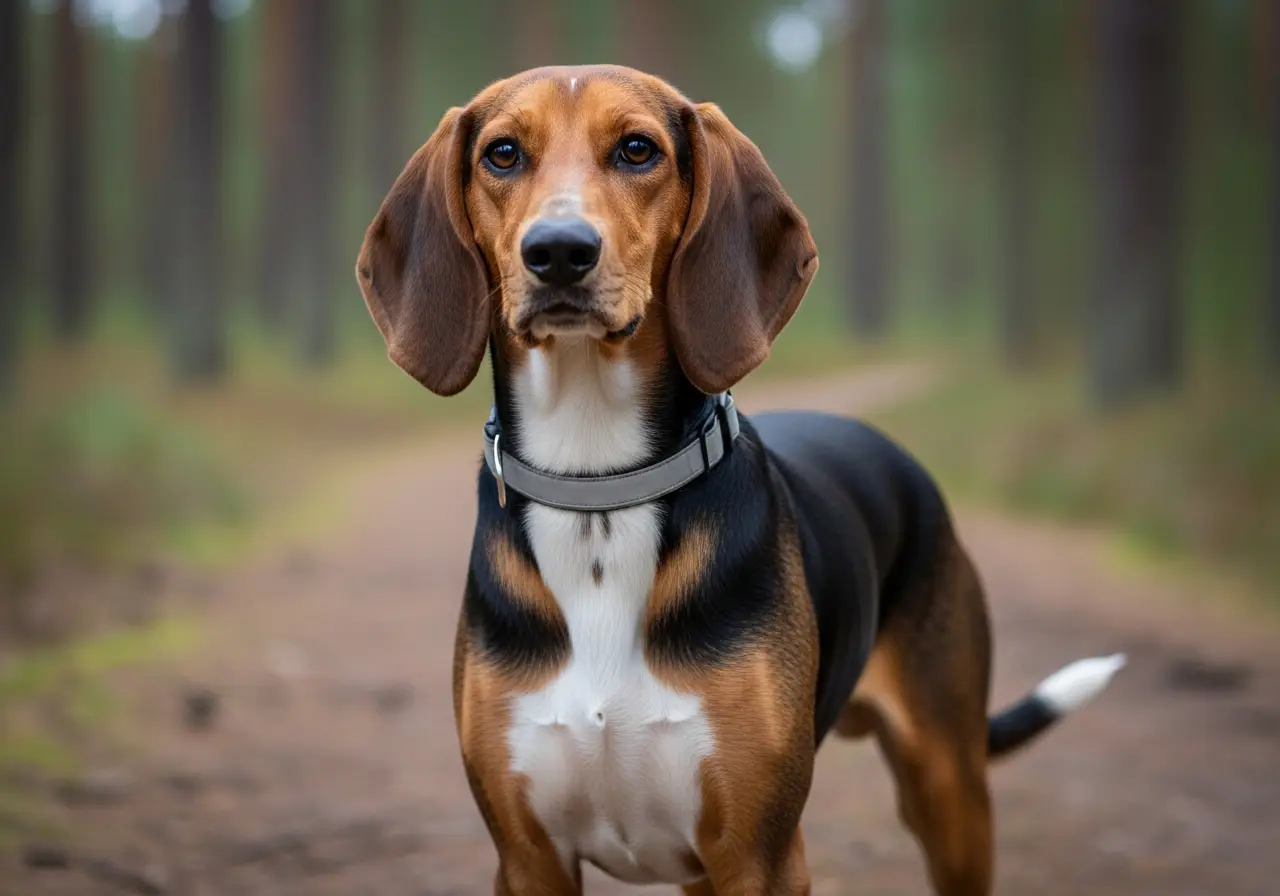
The Hamiltonstövare is Sweden’s most famous hound, tri-coloured, enduring and equipped with a genetically fixed desire to follow a scent trail. In the house it shows itself calm and sociable; outside it switches to hunting mode. Anyone keeping this breed without hunting or comparable stimulation significantly underestimates its innate traits. A realistic picture of the need for exercise and prey drive is absolutely necessary before getting a dog.
02Introduction
What makes the Hamiltonstövare (Swedish Hound) special
The Hamiltonstövare is Sweden’s most popular hound, FCI Group 6, tricolour and cold-resistant, withers height 49–61 cm.
03Profile
Key facts and suitability
- Origin
- Schweden
- Original purpose
- Hare hunting in Sweden
- FCI
- No. 132 · Group 6 · Section 1.2
- height at the withers
- 49–61 cm
- Weight
- 23–27 kg
- Life expectancy
- 10–13 Years
- Coat type
- Short-haired
- Minimum exercise
- 90 min/day
- Puppy price
- 800–1'400 CHF
- Waiting period
- 9 months
- Sports
- Hunting · Tracking · Mantrailing
04Temperament
How the Hamiltonstövare (Swedish Hound) shows up in everyday life
Upon returning home, the Hamiltonstövare greets its owner in a friendly and affectionate manner, without excessive excitement. In the house, it behaves calmly as long as its need for exercise is met. This calm behaviour at home easily leads to the mistaken assumption that the breed is undemanding.
Outside, the Hamiltonstövare switches to a fundamentally different behavioural programme. As soon as it picks up a scent trail, it works with high concentration, independently and with distinct vocalisation. Orientation towards the owner recedes into the background, with the sense of smell taking the lead. This is not disobedience, but genetically ingrained working behaviour.
This separation between internal need and external behaviour is central: The Hamiltonstövare’s need for social contact is moderate to high; it seeks contact with the family and gets along well with conspecifics. Towards strangers, it shows itself open and friendly (Friendliness towards strangers: 4 out of 5). However, this openness does not mean that it is easy to handle. Its mental workload and its need for exercise are significantly higher than its social appearance suggests.
A typical daily routine with a Hamiltonstövare looks like this: an extended exercise session with nose work or mantrailing in the morning, and another intensive session in the terrain in the evening. In between lies a calm dog, provided that the stimulation is appropriate. Anyone who cannot maintain this rhythm will end up with a dog that makes itself noticeable through vocalisation, restlessness or destructive behaviour. The Hamiltonstövare tolerates being left alone for a maximum of four hours if its basic needs are met.
05Needs
What this breed needs daily
The Hamiltonstövare requires at least 120 to 180 minutes of intensive exercise daily. Walks in the city neighbourhood do not meet this need. Suitable activities include extended runs in terrain, bikejoring on field paths, mantrailing, scent work or hunting-related forms of occupation such as trailing blood.
The mental workload is 4 out of 5; the Hamiltonstövare requires structured nose work as a fixed component of daily life. Pure physical exhaustion without mental stimulation is insufficient. Nose work, search games in terrain or scent trail training directly engage its genetic strengths and simultaneously promote bonding with the owner.
A secure outdoor enclosure is almost a prerequisite. The prey drive is strongly pronounced; an open field without fencing is not a suitable exercise area. Fenced dog meadows, forest areas with clear boundaries or hunting grounds used under supervision are sensible alternatives.
The need for social contact is moderate to high. The Hamiltonstövare benefits from contact with conspecifics, generally gets along well in multi-dog households and requires regular contact with its primary caregiver. Being left alone is realistically possible for a maximum of four hours, provided there is sufficient prior stimulation.
A rural or at least suburban environment with direct access to nature and terrain is not a recommendation, but a basic prerequisite for species-appropriate keeping of this breed.
Exercise
Very high
mental work
A lot
Social needs
Medium
training
Demanding
06Sport & Mental and Physical Stimulation
What sports the Hamiltonstövare (Swedish Hound) is suited for
Realistic in terms of physiology and genetics – not every breed suits every sport.
Structurally and physiologically suitable: Suitable for mantrailing, dummy work and tracking · CaniCross / bikejoring possible.
07Quick Check
08Suitability
Who this breed is suitable for – and who it isn't
✓Matches
The Hamiltonstövare suits owners who can plan two to three hours of active outdoor exercise daily, preferably in nature and terrain. A rural residence or direct access to extensive areas is necessary.
Hunting-active owners with access to hunting grounds and an interest in scent trail or blood trailing work will find a high-performance partner in the Hamiltonstövare that corresponds to its original task. Owners without a hunting licence who engage in mantrailing, nose work or terrain sports can also provide species-appropriate stimulation for the Hamiltonstövare if the time budget and environment are suitable.
Experience with independently working dogs or hunting-motivated breeds is important. Anyone who has already kept a hound, a scenthound or a pointing dog knows the behavioural profile and can realistically assess what lies ahead.
Families with children of school age are suitable if the need for exercise is consistently met by at least one adult owner. The Hamiltonstövare shows friendliness and patience towards children, provided it is sufficiently stimulated and socialised. Multi-dog households generally work well as the breed is sociable.
×Doesn't match
The Hamiltonstövare is not suitable for owners who are away from home for more than four hours a day and do not have a reliable dog care plan. The breed only tolerates being alone to a limited extent and develops stress-related behaviour when under-stimulated.
Those living in an apartment in the city without direct access to nature and terrain structurally underestimate the housing requirements of this breed. Two short walks in the city daily do not come close to meeting the need for exercise.
Owners who equate the friendliness of the Hamiltonstövare towards strangers with general obedience will be surprised in the field. The external openness towards people says nothing about recall reliability when encountering game; these two axes are fundamentally different.
Anyone looking for a dog that reliably runs off-lead and responds immediately to a call should not choose the Hamiltonstövare. The desire to follow a scent trail is genetically deeply ingrained and cannot be completely overwritten by training.
Households keeping a dog for the first time and without prior experience with hunting-motivated dogs will find this breed overwhelming. Training requires patience, consistency and a realistic understanding of hound behaviour – characteristics that presuppose experience.
10Line reality
Show line, working line, breeder market
In Sweden, the Hamiltonstövare is traditionally bred as a working dog, with working tests being an integral part of the FCI standard (Group 6, Section 1.2, with working test). A pronounced separation between working and show lines, such as that known for the German Shepherd Dog or the Labrador Retriever, does not exist in comparable form for the Hamiltonstövare.
In Sweden, the focus of breeding remains on hunting performance and scenting drive. The Swedish Kennel Club (SKK) conducts working tests that are relevant for breeding approval. Dogs bred exclusively for show performance are a minority within the total population.
In Germany, Austria and Switzerland, the breed is rare. The few breeding facilities largely orient themselves towards the Swedish standard and place value on working characteristics. An independent DACH show line has not developed.
Anyone acquiring a Hamiltonstövare from Swedish working lines obtains a dog with pronounced prey drive, high endurance and strong vocalisation on the trail. These characteristics are breeding goals, not exceptions. This must be factored into keeping plans from the outset.
11Health · Reality
What you need to plan for medically with your Hamiltonstövare (Swedish Hound)
The Hamiltonstövare is considered robust compared to many other breeds. According to the Swedish Kennel Club (SKK), life expectancy averages 12 to 14 years, an above-average span for medium-sized dogs.
Hip dysplasia (HD) occurs in the breed but is not as widespread as in heavy breeds. The SKK recommends an HD X-ray examination for breeding dogs before approval for breeding. Concrete population-wide HD rates for the Hamiltonstövare are not published in German-language specialist literature; parent dog findings should be actively requested from the breeder.
Ear infections are generally more common in drop-eared breeds. The Hamiltonstövare has soft, flat-hanging ears that restrict ventilation of the ear canal. Regular ear checks and cleaning are part of basic care.
Overweight is rarely a problem in sufficiently exercised Hamiltonstövares. In dogs with reduced activity, for example after injuries or in old age, calorie intake should be adjusted as the breed can tend to gain weight when inactive.
Preventive examinations include: annual general check-up, dental check, ear check after every field use and HD screening for breeding dogs. In cases of lameness, loss of performance or recurring ear problems, veterinary clarification should be initiated promptly. Foreign health insurance for hunting activities is recommended for actively working dogs.
12Structured data
Health by the numbers
Prone to diseases
Hip dysplasia, generally robust
Recommended health tests
Hip X-ray
13Myths ↔ Reality
What is often said incorrectly about this breed
Five myths, five realities, five sources.
The Hamiltonstövare is a calm family dog that is content with little exercise.
The Hamiltonstövare has been selected for endurance and scenting desire over generations. Its daily exercise need is at least 120 to 180 minutes of intensive activity. Calm behaviour in the house masks the actual stimulation need; without sufficient exercise and nose work, frustration and stress behaviours develop.
Because the Hamiltonstövare is friendly towards people, it is also suitable for inexperienced owners.
Friendliness towards strangers is an external behavioural axis and says nothing about the keeping requirements. The Hamiltonstövare has a strongly pronounced prey drive and high independence in the field. Without experience in handling hunting-motivated hounds, problems with recall, loose-leash walking and impulse control quickly arise.
The Hamiltonstövare can easily run off-lead because it is a social dog.
The scenting desire of the Hamiltonstövare is genetically hard-wired. As soon as it picks up a trail, it orients itself primarily by smell and not by recall signals from the owner. Off-lead running without secure terrain carries considerable risk. Even well-trained individuals show significantly reduced recall in contact with wildlife.
As a hunting dog, the Hamiltonstövare is aggressive and unsuitable for life with children.
The FCI standard explicitly describes the Hamiltonstövare as friendly and balanced in temperament. It is generally open and amicable towards people, including children. Its prey drive is directed at game, not at humans or conspecifics. Careful socialisation during the puppy phase and a structured daily routine are nevertheless prerequisites.
The Hamiltonstövare is a rare designer breed without an established breeding structure.
The Hamiltonstövare is a breed officially recognised since 1921 with FCI Standard No. 132. In Sweden, there is long-standing, structured breeding involving working tests. The breed has a clear breeding history dating back to the 19th century and is managed by the Swedish Kennel Club (SKK).
14animal welfare
The animal welfare perspective
Breeder market, designer versions, animal shelter reality — what no one writes in the puppy ad.
The Hamiltonstövare is a rare breed in Germany, Austria and Switzerland. Precisely this rarity makes it susceptible to wrong purchases: anyone acquiring it for aesthetic reasons or because of its calm house character without realistically planning for prey drive and exercise needs will quickly become overwhelmed.
Puppy farms and unreliable providers deliberately exploit the low market knowledge regarding rare breeds. Puppies from uncontrolled breeding are sold without working trial certificates for the parent dogs and without health screenings. Price alone is not a quality indicator; a cheap Hamiltonstövare puppy from abroad without papers is not a bargain but a risk for the animal and the owner.
A specific housing problem arises from the discrepancy between calm house behaviour and actual stimulation needs. Many owners underestimate what the breed requires outside. The result: dogs are surrendered because they become vocal, overcome fences or act destructively – all symptoms of under-stimulation, not character flaws.
Designer versions or crossbreeds with the Hamiltonstövare as a base exist in isolated cases, but are not established. The risk lies more in the mismarketing of purebred dogs as calm family dogs without any hunting context.
Acquisition through breed protection organisations or animal welfare associations is an equivalent option to buying a puppy. Rehomed Hamiltonstövares are often healthy, well-socialised dogs that have simply ended up in a household without sufficient stimulation. Anyone who knows the breed and meets the requirements will often find an adult dog with a known character through rehoming channels, while simultaneously helping an animal that deserves a second chance.
15Costs · Transparency
What this breed realistically costs
A Hamiltonstövare puppy from reputable breeding with VDH/ÖKV/SKG papers costs between 1,200 and 1,800 EUR in the DACH region. Offers significantly below this often come from uncontrolled breeding without health screening.
The annual living costs consist of: food (high-quality dry food or BARF for a medium-sized, active dog) approx. 600 to 900 EUR/year, basic care (ears, claws, coat) approx. 100 to 200 EUR/year, basic equipment in the first year (leash, collar, transport box, sleeping place) approx. 300 to 500 EUR one-off.
Average vet costs: annual preventive care including vaccinations approx. 150 to 250 EUR, deworming and parasite protection approx. 80 to 120 EUR/year. Injuries from hunting or field use can quickly lead to treatment costs of 500 to 1,500 EUR.
Dog health insurance costs between 40 and 90 EUR/month depending on the provider and scope of cover. For dogs actively used in the field, surgery cost insurance is recommended. The total annual costs realistically lie between 1,500 and 2,500 EUR, excluding extraordinary vet costs.
16Puppy search
What you need to consider when choosing a breeder
- A reputable breeder of Hamiltonstövares presents working trial certificates for the parent dogs and discloses HD findings for both parents.
- The puppies grow up in a stimulating environment and have demonstrably had contact with people and everyday situations.
- A breeder who evades questions about prey drive or exercise needs is not a reliable point of contact.
- Reputable breeders are usually listed via the Verband für das Deutsche Hundewesen (VDH) or the Österreichischer Kynologenverband (ÖKV).
- In Switzerland, the Schweizerische Kynologische Gesellschaft (SKG) is the responsible umbrella organisation.
- Breeders outside these structures are not automatically unreliable, but verifiability is lower.
- Warning signs: no personal conversation before purchase, no viewing of the mother dog, puppies under eight weeks old, missing vaccination and deworming documentation, shipping without accompaniment.
- Adoption via animal welfare organisations or breed protection groups is a fully valid alternative.
- Surrendered Hamiltonstövares are often adult dogs with known behaviour, which facilitates assessing whether the breed fits one’s own daily life.
- A trial period and an honest conversation with the adoption agency about prerequisites and expectations are taken for granted.
FAQ
Frequently asked questions about the Hamiltonstövare (Swedish Hound)
Is Hamiltonstövare (Swedish Hound) a family dog?
Hamiltonstövare (Swedish Hound) is considered suitable for families with good socialisation and species-appropriate care.
How much exercise does Hamiltonstövare (Swedish Hound) need?
At least around 90 minutes of exercise per day. As an active breed, more so — plus mental stimulation.
What is the size and weight of Hamiltonstövare (Swedish Hound)?
Fully grown, Hamiltonstövare (Swedish Hound) reaches about 49–61 cm at the withers and weighs around 23–27 kg.
What is the life expectancy of Hamiltonstövare (Swedish Hound)?
The life expectancy of Hamiltonstövare (Swedish Hound) is approximately 10–13 years.
Which diseases are common in Hamiltonstövare (Swedish Hound)?
Hip dysplasia, generally robust
17Breed clubs
Official breed clubs in DACH
19Related
Similar breeds – and their differences
You might also be interested in
Participate
Do you have a good photo of your Hamiltonstövare (Swedish Hound)?
We are looking for expressive images for our breed profiles. Submit yours; the editorial team reviews every submission before publication.
Does this breed suit you?
Most well-known Swedish hound. National hero in Sweden. Rare in D-A-CH.