
01Summary
In a paragraph
If you only have 30 seconds.
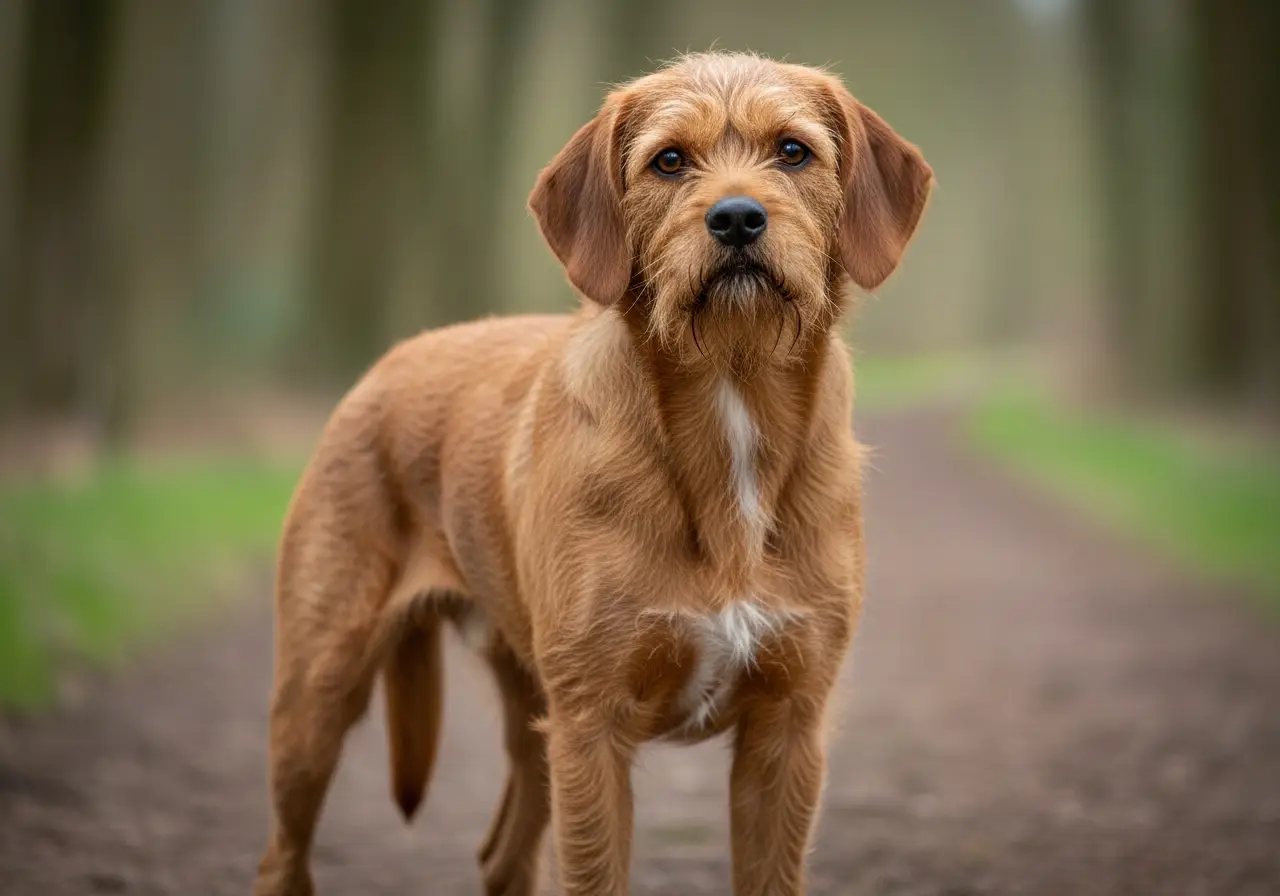
The Griffon Fauve de Bretagne is a rough-coated hound from Brittany, bred for pack hunting of wolves and large game. Its pronounced prey drive, independence in the field and daily need for stimulation make it a dog that requires consistent handling and hunting competence. Outside France it is rare; anyone who keeps it takes responsibility for a breed with a small gene pool.
02Introduction
What makes the Griffon Fauve de Bretagne special
The Griffon Fauve de Bretagne is a rough-coated French scent hound from Brittany, FCI Group 6, originally bred for wolf hunting, withers height 48–56 cm.
03Profile
Key facts and suitability
- Origin
- Frankreich
- Original purpose
- Scent hound for pack hunting, originally for wolf, today for wild boar, hare and fox
- FCI
- No. 66 · Group 6 · Section 1.2
- height at the withers
- 48–56 cm
- Weight
- 18–22 kg
- Life expectancy
- 12–14 Years
- Coat type
- Rauhaar
- Minimum exercise
- 90 min/day
- Puppy price
- 1'200–1'800 CHF
- Waiting period
- 18 months
- Sports
- Tracking · Mantrailing · Long line work · Hunting work
04Temperament
How the Griffon Fauve de Bretagne shows up in everyday life
Anyone who takes the lead in the morning experiences a dog that is immediately at operating temperature. The nose goes to the ground, the pace picks up, the Griffon Fauve de Bretagne switches outdoors into a work mode that does not end on command. This is not a reaction of disobedience, but the result of centuries of selection for independent decision-making in the field.
In daily household life, a different picture emerges. After sufficient mental and physical stimulation, the Griffon Fauve de Bretagne is calm, affectionate towards its key people and pleasant to handle. It seeks physical contact without being intrusive. Visitors are registered and generally received openly, but without exuberant greeting; the external axis (friendliness towards strangers) lies in the middle range, clearly below its internal need for social contact with its own family.
This distinction is crucial: A high need for social contact within the reference group does not mean that the dog reacts openly to every person or every dog. Anyone who confuses this underestimates its need for guidance in new situations.
It tolerates being left alone for up to about four hours, provided it has been sufficiently stimulated beforehand. Longer separation times without preparation and without an enrichment offer lead to vocalisations and restlessness. When living with other dogs, particularly with familiar conspecifics, it shows its pack background: it seeks company, coordinates itself and is significantly more balanced in the pack than when kept alone.
05Needs
What this breed needs daily
The Griffon Fauve de Bretagne requires at least 90 to 120 minutes of active exercise daily, not as a leisurely walk, but as a combination of physical stimulation and nose work. Mantrailing, tracking, scent work or controlled hunting guidance best match its genetic profile. Anyone who does not provide a hunting context must actively seek alternatives that generate the same mental effort.
The need for mental work is high. A dog that makes independent decisions in the field also needs tasks in everyday life that challenge it cognitively. Nose games, search tasks and structured training sessions with positive reinforcement are not optional extras, but part of basic care.
The prey drive requires permanent safety management. Off-leash exercise is only responsible in fully secured terrain or with a long line. A garden with a stable, escape-proof fence is not a luxury, but a basic prerequisite for safe keeping.
Being left alone should be built up gradually. Four hours are the realistic maximum for a well-exercised animal. Anyone who is regularly away from home for more than four hours needs a reliable care solution.
Training requires consistency and experience in dealing with high-drive dogs. Pressure and punishment methods lead to withdrawal or resistance, while positive reinforcement combined with clear structure shows more sustainable results. A supporting dog training school with experience in working with hounds or hunting dogs is recommended.
Exercise
High
mental work
A lot
Social needs
Medium
training
Demanding
06Sport & Mental and Physical Stimulation
What sports the Griffon Fauve de Bretagne is suited for
Realistic in terms of physiology and genetics – not every breed suits every sport.
Structurally and physiologically suitable: Suitable for mantrailing, dummy work and tracking · CaniCross / bikejoring possible.
07Quick Check
08Suitability
Who this breed is suitable for – and who it isn't
✓Matches
The Griffon Fauve de Bretagne suits owners with proven experience in dealing with high-drive or hunting-guided dogs. A rural or at least suburban environment with access to extensive terrain is a prerequisite, not a bonus.
Specific profiles where keeping the dog is realistic: Active hunters or owners with a hunting network who can enable tracking or scent work for the dog. Sportily active individuals or couples who can plan 90 to 120 minutes of structured activity time daily and bring experience with independently thinking dogs. Owners who have already handled a hound or hound-type dog and know safety management when off-leash.
Families with children from about ten years old are possible if both adults are actively involved in handling and exercise, and the dog is understood not as a child's playmate, but as a working dog with family bonding.
Multiple dogs in the household are no problem, provided the introduction is structured; the pack background facilitates living together with known conspecifics.
×Doesn't match
The Griffon Fauve de Bretagne does not suit owners who are keeping a dog for the first time and have no experience with high-drive or hunting-influenced breeds. The combination of high prey drive, independence and pronounced exercise needs overwhelms households without corresponding prior knowledge.
Anyone who is away from home for more than four hours daily and cannot organise a reliable care solution should not choose this breed. The need for social contact with the reference group is high; prolonged being left alone leads to stress behaviour.
Urban households without access to extensive, secured terrain are structurally unsuitable. A city park does not replace tracking work. Anyone who confuses the dog's high internal need for social contact with general openness towards strangers and therefore omits consistent handling in new situations underestimates the risk potential.
Owners who are guided by the rarity of the breed and assess the prey drive as a negligible characteristic will be confronted with a dog whose basic needs remain permanently unmet in family life without hunting-related stimulation.
09Character
Character and editorial background
The Griffon Fauve de Bretagne is a medium-sized, rough-haired French hound with fox-red coat and pronounced hunting motivation. Outside France it is rarely encountered; occasionally it is kept in the DACH region as a hunting or companion dog. Anyone who decides on this breed must take its working background seriously.
Origin and History
The Griffon Fauve de Bretagne originates from Brittany and is one of the oldest scent hound breeds in France. Originally bred for wolf hunting, it worked in packs that also pursued large game. With the decline of wolves in the 19th century, the breed was on the verge of extinction. Targeted breeding efforts from the 1940s onwards stabilised the population. Today, it is primarily used for hunting small game such as wild boar, hare and fox. The FCI lists it under number 66 in Group 6, Section 1.2 (medium-sized scent hounds). Outside France, the breed remains numerically insignificant.
Appearance
The Griffon Fauve de Bretagne reaches a withers height of 48 to 56 cm and weighs between 18 and 22 kg. The coat is rough, hard and of medium length, with colours ranging from wheaten to deep red-fauve. The build is compact and muscular, the back straight, and the tail of medium length carried in a sabre shape. The ears are set at a medium height and reach just to the nose leather. The facial expression appears alert and friendly.
Nature and Character
Brave, enduring and independent – this is how the Griffon Fauve de Bretagne can be briefly described. In a working context, it shows toughness towards game and high pack loyalty; in everyday life, it is balanced and affectionate towards its reference persons. It behaves openly towards strangers without being intrusive. Due to its pack background, it is usually tolerant of other dogs. The prey drive is strongly pronounced and cannot be trained away. In the field, it makes independent decisions; this trait remains noticeable in family life.
Keeping and Training
The daily exercise requirement is at least 90 to 120 minutes, combined with nose work. Simply walking on a short lead does not meet its needs. Off-lead running is only responsible in secure terrain or with a long line. Keeping it in an apartment is possible if the dog receives sufficient stimulation; a house with land better suits its needs. In training, it requires consistent guidance from an experienced handler. Positive reinforcement works better than pressure. The breed is not suitable for first-time dog owners without hunting experience.
Care
The rough coat requires brushing approximately once a week. The topcoat should be trimmed once or twice a year to maintain the coat structure. Due to their drop shape, the ears must be checked regularly to prevent inflammation. Claws, teeth and paws should be checked routinely, as with any working dog.
Health
The life expectancy is 12 to 14 years. The breed is considered robust, but due to the small gene pool, hip dysplasia and ear infections can occur. Eye diseases and epilepsy are documented in isolated cases. As the population is small, reliable breeding data on hereditary diseases remain limited.
Suitable for whom?
The Griffon Fauve de Bretagne is suitable for owners guided by hunting or very active people with experience in keeping high-drive scent hounds. The ideal combination is a rural environment and consistent stimulation. It is not suitable for urban households, beginners or families without a connection to nose work and prey drive management.
10Line reality
Show line, working line, breeder market
The Griffon Fauve de Bretagne is bred and worked predominantly as an active hunting dog in France. A clear separation between working and show lines, as exists for example with the German Shepherd Dog or the Labrador Retriever, is less pronounced in this breed; the population is too small for strong line differentiation.
Nevertheless, differences exist within breeding: dogs from active hunting operations in Brittany and western France generally show a stronger work drive, higher scent intensity and more pronounced independence in the field. Dogs that have been kept as companion dogs without hunting guidance over several generations may vary in these traits, however reliable line data are largely lacking due to the small population.
In the DACH region, the data situation is sparse. Most puppies offered in Germany, Austria or Switzerland come from French breeding with a hunting background. Anyone buying a puppy from the DACH region should actively enquire about the origin of the parent animals and their use in hunting. Imports from private holdings without pedigree entry are not an indicator of line quality, but a risk factor for unknown health and temperament profiles.
11Health · Reality
What you need to plan for medically with your Griffon Fauve de Bretagne
The life expectancy of the Griffon Fauve de Bretagne is 12 to 14 years according to breed standards and breeder information, a value typical for medium-sized hound breeds, but based on limited data due to the small population.
Hip dysplasia (HD) is documented in the breed. Reliable breed statistics with percentage HD rates are not widely available due to the low breeding volume outside France. Reputable breeders have parent dogs radiologically examined for HD and provide proof of the results; this proof should be actively requested when purchasing a puppy.
Ear inflammation poses an increased risk due to the anatomy of drop ears. Regular ear checks, at least weekly, and consistent cleaning after water contact or field use demonstrably reduce the risk of inflammation. Veterinary studies on otitis externa in drop-eared breeds document a significantly higher incidence compared to prick-eared breeds (Zur et al., Veterinary Dermatology, 2011).
Eye diseases and epilepsy are occasionally documented in the breed context. Due to the small gene pool, there is a structurally increased risk of recessive hereditary diseases. Preventive examinations by an ophthalmologist and a basic neurological examination are advisable if there is a notable family history.
Overweight is rare in sufficiently exercised working dogs of this breed, but can occur with insufficient stimulation and calorically too rich food. Body weight should be checked regularly; a palpable, not visible ribcage serves as a guideline.
12Structured data
Health by the numbers
Prone to diseases
Hip dysplasia, ear infections, eye diseases, occasionally epilepsy
Recommended health tests
Hip X-ray, eye examination
13Myths ↔ Reality
What is often said incorrectly about this breed
Five myths, five realities, five sources.
The Griffon Fauve de Bretagne is an uncomplicated family dog that is content with some walking.
The Griffon Fauve de Bretagne was selected over centuries for endurance pack hunting. Its need for exercise is at least 90 to 120 minutes daily, combined with active nose work. Purely walking on a lead does not cover this need in the slightest. Insufficient mental and physical stimulation manifests itself in destructive behaviour and excessive vocalisation.
The pronounced prey drive can be completely eliminated through consistent training.
The prey drive of the Griffon Fauve de Bretagne is genetically deeply ingrained and cannot be trained away. It can be channelled through early socialisation and hunting guidance, but it remains a permanent part of its behavioural repertoire. Off-lead exercise without secured terrain or a long line is permanently associated with a considerable safety risk.
Because the breed is rare, reputable puppies automatically come from good breeding.
Rarity does not protect against poor breeding. Particularly with small gene pools, there is an increased risk of inbreeding and associated hereditary diseases. Reputable breeders provide proof of health tests and are members of a recognised breeding association. Private offers without pedigree entry and without health certificates are not a quality feature, but a warning sign.
Due to its pack background, the Griffon Fauve de Bretagne gets along easily with all dogs.
A pack background means that the breed tolerates and is accustomed to living with familiar conspecifics. This does not automatically include compatibility with unfamiliar dogs in uncontrolled encounters. The reaction to unknown dogs depends heavily on socialisation, line affiliation and individual imprinting.
As a robust working breed, the Griffon Fauve de Bretagne requires little veterinary preventive care.
Robustness in a working context does not mean immunity to hereditary diseases. In the Griffon Fauve de Bretagne, hip dysplasia, ear infections due to drop ears, and occasionally eye diseases and epilepsy are documented. Regular preventive examinations, particularly ear checks and X-ray diagnostics, are medically necessary even for this breed.
14animal welfare
The animal welfare perspective
Breeder market, designer versions, animal shelter reality — what no one writes in the puppy ad.
The Griffon Fauve de Bretagne is one of the rarest scenthound breeds in the DACH region outside France. This rarity creates a specific animal welfare context that differs from common moderate breeds.
The backyard breeder market for rare breeds functions differently than for trend breeds: uncontrolled imports from France and Eastern Europe, rather than overproduction, are the main problem. Puppies offered via classifieds portals without pedigree registration, without health certificates of the parent dogs, and without personal contact with the breeder often come from operations that do not know temperament tests, HD X-rays, or litter assessments by breeding associations. The low awareness of the breed does not protect buyers; it complicates quality checks because comparative values are missing.
Misplacements of the Griffon Fauve de Bretagne occur almost exclusively due to underestimation of the prey drive. Owners looking for an affectionate, robust companion dog and viewing the working background as a historical footnote will be confronted with an animal that is permanently understimulated in daily family life without hunting-related activity. The result: vocalisations, escape attempts, destruction, and finally surrender. Animal welfare organisations in France regularly report surrendered scenthounds originating from exactly this pattern.
Adopting an adult Griffon Fauve de Bretagne from animal welfare or a breed rescue organisation is an equivalent option to buying a puppy. Adult dogs already show their character; drive strength, social behaviour, and daily behaviour are assessable. Breed-knowledgeable fosterers, particularly in France, can specifically match suitable dogs for experienced owners. This option deserves the same serious consideration as searching for a puppy.
15Costs · Transparency
What this breed realistically costs
A puppy from a reputable breeder affiliated with a breeding association costs between 1,200 and 1,800 EUR in the DACH region, sometimes slightly less in France. Offers significantly below 800 EUR without pedigree registration and without health certificates of the parent dogs are a warning signal, not a bargain.
The annual living costs for a Griffon Fauve de Bretagne realistically lie between 1,800 and 2,800 EUR. Included are: high-quality food for an active medium-sized dog (approx. 600–900 EUR/year), annual core vaccinations and parasite prevention (approx. 200–350 EUR), grooming including one to two trims per year (approx. 100–200 EUR), as well as accessories and consumables.
Veterinary costs vary greatly. An HD X-ray examination costs between 150 and 300 EUR depending on the practice. Ear treatments for chronic otitis externa can cost 80 to 200 EUR per treatment cycle. Pet insurance with solid coverage is 40 to 80 EUR monthly for this weight class, a sensible safeguard given the small gene pool and the associated uncertainty regarding hereditary diseases.
Hunting-related stimulation through external providers (mantrailing, blood tracking) costs an additional 15 to 40 EUR per session.
16Puppy search
What you need to consider when choosing a breeder
- Reputable breeders of the Griffon Fauve de Bretagne are organised in France with the Club du Griffon Fauve de Bretagne, and in the DACH region via the VDH or ÖKV.
- A pedigree entry, HD X-ray results for both parent animals and a personal on-site viewing of the litter are minimum standards; no reputable breeder refuses this transparency.
- Waiting times of six to twelve months are normal for this rare breed.
- Anyone who can buy a puppy immediately should check the origin particularly critically.
- Offers on general classifieds portals without club membership and without documentation deserve increased scepticism.
- The rehoming of an adult dog via animal welfare organisations in France or through breed-knowledgeable mediators is an equivalent alternative.
- Adult dogs already show drive strength and temperament, which significantly reduces the risk of mismatched placement.
- Breed rescue networks in France are accessible via the Club du Griffon Fauve de Bretagne.
- No named recommendations for individual breeders are made on this platform; the entry database at rundum.dog offers verified contacts.
FAQ
Frequently asked questions about the Griffon Fauve de Bretagne
Is Griffon Fauve de Bretagne suitable for beginners?
Griffon Fauve de Bretagne is only suitable for first-time dog owners to a limited extent and is better suited to people with dog experience.
Is Griffon Fauve de Bretagne a family dog?
Griffon Fauve de Bretagne is only recommended as a family dog to a limited extent and is better suited to a household without small children.
How much exercise does Griffon Fauve de Bretagne need?
At least around 90 minutes of exercise per day. As an active breed, more so — plus mental stimulation.
Does Griffon Fauve de Bretagne suit an apartment?
Griffon Fauve de Bretagne needs more space and plenty of exercise and feels less comfortable in an apartment.
What is the size and weight of Griffon Fauve de Bretagne?
Fully grown, Griffon Fauve de Bretagne reaches about 48–56 cm at the withers and weighs around 18–22 kg.
What is the life expectancy of Griffon Fauve de Bretagne?
The life expectancy of Griffon Fauve de Bretagne is approximately 12–14 years.
Which diseases are common in Griffon Fauve de Bretagne?
Hip dysplasia, ear infections, eye diseases, occasionally epilepsy
17Breed clubs
Official breed clubs in DACH
19Related
Similar breeds – and their differences
You might also be interested in
Participate
Do you have a good photo of your Griffon Fauve de Bretagne?
We are looking for expressive images for our breed profiles. Submit yours; the editorial team reviews every submission before publication.
Does this breed suit you?
High-drive French scent hound for hunting-guided or very experienced owners with a focus on nose work. Rare outside France, few breeding facilities in the DACH region, long waiting times usual.