
01Summary
In a paragraph
If you only have 30 seconds.
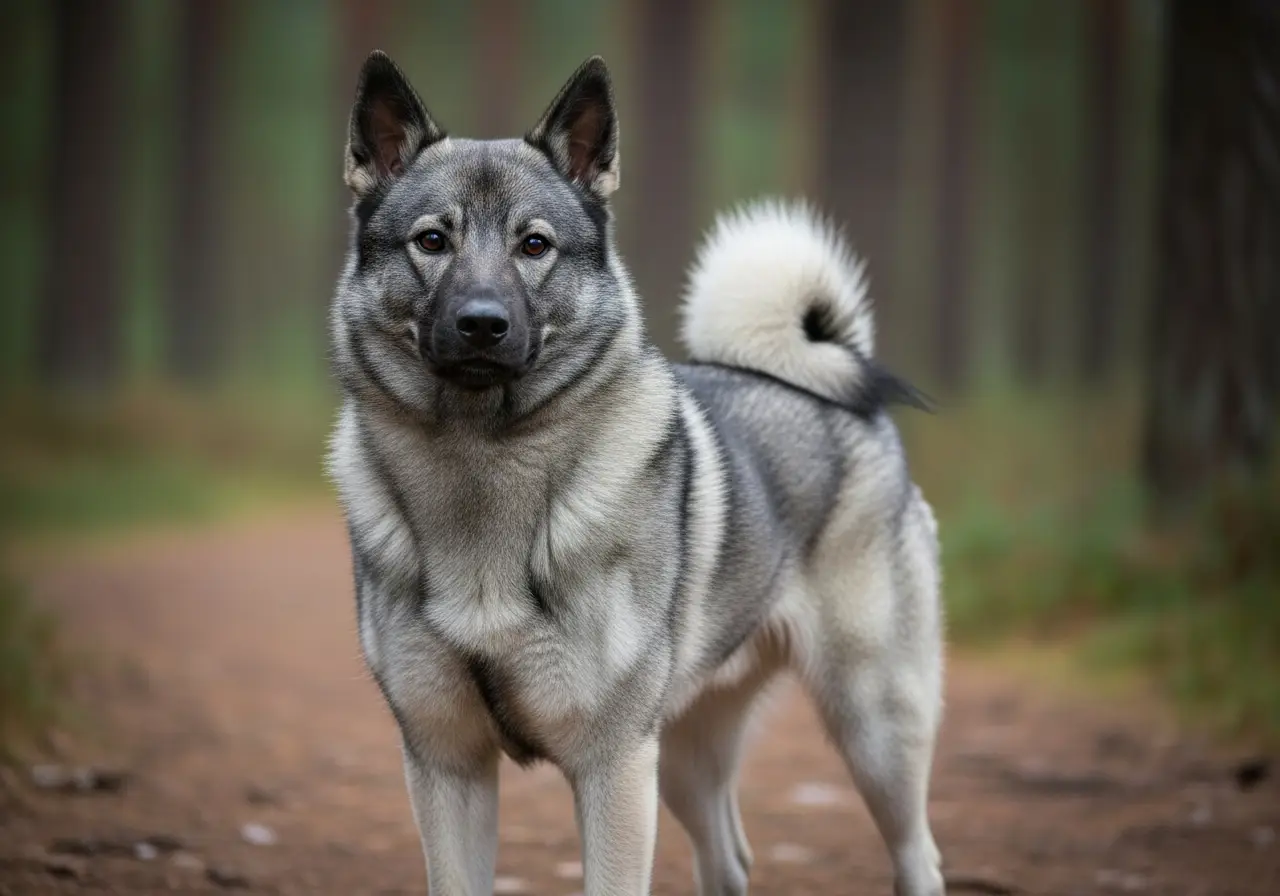
The Norwegian Elkhound (grey) is not a companion dog with Nordic charm; it is a functional hunting spitz bred for independent moose hunting. Its prey drive, barking behaviour and independence are not character flaws, but genetically anchored traits. Anyone who keeps this breed takes responsibility for a dog with clear demands on exercise, tasks and guidance.
02Introduction
What makes the Norwegian Elkhound (grey) special
Norwegian Elkhound grey (Grå Norsk Elghund): traditional hunting spitz from Norway, enduring and weather-resistant with high self-motivation
03Profile
Key facts and suitability
- Origin
- Norwegen
- Original purpose
- Elk hunting
- FCI
- No. 242 · Group 5 · Sektion 2: Nordische Jagdhunde
- height at the withers
- 49–52 cm
- Weight
- 20–23 kg
- Life expectancy
- 12–15 Years
- Coat type
- Doppel
- Minimum exercise
- 90 min/day
- Puppy price
- 1'200–2'000 CHF
- Waiting period
- 5 months
- Sports
- Scent work Mantrailing
04Temperament
How the Norwegian Elkhound (grey) shows up in everyday life
On the morning run in the forest, what makes the Norwegian Elkhound (grey) special becomes apparent: it does not simply run alongside you; it scans the terrain, picks up scents, decides for itself which trail is interesting. This independence is not a training error, but the result of centuries of targeted selection for independent hunting work.
Internally (i.e. in what the dog needs from within), it shows a high need for mental work (value 4 out of 5) and an equally high need for movement. It does not just want to be physically stimulated, but also mentally challenged. Nose work, tracking or structured search tasks correspond much more to its nature than fetching exercises on the sports field.
Externally, i.e. in its reaction to its environment, it behaves differently than many expect: it meets strangers with reserve to watchfulness (value 2 out of 5). Anyone looking for an open greeting dog that joyfully welcomes every visitor encounters a different reality here. The grey elkhound bonds closely with its family but keeps its distance from unknown people. These two poles (strong family bond on the one hand, reserve towards strangers on the other) must not be confused.
At home it is calm if its needs are met. It observes, reports changes in the territory with a clear voice and seeks proximity to its reference persons. It can stay alone for a maximum of four hours without problems, provided it has a defined territory and has received sufficient stimulation. Its barking behaviour is present in everyday life: doorbell, passers-by, unknown noises, the elkhound reports.
05Needs
What this breed needs daily
The Norwegian Elkhound (grey) needs at least 90 to 120 minutes of active movement daily, not as a relaxed walk, but as real physical and mental stimulation. Pure city rounds without stimulus and task are not enough.
Forms of movement with substance:
- Terrain runs in areas rich in wildlife (with secured off-leash running or on a long line)
- Tracking work and nose work as a hunting substitute
- Mantrailing or structured search tasks
- Bikejoring or canicross for physical stimulation
The need for mental stimulation is high. An elkhound that is physically tired but mentally under-stimulated will develop strategies for self-entertainment, mostly ones that owners do not like. Daily tasks with real meaning for the dog are not an option, but a basic requirement.
The need for social contact is directed towards its own family. The dog needs clear key persons, a reliable daily structure and a defined territory. A secure garden corresponds to its nature; keeping it in an apartment without alternative options is unsuitable in the long term.
It can be left alone for up to four hours without signs of stress, provided it is sufficiently occupied and knows its territory. Longer absences require a care solution.
The barking behaviour is typical of the breed and cannot be completely suppressed. Owners in multi-storey buildings or densely populated areas must plan for this aspect realistically. A dog training school with experience in Nordic hunting dogs supports the establishment of clear communication structures, but does not replace daily consistency in everyday life.
Exercise
High
mental work
A lot
Social needs
Medium
training
Demanding
06Sport & Mental and Physical Stimulation
What sports the Norwegian Elkhound (grey) is suited for
Realistic in terms of physiology and genetics – not every breed suits every sport.
Structurally and physiologically suitable: Suitable for mantrailing, dummy work and tracking · CaniCross / bikejoring possible.
07Quick Check
08Suitability
Who this breed is suitable for – and who it isn't
✓Matches
The Norwegian Elkhound (grey) suits owners who meet the following conditions:
Experience: At least one dog with a pronounced prey drive or of Nordic breed has already been kept successfully. First-time owners without prior experience with independently working dogs are overwhelmed by this breed.
Time budget: 90 to 120 minutes of active exercise plus structured tasks daily can be realistically planned, not as an exception, but as part of everyday life.
Living situation: A house with a secure garden in a rural or semi-rural environment corresponds to the dog's nature. Areas rich in wildlife for field runs are accessible.
Social environment: Visitors and strangers in the household are rare, or the dog receives sufficient time to get used to them. Those who have frequently changing guests must actively manage the dog's reserved nature.
Children: Children from about 10 years of age, who handle dogs calmly and respectfully, are compatible with this breed, provided that clear rules apply to all family members.
Motivation: Hunting work, tracking work, nose work or comparable enrichment is actively offered. Anyone who keeps the dog as a running companion without further tasks underestimates its need for mental stimulation.
×Doesn't match
The Norwegian Elkhound (grey) does not suit owners in the following situations:
Lack of time: Anyone who is regularly away from home for more than four hours a day and has no reliable care solution cannot meet the need for social contact and the exercise requirements of this breed.
Urban keeping: Keeping in an apartment in the city without a garden, without access to open land and in multi-storey buildings with noise-sensitive neighbours is hardly compatible with the breed-typical barking behaviour.
First-time owners without support: Anyone who has never kept a dog with a pronounced prey drive and does not plan professional support from an experienced dog training school systematically underestimates the demands of this breed.
Confusion of axes: Anyone who equates the dog's high need for social contact with its own family with general openness towards strangers will experience surprises in everyday life. The reserved reaction to strangers is not an upbringing problem; it is a breed characteristic.
Households needing quiet: Anyone who needs a quiet home or lives in an environment where barking is not tolerated should choose another breed. The alerting behaviour of the elkhound can be reduced, but not switched off.
10Line reality
Show line, working line, breeder market
The Norwegian Elkhound (grey) shows a clear differentiation between working and show lines, which is often underestimated in the DACH region.
Working lines (Scandinavia): In Norway, Sweden and Finland, the breed is actively used for elk hunting. Dogs from working lines show a more pronounced prey drive, greater initiative and more intense barking behaviour. The FCI requires a working test for Nordic countries, a selection criterion that does not apply in Central Europe. Anyone importing a puppy from Scandinavian working breeding receives a dog with a higher demand profile.
Show lines (DACH/Western Europe): In the German-speaking area, lines are dominant that are bred for exterior and temperament balance. The prey drive remains present but is tendentially less intensely pronounced than in pure working lines. The barking behaviour remains typical of the breed.
Practical consequence: Anyone buying a puppy from the DACH region should specifically ask the breeder about the origin of the parent dogs, especially whether Scandinavian working lines have been crossed in. This noticeably affects everyday life. Transparent breeding documentation is not a luxury here, but a serious minimum criterion.
11Health · Reality
What you need to plan for medically with your Norwegian Elkhound (grey)
The Norwegian Elkhound (grey) is considered a robust breed with a life expectancy of 12 to 15 years, an above-average range for medium-sized dogs, which is favoured by traditional working breeding in Scandinavia.
Hip dysplasia (HD): HD occurs in the population, but is rare with consistent breeding selection. Reputable breeders X-ray both parent animals before using them for breeding. Anyone who acquires a puppy without HD documentation of the parents bears an increased risk of costly follow-up diseases. Concrete population data for the DACH region are not available in statistically reliable form due to the low number of dogs.
Eye diseases: Hereditary eye diseases (including progressive retinal atrophy, PRA) are documented in Nordic hunting dog lines. Eye examinations of the parent animals by a veterinary specialist in ophthalmology are a serious breeding criterion.
Weight and condition: The breed tends to become overweight when there is a lack of exercise. An adult dog with regular stimulation maintains its weight; if activity is reduced (e.g., after injuries), the amount of food should be adjusted.
Preventive recommendations: Annual veterinary check-up, check dental status (the breed is prone to tartar formation), intensify grooming during moulting (twice a year). In the event of lameness, changes in vision or persistent reduction in performance, a veterinary investigation should be initiated promptly.
Grooming: The dense double coat requires daily brushing during moulting; outside these phases, weekly care is sufficient.
12Structured data
Health by the numbers
Prone to diseases
Hip dysplasia Eye problems Thyroid problems
Recommended health tests
Hip X-ray Eye examination Thyroid test
13Myths ↔ Reality
What is often said incorrectly about this breed
Five myths, five realities, five sources.
“The Norwegian Elkhound is a calm northerner who is content with little exercise.
The grey elkhound was bred for endurance hunting in the terrain. Its daily need for movement is at least 90 to 120 minutes of active exercise; mere walks without mental stimulation are not enough. An under-stimulated elkhound develops behavioural problems such as excessive barking or destructive behaviour.
“Its friendly appearance makes it an uncomplicated family dog for everyone.
The Norwegian Elkhound (grey) shows a pronounced reserved to watchful attitude towards strangers. Its need for social contact is primarily directed at its own family; openness towards unknown people is not typical of the breed. Without consistent socialisation and experienced handling, this behaviour can become a burden in everyday life.
“The prey drive can be completely eliminated through good training.
The prey drive of the Norwegian Elkhound is genetically deeply rooted and cannot be eliminated by training alone. A reliable recall in areas rich in wildlife requires years of consistent work and remains situation-dependent. Off-leash running without a secure environment is a calculable risk for this breed that owners must consciously plan for.
“Nordic dogs are silent and do not bark.
The opposite is true for the Norwegian Elkhound (grey). Barking at game is its original core task; a clear, enduring voice was a selection criterion in breeding. In urban environments or multi-family houses, this alerting behaviour regularly leads to conflicts with neighbours.
“As a robust working breed, the elkhound is completely healthy and does not require preventive examinations.
Even though the Norwegian Elkhound (grey) counts among the robust breeds, hip dysplasia (HD) and hereditary eye diseases occur in the population. Reputable breeders have parent dogs tested for HD and eye health. Anyone who dispenses with corresponding certificates increases the risk of costly follow-up diseases.
14animal welfare
The animal welfare perspective
Breeder market, designer versions, animal shelter reality — what no one writes in the puppy ad.
The Norwegian Elkhound (grey) is a rare breed with a small number of breeders in the DACH region. This rarity does not automatically protect it from problematic living conditions; it merely shifts the risks.
Backyard breeder market: Because demand exceeds supply, offers occasionally appear that cannot prove membership of VDH, SKG or ÖHZB associations. Puppies without pedigrees, without health certificates for the parent animals and with very short waiting times are warning signs. The price difference between a backyard breeder puppy and an association puppy is often less than expected, but follow-up costs for hereditary diseases can be considerable.
Underestimated prey drive as a reason for surrender: The most common reasons for surrendering the Norwegian Elkhound (grey) are an underestimated prey drive and barking behaviour in urban areas. Owners who expect a "Nordic family dog" will encounter an independently working hunting spitz with clear requirements. This discrepancy between expectation and reality is avoidable through honest information before purchase.
Keeping-related problems: Lack of exercise and insufficient mental stimulation lead to behavioural problems in the Elkhound: excessive barking, attempts to escape, destructive behaviour. These symptoms are not character flaws, but reactions to unmet basic needs. Keeping the dog in a city apartment without access to outdoor space does not meet the requirements of this breed.
Adoption as an equally valid option: Adult Elkhounds from breed rescue organisations or Nordic dog clubs come with a known temperament and assessable behaviour. Anyone who takes in a dog from rescue often gets an already socialised dog, while at the same time relieving the capacity of rescue organisations. The DCNH and SKNH can help with finding dogs available for adoption.
15Costs · Transparency
What this breed realistically costs
Getting a dog: A puppy from reputable association breeding (VDH/SKG) costs between 1,200 and 1,800 EUR in the DACH region. Offers significantly below this often come from backyard breeding without health certificates. Imported puppies from Scandinavia can become more expensive due to transport and customs costs.
Running costs per year (guideline values):
- Food (quality dry food or BARF for approx. 22 kg dog): 600–900 EUR/year
- Vet basic care (vaccinations, parasite prevention, annual check-up): 300–500 EUR/year
- Grooming (brushing, occasional trim appointment): 50–150 EUR/year
- Dog training school/training: 300–600 EUR/year (especially recommended in the first two years)
Vet special costs: HD treatment (conservative to surgical) can cost 1,500–5,000 EUR. Eye diseases such as PRA are not curable, but require regular check-ups.
Insurance: A dog health insurance costs approx. 40–80 EUR/month for this size class (depending on provider and scope of benefits). Dog liability insurance is mandatory in most federal states and costs 50–100 EUR/year.
Total costs/year (realistic): 1,500–2,500 EUR ongoing, excluding extraordinary vet costs.
16Puppy search
What you need to consider when choosing a breeder
- Reputable breeders of the Norwegian Elkhound (grey) are rare in the DACH region.
- The German Club for Nordic Dogs e.V.
- (DCNH) and the Swiss Club for Nordic Dogs (SKNH) maintain breeder lists with breeding facilities affiliated with the VDH or SKG respectively.
- This membership is an initial quality indicator, not a guarantee, but a minimum criterion.
- The following points characterise reputable breeding: The parent animals have been examined for hip dysplasia (HD) and eye health, and the results are available in writing.
- The breeder asks questions about the living conditions and refuses a sale if the conditions do not match.
- Puppies leave the breeding facility no earlier than eight weeks of age.
- A personal visit to the breeding facility is possible and desirable.
- Warning signs: Puppies without pedigree, sale via animal markets without possibility of inspection, multiple litters available simultaneously, no interest in the buyer's living situation.
- **Adoption as an equally valid option:** Since the Norwegian Elkhound (grey) is rarely found in German and Austrian animal shelters, it is worth searching through breed rescue organisations and Nordic dog associations.
- Adult dogs from adoption come with a known temperament, an advantage over the puppy, whose character still has to develop.
FAQ
Frequently asked questions about the Norwegian Elkhound (grey)
Is Norwegian Elkhound (grey) a family dog?
Norwegian Elkhound (grey) is considered suitable for families with good socialisation and species-appropriate care.
How much exercise does Norwegian Elkhound (grey) need?
At least around 90 minutes of exercise per day. As an active breed, more so — plus mental stimulation.
What is the size and weight of Norwegian Elkhound (grey)?
Fully grown, Norwegian Elkhound (grey) reaches about 49–52 cm at the withers and weighs around 20–23 kg.
What is the life expectancy of Norwegian Elkhound (grey)?
The life expectancy of Norwegian Elkhound (grey) is approximately 12–15 years.
Which diseases are common in Norwegian Elkhound (grey)?
Hip dysplasia Eye problems Thyroid problems
17Breed clubs
Official breed clubs in DACH
19Related
Similar breeds – and their differences
You might also be interested in
Participate
Do you have a good photo of your Norwegian Elkhound (grey)?
We are looking for expressive images for our breed profiles. Submit yours; the editorial team reviews every submission before publication.
Does this breed suit you?
Strong prey drive – off-leash only in secure areas Bonding to hunting work or nose work recommended