
01Summary
In a paragraph
If you only have 30 seconds.
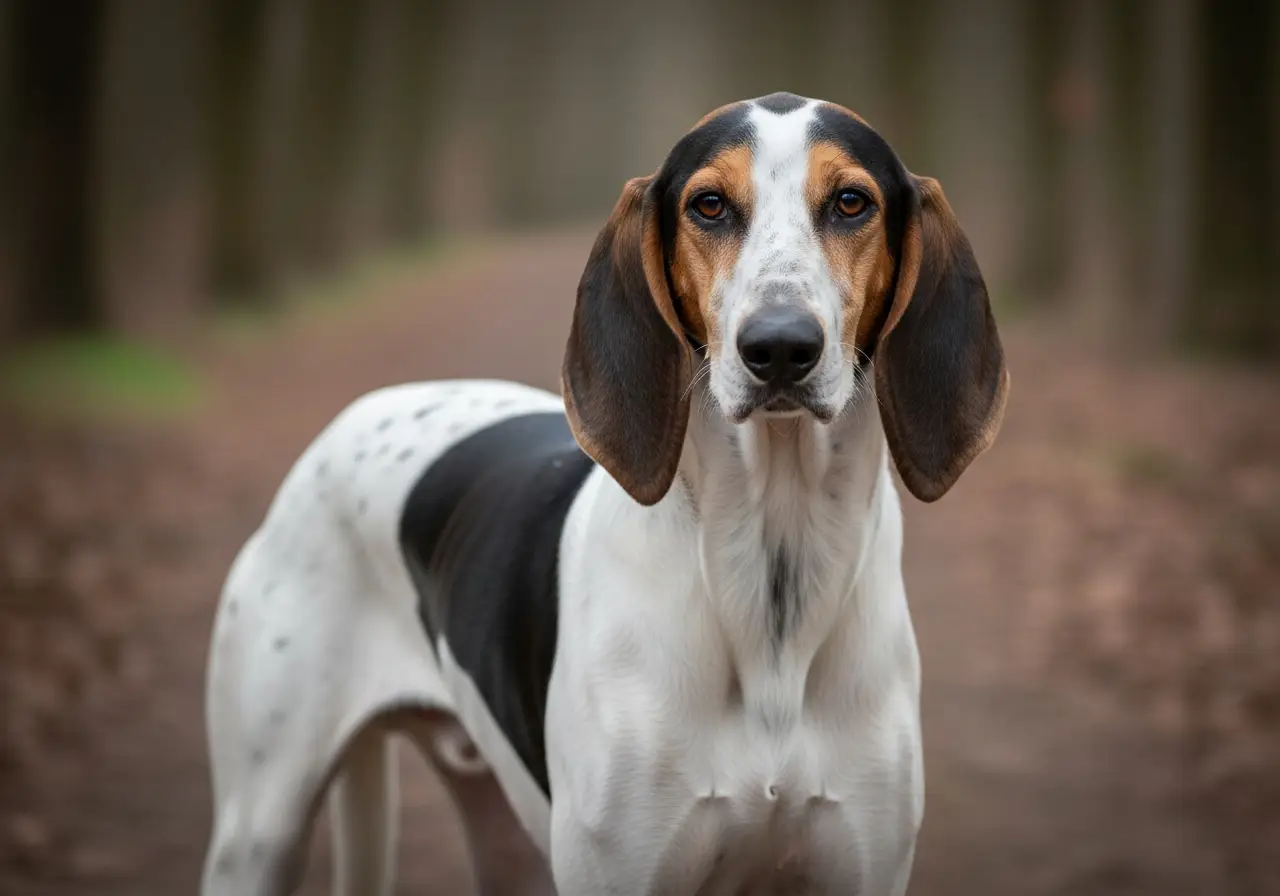
The Gascon Saintongeois is a rare, large French scent hound with centuries-old hunting traditions. Its exercise requirement is at least two hours daily, and its prey drive is deeply rooted genetically. Those who keep it as a companion dog without a hunting concept fundamentally underestimate this breed. Experience with scent-oriented dogs, a rural environment and consistent free-running management are not recommendations; they are prerequisites.
02Introduction
What makes the Gascon Saintongeois special
The Gascon Saintongeois is a rare large French scent hound, FCI Group 6, with a low melodious voice and a withers height of 60–72 cm.
03Profile
Key facts and suitability
- Origin
- Frankreich
- Original purpose
- Hunting roe deer and wild boar in Saintonge
- FCI
- No. 21 · Group 6 · Section 1.1
- height at the withers
- 60–72 cm
- Weight
- 30–40 kg
- Life expectancy
- 11–13 Years
- Coat type
- Short-haired
- Minimum exercise
- 120 min/day
- Puppy price
- 800–1'400 CHF
- Waiting period
- 12 months
- Sports
- Hunting · Tracking · Mantrailing
04Temperament
How the Gascon Saintongeois shows up in everyday life
Anyone who opens the front door in the morning with a Gascon Saintongeois immediately experiences what drives this breed: The nose goes to the ground, the dog starts to weave, and the surroundings recede into the background. This moment illustrates the core of its nature; it is primarily a scent hunter that explores the world through scent trails.
In the house, it shows itself calm and affectionate. The FCI standard describes it as a dog that submits easily and has a gentle, trusting expression. Visitors are generally greeted friendly; the external axis (friendliness towards strangers) is pronouncedly positive in this breed. This distinguishes it from many other hunting dog breeds with a guarding instinct.
The internal axis looks different: The need for social contact is high, the need for exercise is extreme, and the need for mental work is also at a level that demands daily enrichment. A Gascon Saintongeois that has received two hours of exercise in the morning, part of which involves nose work or tracking, is a relaxed housemate in the evening. Without this stimulation, it shows what its baying can achieve, and that is considerable.
With other dogs, it shows itself tolerant to cooperative, which corresponds to its pack heritage. Remaining alone is difficult for it: three hours should be considered the upper limit. Anyone who keeps it with a second dog noticeably reduces this stress factor. It gets along well with children in the household, provided that everyday life is structured; however, its body size and joy of movement require supervision with younger children.
05Needs
What this breed needs daily
The Gascon Saintongeois requires at least 120 to 180 minutes of active exercise daily, and this does not mean a leisurely stroll. Its need for exercise is based on its original task: hours of tracking work over difficult terrain. Jogging, cycling or extended runs in the countryside cover the physical aspect.
At least part of the daily activity should involve the nose. Scent work, mantrailing or structured search games in nature correspond most closely to its genetic profile. Those who are actively involved in hunting can meet this need through real hunting work; this is the context for which this breed was bred.
The need for mental stimulation is at a level that pure physical exercise cannot compensate for. A Gascon Saintongeois that only runs but receives no cognitive tasks remains internally under-stimulated. Nose work, obedience exercises with variations and new environments help to meet this need.
The need for social contact is high. The breed is not designed for solitary living, neither without conspecifics nor with long periods of being left alone. A second or third dog in the household corresponds to the pack principle and significantly reduces stress symptoms. The maximum time alone is about three hours; beyond that, signs of strain occur.
A securely fenced property is not a comfort option, but a safety necessity. The prey drive overrides almost all recall signals upon contact with wildlife. Free running without secured terrain or a long line is not realistically planable with this breed.
Exercise
Very high
mental work
A lot
Social needs
High
training
Demanding
06Sport & Mental and Physical Stimulation
What sports the Gascon Saintongeois is suited for
Realistic in terms of physiology and genetics – not every breed suits every sport.
Structurally and physiologically suitable: Suitable for mantrailing, dummy work and tracking · CaniCross / bikejoring possible.
07Quick Check
08Suitability
Who this breed is suitable for – and who it isn't
✓Matches
The Gascon Saintongeois suits owners who can plan at least two to three hours of active exercise in nature daily, and not as an exception, but as a fixed part of their everyday life. A rural or at least suburban environment with access to forests and fields is not a recommendation, but a practical necessity.
Owners who are actively involved in hunting and have experience in handling scent hounds will find a high-performance partner in it. Those who engage in scent work, mantrailing or field sports can meaningfully meet the exercise and mental stimulation needs of this breed.
Experienced dog owners who have already worked with scent-oriented or high-drive breeds are at an advantage. The breed demands patience, realism regarding recall reliability and the willingness to implement consistent free-running management on a permanent basis.
Households with one or more additional dogs provide the Gascon Saintongeois with a social environment that corresponds to its pack principle. Families with older children from about ten years of age who actively participate in dog life are also suitable, provided the adults' exercise needs are met and there is a securely fenced property.
×Doesn't match
The Gascon Saintongeois does not suit owners who are away from home for eight or more hours daily and do not have a reliable dog care plan. Its high need for social contact and limited tolerance for being alone of about three hours make long working days without alternative care problematic.
Those who live in an apartment without a garden or in a densely populated residential area underestimate the space requirements and the baying of this breed. The Gascon Saintongeois is not a quiet dog; its resonant baying on the scent is a breeding goal, not a flaw.
First-time owners without prior experience with highly motivated hunting dogs face a steep learning curve. Those who expect that a friendly, calm home character automatically means high recall reliability in open fields confuse the external axis (friendliness towards strangers and people) with the internal axis (prey drive, scent orientation, independence). These two levels differ greatly in the Gascon Saintongeois.
Owners who have little time for nose work, scent training or structured stimulation will find that mere walks do not meet the needs of this breed. Households with small animals such as rabbits or cats without long-term, controlled habituation are also to be viewed critically.
10Line reality
Show line, working line, breeder market
The Gascon Saintongeois exists in two officially recognised varieties, which the FCI standard clearly distinguishes: the Large Gascon Saintongeois (Grand Gascon Saintongeois) and the Small Gascon Saintongeois (Petit Gascon Saintongeois). Both varieties are listed in Group 6, but differ in size, area of use and historical origin.
The Large Gascon Saintongeois is the original type, created in the mid-19th century by Count de Carayon-Latour. It is used for gun hunting of large game and hares, employed in packs or as a single tracking dog, and has the larger body mass.
The Small Gascon Saintongeois only emerged in the mid-20th century, when hunters in south-west France deliberately selected the smallest specimens from litters of the Large Gascon Saintongeois. It is more versatile in gun hunting and specialises in hares due to its origins, but also hunts large game.
A differentiation into show and working lines, as exists prominently in other breeds, is hardly relevant for the Gascon Saintongeois in the German-speaking area; the breed is so rare that almost all specimens come from active hunting lines. A show line with a different temperament or reduced drive has not established itself. Anyone who acquires a Gascon Saintongeois generally receives a dog with a full hunting profile, regardless of whether it is used for hunting themselves.
11Health · Reality
What you need to plan for medically with your Gascon Saintongeois
The Gascon Saintongeois is considered a robust breed with a life expectancy of around 10 to 13 years. Reliable breed-specific health statistics are hardly available due to the small population size in the German-speaking region, a circumstance that interested parties should realistically factor in.
Hip dysplasia (HD) and elbow dysplasia (ED) occur as known predispositions in large scenthounds. No published HD/ED rates from DACH breeding programmes are available for the Gascon Saintongeois; comparative data from related large scenthound breeds (e.g. Grand Bleu de Gascogne) show HD prevalences of 15–25 % in unselected populations (Source: OFA database, status 2023). An X-ray examination of the parent dogs for HD/ED before purchasing a puppy is therefore strongly recommended.
The long, low-set drop ears predispose to ear infections (otitis externa). Regular ear checks and cleaning are part of basic care. In the case of recurring inflammation, a veterinary investigation for allergies or anatomical peculiarities is advisable.
Gastric dilatation and volvulus (GDV) is a serious risk in large, deep-chested dogs. Prophylactic measures such as several small meals daily and rest periods after eating have been shown to reduce the risk.
Overweight is an underestimated problem in this breed if the need for exercise is not met. A body condition score that is too high puts strain on the joints and measurably shortens life expectancy. Owners should regularly monitor weight and adjust food intake to the actual activity level.
12Structured data
Health by the numbers
Prone to diseases
Hip dysplasia, ear problems
Recommended health tests
Hip X-ray
13Myths ↔ Reality
What is often said incorrectly about this breed
Five myths, five realities, five sources.
Due to its calm nature, the Gascon Saintongeois is an uncomplicated family dog for city life.
The calm demeanour in the house masks the enormous need for exercise and prey drive. The FCI standard describes it as a pack dog with a pronounced willingness to track and independent working style. An urban environment without a hunting concept and sufficient exercise regularly leads to behavioural problems such as vocalisation, destructiveness and frustration in this breed.
Scenthounds like the Gascon Saintongeois can be reliably recalled with enough consistency, even when encountering game.
The Gascon Saintongeois has been selected over generations for independent tracking. When encountering game, the prey drive overrides almost all learned signals. Specialist associations and scenthound experts recommend consistent off-lead management rather than unrealistic recall expectations. Secure terrain or a long line are not an emergency solution, but standard practice.
The Gascon Saintongeois manages fine on its own because it is accustomed to working independently as a hunting dog.
Independence in the hunt does not mean independence from the social group. The Gascon Saintongeois is a pronounced pack dog with a high need for social contact. Long periods of solitude lead to stress in this breed, which manifests itself, among other things, in loud baying, a problem that can have significant consequences in residential areas. Three hours of solitude should be understood as the upper limit.
As a rare breed, the Gascon Saintongeois is particularly healthy and free from breed-specific problems.
Rarity does not protect against genetic predispositions. Hip and elbow dysplasia as well as ear infections due to the long, floppy ears occur frequently in large scenthounds. The small breeding population in the German-speaking area also makes it difficult to assess the health situation due to the lack of a broad data base.
The Gascon Saintongeois gets along poorly with other dogs because it is a hunting dog.
The opposite is true. The Gascon Saintongeois was explicitly bred for pack hunting and generally shows high social compatibility with conspecifics. The FCI standard describes it as a dog that instinctively fits into the pack. Conflicts arise more often from insufficient socialisation or lack of structures in everyday life.
14animal welfare
The animal welfare perspective
Breeder market, designer versions, animal shelter reality — what no one writes in the puppy ad.
The Gascon Saintongeois is one of the rarest dog breeds in the German-speaking region. This rarity has a direct consequence for the market: reputable breeders are hard to find, and waiting times for puppies can be years. At the same time, the rarity creates fertile ground for backyard breeders who respond to demand without carrying out the necessary health checks or hunting aptitude tests.
Anyone looking for a puppy should buy exclusively from breeders who are members of the Verein für Französische und Schweizer Laufhunde e.V. or a comparable FCI-recognised breeding association. Puppies without documentation of HD/ED examinations of the parent dogs and without a background in working tests are a warning signal, not because of the paperwork, but because the health and temperament foundation is missing.
Designer versions or crosses under the name Gascon Saintongeois hardly exist in the DACH region, as the breed is not trendy enough. This protects it from the fate of other breeds that have suffered from overproduction and loss of quality.
Keeping-related problems with the Gascon Saintongeois arise almost exclusively from a misjudgement of needs: a dog bred for pack hunting over hours and kept in a city apartment with two short walks daily suffers, not because the owner is malicious, but because the expectations do not match the genetics.
Adoption via animal welfare organisations is a realistic option for the Gascon Saintongeois that should not be underestimated. The few specimens given up in the DACH region often find their way into new hands via hunting networks or specialised scenthound rehoming services. Anyone open to an adult dog often receives an animal with a known character and assessable drive profile, an advantage over a puppy with an uncertain development course.
15Costs · Transparency
What this breed realistically costs
The acquisition costs for a puppy from a reputable breeder are around 1,200 to 2,000 EUR for the Gascon Saintongeois due to the rarity of the breed. Offers significantly below this without complete health documentation of the parent dogs are a warning signal.
The annual maintenance costs consist of several items. High-quality food for a large, active dog costs between 600 and 1,200 EUR per year, depending on the type of food and body weight. Basic care (ear cleaning, nail trimming, occasional bathing) is comparatively inexpensive in this breed; the short coat does not require professional trimming. Approximately 100 to 200 EUR annually are realistic.
Veterinary costs for routine examinations, vaccinations and parasite prevention are around 300 to 500 EUR per year in the DACH region. Orthopaedic investigations (HD/ED X-rays) cost a one-off 150 to 300 EUR. In the event of illness or surgical interventions, costs of several thousand EUR can arise.
Dog liability insurance is mandatory in Germany depending on the federal state and costs 50 to 150 EUR annually. Pet health insurance for dogs ranges from 400 to 1,200 EUR per year depending on the tariff and scope of benefits and can be sensible for a rare breed with limited data availability. The total annual costs are realistically between 1,500 and 3,500 EUR.
16Puppy search
What you need to consider when choosing a breeder
- Reputable breeders of the Gascon Saintongeois are extremely rare in the German-speaking region.
- The first point of contact is the Association for French and Swiss Scent Hounds e.V.
- (laufhunde.eu), which facilitates contacts with FCI-recognised breeders.
- Breeders in France and Belgium are more commonly found; importing from the country of origin is not an exception for this breed.
- Reputable breeders provide X-ray results of the parent dogs (HD/ED), participate with their dogs in working tests and allow a visit to the litter before handover.
- Puppies offered without pedigree, without health certificates or via classified ad portals without breeder background should be viewed with great caution.
- Adopting an adult Gascon Saintongeois through animal welfare organisations or hunting networks is an equally valid option.
- An adult dog brings an assessable drive and temperament profile, which is particularly relevant for a breed with such pronounced prey drive.
- Specialised scent hound rehoming services in France know the breed and can facilitate targeted placements.
- Waiting times of a year or more are not uncommon for this breed.
- Those who buy under time pressure risk ending up with an unscrupulous provider.
- Patience when searching for a Gascon Saintongeois puppy is not a virtue, but a protective measure.
FAQ
Frequently asked questions about the Gascon Saintongeois
Is Gascon Saintongeois a family dog?
Gascon Saintongeois is considered suitable for families with good socialisation and species-appropriate care.
How much exercise does Gascon Saintongeois need?
At least around 120 minutes of exercise per day. As an active breed, more so — plus mental stimulation.
What is the size and weight of Gascon Saintongeois?
Fully grown, Gascon Saintongeois reaches about 60–72 cm at the withers and weighs around 30–40 kg.
What is the life expectancy of Gascon Saintongeois?
The life expectancy of Gascon Saintongeois is approximately 11–13 years.
Which diseases are common in Gascon Saintongeois?
Hip dysplasia, ear problems
17Breed clubs
Official breed clubs in DACH
19Related
Similar breeds – and their differences
You might also be interested in
Participate
Do you have a good photo of your Gascon Saintongeois?
We are looking for expressive images for our breed profiles. Submit yours; the editorial team reviews every submission before publication.
Does this breed suit you?
Rare large French scent hound. Kept almost exclusively for hunting in France.