
01Summary
In a paragraph
If you only have 30 seconds.
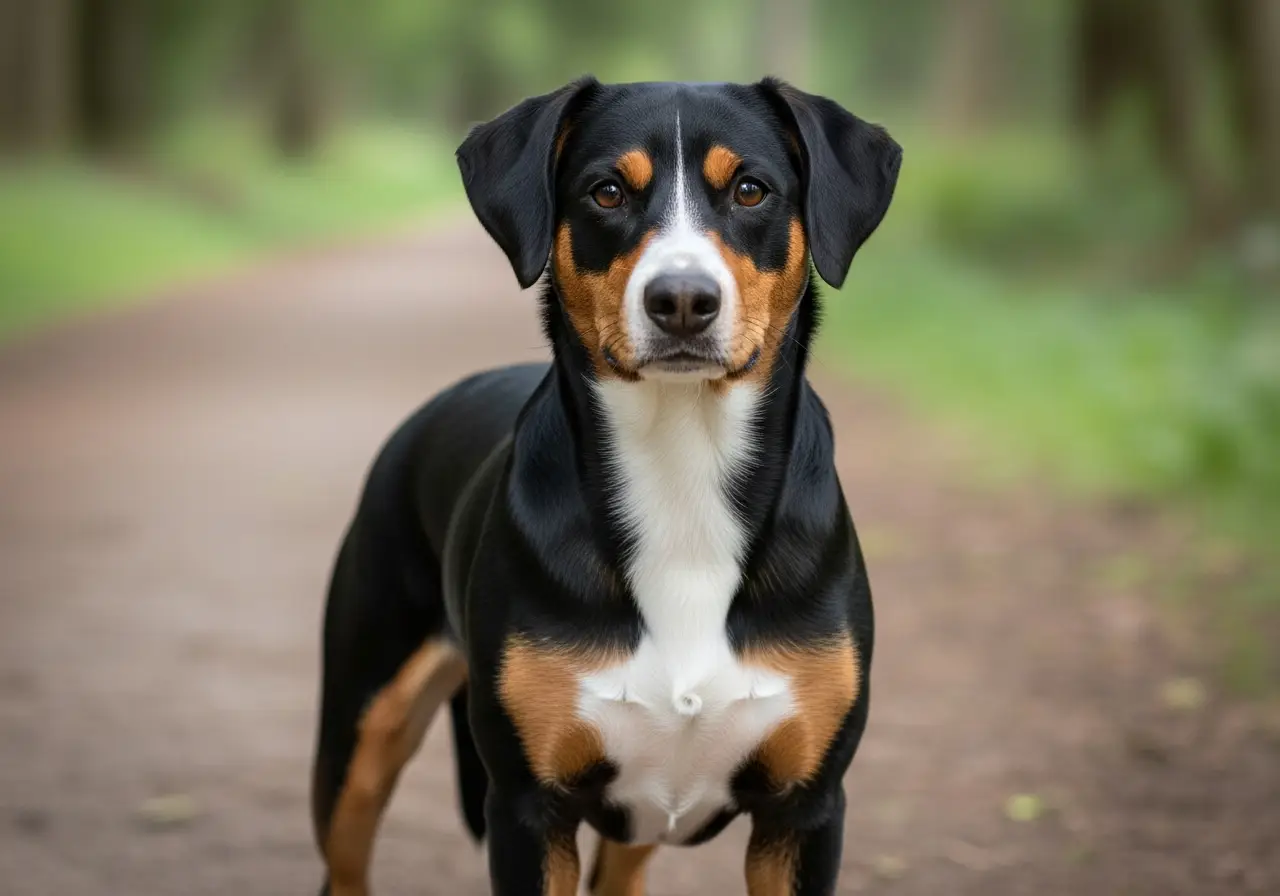
The Entlebucher Mountain Dog is the smallest of the four Swiss Mountain Dogs and the most demanding in everyday life. Whoever gets one receives a dog with a pronounced drive for movement, a strong herding instinct, and a close bond with the family, which goes hand in hand with reserve towards strangers. At least two hours of active stimulation daily are not a recommendation, but a basic requirement.
02Introduction
What makes the Entlebucher Mountain Dog special
The Entlebucher Mountain Dog is the smallest of the four Swiss Mountain Dogs, FCI Group 2, energetic and tri-coloured, with a withers height of 44–52 cm.
03Profile
Key facts and suitability
- Origin
- Schweiz
- Original purpose
- Cattle herding in the Entlebuch
- FCI
- No. 47 · Group 2 · Section 3
- height at the withers
- 44–52 cm
- Weight
- 20–30 kg
- Life expectancy
- 11–13 Years
- Coat type
- Short-haired
- Minimum exercise
- 90 min/day
- Puppy price
- 1'200–2'000 CHF
- Waiting period
- 12 months
- Sports
- Agility · Obedience · Herding work · Sled dog sports
04Temperament
How the Entlebucher Mountain Dog shows up in everyday life
The morning run shows what makes the Entlebucher special: It does not simply run alongside you, but observes, anticipates and reacts to every change of direction with immediate attention. This dog works, even when no livestock is in sight.
Internally, it needs intensive exercise, mental enrichment and a clear task daily. Its need for social contact with its own family is high: It seeks closeness, contact and inclusion in the daily routine. Four hours alone are its upper limit, and only if it has been sufficiently stimulated beforehand.
Externally, it behaves reservedly to suspiciously towards strangers. When visitors come, it first observes from a distance. It does not greet everyone spontaneously; this is not a mistake, but its guarding instinct. These two axes, high family bonding and reserve towards unknown people, must not be confused. An Entlebucher that is affectionate towards its family will therefore not automatically become a sociable party dog.
Its herding instinct manifests concretely in everyday life: children running, cyclists passing by, or cats fleeing all activate its driving instinct. Without clear rules and consistent guidance, this behaviour is directed at unintended targets. With structure and stimulation, however, it is an attentive, reliable companion that knows its place in the family and fulfils it.
05Needs
What this breed needs daily
The Entlebucher Mountain Dog requires at least 120 minutes of active exercise daily, not just walking, but forms of movement that challenge it physically and mentally. Jogging, cycling, hiking in rough terrain or dog sports such as agility, obedience or mantrailing meet its needs significantly better than simple leash walks.
Its need for mental work is just as high as its need for physical exercise. Nose work, search games, structured training and varying tasks prevent it from seeking out its own enrichment, which rarely ends in the owner's interest. Monotonous repetitions bore it quickly; variety in training keeps its motivation stable.
Being alone is learnable for it, but not automatic. Four hours are realistic if the build-up is consistent and starts early. Longer absences without a care solution lead to stress behaviour in this highly bond-oriented breed.
A rural environment with opportunities for exercise is advantageous, but not an absolute requirement. What matters is that the owner brings the necessary time and energy, not the square metres of the apartment. Keeping it in an apartment works if sufficient daily stimulation takes place.
The Entlebucher also requires clear, consistent guidance. It tests boundaries and reacts sensitively to inconsistency. Attending a dog training school with experienced trainers is particularly sensible during the first two years of life.
Exercise
Very high
mental work
A lot
Social needs
High
training
Medium
06Sport & Mental and Physical Stimulation
What sports the Entlebucher Mountain Dog is suited for
Realistic in terms of physiology and genetics – not every breed suits every sport.
Structurally and physiologically suitable: Suitable for herding work, treibball and coursing · CaniCross / bikejoring possible.
07Quick Check
08Suitability
Who this breed is suitable for – and who it isn't
✓Matches
The Entlebucher Mountain Dog suits owners who can spend at least two hours a day on active exercise with it, not occasionally, but structurally embedded in everyday life. Sportily active people who jog, hike or participate in dog sports will find an enduring partner in it.
Experience in dealing with high-drive or self-confident dogs is a clear advantage. Anyone who has already kept a herd or driving dog and knows how to set boundaries consistently will be able to work well with the Entlebucher.
Families with children from about eight years of age are suitable if the parents take on the leadership role and guide the children in dealing with the dog. Its herding instinct towards young children must be channelled through clear rules.
Owners living in rural or suburban environments with access to terrain and exercise areas benefit from its enjoyment of variable terrain. Owners in the city can also live with it, provided they consistently ensure daily stimulation and use a supporting dog training school.
Anyone who enjoys genuine collaboration with the dog (in training, tasks and joint activity) will receive a keen-to-learn, attentive partner with the Entlebucher.
×Doesn't match
The Entlebucher Mountain Dog does not suit owners who are regularly away from home for more than four hours a day without having a reliable care solution. Its close family bond and high need for social contact do not tolerate permanent hours alone.
Anyone looking for a calm, uncomplicated companion dog that occupies itself and requires little guidance is mistaken with this breed. The Entlebucher demands time, structure and consistency daily; this is not a phase, but its permanent profile.
Households with very young children under six years of age should realistically assess its pronounced herding and driving instincts. Without clear rules and experienced guidance, this behaviour towards toddlers can become problematic.
Anyone who believes that its high family bond also means openness towards strangers underestimates its reserve. Households with frequently changing visitors or a very social environment require a consistent socialisation plan; otherwise, its mistrust will develop in undesirable directions.
First-time owners without support from an experienced dog training school and without prior experience with high-drive breeds should carefully weigh the decision for an Entlebucher. Its eagerness to learn masks the fact that it quickly exploits inconsistency in guidance.
10Line reality
Show line, working line, breeder market
The Entlebucher Mountain Dog is not bred into clearly separated working and show lines, as is the case with the German Shepherd or Labrador Retriever, for example. Breeding focuses on a uniform type that should combine both working dog characteristics and show suitability.
Nevertheless, differences in drive strength and intensity exist within the breed, depending on the focus of individual breeders. Breeders who actively participate in dog sports or present their dogs in working trials tend to place more emphasis on willingness to work, drive strength and resilience. Breeders with a show focus pay more attention to exterior and standard conformity.
For everyday life, this means: An Entlebucher from a sportily active breeding line can be significantly higher in drive and more demanding than a dog from a breeding line with a moderate working profile. Anyone looking for an Entlebucher as a family dog should specifically ask the breeder about the focus of the parent animals and, if possible, observe the parent animals in everyday life.
The Swiss Club for Entlebucher Mountain Dogs (SKES) and the Swiss Mountain Dog Association for Germany (SSV) maintain stud books and issue breeding licences based on health and temperament assessments. Breeding without club affiliation and corresponding proofs is a warning signal.
11Health · Reality
What you need to plan for medically with your Entlebucher Mountain Dog
The Entlebucher Mountain Dog is considered a comparatively robust breed with a life expectancy of about 11 to 13 years. However, this range is no guarantee; keeping conditions, nutrition, and breeding quality influence it significantly.
Hip dysplasia (HD) and patellar luxation are documented as typical for the breed. Reputable breeders provide HD X-ray results of the parent animals; a result of HD-A or HD-B is considered a breeding prerequisite for club-affiliated breeders of SKES and SSV. Puppies from litters without HD proof carry an increased risk of later joint problems, which can lead to costly treatments.
Hereditary eye diseases, including Progressive Retinal Atrophy (PRA), are known in the breed. Eye examinations of the parent animals by a specialist veterinarian for ophthalmology should be presented before purchase. First symptoms such as night blindness or altered pupil reaction require veterinary clarification.
Overweight poses a real risk in this breed if the need for movement is not met. An Entlebucher that is actively exercised for less than 90 minutes daily tends to gain weight, with direct consequences for joints and the cardiovascular system.
Preventive examinations on an annual basis, vaccination protection according to the current vaccination schedule, and dental treatment if necessary are part of basic care. In cases of lameness, visual changes, or unusual gait, a veterinary examination without delay is indicated.
12Structured data
Health by the numbers
Prone to diseases
Hip dysplasia, ectopic ureter (common in bitches), progressive retinal atrophy
Recommended health tests
Hip X-ray, DNA test for PRA, ureter examination in bitches
13Myths ↔ Reality
What is often said incorrectly about this breed
Five myths, five realities, five sources.
"The Entlebucher is a small Mountain Dog, so it is also a calmer family dog.
Body size says nothing about the need for activity. Among the four Swiss Mountain Dogs, the Entlebucher is considered the most temperamental. Its exercise requirement is at least two hours daily, plus mental stimulation. Anyone looking for a calm companion dog is mistaken with this breed.
"Because he loves his family, he is also open to visitors and strangers.
Close family bonding and openness towards strangers are two different behavioural axes. The FCI standard explicitly describes the Entlebucher as slightly suspicious of strangers. Its guarding instinct is clearly pronounced. Without consistent socialisation, this suspicion can turn into undesirable protective behaviour.
"Its herding instinct is not a problem in everyday life; that's just an instinct.
The herding and driving instinct of the Entlebucher is genetically deeply rooted and shows itself concretely in everyday life: It can drive, nudge or jump at children, other animals or cyclists. Without clear rules and consistent training, this behaviour is directed towards unintended targets. The instinct does not disappear; it must be channelled.
"The Entlebucher is suitable for first-time owners because it is eager to learn.
Eagerness to learn and easy trainability are not the same thing. The Entlebucher learns quickly but also quickly tests inconsistency in handling. It requires a clear, consistent primary caregiver with experience in dealing with high-drive dogs. First-time owners without accompanying dog training school attendance and prior experience regularly underestimate its demand for leadership.
"As a Swiss Mountain Dog, it is robust and does not require special health examinations.
Although the Entlebucher is considered a comparatively robust breed, it has breed-typical risks: hip dysplasia (HD), patellar luxation and hereditary eye diseases are documented. Reputable breeders provide HD and eye examination results of the parent animals. A purchase without these proofs increases the risk of costly follow-up treatments.
14animal welfare
The animal welfare perspective
Breeder market, designer versions, animal shelter reality — what no one writes in the puppy ad.
The Entlebucher Mountain Dog regularly ends up in animal welfare organisations in Switzerland and Germany, and for one clearly identifiable reason: underestimated need for movement combined with a lack of consistency in training. Whoever buys a compact, tri-coloured dog with a friendly facial expression while ignoring the driving dog behind it will find themselves facing a dog that drives children, barks at visitors, and rearranges the apartment after just a few months.
The Entlebucher appears less frequently on the backyard breeder market than popular breeds like Labrador or Golden Retriever; its population is simply smaller. However, this does not protect against dubious offers. Puppies without HD proof of the parent animals, without club affiliation, and at unusually low prices are a reliable warning signal. Whoever pays 500 euros for a "purebred Entlebucher" usually finances a breeding operation that skimps on health examinations.
Designer versions or targeted crosses of the Entlebucher hardly exist on the market. This is an advantage: the breed picture remains comparatively clear, and the breeding clubs have a real control function.
The actual animal welfare problem of this breed is structural in nature: A dog with a need for movement of 120 minutes daily and a pronounced herding instinct is kept in households that cannot meet this need. The result is stress behaviour, which is misinterpreted as aggression or destruction, leading to surrender.
Adopting an adult Entlebucher from animal welfare is a serious option. Adult dogs show their character clearly, and specialised Mountain Dog rescues accompany the move in with expertise. Whoever has the capacity for this breed often finds dogs in animal welfare that have simply ended up in the wrong household, not because they are problematic, but because their needs were underestimated.
15Costs · Transparency
What this breed realistically costs
A puppy from reputable, club-affiliated breeding costs between 1,400 and 2,000 CHF or EUR in Switzerland and Germany. Offers significantly below this, under 800 EUR, often come from breeders without health certificates. The price difference reflects investments in hip X-rays, eye examinations, puppy socialisation, and stud book registration.
Annual living costs are approximately 1,500 to 2,500 EUR depending on keeping conditions. Included are: high-quality food (approx. 600–900 EUR/year for an adult Entlebucher with an active movement profile), grooming needs (low, approx. 100–200 EUR/year), basic equipment and accessories, and dog training school (first two years: 400–800 EUR recommended).
Basic veterinary care (vaccinations, parasite prophylaxis, annual examination) costs approx. 300–500 EUR annually. Orthopaedic treatments for HD or patellar luxation can reach 2,000–5,000 EUR in individual cases. Pet health insurance with surgery cover costs between 30 and 80 EUR monthly depending on provider and tariff and is a sensible safeguard for this breed due to the documented joint risks.
Dog tax (depending on municipality 50–150 EUR/year) and liability insurance (approx. 50–100 EUR/year) are mandatory items that must be included in the budget.
16Puppy search
What you need to consider when choosing a breeder
- A reputable breeder provides health certificates of the parent animals before purchase: HD X-ray results, eye examinations and, where available, patella assessments.
- Anyone who does not show these documents or describes them as unnecessary is disqualified as a breeder.
- The breeder asks questions about everyday life, experience and living conditions.
- A breeder who serves every interested party without asking questions is not acting in the interest of the puppies.
- The puppies grow up in the apartment or house, not in a kennel without human contact.
- Socialisation in the first weeks of life is crucial for later behaviour towards strangers and new situations.
- Club-affiliated breeders of the SKES or SSV are subject to breeding regulations that define minimum standards for health and keeping.
- The club websites of both clubs list breeders.
- Adopting an Entlebucher from animal welfare is an equally valid option.
- In Switzerland, Entlebuchers often end up in animal welfare organisations due to underestimated exercise needs or a lack of consistency in training.
- Organisations such as the Swiss Animal Welfare Network or specialised Mountain Dog rescues place dogs with a known history and supported integration.
- An adult dog from adoption also brings an already recognisable temperament.
FAQ
Frequently asked questions about the Entlebucher Mountain Dog
Is Entlebucher Mountain Dog a family dog?
Entlebucher Mountain Dog is considered suitable for families with good socialisation and species-appropriate care.
How much exercise does Entlebucher Mountain Dog need?
At least around 90 minutes of exercise per day. As an active breed, more so — plus mental stimulation.
What is the size and weight of Entlebucher Mountain Dog?
Fully grown, Entlebucher Mountain Dog reaches about 44–52 cm at the withers and weighs around 20–30 kg.
What is the life expectancy of Entlebucher Mountain Dog?
The life expectancy of Entlebucher Mountain Dog is approximately 11–13 years.
Which diseases are common in Entlebucher Mountain Dog?
Hip dysplasia, ectopic ureter (common in bitches), progressive retinal atrophy
17Breed clubs
Official breed clubs in DACH
19Related
Similar breeds – and their differences
You might also be interested in
Participate
Do you have a good photo of your Entlebucher Mountain Dog?
We are looking for expressive images for our breed profiles. Submit yours; the editorial team reviews every submission before publication.
Does this breed suit you?
Smallest and most energetic Swiss Mountain Dog. Needs intensive enrichment daily. Suitable for outdoor keeping.