
01Summary
In a paragraph
If you only have 30 seconds.
The Polish Hound is a traditional Polish scent hound bred for enduring, independent tracking work. In everyday life, it appears calm and people-oriented; in the field, it switches to an independence that regularly overwhelms inexperienced owners. Those who cannot realistically plan 90 to 120 minutes of intensive exercise plus nose work daily should not choose this breed.
02Introduction
What makes the Polish Hound special
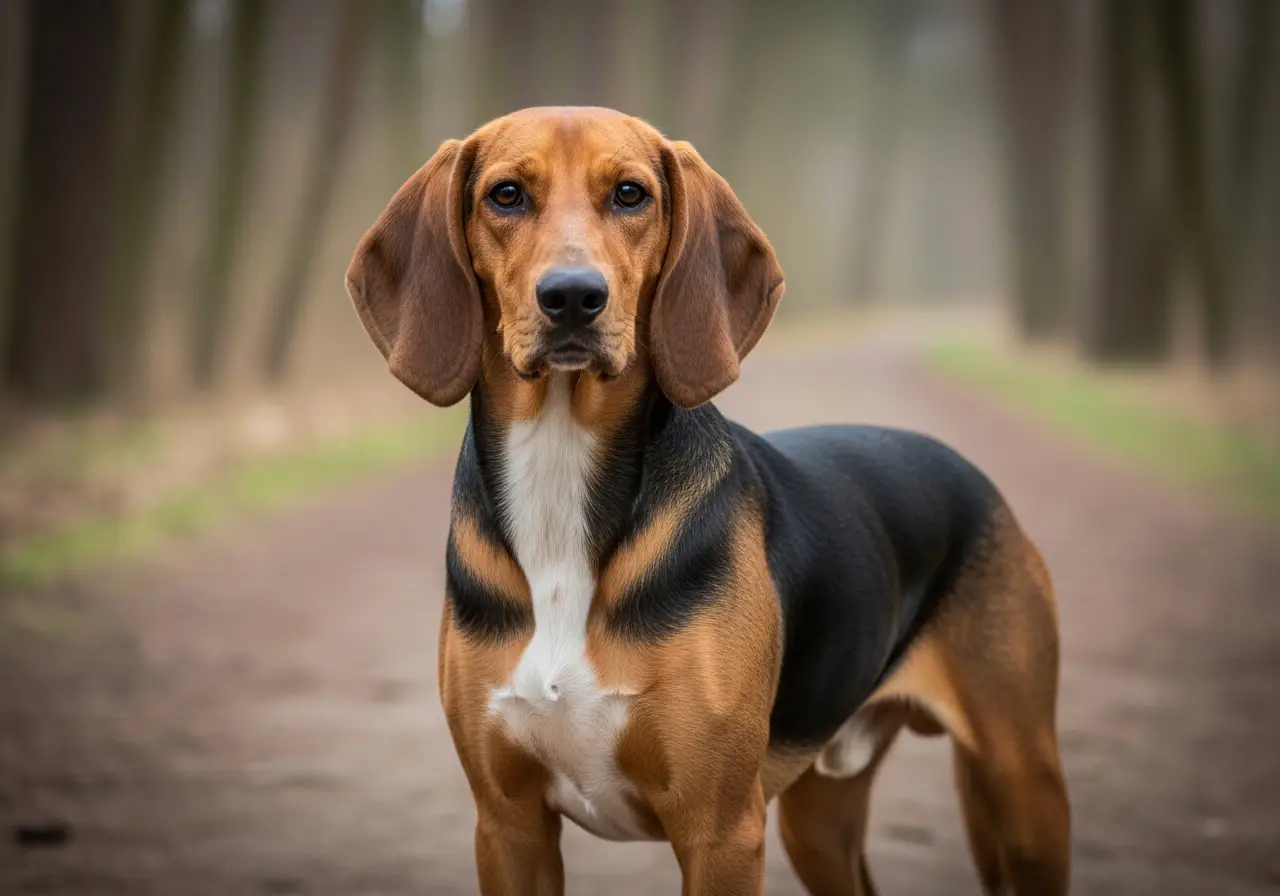
Polish Hound: traditional Polish hunting dog with a keen nose and great stamina
03Profile
Key facts and suitability
- Origin
- Polen
- Original purpose
- Small game hunting
- FCI
- No. 52 · Group 6 · Sektion 1.1: Große Laufhunde, mit Arbeitsprüfung
- height at the withers
- 55–65 cm
- Weight
- 25–32 kg
- Life expectancy
- 10–13 Years
- Coat type
- Short-haired
- Minimum exercise
- 90 min/day
- Puppy price
- 900–1'500 CHF
- Waiting period
- 4 months
- Sports
- Scent work Mantrailing
04Temperament
How the Polish Hound shows up in everyday life
During the morning run through the forest, the Polish Hound switches to an independence that can surprise the owner: A trail in the undergrowth is enough, and the dog pulls away concentrated and baying; the recall still reaches it, but the decision on whether to follow is made by itself. This is not an obedience problem. This is the working profile of this breed.
At home, the same dog behaves calmly and people-oriented. It seeks physical contact, follows the owner through the apartment, and shows little hyperactivity. However, this calmness only arises if the need for movement and nose work is met. If stimulation is lacking, this manifests as persistent vocalisation—the breed's baying is deep and far-reaching—or as restless pacing.
Here, the two behavioural axes diverge significantly: The internal need for social contact is high. The Polish Hound bonds closely with its primary caregivers and tolerates long periods of being left alone poorly. The external reaction to strangers, however, is reserved; the breed is not an open greeting dog. Visitors are observed, not received joyfully. Anyone who interprets this reserve as aggression is mistaken; anyone who misunderstands it as openness is equally mistaken.
With other dogs, the Polish Hound generally shows compatibility, especially if socialisation was early and broad. It has been used in packs for hunting for centuries, which shapes its behaviour. Nevertheless, in everyday urban dog encounters, it requires clear guidance, as the focus on environmental stimuli (smells, movements) quickly overshadows social interaction with conspecifics.
05Needs
What this breed needs daily
The Polish Hound needs at least 90 to 120 minutes of intensive exercise daily. Walks at a walking pace are not sufficient. The dog needs phases in which it can actively use its nose, such as trail work, mantrailing, blood trailing, or structured search exercises. This nose work is not an optional addition, but a genetically anchored basic prerequisite for psychological balance.
Mental work complements physical stimulation, but does not replace it. Search games in the apartment, food-search tasks, or nose work courses lower the activation level and promote impulse control. The need for mental work is at 4 on a scale of 1 to 5; the breed needs mental challenge daily, not occasionally.
Being left alone presents a real challenge. The breed bonds closely and tolerates isolation poorly. A maximum of four hours alone is realistic if the bond is stable and the dog has been sufficiently stimulated. Longer absences require a reliable care solution.
A securely fenced area is not a matter of comfort, but a safety requirement. In an emergency, the prey drive overrides any obedience performance. Off-leash exercise in unsecured areas remains permanently risky, even with well-trained animals.
The breed requires a primary caregiver with experience in handling high-drive dogs. Calm, consistent communication works better than pressure. Anyone who brings hunting practice or has access to structured trail work fully exploits the potential of this breed.
Exercise
High
mental work
A lot
Social needs
Medium
training
Demanding
06Sport & Mental and Physical Stimulation
What sports the Polish Hound is suited for
Realistic in terms of physiology and genetics – not every breed suits every sport.
Structurally and physiologically suitable: Suitable for mantrailing, dummy work and tracking · CaniCross / bikejoring possible.
07Quick Check
08Suitability
Who this breed is suitable for – and who it isn't
✓Matches
The Polish Hound suits owners who can realistically plan at least 90 to 120 minutes of structured exercise daily, a significant portion of which should be nose work or tracking. Hunters looking for a hound for boar or fox hunting correspond most directly with the original usage profile.
Active owners without a hunting background are suitable if they have access to mantrailing courses, bloodhounding, or organised nose work and bring experience with high-drive dogs. A house with a secure garden or direct access to extensive terrain is advantageous.
Families with children of school age are possible if the dog's workload does not depend on the children; an adult must take responsibility for handling. The reserved attitude towards strangers requires early, broad socialisation, especially in households with regular visitors.
Owners who have already gained experience with hounds, bloodhounds, or other scent hounds will find an enduring, loyal working partner with a calm basic character in the Polish Hound.
×Doesn't match
The Polish Hound does not suit owners who are regularly away from home for more than four hours a day and cannot organise reliable dog care. The high need for social contact and close bond make longer periods alone a real stress factor.
First-time owners without prior experience with high-drive or hunting-motivated dogs will be overwhelmed by this breed. The independence on the trail, the deep baying, and the restricted off-leash freedom require handling competence that cannot be derived from general dog books.
Those who interpret the breed's calm everyday demeanour as a sign of low needs will quickly experience the consequences of under-stimulation: vocalisation, restlessness, destructive behaviour. This misconception, equating a calm nature with low effort, is the most common reason why Polish Hounds end up in animal welfare organisations.
Purely urban keeping without regular access to forest, meadow, or structured nose work is not suitable for this breed. Those looking for a dog that reacts openly and warmly to strangers will also not find the desired profile in the Polish Hound; reserve towards strangers is typical of the breed and not a training error.
10Line reality
Show line, working line, breeder market
The Polish Hound is listed by the FCI as a scenthound with working trials, which means that working ability is officially part of the breeding goal. A pronounced separation into working and show lines, such as exists for example in the German Shepherd Dog or the Labrador Retriever, is not documented to a comparable extent in this breed.
Since the breed was reconstructed from a very small remaining population after the Second World War, the breeding base is narrow. Most animals come from Polish hound kennels that select for trail performance and endurance. Show breeding in the Western European sense plays a subordinate role.
In the German-speaking region, Polish Hounds are extremely rare. Anyone looking for a puppy will generally have to rely on Polish kennels that are affiliated with the Polish Hunting Dog Association or the FCI umbrella organisation. The working trial is a breeding prerequisite in Poland; this is a structural quality advantage compared to breeds where working suitability is optional.
Owners without a hunting background should be aware that they are acquiring a dog that was selected for a specific working task. The working trial requirement in the FCI standard is not a historical relic, but an active breeding goal.
11Health · Reality
What you need to plan for medically with your Polish Hound
The Polish Hound is considered a robust breed with a life expectancy of 12 to 14 years. Reliable breed-specific health statistics are limited due to the small population size; systematic studies on the scale of larger breeds do not exist.
Hip dysplasia (HD) is the most frequently documented orthopaedic problem in scent hounds of this size class. The VDH recommends an HD X-ray examination for breeding dogs before approval for breeding. Owners should insist on HD findings for both parent dogs when buying a puppy. In dogs used for hunting, the strain from rough terrain increases the risk of joint wear and tear in old age.
Ear problems are more common in dogs with drop ears, such as the Polish Hound, than in prick-eared breeds. Regular ear checks and cleaning demonstrably reduce the risk of infection (Source: Tierärztliche Vereinigung für Tierschutz e.V., status 2022).
Overweight poses a real risk for well-provided, under-exercised scent hounds. The breed tends towards inactivity indoors when under-stimulated, which favours weight gain that in turn strains joints and the cardiovascular system. Regular weight checks by the vet are recommended.
Preventive examinations: annual veterinary check-up, dental status, parasite management (especially with hunting use involving tick contact), heart auscultation from the 7th year of life. In case of performance decline, lameness, or persistent lethargy, prompt veterinary investigation is necessary.
12Structured data
Health by the numbers
Prone to diseases
Hip dysplasia Ear infections
Recommended health tests
Hip X-ray Ear check
13Myths ↔ Reality
What is often said incorrectly about this breed
Five myths, five realities, five sources.
"The Polish Hound is a calm family dog that requires little stimulation.
In everyday household life, the breed does indeed show a calm basic attitude. However, this calmness deceives regarding the genetically anchored need for exercise and nose work. Without 90 to 120 minutes of intensive enrichment daily plus structured tracking work, many animals develop stress behaviour such as vocalisation, destruction or excessive marking. A calm nature in the house does not mean lower needs; it means that the dog has not yet had its needs met.
"A pronounced prey drive can be completely eliminated through consistent training.
The tracking will of the Polish Hound is not a training problem, but a breeding characteristic. The FCI classifies the breed as a scent hound with a working test; the prey drive is a selection criterion, not a fault. Consistent training can improve recall and promote impulse control, but cannot eliminate the drive itself. Off-lead running in unsecured terrain remains a permanent risk.
"The Polish Hound is suitable for beginners because it has a balanced temperament.
A balanced temperament and suitability for first-time owners are two different characteristics. The breed works independently, makes its own decisions on the trail, and is hardly interruptible in a hunting context. This requires owners with experience in handling high-drive dogs, solid recall training, and ideally a hunting background or access to structured nose work.
"Polish Hounds are easy to get along with cats and small animals.
The breed was selected for hunting game birds and wild boar. The prey drive is not directed exclusively at wildlife in the forest; small animals in the household can also be perceived as prey. Cohabitation with cats or small animals is possible, but requires early socialisation and careful observation. There is no guarantee of compatibility.
"Because the breed is rare, puppies automatically come from reputable breeding.
Rarity does not protect against irresponsible breeding. Especially with rare breeds, there is a risk that puppies are offered without health tests, working trials, or breeding approval. Reputable breeding documents hip health (HD X-rays), conducts working trials, and is affiliated with a recognised breeding association. The rarity of the breed increases the duty of care when searching for a puppy; it does not reduce it.
14animal welfare
The animal welfare perspective
Breeder market, designer versions, animal shelter reality — what no one writes in the puppy ad.
Polish Hounds regularly appear in German and Austrian animal welfare organisations, rarely but with a clear pattern: the prey drive and exercise needs were underestimated before getting a dog. This is not a failure of individual owners, but a structural information problem. Anyone looking for a calm, people-oriented dog and misinterpreting the hound's everyday calmness as an indicator of need makes a decision on a false basis.
The backyard breeder market for rare breeds works differently than with fashion dogs. There is no mass supply, but this does not mean that all offers are reputable. Especially with breeds with a small breeding base, there is a risk that animals are bred without health tests, without proof of working trials and without breeding approval, using the argument of rarity as a quality feature. Rarity is not a quality feature.
Breeding and keeping-related problems arise with this breed less through anatomical exaggerations than through husbandry errors. The Polish Hound is not a brachycephalic dog, not an extreme type. Its risk profile lies in under-stimulation: A hound without running tasks develops behavioural problems that appear in animal welfare statistics as "aggression" or "uncontrollability", but are actually an expression of chronic stress.
Adopting an adult animal from animal welfare is a serious option with this breed. An adult dog shows an assessable temperament profile, which is a concrete advantage with high-drive breeds. Animal welfare organisations that place hounds generally carry out behavioural assessments and advise on keeping requirements. The prejudice that rescue dogs are "burdened" does not apply to well-supported placements.
15Costs · Transparency
What this breed realistically costs
A puppy from reputable, VDH- or ZKwP-affiliated breeding costs between 1,200 and 2,000 EUR in the German-speaking region. Offers significantly below this, especially without proof of working trials for the parent animals, indicate a lack of breeding standards.
The annual living costs for a breed of this size (20–32 kg) are typically between 1,800 and 3,000 EUR. Included: high-quality food (approx. 600–900 EUR/year), basic equipment and care (approx. 200–400 EUR/year), basic vaccinations and parasite prevention (approx. 300–500 EUR/year) as well as dog liability insurance (approx. 80–150 EUR/year depending on provider and federal state).
Veterinary costs for unforeseen illnesses or injuries, with the risk of injury increasing for dogs used in hunting, can amount to 500 to several thousand euros per incident. Pet insurance with surgery cover costs approx. 40–100 EUR/month for this size class and reduces financial risk for major procedures.
Anyone who handles the breed for hunting also calculates in hunting licence costs, training fees for tracking or bloodhounding work as well as possible kennel costs. Nose work courses for dogs not used for hunting cost approx. 150–300 EUR per course.
16Puppy search
What you need to consider when choosing a breeder
- Reputable breeders of the Polish Hound are affiliated with an FCI-recognised breeding association, in Poland the Związek Kynologiczny w Polsce (ZKwP), and in the German-speaking area the VDH or ÖKV.
- The working test is anchored in the FCI standard as a breeding prerequisite; a reputable breeder will provide proof of working tests for the parent dogs.
- Health examinations for hip dysplasia (HD) should be documented for both parent dogs.
- Puppies are given away no earlier than eight weeks of age, are vaccinated, dewormed, and equipped with an EU pet passport.
- As the breed is rare in the German-speaking area, the search often leads to Poland.
- This is not a quality indicator in itself; here too, visit kennels, see the parent dogs, and check documentation.
- Distrust is appropriate if puppies are available immediately without a waiting period or if the price is significantly below the market average.
- Adoption through animal welfare organisations is an equally valid option.
- Polish Hounds occasionally end up in rescue centres because their prey drive and exercise needs were underestimated.
- An adult dog from adoption already has an assessable temperament profile, which is a real advantage over a puppy with an open developmental trajectory for a high-drive breed.
FAQ
Frequently asked questions about the Polish Hound
Is Polish Hound a family dog?
Polish Hound is considered suitable for families with good socialisation and species-appropriate care.
How much exercise does Polish Hound need?
At least around 90 minutes of exercise per day. As an active breed, more so — plus mental stimulation.
Does Polish Hound suit an apartment?
With enough exercise and enrichment, Polish Hound can also be kept in an apartment.
What is the size and weight of Polish Hound?
Fully grown, Polish Hound reaches about 55–65 cm at the withers and weighs around 25–32 kg.
What is the life expectancy of Polish Hound?
The life expectancy of Polish Hound is approximately 10–13 years.
Which diseases are common in Polish Hound?
Hip dysplasia Ear infections
17Breed clubs
Official breed clubs in DACH
19Related
Similar breeds – and their differences
You might also be interested in
Participate
Do you have a good photo of your Polish Hound?
We are looking for expressive images for our breed profiles. Submit yours; the editorial team reviews every submission before publication.
Does this breed suit you?
Enduring scent hound – needs regular hunting work or nose work as compensation