
01Summary
In a paragraph
If you only have 30 seconds.
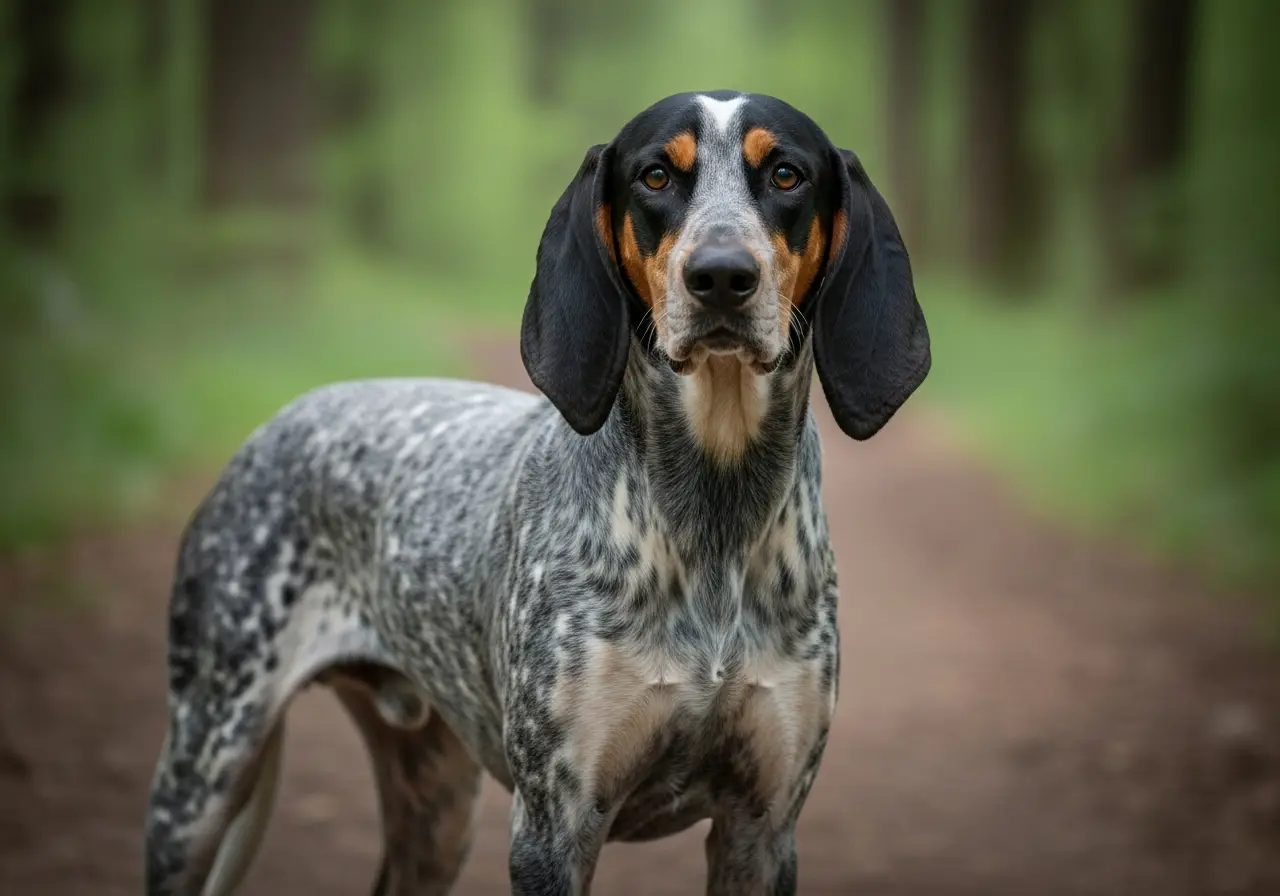
The Bluetick Coonhound is a high-performance American scent hound bred for night hunting of raccoons and black bears. Its blue ticking, deep voice and pronounced prey drive are not style features; they are working tools. Anyone who keeps this dog in an urban household without nose work and sufficient exercise fundamentally underestimates its genetic profile.
02Introduction
What makes the Bluetick Coonhound special
The Bluetick Coonhound is a US-American hunting dog, not FCI-recognised, known for its blue ticked pattern and penetrating hunting bark, shoulder height 53–69 cm.
03Profile
Key facts and suitability
- Origin
- USA
- Original purpose
- Raccoon and black bear hunting
- height at the withers
- 53–69 cm
- Weight
- 20–36 kg
- Life expectancy
- 11–12 Years
- Coat type
- Short-haired
- Minimum exercise
- 90 min/day
- Puppy price
- 600–1'200 CHF
- Waiting period
- 6 months
- Sports
- Hunting · Mantrailing · Scent work
04Temperament
How the Bluetick Coonhound shows up in everyday life
When returning home, the Bluetick Coonhound greets its owner with clear joy, wagging its tail, close to the body, loudly. This warmth is genuine. However, it says nothing about how the dog deals with strangers: towards unknown people, it usually shows calm openness, rarely mistrust, but also no exuberant desire for contact. The external axis, i.e. how it reacts to stimuli outside the family, thus differs clearly from its internal bonding intensity.
On a walk in a wooded area, the picture changes abruptly. As soon as the Bluetick Coonhound picks up a scent trail, it switches into a work mode that is hardly interruptible. The head goes down, the ears fall forward, and the pace increases. Recall signals from the owner reach it only to a limited extent in this state. This is not an obedience problem; it is the result of decades of selection for precisely this behaviour.
In the house, it is calm if it has been sufficiently stimulated. It seeks physical contact, likes to lie next to its owner and sleeps extensively. This contrast, relaxed housemate versus determined scent hound, leads many owners to underestimate its need for work.
It generally shows itself to be compatible with other dogs; its pack background facilitates living together with conspecifics. Small animals in the household are, however, a different matter: the prey drive makes no exception for rabbits or cats that it does not know from puppyhood. It accepts children friendlily, provided its need for movement is met; an under-stimulated Bluetick Coonhound is not a calm housemate.
05Needs
What this breed needs daily
The Bluetick Coonhound requires at least two hours of active exercise daily, and this does not mean a leisurely walk. Guided activity with scent stimuli, changes in terrain and physical stimulation is the minimum. On days without sufficient enrichment, it shows vocalisation, restlessness and destructive behaviour.
Nose work is not an optional addition but a basic prerequisite for its balance. Mantrailing, tracking or controlled hunting accompaniment channel its scent instinct in a regulated manner. Anyone who does not have access to hunting activities must invest seriously in nose work courses, and this permanently, not as a one-off measure.
Its need for mental work is high. It requires tasks that challenge its sense of smell. Pure obedience exercises are not sufficient; they do not address its primary motivation, the scent trail.
It can be left alone for a maximum of four hours without problems, provided it has been sufficiently stimulated beforehand. Longer absences without preparation lead to stress signals and loud vocalisation, which is not tolerable in multi-storey residential buildings.
A rural environment with access to large open spaces and secured terrain is not a recommendation; it is a practical necessity. Free running on unsecured terrain is incompatible with the prey drive of this breed. High, stable fences are mandatory; the Bluetick Coonhound is an enduring and motivated escape artist when a scent trail tempts it.
Exercise
High
mental work
A lot
Social needs
Medium
training
Demanding
06Sport & Mental and Physical Stimulation
What sports the Bluetick Coonhound is suited for
Realistic in terms of physiology and genetics – not every breed suits every sport.
Structurally and physiologically suitable: Suitable for mantrailing, dummy work and tracking · CaniCross / bikejoring possible.
07Quick Check
08Suitability
Who this breed is suitable for – and who it isn't
✓Matches
The Bluetick Coonhound suits owners who can plan at least two hours of structured outdoor activity daily, not as an exception but as a daily routine. Anyone living in a rural region, having access to large open spaces and owning a secured property with a stable fence, creates the spatial prerequisites.
It is particularly well suited for owners with a hunting background or proven experience in nose work, such as mantrailing or tracking at club level. The internal axis (high need for mental and physical exercise) demands an owner who actively and permanently meets these needs.
Families with children from about eight years of age are conceivable if the dog’s need for movement is met by the adults and children are experienced in dealing with large, active dogs. Several dogs in the household are not a problem, provided socialisation is correct; its pack background facilitates living together with conspecifics.
Owners who enjoy having a dog that needs a clear task and fulfils it with full commitment will find a loyal, enduring partner in the Bluetick Coonhound. The prerequisite is the willingness not to suppress its prey drive but to channel it.
×Doesn't match
The Bluetick Coonhound is not suitable for owners who are away from home for eight or more hours daily and do not have a reliable dog care plan. Four hours of being left alone is the maximum; beyond that, stress signals and vocalisation arise, which are not tolerable in urban living conditions.
Anyone living in a rented flat or a multi-storey residential building regularly underestimates the volume of the baying. This characteristic cannot be trained away; it is a breeding-selected work trait. Neighbourhood conflicts are structurally pre-programmed in such keeping situations.
Owners looking for a dog with a reliable recall and safe free running make the wrong choice with the Bluetick Coonhound. Anyone who interprets the dog’s calm house character as a sign of low need misunderstands both axes: The inner calm in the house is the result of sufficient stimulation, not a baseline state. And the external reaction to scent stimuli cannot be overridden by affection.
First-time owners without experience with hunting-motivated hounds are overwhelmed by this breed. Also, owners who keep small animals such as rabbits or cats in the household must assess the prey drive realistically; a conflict-free coexistence is not to be expected without intensive socialisation from puppyhood.
10Line reality
Show line, working line, breeder market
The Bluetick Coonhound is bred exclusively for performance in the USA. A separation into working and show lines, as is often observed with European breeds, does not exist in this form. Competition suitability (measured by scenting ability, tracking stamina and vocalisation) remains the primary breeding goal, even for dogs that participate in bench shows.
In Europe, the breed is so rare that it is not possible to speak of an independent European breeding line. The few individuals living in Germany, Austria or Switzerland mostly come from US imports or are offspring of imported parent animals. There is no FCI recognition, which additionally complicates breeding in Europe and restricts quality control by umbrella organisations.
Anyone looking for a Bluetick Coonhound in Europe must expect to rely on breeders in the USA, with all the logistical, legal and animal welfare consequences that a puppy import entails. Checking breeding conditions is significantly more difficult from a distance than during a personal inspection on site.
11Health · Reality
What you need to plan for medically with your Bluetick Coonhound
The Bluetick Coonhound is considered a comparatively robust working breed with a life expectancy of 11 to 12 years. This range is realistic for a dog of its size (20–36 kg) and corresponds to the data provided by the AKC (as of 2023).
Hip dysplasia (HD) occurs in the breed but is documented less frequently than in many large companion dog breeds. The Orthopedic Foundation for Animals (OFA) conducts evaluations for Coonhound breeds; specific HD rates for the Bluetick Coonhound specifically are difficult to quantify due to the small population size outside the USA. Breeders should nevertheless provide X-ray evidence of the parent dogs.
A breed-specific hereditary disease is Lysosomal Storage Disease (LSD, also Globoid Cell Leukodystrophy), a neurological storage disease documented in the Bluetick Coonhound. The OFA offers a DNA test; breeders should have parent dogs tested before planning litters.
The long ear flaps (floppy ears) predispose to otitis externa, ear inflammation due to restricted air circulation in the ear canal. Weekly ear checks and regular cleaning are mandatory, not optional. For recurring inflammation, a veterinary investigation for allergies or anatomical peculiarities is advisable.
Overweight is a real risk in this breed if the need for exercise is not met. An under-exercised Bluetick Coonhound tends to gain weight, which puts strain on joints and the cardiovascular system. Regular weight checks at the vet, at least once a year, are recommended.
12Structured data
Health by the numbers
Prone to diseases
Hip dysplasia, ear infections
Recommended health tests
Hip X-ray
13Myths ↔ Reality
What is often said incorrectly about this breed
Five myths, five realities, five sources.
"The Bluetick Coonhound is a gentle family dog that relaxes in the house and requires little effort.
In the house, the Bluetick Coonhound indeed shows a calm, friendly temperament, but this masks its enormous need for work. Without at least two hours of active exercise daily and regular scent work, it develops behavioural problems such as excessive barking, destructive behaviour or attempts to escape. Its calm behaviour in the house is the result of sufficient stimulation, not its baseline state.
"Coonhounds can be trained to recall well and can run freely safely.
The Bluetick Coonhound has a genetically deeply ingrained hunting and tracking instinct. As soon as it picks up an interesting scent trail, it largely ignores environmental stimuli, including the owner's recall signals. Free running without secure terrain involves considerable risk. Even well-trained individuals show limited recallability in situations triggered by scent.
"The loud voice of the Bluetick Coonhound can be switched off through training.
The barking and baying of the Bluetick Coonhound is not a learned behaviour, but a breeding-selected working characteristic. It can be reduced in intensity and frequency through training, but not fundamentally suppressed. In densely populated areas or multi-family houses, this trait regularly leads to conflicts with neighbours and is a common reason for relinquishment in the USA.
"As an American working breed, the Bluetick Coonhound is completely healthy and robust, preventive examinations are unnecessary.
Although the Bluetick Coonhound is considered a relatively robust breed, it is not free from breed-specific health risks. Hip dysplasia, ear infections due to long drop ears and Lysosomal Storage Disease (LSD, a neurological hereditary disease) are documented. Regular ear checks and veterinary preventive examinations are medically sensible for this breed as well.
"A large garden replaces the daily walk for the Bluetick Coonhound.
A garden does provide the Bluetick Coonhound with space to move, but it does not replace guided activity with scent work and tracking stimuli. Dogs of this breed need structured enrichment that channels their hunting instinct, such as mantrailing, tracking or controlled hunting accompaniment. Standing around independently in the garden often leads to boredom and vocalisation in this breed.
14animal welfare
The animal welfare perspective
Breeder market, designer versions, animal shelter reality — what no one writes in the puppy ad.
In the USA, the Bluetick Coonhound is one of the most frequently surrendered dogs in animal shelters and rescue organisations. The reason is structural: owners underestimate the prey drive, volume and need for exercise, and give up the dog when keeping it in everyday life no longer works. Specialised organisations such as "Coonhound Companions" or "Southeast Coonhound Rescue" place hundreds of animals annually, including Bluetick Coonhounds.
In Europe, the situation is different. The breed is so rare that animal welfare cases are hardly documented. This does not mean that the risk is absent; it means that the population is too small to make statistical statements. Anyone importing a Bluetick Coonhound from the USA should be aware that puppy imports from overseas carry animal welfare-related risks: long transport routes, limited verifiability of breeding conditions and a lack of kennel club structure due to the absence of FCI recognition.
Backyard breeders and dubious suppliers exploit the rarity of the breed in Europe. A puppy offered without health documentation, without the possibility of viewing and at a suspiciously low price is highly unlikely to come from responsible breeding. The lack of FCI recognition makes it more difficult to demand minimum standards, making your own due diligence in selecting a breeder all the more important.
Placing an adult Bluetick Coonhound from a US rescue organisation is a serious alternative to buying a puppy. Adult dogs already show their character; prey drive, volume and social behaviour can be assessed. Anyone with the necessary experience will often find a dog in a rescue whose profile is already known.
15Costs · Transparency
What this breed realistically costs
The purchase price for a Bluetick Coonhound from reputable breeding in Europe ranges from 1,500 to 3,000 EUR due to the rarity of the breed and the frequent necessity of imports from the USA. Cheaper offers from the internet without health documentation are a warning sign. In addition, imports incur transport costs, veterinary certificates and possibly quarantine costs.
The annual living costs for a dog of this size (20–36 kg) are typically between 2,000 and 3,500 EUR. This includes high-quality food (approx. 600–1,000 EUR/year), grooming needs (ear cleaning, nail care: approx. 100–200 EUR/year) as well as basic equipment and accessories.
Veterinary costs vary greatly. For routine examinations, vaccinations and parasite prevention, 300–600 EUR per year is realistic. For ear inflammation, a common problem in the breed, treatment costs of 80–200 EUR per episode are added. Pet insurance with cost reimbursement for treatments costs 50–120 EUR/month depending on the provider and scope of benefits, and can be useful for chronic conditions.
Nose work courses and mantrailing training, which are not an option but a necessity for this breed, cost 150–400 EUR per course depending on the region and provider.
16Puppy search
What you need to consider when choosing a breeder
- As the Bluetick Coonhound is very rare in Europe, finding a puppy is more involved than with established FCI breeds.
- Reputable breeders, whether in the USA or in Europe, enable a personal inspection of the parent animals, provide health certificates (hip X-rays, eye examination, possibly LSD gene test) and ask questions about the planned keeping situation.
- Anyone who does not ask questions does not breed responsibly.
- Puppies from online adverts without the possibility of viewing, without health documentation or at suspiciously low prices often come from backyard breeding.
- For imports from the USA, the following applies: Checking breeding conditions from a distance is difficult; personal contact with the breeder, references from other buyers and video viewings are the minimum.
- Placement via animal welfare organisations is an equally valid option.
- In the USA, Coonhounds are frequently given up when owners have underestimated their prey drive and volume.
- Specialised rescue organisations such as "Coonhound Companions" also place dogs in Europe, with lead time and an assessment of the living conditions.
- A dog from a rescue is not a compromise, but a well-founded decision.
FAQ
Frequently asked questions about the Bluetick Coonhound
Is Bluetick Coonhound a family dog?
Bluetick Coonhound is considered suitable for families with good socialisation and species-appropriate care.
How much exercise does Bluetick Coonhound need?
At least around 90 minutes of exercise per day. As an active breed, more so — plus mental stimulation.
What is the size and weight of Bluetick Coonhound?
Fully grown, Bluetick Coonhound reaches about 53–69 cm at the withers and weighs around 20–36 kg.
What is the life expectancy of Bluetick Coonhound?
The life expectancy of Bluetick Coonhound is approximately 11–12 years.
Which diseases are common in Bluetick Coonhound?
Hip dysplasia, ear infections
17Breed clubs
Official breed clubs in DACH
19Related
Similar breeds – and their differences
You might also be interested in

Participate
Do you have a good photo of your Bluetick Coonhound?
We are looking for expressive images for our breed profiles. Submit yours; the editorial team reviews every submission before publication.
Does this breed suit you?
Classic US hunting dog with blue ticked pattern. Extremely loud hunting vocalisation. Rare in Europe.