
01Summary
In a paragraph
If you only have 30 seconds.
The Belgian Griffon is a small companion dog with a strong need for bonding and a distinct guarding instinct. It requires a present primary caregiver, consistent training, and daily mental stimulation. Its brachycephalic anatomy demands a careful examination of breathing quality and nasal structure before purchase. Those who meet these conditions will receive an attentive, character-strong dog with a life expectancy of 12 to 15 years.
02Introduction
What makes the Belgian Griffon (Griffon Belge) special
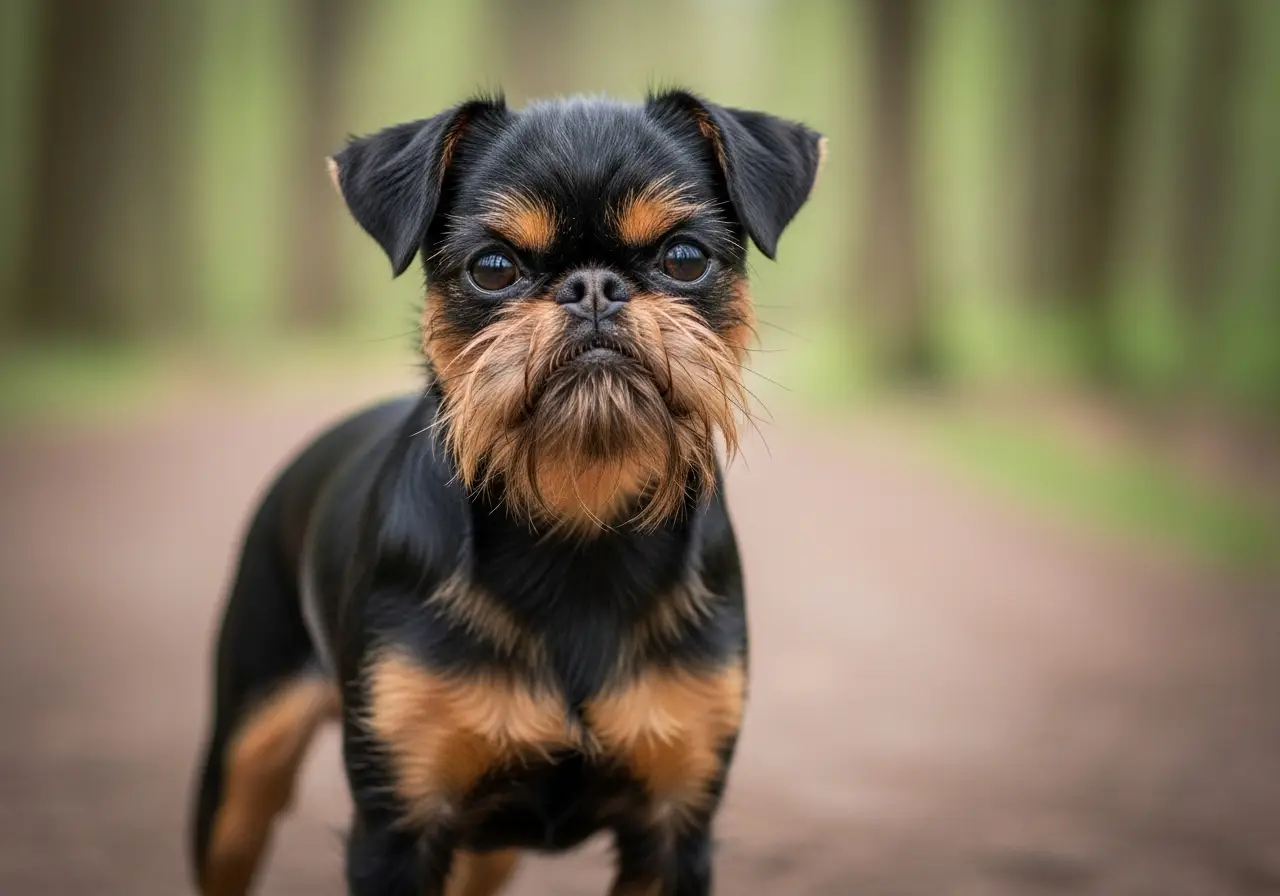
The Belgian Griffon is a small Belgian companion dog, FCI Group 9, with rough coat and expressive face, height at withers 18–22 cm.
03Profile
Key facts and suitability
- Origin
- Belgien
- Original purpose
- Rat control, companion dog
- FCI
- No. 81 · Group 9 · Section 3
- height at the withers
- 18–22 cm
- Weight
- 3–5 kg
- Life expectancy
- 12–15 Years
- Coat type
- Wire-haired
- Minimum exercise
- 30 min/day
- Puppy price
- 1'000–2'000 CHF
- Waiting period
- 9 months
- Sports
- Obedience · Agility
04Temperament
How the Belgian Griffon (Griffon Belge) shows up in everyday life
Upon your return home, the Griffon Belge announces itself immediately, registers every movement in the household environment and comments on new things with attention. This is not nervousness but its historically developed guarding instinct, which remains active even in apartment life.
The internal axis shows a high need for social contact: the Griffon Belge consistently seeks proximity to its primary caregiver. It follows you through the apartment, positions itself within sight and noticeably reacts to mood changes in the household. Anyone planning long phases without dog contact structurally underestimates this need.
The external axis, i.e. behaviour towards external stimuli, looks different. The Griffon Belge meets strangers with reserve. When an unknown person visits the apartment for the first time, it typically shows tension, barking and keeping its distance. This is not a training error but breed character. It relaxes with time and repeated contact, but immediate warmth towards strangers is not its profile.
In daily life with children, the Griffon Belge works well if children interact with it calmly and respectfully. Loud, unpredictable movements cause stress. With conspecifics, it shows tolerance after early socialisation but remains selective.
Its mental workload requirement is at a medium level: short search games, nose work or trick training are sufficient to mentally exhaust it. Overload from too intensive training sessions should be avoided just as much as complete under-stimulation, which manifests itself in barking enthusiasm and restlessness.
05Needs
What this breed needs daily
The Belgian Griffon requires 45 to 60 minutes of active exercise daily. This can be divided into two to three sessions; a long walk in the morning and a shorter one in the evening cover the basic requirement. Endurance sports or intensive physical exertion are not advisable due to its brachycephalic anatomy; in hot weather and high humidity, the workload should generally be reduced.
In addition to exercise, the Griffon Belge requires daily mental stimulation. Nose work, short search games, or structured trick training for 10 to 15 minutes meet its moderate-level need for mental activity. Monotonous repetitions without variation lead to disinterest; varied, short sessions are more effective than long training blocks.
The need for social contact is the most critical factor in everyday life. The Griffon Belge tolerates being left alone for a maximum of three hours without an alternative care arrangement. Longer absences without a dog sitter, day care, or a second primary caregiver structurally overwhelm it. Anyone working full-time away from home must plan for reliable care; this is not a recommendation but a requirement.
The Griffon Belge’s coat requires regular trimming, not clipping. Trimming maintains the coat structure and prevents matting. Planning for a professional trimmer every eight to twelve weeks is realistic. The eyes and nasal folds should be checked daily for irritation; brachycephalic dogs are prone to eye irritation due to the anatomical proximity of fur and eyeball.
Exercise
Low
mental work
Medium
Social needs
High
training
Medium
06Sport & Mental and Physical Stimulation
What sports the Belgian Griffon (Griffon Belge) is suited for
Realistic in terms of physiology and genetics – not every breed suits every sport.
Structurally and physiologically suitable: not an endurance sport (brachycephaly / BOAS).
07Quick Check
08Suitability
Who this breed is suitable for – and who it isn't
✓Matches
The Griffon Belge suits individuals or households who spend a large part of the day at home or can organise reliable care for absences of more than three hours. Keeping it in an apartment is possible, provided daily walks and mental stimulation are ensured.
Suitable candidates include individuals or couples with a structured routine who actively seek contact with dogs and are prepared to implement consistent training from the start. Families with children aged around eight years and older are also suitable, provided the children are trained in handling small dogs and behave calmly.
Those who already have experience with highly bonded or alert small dogs will find the Griffon Belge to be a manageable dog. First-time owners are not excluded in principle, but they require support from a dog training school and the willingness to channel guarding behaviour early on.
Individuals living in quiet residential settings who can inform neighbours about potential barking behaviour have an advantage. The Griffon Belge is also suitable for older owners with a moderate activity level, as long as the dog’s need for social contact is met daily.
×Doesn't match
The Griffon Belge does not suit individuals who are regularly away from home for eight or more hours daily and cannot organise alternative care. Its need for social contact is non-negotiable; prolonged isolation leads to stress-related behaviour.
Those looking for an uncomplicated, open dog towards strangers will be disappointed by the Griffon Belge. Its reserve towards unknown people is typical of the breed and not a training issue that can be completely resolved. Anyone who frequently receives visitors and expects an immediately sociable dog should consider other breeds.
Households with very young children under six years old, where loud and unpredictable behaviour characterises daily life, are structurally unsuitable for the Griffon Belge. The dog reacts to sensory overload with stress.
Those who do not wish to plan for trimming effort or consider grooming a secondary matter underestimate the maintenance needs of this breed. Likewise, the Griffon Belge is unsuitable for owners who tolerate guarding behaviour and barking enthusiasm or find it cute; without clear boundaries, this behaviour becomes permanently reinforced.
10Line reality
Show line, working line, breeder market
The Belgian Griffon is not divided into classic working and show lines, as is common with retriever or herding breeds. The FCI lists it without a working test; a differentiation by performance line does not exist.
Nevertheless, differences can be observed within breeding: some breeders focus on the characteristic head expression and coat structure according to the FCI standard, which sometimes goes hand in hand with a stronger expression of brachycephalic features. Other breeders prioritise respiratory health and vitality, which may result in a slightly less extreme nose area.
These differences are relevant for the purchase decision: a puppy from a breeding focused on show success may be anatomically built differently than a puppy from a health-oriented line. Therefore, looking at the breathing quality of the parent animals and existing health certificates is more important than the show title of the sire.
Regionally, the breed is more widespread in Belgium and the Netherlands than in the German-speaking area. In Germany and Switzerland, litters are rare; long waiting times with reputable breeders are the rule, not the exception.
11Health · Reality
What you need to plan for medically with your Belgian Griffon (Griffon Belge)
The life expectancy of the Belgian Griffon is 12 to 15 years, which is within the usual range for a small dog breed. Reliable breed-specific mortality studies with large case numbers do not exist for the Griffon Belge due to its small population size; data from general small dog studies serve as a guide.
The brachycephalic flag is the most medically relevant factor. Brachycephalic Obstructive Airway Syndrome (BOAS) occurs in breeds with shortened skulls and includes narrowed nostrils, an elongated soft palate, and a constricted trachea. A study by the University of Cambridge (Packer et al., 2015, PLOS ONE) showed that brachycephalic dogs with a skull-to-nose ratio below 0.5 carry a significantly increased risk to their airways. The Griffon Belge falls within this risk range. Before purchase, the breathing quality of the parent animals should be checked at rest and after light exertion.
The anaesthesia risk is increased in brachycephalic dogs; a vet practice with experience in small dog anaesthesia is to be preferred.
Eye irritation arises from the anatomical proximity of fur and eyeball, as well as from the flat skull. Daily inspection of the eye area and regular cleaning reduce the risk of conjunctivitis.
Dental problems are common in small dogs with shortened jaws: misaligned teeth and tartar build-up result from cramped space. Regular dental checks by the vet, at least once a year, are recommended.
Overweight poses an increased risk as it directly worsens respiratory strain in brachycephalic dogs. Weight should be monitored regularly and food intake adjusted to the actual activity level.
12Structured data
Health by the numbers
Prone to diseases
Breathing problems (brachycephalic), eye problems, patellar luxation
Recommended health tests
Airway examination (BOAS), eye examination, patella screening
13Myths ↔ Reality
What is often said incorrectly about this breed
Five myths, five realities, five sources.
The Belgian Griffon is a calm lap dog that requires little attention.
The Griffon Belge has a need for social contact of 4 out of 5 on the CCT scale. It actively seeks proximity to its primary caregiver and reacts to isolation with restlessness or increased barking. A daily routine involving long absences without alternative care is incompatible with this breed.
Small dogs like the Griffon Belge require hardly any training.
The pronounced guarding instinct of the Griffon Belge leads to persistent barking and taking over door control if clear boundaries are not set. Consistent, positively structured training from day one is necessary, not optional. Small dogs are systematically underestimated in this regard, which contributes to them being surrendered to animal welfare organisations.
The brachycephalic anatomy of the Griffon Belge is merely an optical feature with no health relevance.
The Griffon Belge carries the brachycephalic flag in the FCI standard. Narrowed airways, heat intolerance, and increased anaesthesia risk are documented risks in brachycephalic breeds. Before purchasing, the breathing quality of the puppy and its parents should be checked directly with the breeder; panting at rest is not normal.
The Griffon Belge is open and sociable towards strangers.
The external axis shows a friendliness towards strangers of 3 out of 5. The Griffon Belge behaves reservedly and alertly towards unknown people, a trait that corresponds to its historical guarding role. This reserve is not a training error but typical of the breed. Early and broad socialisation reduces exaggerated reactions but does not eliminate the basic predisposition.
Griffon Belge and Brussels Griffon are the same breed under different names.
The FCI lists Griffon Bruxellois (No. 80), Griffon Belge (No. 81) and Petit Brabançon (No. 82) as three independent standards. The Belgian Griffon differs from the Brussels Griffon primarily in coat colour: the Griffon Belge has black or black-and-tan fur, whereas the Brussels Griffon is reddish-brown. The Petit Brabançon is short-haired.
14animal welfare
The animal welfare perspective
Breeder market, designer versions, animal shelter reality — what no one writes in the puppy ad.
The Belgian Griffon is one of the rare breeds in the German-speaking region. This rarity does not automatically protect it from problems in breeding; rather, it shifts them.
Backyard breeders and dubious suppliers exploit the low availability to achieve inflated prices for puppies without health documentation. Offers on general classifieds platforms with immediate availability, no waiting period, and no access to parent animals are a reliable warning sign. Reputable breeders in the VDK or comparable associations maintain waiting lists and provide health certificates for the parent animals.
A specific breeding problem concerns brachycephalic anatomy: The trend towards particularly expressive, flat faces increases the risk of BOAS. Anyone who finds a puppy with an especially short muzzle and strikingly large eyes particularly attractive should know that exactly these traits correlate with an increased airway risk. Beauty and health are in tension in extreme types.
Surrenders of Griffon Belge dogs to animal welfare organisations are rare but regular. Common reasons include underestimated barking enthusiasm in multi-family houses, too high a need for social contact when the owner's living circumstances change, and being overwhelmed by guarding behaviour that was not channelled early on.
Adopting an adult Griffon Belge from animal welfare or a breed rescue organisation is an equivalent option to buying a puppy. Adult dogs already show their character; surprises due to unexpected behaviour are rarer than with puppies. Breed-knowledgeable animal welfare organisations and the Association of German Small Dog Breeders can assist in finding dogs for rehoming.
15Costs · Transparency
What this breed realistically costs
A puppy from reputable breeding costs between 1,500 and 2,500 euros in the German-speaking region. Offers significantly below this range without affiliation to a breeding association and health documentation carry increased risk.
Annual living costs consist of several items: High-quality dry food for a small dog costs between 300 and 600 euros per year, depending on brand and food type. Professional trimming every eight to twelve weeks amounts to 50 to 100 euros per session, resulting in annual costs of 200 to 600 euros for grooming alone.
Veterinary costs for basic care (annual vaccination, parasite prevention, routine examination) amount to 150 to 300 euros annually. For brachycephalic dogs, an increased risk of airway treatments, eye treatments, and more complex anaesthesia must be planned for; individual procedures can cost 500 to 2,000 euros.
Dog health insurance or pet health insurance with surgery cover costs between 30 and 80 euros monthly for a small dog, depending on provider and scope of benefits. Given the brachycephalic risk profile, such coverage is recommended. Total costs in the first year, including getting a dog, basic equipment, and vet visits, realistically lie between 3,000 and 5,000 euros.
16Puppy search
What you need to consider when choosing a breeder
- Reputable breeders of the Belgian Griffon in Germany are organised through the Association of German Small Dog Breeders (VDK).
- A waiting period of several months is standard with reputable breeders; anyone receiving a puppy immediately and without a waiting period should critically examine its origin.
- The following points should be checked during a visit to the breeder: breathing quality of both parent dogs at rest and after light exercise, condition of the mother’s eyes, rearing conditions of the puppies (social contact, environmental stimulation), presentation of pedigree and vaccination record, and the breeder’s willingness to answer questions after purchase.
- Breeders who refuse inspections or send puppies without personal contact should be rejected.
- Prices for puppies from reputable breeding typically range between 1,500 and 2,500 euros in the German-speaking region.
- Significantly lower prices on classifieds platforms without affiliation to a breeding association are a warning sign.
- Adopting an adult Griffon Belge through animal welfare organisations or breed rescue networks is a fully valid alternative.
- Contact with the VDK or Belgian breed associations can also help when looking for rehoming dogs.
- rundum.dog fundamentally does not provide named breeder recommendations.
FAQ
Frequently asked questions about the Belgian Griffon (Griffon Belge)
Is Belgian Griffon (Griffon Belge) suitable for beginners?
Belgian Griffon (Griffon Belge) is considered suitable for first-time dog owners.
Is Belgian Griffon (Griffon Belge) a family dog?
Belgian Griffon (Griffon Belge) is considered suitable for families with good socialisation and species-appropriate care.
How much exercise does Belgian Griffon (Griffon Belge) need?
At least around 30 minutes of exercise per day.
Does Belgian Griffon (Griffon Belge) suit an apartment?
With enough exercise and enrichment, Belgian Griffon (Griffon Belge) can also be kept in an apartment.
What is the size and weight of Belgian Griffon (Griffon Belge)?
Fully grown, Belgian Griffon (Griffon Belge) reaches about 18–22 cm at the withers and weighs around 3–5 kg.
What is the life expectancy of Belgian Griffon (Griffon Belge)?
The life expectancy of Belgian Griffon (Griffon Belge) is approximately 12–15 years.
Which diseases are common in Belgian Griffon (Griffon Belge)?
Breathing problems (brachycephalic), eye problems, patellar luxation
17Breed clubs
Official breed clubs in DACH
19Related
Similar breeds – and their differences
You might also be interested in
Participate
Do you have a good photo of your Belgian Griffon (Griffon Belge)?
We are looking for expressive images for our breed profiles. Submit yours; the editorial team reviews every submission before publication.
Does this breed suit you?
Small companion dog with big character. Check airways when buying. One of three Belgian Griffons (Brussels, Belgian, Brabançon Griffon).