
01Summary
In a paragraph
If you only have 30 seconds.
The Borzoi is a Russian sighthound with an aristocratic appearance, a calm temperament, and a prey drive that switches on immediately and completely upon sight of wildlife. It forms a close bond with its primary caregiver, yet remains independent and selective. Anyone keeping one requires a securely enclosed off-leash area, experience with independent dogs, and realistic expectations regarding recall and obedience.
02Introduction
What makes the Barsoi special
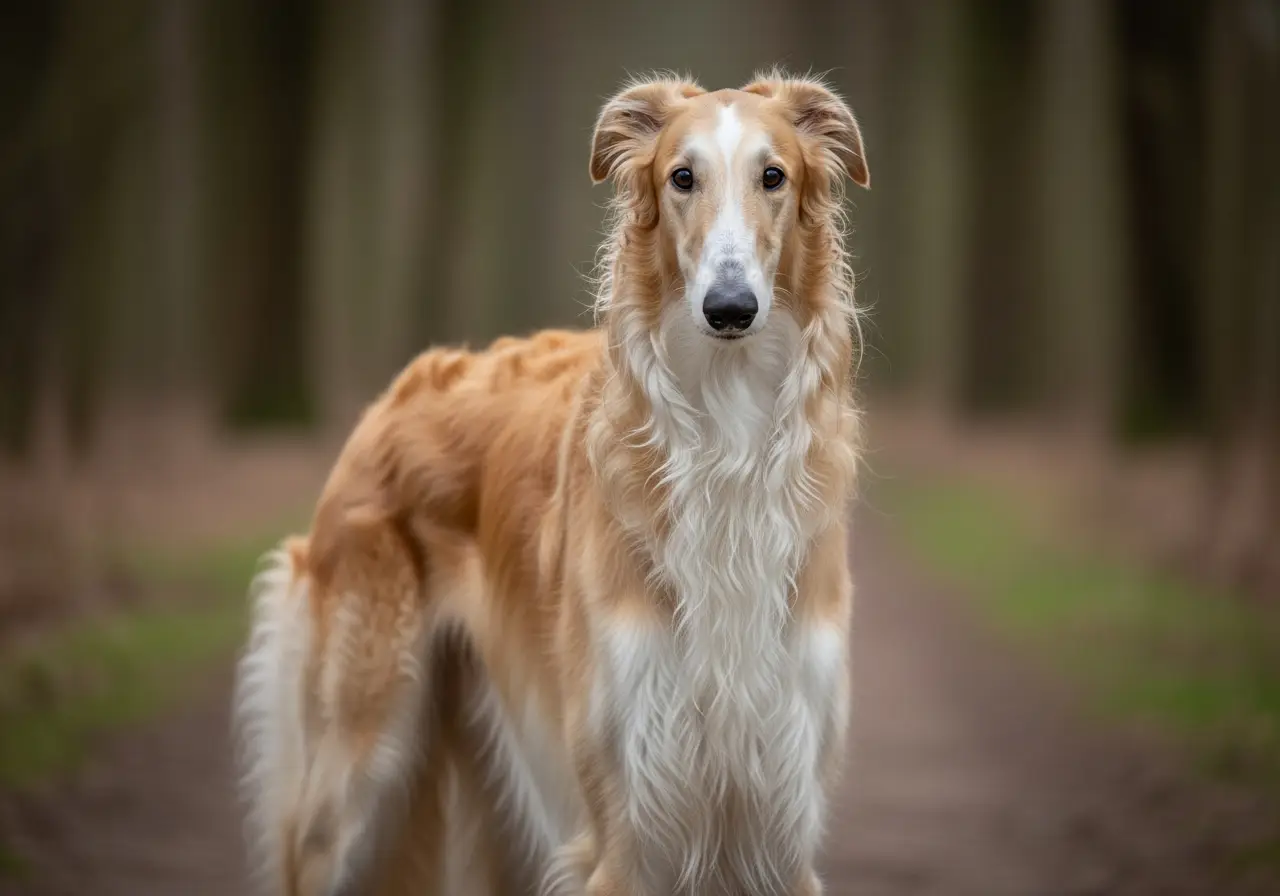
The Borzoi is an elegant Russian sighthound, FCI Group 10, with silky long hair, originally bred for wolf hunting, standing 68–85 cm at the withers.
03Profile
Key facts and suitability
- Origin
- Russland
- Original purpose
- Wolf hunting, coursing
- FCI
- No. 193 · Group 10 · Section 1
- height at the withers
- 68–85 cm
- Weight
- 25–48 kg
- Life expectancy
- 10–12 Years
- Coat type
- Long-haired
- Minimum exercise
- 60 min/day
- Puppy price
- 1'500–3'000 CHF
- Waiting period
- 12 months
- Sports
- Lure Coursing · Racing
04Temperament
How the Barsoi shows up in everyday life
When you come home, the Borzoi greets its primary caregiver calmly, no jumping, no barking, no chaos. It stands up, sniffs briefly, lies down again. This restraint is not disinterest, but an expression of character: The Borzoi is internally present without showing it loudly.
In everyday life, this means concretely: The dog follows its primary caregiver through the apartment, keeps its distance from frantic activity and noise, seeks quiet lying places. It does not need permanent contact, but reacts sensitively to pressure, loud voices or abrupt movements. Whoever communicates in a frantic manner loses its cooperation.
Here the two behavioural axes separate clearly. Internally, i.e. what the dog itself needs, the Borzoi shows a high need for social contact with its core primary caregiver: It wants to be nearby, remain part of the daily rhythm, not be isolated permanently. Externally, i.e. how it reacts to stimuli, it behaves reservedly to distantly towards strangers. A visitor who immediately seeks contact will be ignored or avoided. This is not a training problem, but breed typicality.
On the walk, a different mode kicks in: As soon as a visual stimulus (a hare, a deer, a bird) appears, the prey drive is immediately and fully active. The dog is not responsive at this moment. This state cannot be trained away, only managed. Loose-leash walking in everyday life is quite possible; off-leash without a secured area is not.
The Borzoi generally gets on well with other sighthounds. Caution is advised towards small animals (cats, small pets), as the prey drive does not distinguish between wild and domestic animals.
05Needs
What this breed needs daily
The Borzoi needs about 90 minutes of exercise daily. Here quality is more decisive than duration: Short, intensive sprints in secured terrain correspond to its genetic makeup as a sprinter far more than hours-long leash rounds. A fenced area (at least 1.80 m fence height, as the dog jumps) is almost indispensable.
Coursing and sighthound racing offer species-appropriate stimulation that is close to the original purpose of use. Whoever does not have access to such offers should plan this realistically before getting a dog. Leash walks alone do not fully cover the need for exercise.
Mentally, the Borzoi needs less mental work than, for example, herding or retrieving dogs. Its need for mental work is moderate. Nose work, calm search games or structured freedom training in secured terrain complement the exercise offer sensibly. Classic obedience exercises motivate it little; it works selectively and only with a clear relationship.
The need for social contact is high, but relates to the core primary caregiver. The Borzoi wants to be part of everyday life, not alone permanently. Being left alone for up to five hours is possible if the bond has been built up stably and the dog has received sufficient exercise. It tolerates abrupt changes in the daily rhythm poorly.
Keeping in an apartment is possible if the need for exercise is covered consistently. A quiet home without constant noise, frantic activity or frequent visitors corresponds to its character. Cold sensitivity due to the slim body build must be taken into account in winter; a dog coat for temperatures below five degrees is not an exaggeration, but a practical necessity.
Exercise
High
mental work
Something
Social needs
Medium
training
Demanding
06Sport & Mental and Physical Stimulation
What sports the Barsoi is suited for
Realistic in terms of physiology and genetics – not every breed suits every sport.
Structurally and physiologically suitable: Suitable for mantrailing, dummy work and tracking.
07Quick Check
08Suitability
Who this breed is suitable for – and who it isn't
✓Matches
The Borzoi suits owners who already have experience with independent or sighthound-typical dogs. Whoever knows that recall in open terrain is not a realistic goal and accepts management as an integral part of keeping the dog is well prepared.
Specifically suitable are calm single people or couples with a regulated daily rhythm who can plan at least 90 minutes for exercise daily, including regular sprints in secured terrain. Access to a fenced area or coursing offers is a prerequisite, not an optional extra.
Families with older children from about ten years of age who handle the dog calmly and respectfully are also suitable, provided the home is overall quietly structured. The Borzoi does not tolerate a permanently loud or frantic environment.
Owners who find joy in the relationship with an independent, sensitive dog without expecting permanent willingness to cooperate experience the Borzoi as an extraordinary companion. Whoever plans coursing or sighthound racing as a shared hobby finds a motivated partner in it. Experience with the breed or at least with sighthounds in general is a clear advantage.
×Doesn't match
The Borzoi is unsuitable for owners looking for an obedient companion dog that is available at any time. Whoever expects the dog to run reliably off-leash in the park and respond to recall will be permanently frustrated with this breed.
Households with small animals (rabbits, cats, guinea pigs) carry a considerable risk, as the prey drive does not distinguish between wildlife and pets. Households with toddlers who act loudly and unpredictably also do not provide the environment in which the Borzoi feels comfortable.
Anyone who is away from home for eight hours a day and cannot organise dog care overburdens the Borzoi's need for social contact. Anyone who does not have access to a securely enclosed off-leash area and relies exclusively on walks on a lead fails to meet the species-appropriate exercise requirements.
A common misconception: anyone who plans to keep the Borzoi as a "calm city dog" because it requires little effort indoors confuses the dog's internal calmness with uncomplicated ownership. The prey drive is not compatible with city life without consistent management. First-time owners without prior experience with independent dogs should first familiarise themselves with the breed before making a decision.
10Line reality
Show line, working line, breeder market
The Borzoi is now bred in two main contexts: as a show dog (show type) and as a coursing or racing athlete (working type). The differences are relevant but less pronounced than, for example, in the Labrador or the Irish Setter.
The show type is strongly oriented towards the FCI standard in terms of appearance, proportions, coat, colour and gait. Breeders in this area place value on the aristocratic overall impression. The prey drive remains present as typical for the breed, but is not actively selected for.
The working type, coursing and racing, is bred for speed, endurance and responsiveness. These dogs are generally somewhat slimmer and more athletic, their prey drive is more pronounced and is regularly activated. Anyone getting a Borzoi from this line should plan the sport as an integral part of keeping the dog.
Regionally, lines exist in Russia and Eastern Europe that are more strongly oriented towards the original hunting function. These dogs are rare in Western Europe, but occasionally available through specialised breeders.
The question of the line is relevant for the decision on keeping the dog: A show type from calm breeding and a coursing dog from an active working line place different demands on everyday life. Asking the breeder about the use of the parent animals and their test results provides insight.
11Health · Reality
What you need to plan for medically with your Barsoi
The Borzoi is considered a functionally bred breed with comparatively robust health. The average life expectancy is 10 to 12 years, although well-kept dogs occasionally reach 13 to 14 years.
Gastric torsion (gastric dilatation-volvulus, GDV) is the most serious breed-typical danger. Deep-chested, large-framed dogs are generally more affected; a study by Purdue University (2000) identified deep-chestedness as a significant risk factor. Owners should know the symptoms: distended abdomen, unproductive retching, restlessness. GDV is a veterinary emergency with a time window of just a few hours. Preventive measures recommended include: several small meals instead of one large one, no intense exercise immediately after eating.
Heart problems, particularly cardiomyopathy, occur in large dog breeds and are documented in the Borzoi, although not supported by published breed-specific rates. An annual heart auscultation by the vet is advisable.
Orthopaedic issues such as osteochondrosis (OCD) and fractures of long tubular bones occur due to the slender bone structure. Intensive strain on hard surfaces should be avoided during growth.
Due to the low body fat percentage, the Borzoi reacts sensitively to anaesthetic agents; the treating vet should be informed about the breed before anaesthesia is administered. This point is medically relevant and is explicitly communicated by sighthound breeding associations (DWZRV).
Preventive examinations: annual heart auscultation, weight control (underweight is typical for the breed, overweight however is a sign of lack of exercise), dental check from the 5th year of life.
12Structured data
Health by the numbers
Prone to diseases
Gastric torsion (deep chest), heart problems, osteosarcoma, anaesthesia sensitivity
Recommended health tests
Cardiac examination, keep anaesthesia protocol with the vet
13Myths ↔ Reality
What is often said incorrectly about this breed
Five myths, five realities, five sources.
"The Borzoi is a lap dog, calm, gentle and therefore easy to keep.
The Borzoi is indeed calm and unobtrusive in the house. However, this masks its pronounced sight-hunting instinct, which takes over immediately and uncontrollably upon seeing game. Without secure off-leash areas and consistent management, keeping the dog is not compliant with animal welfare standards. A calm temperament at home does not mean easy everyday care.
"As a sighthound, the Borzoi requires little exercise; a short walk suffices.
Sighthounds are sprinters, not endurance runners; that is true. Nevertheless, the Borzoi needs approximately 90 minutes of exercise daily, including regular short, intense sprints in secure terrain. Continuous walks on a lead do not replace this need. The FCI standard explicitly describes it as a dog that combines great liveliness with endurance.
"The Borzoi was bred for wolf hunting, so it is a guard dog with strong territorial behaviour.
The Borzoi was primarily used for hare and fox hunting, less frequently for wolf hunting. Guarding instinct or territorial behaviour are not pronounced breed traits. It behaves reservedly towards strangers, not aggressively. It is not a guard dog and was never selected for protection tasks.
"Because the Borzoi is so sensitive, it is particularly easy to train.
Sensitivity in the Borzoi means it reacts finely to pressure and haste, not that it is particularly cooperative or obedient. It works selectively and does not perform commands out of obligingness. Classical obedience training quickly reaches its limits with this breed. Experience with independent dogs is a prerequisite, not an option.
"A Borzoi can easily run off-leash; sighthounds always come back.
Recall of a Borzoi in open terrain is not reliable when prey drive is activated. A visual stimulus (a hare, a deer, a bird) is sufficient to propel the dog to speeds exceeding 60 km/h. Off-leash exercise without a secure area poses a significant risk to both the dog and wildlife. Management does not replace training here.
14animal welfare
The animal welfare perspective
Breeder market, designer versions, animal shelter reality — what no one writes in the puppy ad.
The Borzoi is not a breed with a massive backyard breeder problem; it is rare enough that impulse purchases remain the exception. Nevertheless, a grey market exists that capitalises on the elegance and aristocratic appearance of the dog. Puppies from dubious sources are sold without health checks of the parent animals, without socialisation, and without breed knowledge. The price is often lower than that of reputable breeders—a warning sign, not an advantage.
A specific animal welfare issue with the Borzoi is the underestimated prey drive. Many surrenders to shelters and rehoming organisations do not arise from indifference but from being overwhelmed: the owner expected a calm, elegant dog and received one that cannot be kept in a species-appropriate manner without a securely enclosed off-leash area. This mismatch between expectation and reality is the most common reason for surrender.
Designer versions of the Borzoi hardly exist; the breed is not systematically crossed with other breeds. However, offers occasionally appear that sell Borzoi mixes as purebreds. Proof of pedigree from a recognised association (FCI, VDH, SKG, ÖKV) protects against such offers.
Adopting an adult Borzoi from animal welfare is an equivalent option to acquiring a puppy, and in some respects even more advantageous. Adult dogs already show their temperament, the character is assessable, and the prey drive can be realistically assessed in advance during discussions with the rehoming organisation. Specialised sighthound rehoming groups know the breed and can provide targeted advice. Anyone taking in a Borzoi from animal welfare gives a dog a second chance and often receives more transparency about the dog than when buying a puppy.
15Costs · Transparency
What this breed realistically costs
A Barsoi puppy from reputable breeding with a pedigree costs between 1,200 and 2,000 euros in Germany and Austria. Offers significantly below this usually come from non-club-affiliated breeding without documented health examinations.
The annual living costs consist of: food (high-quality dry food or BARF for a large dog) approx. 600–1,000 euros/year, care (comb, occasional trimming of the long hair) approx. 100–200 euros/year, basic equipment (lead, collar, muzzle for coursing, coat for winter) one-off approx. 200–400 euros.
Average vet costs: basic care (vaccinations, parasite prevention, annual check-up) approx. 300–500 euros/year. Emergency costs for gastric torsion can reach 2,000–5,000 euros; pet insurance is therefore particularly recommended for this breed. Monthly premiums range between 50 and 120 euros depending on the provider and scope of cover.
Coursing licences and entry fees for races are additional costs incurred with sporting use, approx. 100–300 euros/year depending on activity.
16Puppy search
What you need to consider when choosing a breeder
- A reputable Borzoi breeder is a member of a recognised breeding association, in Germany for example the German Sighthound Breeding and Racing Association (DWZRV) or an FCI-affiliated club.
- The puppies receive a pedigree, and the parent animals are tested for breed-typical health risks.
- The breeder asks questions about the off-leash area, experience, and daily routine.
- Anyone who does not ask questions is selling, not breeding.
- Warning signs: puppies under twelve weeks old, no visit to the breeder possible, mother not present or not available for viewing, price significantly below 1,000 euros, offers via general classifieds portals without proof of breeding.
- Adopting an adult Borzoi through specialised sighthound animal welfare organisations is a fully valid alternative.
- Adult dogs are assessable in terms of temperament, an advantage over puppies whose character is still developing.
- Rehoming organisations generally conduct preliminary interviews and check living conditions.
- No specific breeder recommendations; points of contact are the DWZRV and the breeding clubs of the national cynological associations (VDH, SKG, ÖKV).
FAQ
Frequently asked questions about the Barsoi
How much exercise does Barsoi need?
At least around 60 minutes of exercise per day.
What is the size and weight of Barsoi?
Fully grown, Barsoi reaches about 68–85 cm at the withers and weighs around 25–48 kg.
What is the life expectancy of Barsoi?
The life expectancy of Barsoi is approximately 10–12 years.
Which diseases are common in Barsoi?
Gastric torsion (deep chest), heart problems, osteosarcoma, anaesthesia sensitivity
17Breed clubs
Official breed clubs in DACH
19Related
Similar breeds – and their differences
You might also be interested in
Participate
Do you have a good photo of your Barsoi?
We are looking for expressive images for our breed profiles. Submit yours; the editorial team reviews every submission before publication.
Does this breed suit you?
Calm, distinguished sighthound with explosive hunting passion. Must always be exercised in a fenced area. Sensitive to anaesthetics – inform the vet.