
01Summary
In a paragraph
If you only have 30 seconds.
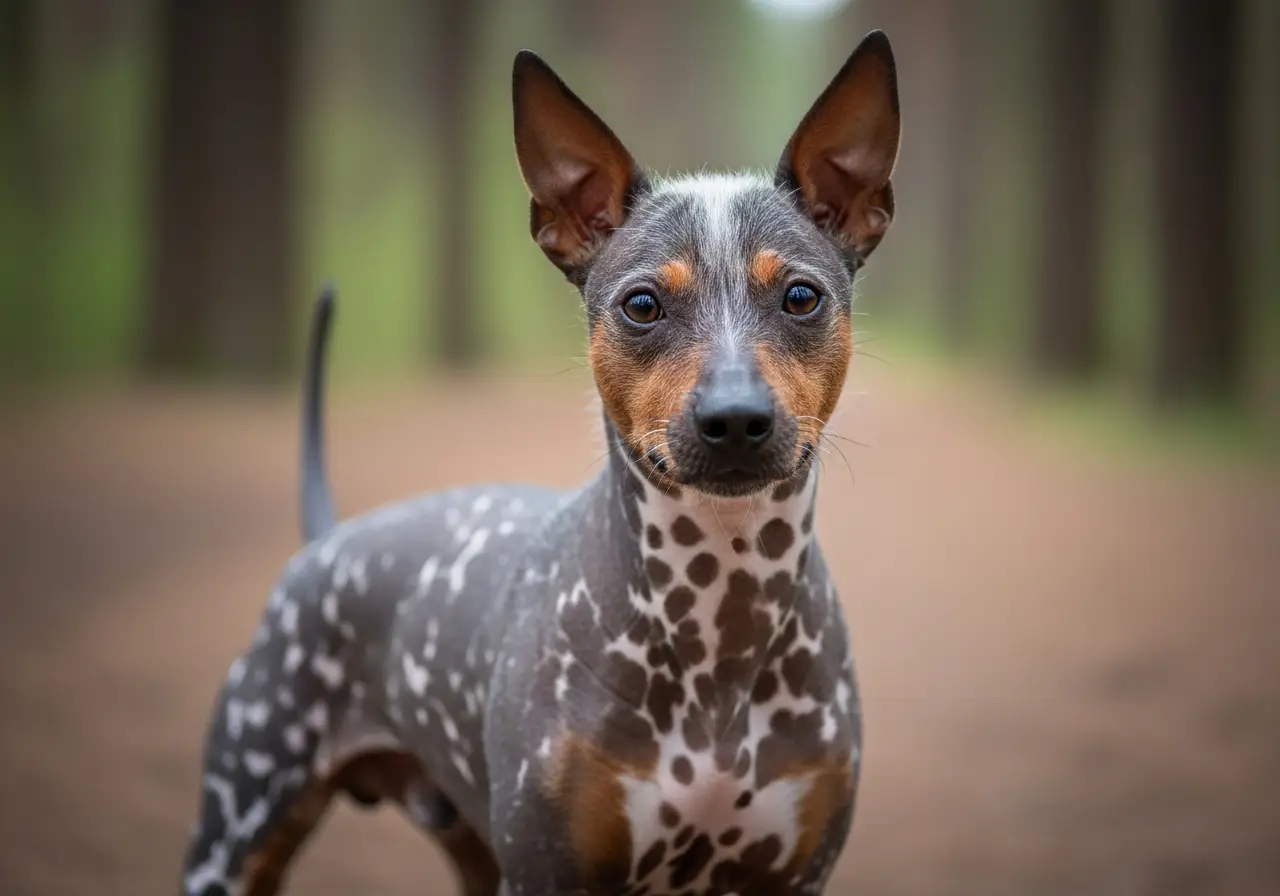
The American Hairless Terrier is a US-American terrier breed that originated from a spontaneous mutation of the Rat Terrier. Its lack of coat does not make it a low-maintenance companion; on the contrary, sun protection, cold protection, and consistent skin care are part of everyday life. Added to this is a pronounced prey drive, a high need for social contact, and a temperament that demands clear structures and regular training. Those who understand this receive a long-lived, eager-to-learn dog with genuine bonding depth.
02Introduction
What makes the American Hairless Terrier special
The American Hairless Terrier is a hairless US terrier, particularly suitable for allergy sufferers, with a withers height of 18–41 cm.
03Profile
Key facts and suitability
- Origin
- USA
- Original purpose
- Companion dog (mutation from Rat Terrier)
- height at the withers
- 18–41 cm
- Weight
- 2–7 kg
- Life expectancy
- 14–16 Years
- Coat type
- hairless dog
- Minimum exercise
- 45 min/day
- Puppy price
- 1'200–2'500 CHF
- Waiting period
- 6 months
- Sports
- Agility · Obedience · Ratting
04Temperament
How the American Hairless Terrier shows up in everyday life
Morning exercise reveals what defines the American Hairless Terrier: it observes every bird, every movement in the bushes, and is on a pursuit course within fractions of a second. The prey drive is not an occasional flare-up, but a permanent baseline state that must be taken into account in training and daily life management.
Internally, the dog requires a high degree of social closeness. It orients itself closely to its primary caregiver, follows movements through the apartment and reacts to mood changes in the household. Being left alone for up to four hours is possible if it has been built up gradually; longer absences without preparation lead to signs of stress.
Externally, the American Hairless Terrier behaves attentively and initially reservedly towards strangers. Friendliness towards unknown people is in the middle range; it is not a dog that immediately greets every visitor. This reserve is not a deficiency, but typical terrier guarding behaviour. Anyone who misinterprets this as shyness and pushes the dog in encounters is more likely to reinforce insecurity than openness.
With other dogs, it shows tolerance with early and consistent socialisation. Towards small animals in the household (rabbits, guinea pigs, birds), the prey drive remains a permanent safety risk that can be managed through training but cannot be completely eliminated.
He enjoys mental work: nose work, search games and short training sequences with a task-based character are within his strengths. Pure enrichment through movement without a mental component is not sufficient.
05Needs
What this breed needs daily
The American Hairless Terrier requires 60 to 90 minutes of active exercise daily, divided into several sessions, not as a single long walk. Monotonous laps without variety are not enough for the dog. Changing terrain, sniffing trails and controlled free work in a secure area suit its profile better than uniform city walks.
Mental stimulation is not an optional add-on. The dog comes from a working line with high responsiveness; without mental work, frustration arises, which manifests itself in barking, restlessness or destructive behaviour. Nose work, search games, short training sequences with varying tasks and impulse control exercises are part of the weekly programme.
The need for social contact is high. The dog is closely oriented towards its primary caregiver and requires active interaction, not just physical proximity. Anyone who ignores the dog for hours in the same room does not meet this need.
Being left alone can be trained, but it is not self-evident. A gradual build-up over weeks is necessary. Four hours are a realistic maximum for a well-prepared dog, not a starting point for the first day.
Climatic requirements constitute a separate category of demands: In summer, the dog needs sun protection (cream or protective clothing) and must not lie in direct sunlight. In winter, it requires protective clothing at outdoor temperatures of around 10 °C. These requirements must be taken into account in everyday life, on every outing, and are not a rare special case.
Exercise
Medium
mental work
Medium
Social needs
High
training
Easy
06Sport & Mental and Physical Stimulation
What sports the American Hairless Terrier is suited for
Realistic in terms of physiology and genetics – not every breed suits every sport.
Structurally and physiologically suitable: Suitable for mantrailing, dummy work and tracking.
07Quick Check
08Suitability
Who this breed is suitable for – and who it isn't
✓Matches
The American Hairless Terrier suits owners who can plan 60 to 90 minutes of active exercise plus structured training time daily. Active individuals or couples without small children, who enjoy consistent training and are prepared to seriously build up recall and impulse control, will find a keen-to-learn partner in this breed.
Families with children from about eight years of age are suitable if the handling of the dog is respectful and calm and supervision during interactions is ensured. The dog does not automatically tolerate lively children's play; it needs opportunities to withdraw and clear rules in the household.
Owners living in an apartment can keep this breed if daily outdoor breaks and mental stimulation are ensured. A garden is not a must, but it must be securely fenced, as the prey drive is also active on one's own property.
Anyone who already has experience with terrier breeds or is prepared to use a dog training school from the beginning is clearly at an advantage. First-time owners are not fundamentally excluded, but they require professional support from the start and should assess the terrier characteristics realistically. Owners who accept climatic peculiarities (sun protection, winter clothing) as a matter-of-course part of everyday life are well positioned for this breed.
×Doesn't match
The American Hairless Terrier does not suit owners who are away from home for more than four hours daily and do not have a reliable care solution. The high need for social contact is not negotiable; prolonged periods of being alone lead to stress behaviour.
Anyone looking for a dog that occupies itself and gets by with minimal training makes the wrong decision with this breed. The prey drive requires active management: leading on a lead in unsecured terrain, consistent recall training and caution towards small animals in the household are not exceptions, but permanent tasks.
Households with small animals (rabbits, guinea pigs, birds, hamsters) carry a permanent risk that can be reduced through training but not eliminated. Anyone who does not wish to take this risk should choose another breed.
Owners who regard skin care as trivial underestimate the effort involved. Sun protection in summer, protective clothing in winter and regular skin care are relevant on every outing, not just in extreme weather conditions.
Anyone who considers the dog's reserve towards strangers a problem and expects an open, sociable dog that greets every visitor joyfully will be disappointed by this breed. The moderate friendliness towards strangers is not a training error; it is a breed characteristic. Anyone who regards this as a deficit should choose a breed with higher friendliness towards strangers.
10Line reality
Show line, working line, breeder market
The American Hairless Terrier has existed as a breed since the 1970s and does not have a historically grown line differentiation in the sense of working versus show lines, as is known, for example, with the Labrador Retriever or German Shepherd Dog.
The breeding base is narrow internationally. In the German-speaking region, there are only a few active breeding facilities, which effectively excludes line differentiation in the DACH region. Most puppies come from US or British lines registered via the AKC (American Kennel Club).
Within the breed, there is a particularity: there are both completely hairless and short-haired representatives; the latter carry the hairlessness gene in a single form (heterozygous) and are phenotypically coated. These short-haired dogs are bred in some litters because mating two hairless parent animals can lead to weakness in part of the puppies. Buyers should know this genetic background and actively ask the breeder how the mating was planned.
A differentiation between performance and exhibition lines is not documented for this breed and would also not be sensible given the small breeding base. The focus is on healthy reproduction and preserving the breed character.
11Health · Reality
What you need to plan for medically with your American Hairless Terrier
According to the AKC breed standard, the life expectancy of the American Hairless Terrier is 14 to 16 years, placing it among the longer-lived dog breeds in its size class.
The most striking health particularity is the bare skin. Sunburn occurs after short exposure without protection and can lead to painful redness, blistering, and long-term skin damage. Vets recommend mineral sun protection (SPF 30+) for uncovered skin areas under direct sunlight. In winter, hypothermia is a real risk; protective clothing at outdoor temperatures of around 10 °C is not a fashion choice but medically justified.
Skin irritations, contact allergies, and acne-like skin changes occur more frequently in this breed than in coated dogs. Regular skin checks and the choice of skin-friendly care products reduce the risk.
Unlike other hairless dog breeds (e.g., Xoloitzcuintle), the American Hairless Terrier does not show a genetically determined prevalence of dental defects; the hairlessness gene of this breed is autosomal recessive and not associated with tooth development disorders (Kimura 2011, NCBI PMC3532182).
Reliable breed-specific HD/ED statistics are not widely available for the American Hairless Terrier due to its small population size. The OFA (Orthopedic Foundation for Animals) conducts evaluations for the breed, but the data base is small. Buyers should request health certificates of the parent animals (heart, patella, eyes) from the breeder; these examinations are standard in reputable breeding operations.
12Structured data
Health by the numbers
Prone to diseases
Sunburn (skin), sensitivity to cold, skin irritation
Recommended health tests
Eye examination
13Myths ↔ Reality
What is often said incorrectly about this breed
Five myths, five realities, five sources.
"The American Hairless Terrier is an allergy-friendly dog; anyone with a dog hair allergy can keep it without problems."
Dog hair allergies are in most cases not directed against the coat itself, but against the protein Can f 1, which occurs in saliva, urine and skin flakes. The American Hairless Terrier also produces this allergen. Anyone who reacts to Can f 1 may also react allergically to this dog. Before getting a dog, an allergy test by a doctor and trial contact with the specific dog are essential.
"Without fur, the dog requires hardly any care."
The opposite is true. The bare skin of the American Hairless Terrier requires regular cleaning, moisturising care and consistent sun protection; sunburn is a real danger. In winter, the lack of an insulating layer requires protective clothing at temperatures below approximately 10 °C. The care effort differs from that of long-haired breeds, but is by no means lower.
"As a small dog, short walks are completely sufficient."
The American Hairless Terrier descends from the Rat Terrier, a working dog with high endurance and a pronounced prey drive. A daily exercise requirement of 60 to 90 minutes plus mental stimulation corresponds to the breed profile. Anyone who underestimates this requirement risks frustration and stress behaviour such as excessive barking, destruction or restlessness.
"The dog has no prey drive; after all, it was bred as a companion dog."
The breed was developed from the Rat Terrier, whose core task was pest control. The prey drive is genetically anchored and remains pronounced in the American Hairless Terrier. Small animals such as rabbits, hamsters or birds in the household pose a real risk. A reliable recall requires consistent training and is not self-evident without being on a lead in open spaces.
"Hairless dogs always have dental problems."
In some hairless dog breeds, such as the Xoloitzcuintle, hairlessness is linked to a dominant gene that also causes dental development disorders. The American Hairless Terrier carries a different, autosomal recessive gene for hairlessness, which has no connection to dental defects. The dentition of this breed generally corresponds to the standard of a fully coated terrier.
14animal welfare
The animal welfare perspective
Breeder market, designer versions, animal shelter reality — what no one writes in the puppy ad.
The American Hairless Terrier is a pronounced rarity in Europe. The breed practically does not appear in animal welfare and rescue stations; those looking for an American Hairless Terrier will rarely find one through rehoming services. This is an honest assessment, not advertising for purchase.
For those still considering animal welfare: mixed hairless dogs or Rat Terrier mixes from abroad are occasionally rehomed via animal welfare organisations. These dogs bring similar requirements (skin care, prey drive, need for social contact) without breed purity. Those who can cope with the profile of an active terrier will find an equivalent option there.
A grey area exists on the breeder market. As the breed is internationally rare, some providers exploit its low recognition: puppies are offered without health certificates of the parent animals, without FCI papers, and without socialisation, often at inflated prices with the argument of rarity. The argument "rare = valuable" does not replace breeding documentation.
A specific animal welfare problem of this breed is the misjudgement of temperament. Buyers who expect a low-maintenance dog for allergy sufferers and receive an active terrier with prey drive often surrender the dog after a few months. These surrenders rarely end up in organised animal welfare; they are often passed on informally, making the dog's socialisation history difficult to trace for the next owner.
Designer versions or crosses with the label "Hairless Terrier" without clear lineage are present on the market. Those buying an American Hairless Terrier should insist on FCI or AKC proof of descent and actively ask the breeder about the mating strategy (hairless × short-haired parent animal); this is not distrust but an informed decision.
15Costs · Transparency
What this breed realistically costs
A puppy from a reputable breeder with FCI or AKC papers costs between 1,500 and 2,500 EUR in the German-speaking area. Offers significantly below this, under 800 EUR, should be critically examined: missing health certificates of the parent animals and inadequate socialisation are common accompanying factors.
Annual living costs for an American Hairless Terrier are experienced to be above average compared to similar small dog breeds. The main reason is skin care. Sun protection products (mineral, vet-recommended), protective clothing for winter and summer, as well as regular skin checks at the vet add up to an estimated 200 to 400 EUR per year in addition to standard costs.
Food for a dog of this size (up to approx. 8 kg) costs 40 to 80 EUR per month with high-quality nutrition, i.e., 480 to 960 EUR annually.
Vet costs for basic care (vaccinations, parasite prevention, annual check-up) are 300 to 500 EUR per year. Additional treatments due to skin conditions (allergy clarification, skin irritations) can significantly increase this amount.
Dog liability insurance costs from approx. 50 to 100 EUR annually for this size class. Health insurance is recommended given the skin-specific risks; annual premiums start at around 300 EUR, depending on provider and scope of benefits.
16Puppy search
What you need to consider when choosing a breeder
- Reputable breeders of the American Hairless Terrier are rare in the German-speaking area.
- The first point of contact is the VDH (Verband für das Deutsche Hundewesen) or the FCI member associations in Austria (ÖKV) and Switzerland (SKG), where affiliated breeding facilities are listed that must adhere to minimum standards in health examinations and socialisation.
- A reputable breeder presents health certificates for both parent animals (at least patella, heart, eyes), explains the mating strategy (hairless × short-haired parent) and allows visits to the litter before the puppy is handed over.
- Puppies leave the breeding facility no earlier than at eight weeks of age, are microchipped, vaccinated and dewormed.
- For those not looking for a puppy from a breeder: animal welfare organisations occasionally mediate Rat Terrier mixes or similar dogs with a comparable profile.
- Platforms such as Petfinder (USA) or European animal welfare networks list such dogs.
- The requirements for keeping and training are the same; the origin is different.
- Be cautious of offers without papers, without the possibility of a visit and with advance payment before meeting the dog.
- The argument of "rarity" does not justify missing documentation.
- Anyone who is unsure can consult the responsible breed club before purchasing.
FAQ
Frequently asked questions about the American Hairless Terrier
Is American Hairless Terrier suitable for beginners?
American Hairless Terrier is considered suitable for first-time dog owners.
Is American Hairless Terrier a family dog?
American Hairless Terrier is considered suitable for families with good socialisation and species-appropriate care.
How much exercise does American Hairless Terrier need?
At least around 45 minutes of exercise per day.
Does American Hairless Terrier suit an apartment?
With enough exercise and enrichment, American Hairless Terrier can also be kept in an apartment.
What is the size and weight of American Hairless Terrier?
Fully grown, American Hairless Terrier reaches about 18–41 cm at the withers and weighs around 2–7 kg.
What is the life expectancy of American Hairless Terrier?
The life expectancy of American Hairless Terrier is approximately 14–16 years.
Is American Hairless Terrier suitable for allergy sufferers?
American Hairless Terrier is considered relatively hypoallergenic. There’s never a guarantee — test direct contact beforehand.
Which diseases are common in American Hairless Terrier?
Sunburn (skin), sensitivity to cold, skin irritation
17Breed clubs
Official breed clubs in DACH
19Related
Similar breeds – and their differences
You might also be interested in
Participate
Do you have a good photo of your American Hairless Terrier?
We are looking for expressive images for our breed profiles. Submit yours; the editorial team reviews every submission before publication.
Does this breed suit you?
Ideal for allergy sufferers due to lack of fur. Needs sun protection and warm clothing. Lively, eager-to-learn terrier for active city dwellers.