
01Summary
In a paragraph
If you only have 30 seconds.
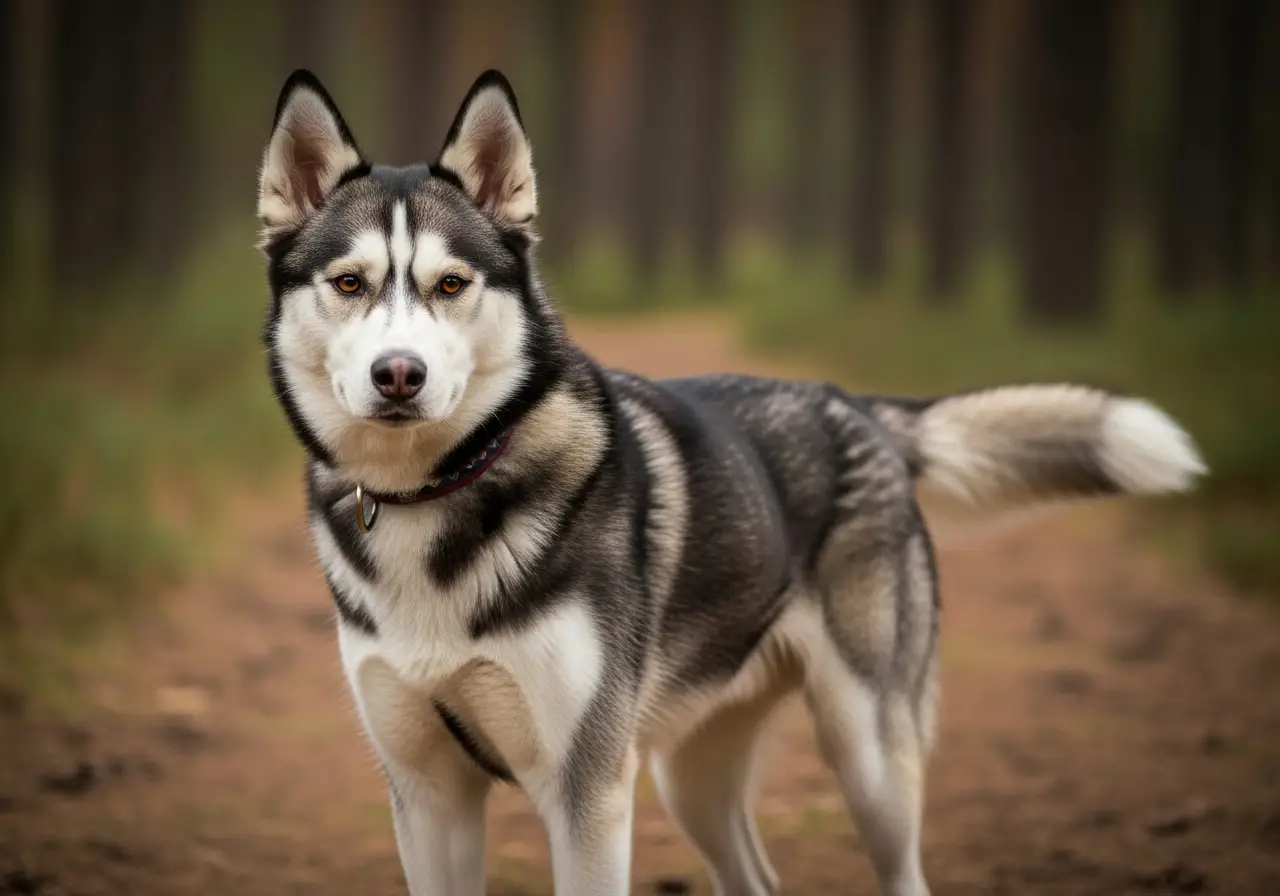
The Alaskan Husky is not a recognised breed type in the FCI sense, but rather a performance-bred sled dog type from North America. Its entire profile (endurance, team orientation, drive for movement) emerged through decades of selection for suitability in sled dog sports. Anyone bringing this dog into their daily life is not taking on an animal with show qualities, but a working partner that demands intensive physical stimulation every day.
02Introduction
What makes the Alaskan Husky special
The Alaskan Husky is not an FCI-recognised type, but a performance-bred sled dog from Alaska, withers height 55–65 cm.
03Profile
Key facts and suitability
- Origin
- USA (Alaska)
- Original purpose
- High-performance sled dog (racing)
- height at the withers
- 55–65 cm
- Weight
- 16–27 kg
- Life expectancy
- 10–15 Years
- Coat type
- Doppel
- Minimum exercise
- 120 min/day
- Puppy price
- 500–1'500 CHF
- Waiting period
- 3 months
- Sports
- Canicross · Bikejöring · Sled dog sports · Skijöring
04Temperament
How the Alaskan Husky shows up in everyday life
When you come home after a long day at work, the owner is not greeted by a relaxed dog with a calm welcome ritual. The Alaskan Husky signals immediately: it needs exercise, and now. Anyone who grabs the lead and strolls through the park for an hour will bring home a dog that is still far from sufficiently stimulated.
Internally, i.e. due to its genetics, this dog carries an exercise need that could hardly be higher on the scale. Mental work alone is not enough. Snuffle mats and puzzle games are a supplement, not a replacement. The actual stimulation arises from coordinated physical activity: pulling, pace, endurance.
Externally, i.e. in its reaction to its environment, a different picture emerges. Towards strangers, the Alaskan Husky is generally open and not very reserved. Territorial behaviour was not desirable in breeding; a dog that reacted aggressively towards strangers in the team would have been unsuitable. This openness does not mean, however, that it is a guard dog; it is not.
The prey drive varies depending on the line composition. In dogs with pointing or sighthound ancestry, it can be strongly pronounced. Unsecured off-leash exercise without a reliable recall therefore carries real risks. In everyday life, this means: long lead in unfamiliar terrain, secured exercise area at home.
With conspecifics, it is generally tolerant; teamwork in the team was a prerequisite, not a bonus. Anyone keeping several dogs facilitates social stimulation. Anyone leading it as a single dog must compensate for social contact through intensive joint activity.
05Needs
What this breed needs daily
The Alaskan Husky requires at least two hours of structured exercise daily, realistically three hours or more for sport-oriented lines. Relaxed walks do not count as stimulation. What counts: dog sports involving pulling, bikejöring, canicross, skijöring in winter or coordinated running sessions with a clear training structure.
Mental stimulation supplements physical exercise, but does not replace it. Nose work, search games or obedience training are sensible supplements on rest days or in bad weather. A dog that is physically understimulated cannot be stabilised by mental work alone.
The need for social contact is in the medium range. The Alaskan Husky is not a dog that demands constant human proximity, but it is also not a loner. Keeping with one or more conspecifics corresponds to its social structure from team keeping. Being left alone is possible for about four hours after sufficient exercise; thereafter, the risk of stress increases.
A secured exercise area is not a luxury, but a basic requirement. The prey drive, varying in intensity depending on the line, makes unsecured off-leash exercise in open terrain risky. A fenced property or a secured dog run enables free movement without loss of control.
Keeping in an apartment works under one condition: the owner provides the necessary daily training load, regardless of weather, season or daily form. Anyone who does not implement this consistently structurally underestimates this dog.
Exercise
Very high
mental work
A lot
Social needs
Medium
training
Medium
06Sport & Mental and Physical Stimulation
What sports the Alaskan Husky is suited for
Realistic in terms of physiology and genetics – not every breed suits every sport.
Structurally and physiologically suitable: Suitable for mantrailing, dummy work and tracking · CaniCross / bikejoring possible.
07Quick Check
08Suitability
Who this breed is suitable for – and who it isn't
✓Matches
The Alaskan Husky suits owners who already have experience with working dogs or sled dog sports. First-time owners without prior dog experience face a steep learning curve; it is not impossible, but only realistic with the support of a dog training school and a clear training routine.
Specifically suitable are: athletes who can integrate two to three hours of active movement into their daily routine, runners, cyclists, skiers who want to use their dog as a training partner. Families with children aged ten and above, in which at least one adult person manages and ensures the sporting training routine. Owners with access to secure exercise areas or a rural environment where sled dog sports can be practically implemented.
Those who already have experience with Nordic breeds or working dogs will understand the basic structure of this dog more quickly. Those willing to maintain the training workload in all weather conditions (rain, snow, heat with adjustments) will find a performance-ready partner. The dog does not simply overlook under-stimulation; it shows it clearly.
×Doesn't match
The Alaskan Husky does not suit owners who are away from home for eight hours daily and do not have a reliable dog care plan. Four hours alone is the realistic maximum; beyond that, stress patterns emerge that become entrenched in everyday life.
It is unsuitable for casual sports enthusiasts who jog on good days and prefer the couch on bad days. This dog requires consistency, not motivation dependent on the weather. Anyone hoping that two hours of city walking will suffice will experience an unsatisfied dog and bear the consequences.
Anyone who gets an Alaskan Husky for its appearance while ignoring its internal profile (exercise need 5/5, mental work need 4/5) makes a structural error. Openness towards strangers does not mean the dog is content with little stimulation. The external friendliness masks the internal demands.
It is also risky for owners without secure exercise areas and with a strong desire for off-leash freedom in open terrain; the prey drive makes reliable recall a training task that requires time and consistency. Anyone who does not plan for this endangers the dog.
10Line reality
Show line, working line, breeder market
The Alaskan Husky does not exist as a uniform line, but as a spectrum of performance-oriented breeding directions. The most important distinction lies between long-distance and sprint lines.
Long-distance lines, bred for races such as the Iditarod over 1,600 kilometres, prioritise endurance, paw stability, feed efficiency and mental resilience over days. These dogs are calmer in their basic temperament, but their need for endurance is enormous. As a pet, they require long, structured sessions daily.
Sprint lines, for races of 6 to 30 kilometres, often carry higher proportions of Greyhound or other sighthounds. They are faster and more explosive, but also more sensitive in their nervous system. Their prey drive is often more pronounced. In everyday life, they react more intensely to stimuli.
For owners without a dog sport background, the line origin of a specific dog is decisive. A dog from long-distance breeding and a dog from sprint breeding pose different demands, although both are referred to as “Alaskan Husky”. Anyone taking over a dog from dissolved sled dog kennels should ask the previous owner about the line of origin.
11Health · Reality
What you need to plan for medically with your Alaskan Husky
The Alaskan Husky is considered a robust working type because performance-oriented breeding excludes dogs with hereditary diseases from breeding activities early on. The life expectancy is 12 to 15 years, a value that is above average for a large dog.
Nevertheless, specific health risks exist. Orthopaedic stress injuries due to intensive endurance sports are documented: shoulder and carpal joint injuries occur regularly in sled dog sport dogs. A study by the University of Alaska Fairbanks (2019) showed that Iditarod participants required veterinary treatment in up to 30% of cases during or after the race, predominantly affecting the musculoskeletal system and paws.
Gastric torsion (gastric dilatation-volvulus) is a real risk in large, deep-chested dogs with high activity levels. Feeding immediately before or after intense exercise increases the danger. Two smaller meals instead of one large portion demonstrably reduce the risk.
Cardiovascular strain during high-performance training requires regular check-ups. A basic cardiological examination is recommended before starting an intensive training programme. Eye diseases such as progressive retinal atrophy (PRA) occur in individual lines; an eye test for breeding animals is advisable.
The coat is functional and easy to care for: heavy shedding twice a year, otherwise low maintenance effort. Regular paw checks after sports sessions are mandatory.
12Structured data
Health by the numbers
Prone to diseases
Progressive retinal atrophy, thyroid problems, hip dysplasia
Recommended health tests
Eye examination, thyroid screening
13Myths ↔ Reality
What is often said incorrectly about this breed
Five myths, five realities, five sources.
“The Alaskan Husky is the same as a Siberian Husky, just without papers.
The Siberian Husky is an FCI-recognised breed with a binding standard (FCI Group 5, No. 270). The Alaskan Husky, on the other hand, is a performance-oriented working type without a breed standard, genetically carrying parts of pointing dogs, sighthounds and Northern spitzes. Appearance, weight and coat structure vary considerably between lines.
“Two hours’ walk daily are enough for an Alaskan Husky.
Two hours of relaxed walking do not even begin to cover the exercise needs of a performance-bred Alaskan Husky. Sport-oriented lines require structured endurance training (bikejöring, canicross or sledding) for several hours daily. Understimulation manifests as frustrated behaviour, destruction and persistent vocalisation.
“Alaskan Huskies are wolves in a domestic coat and therefore dangerous.
The Alaskan Husky has been selected over generations for teamwork with humans and other dogs. Aggression towards people or team partners was undesirable in breeding, as it impaired racing suitability. Territorial behaviour is weakly pronounced. Confusion with wolf-hybrid appearance leads to unfounded prejudices.
“As a sled dog type, he copes easily being left alone; after all, he is a working dog.
Alaskan Huskies were kept in teams and rely on social contact with humans and conspecifics. A need for social contact score of 3/5 means: the dog tolerates periods of rest after sufficient stimulation, but is not a loner. Being left alone for more than four hours without prior intensive exercise leads to stress behaviour.
“The Alaskan Husky is completely healthy due to its robustness and hardly requires vet visits.
Performance-oriented breeding does reduce certain hereditary diseases, but does not rule out orthopaedic stress injuries from intensive sport. Gastric torsion (bloat), paw injuries and cardiovascular strain are documented in high-performance dogs. Regular veterinary check-ups, particularly of the locomotor system and heart function, are mandatory for sport-oriented dogs.
14animal welfare
The animal welfare perspective
Breeder market, designer versions, animal shelter reality — what no one writes in the puppy ad.
The Alaskan Husky type appears in animal welfare contexts for a specific reason: sled dog sport dogs are rehomed when their performance declines, they get injured, or a kennel is dissolved. This is not an isolated phenomenon; it is a structural characteristic of sled dog sports. Anyone taking on an Alaskan Husky from animal welfare often gets a trained, socialised dog with a clear work history.
Backyard breeders and unscrupulous suppliers have recognised the trend towards Nordic dogs. Puppies resembling Alaskan Huskies are offered on classifieds platforms without proof of origin, without health tests for the parent animals and without lineage details. The buyer receives no information as to whether the dog comes from a long-distance or sprint line, a difference that significantly affects everyday life.
As the Alaskan Husky does not have an FCI standard, there is no studbook that enforces transparency. This makes it easier for unscrupulous suppliers. Anyone buying a puppy should explicitly ask about the parent animals, their performance history and health certificates.
Problems related to keeping almost exclusively arise from under-stimulation. An Alaskan Husky that requires three hours of structured exercise daily but instead waits in a city apartment develops behavioural problems, not out of malice, but due to unfulfilled work drive. Many surrenders to animal shelters have exactly this cause.
Adopting an adult Alaskan Husky from animal welfare is an equivalent option to buying a puppy, often even more transparent, as the character and exercise needs of the specific dog can already be assessed.
15Costs · Transparency
What this breed realistically costs
The purchase price for an Alaskan Husky puppy from a reputable source ranges between 800 and 1,500 euros, depending on lineage composition and origin. Dogs from dissolved racing kennels or animal welfare are significantly cheaper or free of charge; protection fees usually range between 150 and 400 euros.
The annual living costs consist of: food (high-quality, high-protein for working dogs) approx. 800–1,200 euros/year; basic vet care (vaccinations, parasite prophylaxis, annual check-up) approx. 300–500 euros/year; sports equipment (sledding harness, lead, bikejoring adapter) one-off 200–500 euros. In addition, there are training and course costs at sled dog sports clubs: 100–300 euros/year.
Pet insurance is advisable for a high-performance dog. Monthly premiums range between 40 and 90 euros (approx. 480–1,080 euros/year) depending on the provider and coverage scope. Orthopaedic treatments after sports injuries can quickly reach 1,000–3,000 euros without insurance.
Total costs in the first year (incl. purchase, basic equipment, vet): realistically 3,000–5,000 euros. From the second year onwards: 1,500–2,500 euros/year with sporting guidance.
16Puppy search
What you need to consider when choosing a breeder
- As the Alaskan Husky is not an FCI-recognised breed type, there is no studbook and no association control.
- This significantly increases the duty of care when purchasing.
- Reputable providers name the lineage composition of the parent animals and can provide performance records or backgrounds in sled dog sports.
- They allow a visit to the litter, show both parent animals, and make health certificates available (at least eye tests, heart examinations).
- A reputable provider actively asks about the buyer's daily routine and refuses to hand over the dog if the exercise needs cannot be met.
- Warning signs: puppies without origin details on classifieds platforms, missing information on lineage, no right to visit the litter, prices significantly below 800 euros without explanation.
- Adopting an adult Alaskan Husky from animal welfare organisations or dissolved sled dog kennels is a fully valid alternative.
- The character, exercise needs, and social behaviour of the specific dog are already assessable in an adult animal, which is an advantage over a puppy.
- Animal welfare organisations with experience in Nordic working dogs can provide advisory support during the rehoming process.
FAQ
Frequently asked questions about the Alaskan Husky
Is Alaskan Husky a family dog?
Alaskan Husky is considered suitable for families with good socialisation and species-appropriate care.
How much exercise does Alaskan Husky need?
At least around 120 minutes of exercise per day. As an active breed, more so — plus mental stimulation.
What is the size and weight of Alaskan Husky?
Fully grown, Alaskan Husky reaches about 55–65 cm at the withers and weighs around 16–27 kg.
What is the life expectancy of Alaskan Husky?
The life expectancy of Alaskan Husky is approximately 10–15 years.
Which diseases are common in Alaskan Husky?
Progressive retinal atrophy, thyroid problems, hip dysplasia
17Breed clubs
Official breed clubs in DACH
19Related
Similar breeds – and their differences
You might also be interested in

Participate
Do you have a good photo of your Alaskan Husky?
We are looking for expressive images for our breed profiles. Submit yours; the editorial team reviews every submission before publication.
Does this breed suit you?
Not an FCI-recognised breed type, but a performance dog for racing. Needs extreme stimulation. Not suitable for normal household keeping without sporting use.