
01Summary
In a paragraph
If you only have 30 seconds.
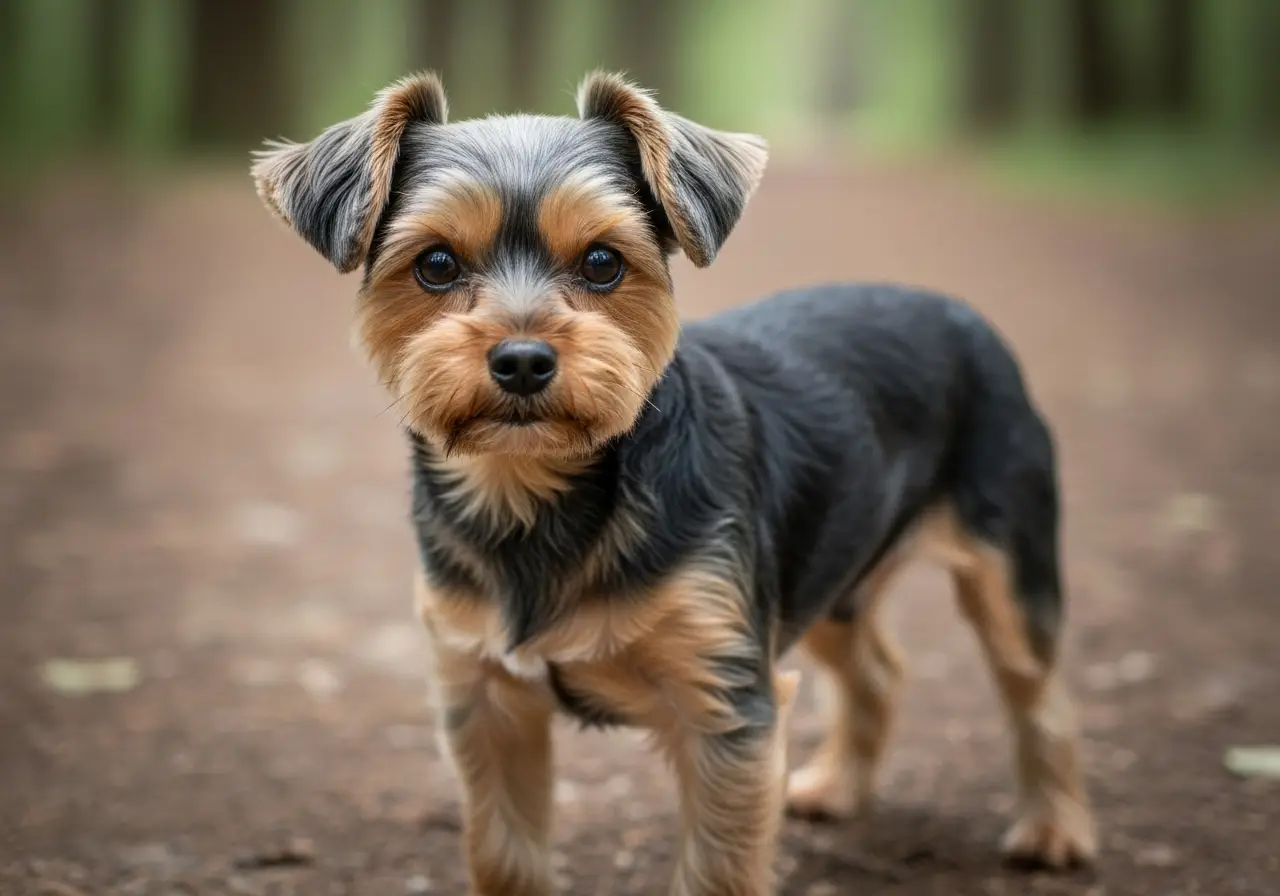
The Yorkiepoo is a crossbreed not recognised by the FCI, consisting of a Yorkshire Terrier and a Toy or Miniature Poodle. It combines two genetically very different types; the result varies considerably in temperament, coat structure and health. Anyone choosing this dog will encounter a lively, trainable companion with pronounced independence. This demands daily structure, consistent training and careful selection of origin.
02Introduction
What makes the Yorkiepoo special
Yorkiepoo: Cross between Yorkshire Terrier and Miniature Poodle, small, lively, and with a variable character depending on genetics
03Profile
Key facts and suitability
- Origin
- USA
- Original purpose
- Companion dog
- height at the withers
- 18–38 cm
- Weight
- 2–10 kg
- Life expectancy
- 10–15 Years
- Coat type
- Gelockt
- Minimum exercise
- 30 min/day
- Puppy price
- 600–1'400 CHF
- Waiting period
- 2 months
- Sports
- Tricks Nose work
04Temperament
How the Yorkiepoo shows up in everyday life
When you come home, a Yorkiepoo with a strong terrier component immediately makes its presence felt: it announces itself, observes the situation and then decides whether greeting or control is in order. This is not a mistake, this is terrier instinct. A Yorkiepoo with a stronger poodle component reacts more cooperatively, seeks physical contact more quickly and orients itself towards the owner.
Internally, what the dog needs: The need for social contact is high. The Yorkiepoo is oriented towards human closeness and does not tolerate long periods of being alone well. Mental work is not a bonus but a basic requirement: nose work, trick training and short training sessions are part of the daily routine. The exercise requirement is about 60 minutes of active stimulation, distributed over several sessions, not as a single walk.
Externally, how the dog reacts to stimuli: Towards strangers, the Yorkiepoo behaves attentively to reserved. Friendliness towards unknown people is in the middle range; it is not a dog that accepts every visitor immediately. Early, broad socialisation is crucial so that alertness does not turn into barking or overreactions.
With other dogs, it shows itself to be compatible with good socialisation, but can bring a clear independence due to the terrier component. Hunting motivation is possible, especially with small, fast-moving animals. In everyday life, this means: leash control and recall training are not optional extras.
The combination of high need for social contact and moderate friendliness towards strangers must not be confused: A Yorkiepoo that clings closely to its primary caregiver is not automatically open to every person in the household or on the street.
05Needs
What this breed needs daily
The Yorkiepoo needs at least 60 minutes of active exercise daily, divided into several sessions. A single long walk is not enough; the dog benefits from variety in pace, terrain and stimuli.
Mental stimulation is equal to physical exercise. Trick training, nose work, search games and short fetching sequences cover the need for mental work. Without this component, restlessness, excessive barking and self-directed enrichment arise, usually to the detriment of the apartment furnishings.
The need for social contact is pronounced. The Yorkiepoo is strongly oriented towards its primary caregiver and does not tolerate periods of being alone of more than four hours well if no gradual build-up has taken place. Anyone who is regularly away from home for longer periods needs a reliable care solution, dog day care or a familiar person in the household.
Training must be consistent and varied. The poodle component brings high willingness to learn, the terrier component brings independence. Inconsistency is quickly exploited. Attending a dog training school in the first months of life is sensible, not as a luxury but as a structuring measure.
The alerting behaviour must be guided early on. Barking is functional and genetically anchored for this type. Suppression does not work, redirecting to an alternative behaviour does.
Keeping the dog in an apartment is possible if exercise, structure and mental enrichment are ensured. A garden does not replace active stimulation but makes everyday life easier. Regular grooming, depending on coat type weekly to every six weeks at the groomer, is part of the care effort.
Exercise
Medium
mental work
A lot
Social needs
High
training
Medium
07Quick Check
08Suitability
Who this breed is suitable for – and who it isn't
✓Matches
The Yorkiepoo suits owners who can plan at least 60 minutes of active exercise and regular training sessions daily. Experience with sensitive or independent dogs is a clear advantage; anyone who has already kept a terrier or poodle knows the requirements for consistency and variety in training.
Suitable for individuals or couples with a flexible daily routine who can take the dog along frequently or organise reliable care. Families with children from about eight years of age are suitable, provided that the children are familiar with respectful handling of small dogs and the dog is not treated as a toy.
Those living in an apartment can keep this dog, provided that exercise takes place outdoors and alerting behaviour is trained early on. Consideration for neighbours is a real factor in multi-unit buildings.
Owners who enjoy active training and are willing to integrate nose work or trick training into everyday life will be rewarded with an attentive, trainable dog. Anyone looking for a dog that occupies itself is mistaken here; anyone looking for a dog that thinks along and works together is right.
×Doesn't match
The Yorkiepoo is not suitable for owners who wish to invest little time in daily training and structured enrichment. Anyone who assumes that a small dog is content with short walks and little attention will be confronted with barking problems, restlessness or resource guarding.
Not suitable for households where the dog regularly spends more than four hours alone without a care solution being in place. The high need for social contact is not a character flaw; it is genetically anchored and cannot be trained away.
Anyone who chooses the dog primarily because of its appearance or the trend and considers health checks of the parent animals unnecessary assumes a considerable risk of costly follow-up problems. The Yorkiepoo is not a dog for owners who consider training optional because the body size is small.
Families with very young children under six years of age should carefully weigh up the combination of terrier reaction joy and childish behaviour. Anyone who equates the high need for social contact with general friendliness towards strangers (i.e. expects the dog to welcome every visitor warmly) fundamentally misunderstands the profile of this crossbreed.
10Line reality
Show line, working line, breeder market
The Yorkiepoo has no recognised breeding lines in the cynological sense. There is no FCI standard, no VDH studbook and no binding breeding objective. The differences between individual animals arise primarily from the choice of parent dogs.
Two factors are relevant for buyers: firstly, the poodle line used (Toy Poodle or Miniature Poodle), which significantly influences size, energy level and coat structure; secondly, the crossbreeding generation. F1 animals (direct cross Yorkshire Terrier × Poodle) show the greatest variance in temperament and appearance. F1b animals (backcross with Poodle) are said to have a higher poodle content and are marketed by some breeders as “more allergy-friendly”, a promise that is not consistently supported by scientific evidence.
Some North American hybrid registers such as the American Canine Hybrid Club (ACHC) or the Designer Dogs Kennel Club (DDKC) list the Yorkiepoo as a type without enforcing binding health or temperament standards. No comparable structure exists in the German-speaking region.
In practice, this means that buyers must assess the quality of breeding exclusively on the basis of the parent dogs, the health documents and the living conditions, not on the basis of association certificates or line designations.
11Health · Reality
What you need to plan for medically with your Yorkiepoo
The Yorkiepoo can inherit hereditary diseases from both parent breeds. Relevant conditions include patellar luxation, dental problems due to small jaws, progressive retinal atrophy (PRA) and Legg-Calvé-Perthes disease (femoral head necrosis). The latter occurs in Yorkshire Terriers with a frequency of approximately 5–10% (source: OFA, status 2023).
Patellar luxation is common in both parent breeds. In Yorkshire Terriers, the OFA evaluation rate for patellar luxation is approximately 9.5% of examined animals (OFA database, status 2023). Similar values are documented for Toy Poodles. Since both parent breeds can be affected, the risk for offspring without parent animal screening is increased.
Life expectancy is between 12 and 15 years, depending on size, lineage and keeping conditions. Smaller animals with Toy Poodle content tend towards the upper range, provided no serious hereditary diseases are present.
Dental problems are common in small dogs with narrow jaws: baby teeth remain, tartar forms early. Regular dental care and annual veterinary checks are necessary, not optional measures.
Preventive examinations that should be available for the parent animals before purchase: patella examination (OFA or equivalent), eye examination (CAER/ECVO), DNA test for PRA. A reputable breeder provides these documents unsolicited. Overweight is a real risk in this type; small dogs often receive too many treats during training. Already 200 g of overweight corresponds to over 6% of body weight in a 3-kg dog.
12Structured data
Health by the numbers
Prone to diseases
Kneecap problems Eye problems
Recommended health tests
Kneecap check Eye examination
13Myths ↔ Reality
What is often said incorrectly about this breed
Five myths, five realities, five sources.
“Yorkiepoos are hypoallergenic and do not trigger allergies.
No dog is completely allergen-free. Allergies arise primarily from the protein Can f 1 in saliva and skin flakes, not solely from hair. Poodle influence can reduce shedding but does not eliminate allergens. The coat structure varies considerably depending on genetics; no guarantee exists.
“As a mixed-breed dog, the Yorkiepoo is automatically healthier than its parent breeds.
The so-called hybrid advantage (heterosis) does not occur automatically. If parent dogs with the same recessive hereditary diseases are bred together, the risk for offspring increases. Patellar luxation, dental problems, and eye diseases are common in both parent breeds and can be passed on to Yorkiepoos. Without health testing of the parent dogs, no advantage is proven.
“Small dogs require little training; the Yorkiepoo manages that by itself.
Small dogs are often neglected in training because undesirable behaviour is considered less dangerous. The Yorkiepoo possesses pronounced terrier independence and Poodle intelligence, both of which demand consistent, varied guidance. Without clear rules, alert barking, resource guarding, and leash reactivity develop.
“The Yorkiepoo is a calm lap dog for elderly people.
The exercise requirement is at least 60 minutes daily, supplemented by mental stimulation. The terrier component brings alertness, a willingness to react and, in some cases, pronounced hunting motivation. Keeping the dog calmly without sufficient enrichment leads to behavioural problems. Older owners are suitable if they are active and experienced in dealing with sensitive dogs.
“Yorkiepoos always look the same: small, curly, compact.
Appearance, size and coat structure vary considerably depending on the poodle line used (Toy or Miniature) and the terrier component. A weight between 2 and 6 kg and a height at the withers between 18 and 38 cm are possible. Some animals have a smooth coat, others a highly curly one. Buyers who expect a specific appearance run a high risk of disappointment.
14animal welfare
The animal welfare perspective
Breeder market, designer versions, animal shelter reality — what no one writes in the puppy ad.
The Yorkiepoo belongs to the designer hybrids most frequently distributed via classifieds platforms and backyard breeder networks in the German-speaking area. Because no FCI standard exists, there is a lack of binding control by breeding associations. This creates a market where animals are produced and sold without health checks of the parent animals, without veterinary support and without a socialisation concept.
Typical warning signs in the backyard breeder market: puppies under eight weeks old, no personal visit to the breeder possible, no documentation of the parent animals, sale via intermediaries or shipping. Prices below 800 euros for a Yorkiepoo puppy are generally an indicator of missing investments in health and socialisation, not a good deal.
Designer versions such as "Teacup Yorkiepoos" or particularly small variants arise from targeted breeding of underweight or sick parent animals. These animals carry an increased risk of hypoglycaemia, heart problems and skeletal diseases. The appearance is not a quality feature.
Problems related to keeping often arise from underestimating the temperament. Yorkiepoos end up in animal welfare shelters because their barking behaviour leads to conflicts in multi-storey buildings, because their need for social contact was not met or because training was neglected. This is not a failure of the dog; it is an information problem at the time of purchase.
Adoption through animal welfare organisations is an equally valid option. Mixed-breed dogs of this type are regularly found in German and Austrian animal shelters as well as at specialised adoption agencies. An adult dog from an adoption agency has the advantage that temperament and health status can already be assessed, and the surprise variance of the F1 cross largely disappears.
15Costs · Transparency
What this breed realistically costs
A Yorkiepoo puppy from a reputable breeder with health documents for the parent animals costs between 1,200 and 2,500 euros in the German-speaking region. Prices below this generally signal missing investments in health tests or socialisation. Through animal welfare organisations, the adoption fee is usually between 250 and 500 euros.
Ongoing costs per year: food for a 3–5 kg dog costs approximately 300–600 euros annually, depending on quality and type of food. Grooming at the groomer (every 6–10 weeks) costs between 40 and 80 euros per session, resulting in 240 to 700 euros annually. Vet costs for routine care (vaccinations, parasite prophylaxis, annual check-up) are 200–400 euros annually.
Unforeseen vet costs for patellar luxation or dental treatment can amount to 800 to over 3,000 euros. Pet insurance for this type costs between 30 and 80 euros monthly, depending on the provider and scope of cover. Dog liability insurance is mandatory in several federal states and costs 50–100 euros annually.
Total costs in the first year including getting a dog, basic equipment and vet care: realistically 2,500 to 4,500 euros. From the second year onwards, plan for 1,200 to 2,500 euros annually.
16Puppy search
What you need to consider when choosing a breeder
- A reputable breeder allows a personal visit to the litter, including viewing the mother and, if possible, the father.
- Health documents of the parent animals (patella, eyes, PRA DNA test) are provided unsolicited.
- Puppies leave the breeder no earlier than eight weeks of age, are vaccinated, dewormed and microchipped.
- Warning signs: no visit possible, puppies handed over on neutral ground, no documentation of parent animals, pressure to make a quick decision, unusually low prices.
- Platforms such as classifieds or social media are not a guarantee of quality; even high-priced offers there may come from backyard breeders.
- Placement via animal welfare organisations is an equally valid alternative.
- Adult Yorkiepoos from shelters or foster homes are already assessable in their temperament.
- Organisations such as the German Animal Welfare Federation or Austrian shelter associations regularly place mixed breeds of this type.
- A trial period or fostering period before final adoption is customary at reputable placement agencies.
- No named breeder recommendation; for verified entries, the breeder database on rundum.dog is available.
FAQ
Frequently asked questions about the Yorkiepoo
Is Yorkiepoo suitable for beginners?
Yorkiepoo is considered suitable for first-time dog owners.
Is Yorkiepoo a family dog?
Yorkiepoo is considered suitable for families with good socialisation and species-appropriate care.
How much exercise does Yorkiepoo need?
At least around 30 minutes of exercise per day.
Does Yorkiepoo suit an apartment?
With enough exercise and enrichment, Yorkiepoo can also be kept in an apartment.
What is the size and weight of Yorkiepoo?
Fully grown, Yorkiepoo reaches about 18–38 cm at the withers and weighs around 2–10 kg.
What is the life expectancy of Yorkiepoo?
The life expectancy of Yorkiepoo is approximately 10–15 years.
Is Yorkiepoo suitable for allergy sufferers?
Yorkiepoo is considered relatively hypoallergenic. There’s never a guarantee — test direct contact beforehand.
Which diseases are common in Yorkiepoo?
Kneecap problems Eye problems
17Breed clubs
Official breed clubs in DACH
19Related
Similar breeds – and their differences
You might also be interested in
Participate
Do you have a good photo of your Yorkiepoo?
We are looking for expressive images for our breed profiles. Submit yours; the editorial team reviews every submission before publication.
Does this breed suit you?
Temperament variable – Yorkshire Terrier influence can bring stubbornness