
01Summary
In a paragraph
If you only have 30 seconds.
The Transmontano Shepherd Dog is a large-framed livestock guardian dog from the northern Portuguese highlands, selected over generations for independent guarding work against wolves. Its territorial behaviour is not a training topic; it is its genetic foundation. Anyone keeping this dog takes responsibility for an animal that demands space, structure, and a confident primary caregiver without compromise.
02Introduction
What makes the Transmontano Hirtenhund (Cao de Gado Transmontano) special
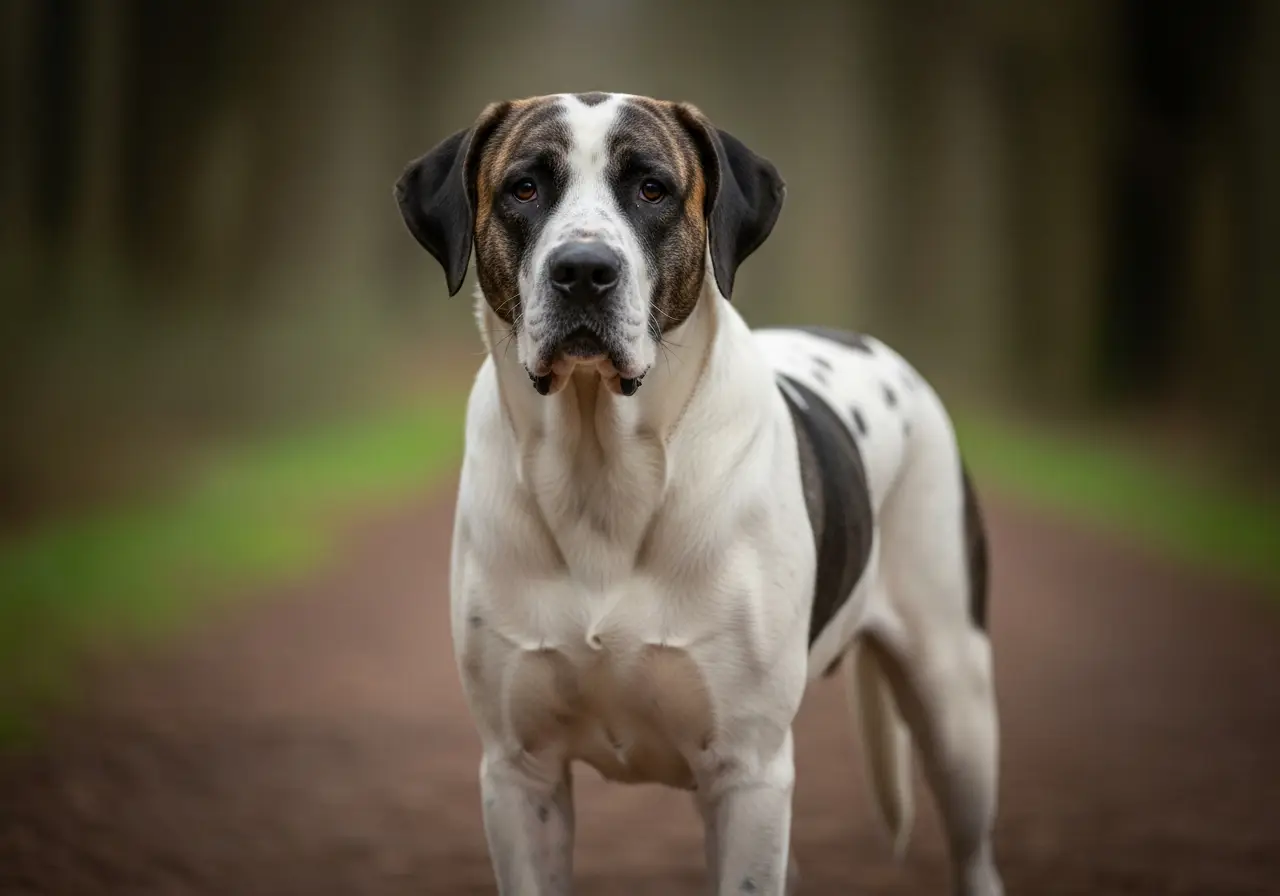
Transmontano Hirtenhund: portugiesischer Herdenschutzhund aus dem Nordosten, gross wehrhaft und stark an seine Herde gebunden
03Profile
Key facts and suitability
- Origin
- Portugal
- Original purpose
- Livestock guarding
- FCI
- No. 368 · Group 2 · Section 2.2
- height at the withers
- 68–85 cm
- Weight
- 45–60 kg
- Life expectancy
- 11–13 Years
- Coat type
- Doppel
- Minimum exercise
- 90 min/day
- Puppy price
- 1'200–2'000 CHF
- Waiting period
- 5 months
- Sports
- Hiking
04Temperament
How the Transmontano Hirtenhund (Cao de Gado Transmontano) shows up in everyday life
Anyone who opens the front door in the morning does not experience a stormy greeting with the Transmontano. The dog registers the return, observes briefly and then turns back to its territory. This behaviour is not disinterest; it is the nature of a dog that has learned to keep its environment permanently in view instead of reacting emotionally to individual events.
Internally, the Transmontano requires a clearly defined territory that it understands as its area of responsibility. Without this spatial framework, it lacks the basis for its behaviour. The need for social contact towards its own group is moderate; it does not seek intensive affection but tolerates close family members with quiet loyalty. Mental work in the sense of fetching exercises or nose work interests it little; its mental stimulation arises from independently monitoring its territory.
Externally, the dog reacts to strangers with clear reserve. The FCI standard describes this caution as typical for the breed; after initial reserve, problem-free interaction is possible if the stranger acts calmly and respectfully. These two levels must not be confused: a Transmontano that appears relaxed towards its family is not automatically open to visitors or unfamiliar situations.
In everyday life, this concretely means: craftsmen on the property, children from the neighbourhood or unannounced visitors require active management by the owner. The dog decides independently whether it assesses a situation as a threat, and this decision carries considerable weight for an animal of its size and constitution.
05Needs
What this breed needs daily
The Transmontano requires daily free movement on a large, securely fenced property. A fence with a minimum height of 180 cm and no possibility of digging under is not a recommendation but a basic prerequisite. In addition, daily controlled walks of 60 to 90 minutes are sensible, not as sporting exertion but for structured environmental exploration under guidance.
Mental stimulation for this breed does not arise from classic activity games. The dog requires a task in the sense of an area of responsibility. Anyone who does not keep livestock must replace this area with clear spatial structure and consistent guidance; a garden alone is not sufficient for this if the owner does not show sovereign presence.
The need for social contact towards people is moderate. The Transmontano does not require intensive daily interaction but reacts to uncertainty or inconsistent behaviour by the owner with increasing independent behaviour. A steady, calm primary caregiver who sets clear boundaries without using harshness is the decisive element in keeping.
Being left alone in its own territory is generally unproblematic for this breed; up to six hours are realistic if the area is familiar and secure. Keeping the dog in an urban apartment or frequent changes of location structurally overwhelm it. It requires continuity: the same space, the same primary caregivers, the same routines.
Exercise
Medium
mental work
Medium
Social needs
Low
training
Experts
07Quick Check
08Suitability
Who this breed is suitable for – and who it isn't
✓Matches
The Transmontano suits owners with proven experience in handling livestock guardian dogs or comparable independent Molossers. Anyone who has already kept a Kangal, a Maremmano, or a Pyrenean Mountain Dog and knows the specific requirements of this group brings an important foundation.
A suitable owner has a large, securely fenced property (at least 1,000 m² as a lower limit, preferably more) in a rural or quiet peripheral location. Properties near cities with high visitor frequency, street noise, or changing environmental stimuli are structurally unsuitable.
Anyone who keeps livestock and is looking for a functional livestock guardian dog will find in the Transmontano a dog that still fully corresponds to its original task. In this context, the breed expresses its behaviour within a meaningful framework.
Families with children are only suitable if the children are older than ten years, handling large dogs is familiar, and daily life has a clear, calm structure. Changing groups of children, school friends, or unknown visitors require consistent management.
In terms of time, this dog requires an owner who is present daily, takes care of the walks themselves, and does not rely on changing carers. Continuity in the primary caregiver is more important for this breed than for many others.
×Doesn't match
The Transmontano is not suitable for owners keeping a dog for the first time, or for people without specific experience with livestock guardian dogs. The independence of this breed overwhelms any owner who understands leadership primarily through consistency in training, without the necessary understanding of the dog’s genetic imprinting.
Anyone living in an apartment, a terraced house, or on a small urban plot cannot structurally meet the basic needs of this breed. This applies regardless of the available time or the good will of the owner.
Anyone who equates reserve towards strangers with lack of socialisation and believes they can shape an open, amiable dog through intensive training misunderstands the nature of this breed. The guarding instinct is not a training issue; it is the foundation of the breed.
Households with frequently changing visitors, children under ten years old, or an active social environment with many unknown people are not a suitable environment for this dog. Anyone expecting the dog to accept every visitor after a short settling-in period significantly underestimates the management effort.
People who rely on dog schools with group training or on changing carers should also not choose this breed. The Transmontano requires continuity, not flexibility.
10Line reality
Show line, working line, breeder market
The Transmontano Shepherd Dog does not have an established differentiation into show and working lines, as is known, for example, with the German Shepherd Dog or the Labrador Retriever. The breed is so rare outside Portugal that line differentiation plays practically no role in the German-speaking area.
However, regional differences exist within Portugal: dogs from active livestock guardian operations in Trás-os-Montes differ in temperament and working motivation from dogs that have been bred over several generations without herd work. Anyone who acquires a Transmontano from an active working line receives a dog with more pronounced territorial behaviour and higher independence; this is not a quality feature per se, but information about the management effort.
The FCI recognition of the standard in 2020 has slightly stimulated international breeding without a significant show line having emerged so far. The breeding association in Portugal, the Clube Português de Canicultura, continues to orient itself primarily towards the working function of the breed.
For interested parties in the German-speaking region, this means: The origin of a puppy from Portugal or from one of the few European breeds outside Portugal should always be linked with a question about the working situation of the parent animals. A dog from an active herd brings different prerequisites than a dog from pure hobby breeding.
11Health · Reality
What you need to plan for medically with your Transmontano Hirtenhund (Cao de Gado Transmontano)
To date, no published breed-specific health studies with large sample sizes exist for the Transmontano Shepherd Dog; the rarity of the breed makes systematic surveys difficult. The life expectancy is stated in specialist literature and by Portuguese breeding associations as 10 to 12 years, which corresponds to a realistic value for a dog of this size class (over 60 kg).
As a large-framed Molosser with a body weight of up to 75 kg, the Transmontano belongs to the risk group for hip dysplasia (HD) and elbow dysplasia (ED). Studies on HD prevalence in comparable Molossers (e.g. Kangal, Maremmano-Abruzzese) show affected rates of 20 to 35% in non-selected populations (OFA database, status 2023). Reputable breeders have both parent animals radiologically examined before breeding; proof of these examinations is part of the minimum requirements when buying a puppy.
The risk of gastric torsion (gastric dilatation-volvulus, GDV) is statistically increased in deep-chested large dogs. A study by Purdue University (Glickman et al., 2000) identified deep-chested breeds over 40 kg as a high-risk group. Prophylactic measures (several small meals daily, no intensive exercise immediately after eating) reduce the risk but do not eliminate it. In the event of symptoms such as a distended abdomen, retching without vomiting, or sudden restlessness, immediate veterinary care is required.
Overweight is an underestimated risk in this breed: an inactive Transmontano kept indoors tends to gain weight, which places additional strain on joints and the cardiovascular system. Regular weight checks with the vet are recommended.
12Structured data
Health by the numbers
Prone to diseases
Hip dysplasia Elbow problems
Recommended health tests
Hip X-ray Elbow X-ray
13Myths ↔ Reality
What is often said incorrectly about this breed
Five myths, five realities, five sources.
Der Transmontano ist wegen seiner Größe ein aggressiver Hund, der nicht mit anderen Hunden verträglich ist.
Der FCI-Standard beschreibt ausdrücklich, dass die Rasse ohne Konflikte in Gesellschaft mit anderen Rüden lebt und sich mit diesen sozialisiert. In traditionellen Herden arbeiteten stets mehrere Hunde gemeinsam. Aggressivität gegenüber Artgenossen ist kein Rassemerkmal, vorausgesetzt, die Sozialisation erfolgt frühzeitig und strukturiert.
Ein Herdenschutzhund wie der Transmontano benötigt keine aktive Erziehung, weil er von Natur aus weiß, was er zu tun hat.
Genetically ingrained protective instincts do not replace structured socialisation. Without early, consistent habituation to people, situations and environments, territorial behaviour can become uncontrollable. Livestock guardian dogs require particularly competent guidance from experienced owners precisely because of their independence.
The Transmontano is suitable as a family dog because it is loyal and gentle towards its family.
Loyalty towards its own group includes pronounced reserve up to readiness to defend against strangers. The FCI standard describes the dog as cautious and reserved in contact with unknown people. In a family everyday life with changing visitors, children from the surroundings or unfamiliar situations, this behaviour places high demands on guidance and management.
Large livestock guardian dogs like the Transmontano have a high need for movement and must walk for hours every day.
The Transmontano is not an endurance athlete in the classical sense. Its need for movement is based on free movement on large, secure terrain, not on sporting exertion through jogging or cycling. Daily controlled walks supplement free movement but do not replace a sufficiently sized territory.
Because the Transmontano is so rare, every puppy offered automatically comes from reputable breeding.
Rarity does not protect against dubious breeding. Especially with rare breeds with a high exotic factor, there is a risk that puppies are offered without health checks, socialisation or knowledge of the breed's requirements. Checking breeding conditions, parent animals and association membership is particularly important for this breed.
14animal welfare
The animal welfare perspective
Breeder market, designer versions, animal shelter reality — what no one writes in the puppy ad.
The Transmontano Shepherd is one of the rarest breeds in the German-speaking region. This rarity does not protect against problematic living conditions; rather, it obscures them. Because hardly any comparative values exist and the breed has no trend status, improper keeping often remains unnoticed for a long time.
The backyard breeder market for this breed is manageable but not non-existent. Occasionally, puppies appear on international classifieds platforms whose origin is unclear, without association membership, without documented health examinations of the parent animals, and without proof of species-appropriate rearing in a herd environment. A puppy that spends the first weeks of its life without contact with livestock, without external stimuli, and without structured socialisation develops a different behavioural profile than a dog from functional working breeding.
A specific keeping problem arises when the Transmontano is acquired as a status symbol or an exotic dog. Its imposing appearance attracts attention, while the requirements for space, handling, and experience are often underestimated. Dogs kept in urban households or on plots that are too small develop behavioural abnormalities attributable to unmet basic needs, not to character weaknesses of the breed.
The rehoming of a Transmontano via animal welfare organisations is rare but not excluded. Dogs given up due to improper keeping require experienced owners with specific livestock guardian dog knowledge, and precisely these owners are the only ones who can responsibly take in such a dog. Anyone who meets the prerequisites should consider rehoming as an option equivalent to breeding. Animal welfare organisations specialising in livestock guardian dogs or Iberian breeds are the appropriate points of contact.
15Costs · Transparency
What this breed realistically costs
A puppy from reputable breeding with FCI papers, documented health examinations of the parent animals, and traceable origin costs between 1,200 and 2,500 EUR in Europe. Offers significantly below this range without corresponding proof should be questioned critically.
The annual living costs for an adult Transmontano (60–75 kg) are considerable. Feed costs alone amount to between 1,200 and 2,000 EUR per year with high-quality nutrition. In addition, there are care costs for the dense coat; regular brushing is your own responsibility, while professional care if needed costs 80 to 150 EUR per session.
Basic veterinary care (vaccinations, annual preventive care, parasite treatment) for a dog of this size should be budgeted at 400 to 700 EUR per year. Orthopaedic examinations in case of suspected HD or lameness can quickly cost 500 to 1,500 EUR per incident. Pet insurance for a dog over 60 kg costs between 80 and 180 EUR per month depending on the provider and scope of benefits (approx. 960 to 2,160 EUR/year).
If you need to fence a suitable plot of land first, you should budget 3,000 to 8,000 EUR for fencing that is sufficiently dimensioned and wolf-proof. This investment is not an optional comfort measure but a basic prerequisite for responsible keeping.
16Puppy search
What you need to consider when choosing a breeder
- Reputable breeders of the Transmontano are scarcely represented in the German-speaking region.
- The first point of contact is the Clube Português de Canicultura as the national breeding association, as well as the VDH and its affiliated breed clubs for the German-speaking region.
- Membership of a breeder in an association is an important quality feature, but it does not replace personal assessment.
- The following criteria characterise reputable breeding: Both parent animals have been radiologically examined for HD and ED, and the results are available in writing.
- The puppies grow up in an environment that corresponds to their later use, ideally with contact to livestock and outdoor stimuli.
- The breeder asks questions about the planned living situation and refuses a sale if the prerequisites are not met.
- Warning signs are: puppies without papers, missing health certificates of the parent animals, immediate availability without waiting time, sale via intermediaries, or transport offers without personal contact.
- The rehoming of a Transmontano through animal welfare organisations is rare but possible.
- Specialised organisations for Iberian herding dogs or livestock guardian dogs know the breed requirements and only rehome to suitable owners.
- This option is equivalent to breeding, provided that the dog’s history and behaviour are transparently documented.
FAQ
Frequently asked questions about the Transmontano Hirtenhund (Cao de Gado Transmontano)
Is Transmontano Hirtenhund (Cao de Gado Transmontano) a family dog?
Transmontano Hirtenhund (Cao de Gado Transmontano) is considered suitable for families with good socialisation and species-appropriate care.
How much exercise does Transmontano Hirtenhund (Cao de Gado Transmontano) need?
At least around 90 minutes of exercise per day.
What is the size and weight of Transmontano Hirtenhund (Cao de Gado Transmontano)?
Fully grown, Transmontano Hirtenhund (Cao de Gado Transmontano) reaches about 68–85 cm at the withers and weighs around 45–60 kg.
What is the life expectancy of Transmontano Hirtenhund (Cao de Gado Transmontano)?
The life expectancy of Transmontano Hirtenhund (Cao de Gado Transmontano) is approximately 11–13 years.
Which diseases are common in Transmontano Hirtenhund (Cao de Gado Transmontano)?
Hip dysplasia Elbow problems
17Breed clubs
Official breed clubs in DACH
19Related
Similar breeds – and their differences
You might also be interested in


Participate
Do you have a good photo of your Transmontano Hirtenhund (Cao de Gado Transmontano)?
We are looking for expressive images for our breed profiles. Submit yours; the editorial team reviews every submission before publication.
Does this breed suit you?
Nicht FCI-anerkannt – sehr territorial kaum in der Schweiz verfügbar