
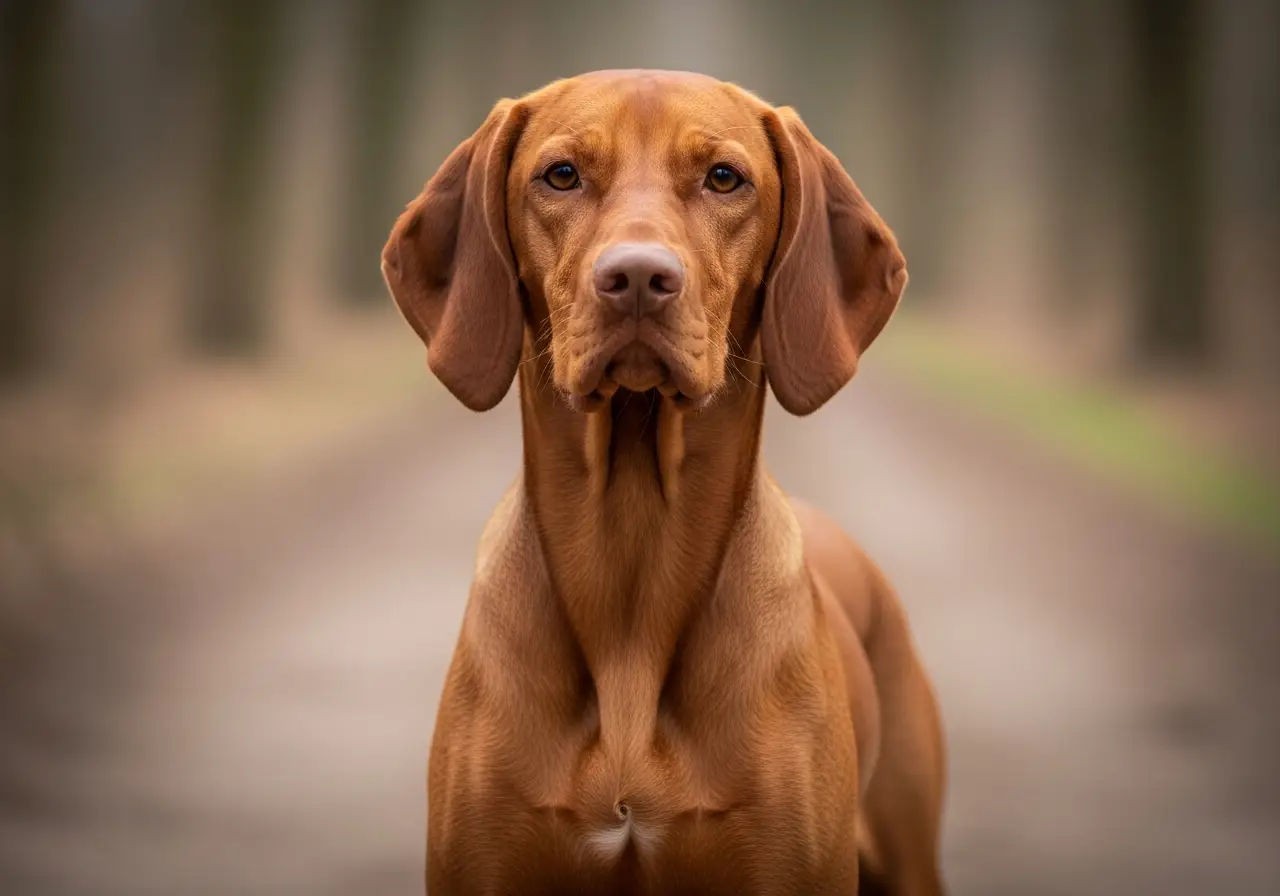
01Summary
In a paragraph
If you only have 30 seconds.
The Magyar Vizsla is an athletic pointing dog from Hungary that demands physical stimulation and close human bonding not as a bonus, but as a basic requirement. Its prey drive is deeply rooted in its genetics, and its need for social contact is unusually high. Anyone keeping this dog commits to at least 90 to 120 minutes of intensive exercise plus nose work daily, and in return receives an exceptionally cooperative working partner.
02Introduction
What makes the Magyar Vizsla special
The Magyar Vizsla is Hungary's golden-red national dog, FCI Group 7, athletic and people-oriented, with a withers height of 54–64 cm.
03Profile
Key facts and suitability
- Origin
- Ungarn
- Original purpose
- Versatile hunting dog of the Hungarian aristocracy
- FCI
- No. 57 · Group 7 · Section 1
- height at the withers
- 54–64 cm
- Weight
- 20–30 kg
- Life expectancy
- 12–15 Years
- Coat type
- Short-haired
- Minimum exercise
- 120 min/day
- Puppy price
- 1'500–2'500 CHF
- Waiting period
- 9 months
- Sports
- Hunting · Agility · Canicross · Field trials · Retrieving · Swimming
04Temperament
How the Magyar Vizsla shows up in everyday life
When you come home, a Vizsla does not greet you briefly and then withdraw; it follows you through the apartment, lies down next to your desk, and observes every move. This dog is not a loner that knows its place and waits. It actively seeks closeness and contact, multiple times a day.
This is the internal axis: the need for social contact is 5 out of 5. A Vizsla left without interaction for hours signals this through restlessness, vocalisation, or destroyed furniture, not out of spite but out of genuine stress.
The external axis looks different. Towards strangers, the Vizsla usually shows itself to be open and curious, rarely shy or aggressive. It is not a protection dog. Visitors in the apartment are generally registered friendly, not viewed with suspicion. However, this outward openness must not be confused with the inner need for bonding: a Vizsla that greets every visitor friendlily is by no means necessarily a dog that copes well with being left alone.
On the walk, the prey drive becomes clearly apparent. The dog pulls into open areas, picks up scents, and searches independently. Without recall training and loose-leash walking, free exercise in open landscapes is not advisable. Anyone who offers hunting-related work (nose work, retrieving training, field trial preparation) will experience a dog that is fully engaged and actually finds calm afterwards.
In the evening on the sofa: the Vizsla is there. Physical contact is not an optional extra for it but standard.
05Needs
What this breed needs daily
The Magyar Vizsla requires at least 90 to 120 minutes of intensive exercise daily, and this does not mean a leisurely city walk. Running, swimming, retrieving in open areas, terrain work: the dog is bred for endurance and demands endurance.
Exercise alone is not enough. The need for mental work is 4 out of 5. Nose work, search games, mantrailing, or classic field trial work are not extras but part of species-appropriate keeping. A physically stimulated but mentally under-challenged Vizsla shows restlessness and nervousness; the dog then appears restless even though it has had "enough" exercise.
Being left alone is one of the biggest challenges with this breed. A Vizsla should not be alone for more than 3 hours a day, and even this limit requires careful, step-by-step building up over weeks. Anyone who works full-time and cannot organise dog care should honestly calculate this before getting a dog.
The Vizsla needs a calm, clear primary caregiver. Hectic behaviour, loudness, and inconsistent rules cause stress in this sensitive dog, which manifests itself as displacement behaviour or hyperactivity. Regular training sessions (short, structured, positive) are more effective than occasional marathon sessions.
Social integration into family life is not an optional extra for the Vizsla: it needs presence, joint activities, and clear rituals. A dog kept in a kennel or permanently in the garden regularly develops behavioural problems in this breed.
Exercise
Very high
mental work
A lot
Social needs
Very high
training
Medium
06Sport & Mental and Physical Stimulation
What sports the Magyar Vizsla is suited for
Realistic in terms of physiology and genetics – not every breed suits every sport.
Structurally and physiologically suitable: Suitable for mantrailing, dummy work and tracking · CaniCross / bikejoring possible.
07Quick Check
08Suitability
Who this breed is suitable for – and who it isn't
✓Matches
The Magyar Vizsla suits owners who can plan at least 2 hours of active time with the dog daily, not as an exception but as a weekly structure. Sportily active people who run, cycle, or hike will find in the Vizsla an enduring companion that keeps up and wants more.
Hunting-related handling corresponds most strongly to the genetic profile of this breed. Anyone who has a hunting licence or aims for field trials receives a dog that was selected specifically for this work. Dog sport participants in disciplines such as mantrailing, agility, or obedience also report high willingness to cooperate.
Families with children from about 8 years of age are suitable if sufficient exercise opportunities are available and children are accompanied in dealing with a drive-strong, energetic dog. A garden is helpful but does not replace structured stimulation.
Owners who already have experience with pointing dogs or other drive-strong breeds cope significantly better with the Vizsla than first-time owners without prior knowledge. Anyone willing to involve a dog training school with experience in hunting dogs from the beginning can partially compensate for this prerequisite.
Home office or part-time work situations, in which the dog spends most of the day in human company, correspond significantly better to the high need for social contact of this breed than classic full-time jobs without a care solution.
×Doesn't match
The Magyar Vizsla is not suitable for owners who are away from home for more than 4 to 5 hours daily and cannot organise reliable dog care. The high need for social contact of this breed is not a character flaw that can be trained away; it is genetically anchored.
Anyone who assesses the Vizsla as an "uncomplicated companion dog" because of its openness towards strangers confuses the external reaction (friendly, curious) with the internal need (close bond, little time alone). This confusion is a common reason for surrendering the dog.
Quiet city households without regular access to open spaces, woodland or dog sports facilities are unsuitable for this breed. A Vizsla that is only walked through the city every day is chronically under-stimulated, regardless of how loving the keeping conditions are.
Owners who rely on harsh training methods or equate consistency with punishment will not build a stable working relationship with this sensitive dog. The Vizsla reacts to pressure by withdrawing or exhibiting over-arousal behaviour, not obedience.
Households with very young children under 5 years of age should realistically assess the high drive for movement and the body size of the Vizsla. Not because the dog is aggressive, but because a young, under-exercised Vizsla can quickly become a burden for both parties in everyday life with toddlers.
10Line reality
Show line, working line, breeder market
The Magyar Vizsla is bred today in two main lines, which differ significantly in type and area of use.
The working line is oriented towards field trial performance: nose work, pointing, retrieving from water and land, and obedience at a distance. Dogs from this line are generally slimmer, more enduring, and have stronger drives. Their need for exercise is even more pronounced than already described in the breed standard. For hunting owners and ambitious dog sport participants, working line dogs are the first choice; for leisure owners without hunting ambitions, they are often too much of a challenge.
The show line selects more strongly for type, colour, and gait in accordance with the FCI standard. These dogs are often somewhat calmer in their basic temperament but still require considerable stimulation. The difference from the working line is less extreme in the Vizsla than, for example, in the German Shepherd Dog, but it remains relevant.
Additionally, there is the Wirehaired Vizsla (Drótszőrű Magyar Vizsla), which is listed as an independent breed under FCI Standard No. 239. It differs by its rough coat and a somewhat more robust constitution but shares the basic character and requirements with the short-haired type.
Anyone looking for a Vizsla puppy should specifically ask the breeder about the orientation of the parent dogs: field trial winners in the pedigree indicate a higher work drive. This information is more relevant for the fit between dog and household than colour or litter size.
11Health · Reality
What you need to plan for medically with your Magyar Vizsla
According to data from the Verein Ungarischer Vorstehhunde e.V., the life expectancy of the Magyar Vizsla is 12 to 15 years, an above-average range for medium-sized gundogs, indicating a comparatively robust constitution.
Hip dysplasia (HD) is the most frequently documented orthopaedic disease in the breed. Reputable breeders have both parent dogs radiologically examined and graded (HD-A or HD-B for breeding approval). No puppy should be acquired without this proof in the litter pedigree certificate.
Epilepsy occurs more frequently in the Magyar Vizsla than in the breed average of comparable pointing dogs. A study by the University of Helsinki (Lotta Koskinen et al., 2017) identified genetic risk factors for idiopathic epilepsy in the breed. Breeders who conceal cases of epilepsy in the pedigree are a warning sign.
Eye diseases — particularly progressive retinal atrophy (PRA) and cataracts — are documented. An eye examination of the parent dogs by a specialist vet for ophthalmology is recommended.
The short coat offers little protection against cold: hypothermia during prolonged outdoor use below 5 °C is a real risk, especially in wet conditions. A dog jacket in these situations is not excessive caution.
Preventive examinations that a responsible owner should plan for: annual weight check (overweight increases HD risk), eye check every 2 years, dental check annually at the vet.
12Structured data
Health by the numbers
Prone to diseases
Hip dysplasia, progressive retinal atrophy, epilepsy
Recommended health tests
Hip X-ray, eye examination
13Myths ↔ Reality
What is often said incorrectly about this breed
Five myths, five realities, five sources.
"The Vizsla is a family dog that can be kept without any problems even without hunting.
The Magyar Vizsla has a genetically deeply anchored prey drive; pointing and tracking work are not switchable options. Without hunting-related substitute work (nose work, retrieving training, field trial preparation), many Vizslas develop restlessness, destructiveness or separation anxiety. Keeping as a family dog works if 90–120 minutes of intensive stimulation plus mental work are offered daily, not as an exception, but as everyday routine.
"Vizslas are so sensitive that you hardly dare to correct them.
Sensitivity means for the Vizsla that harsh punishment methods are counterproductive, not that the dog does not need clear guidance. Consistent, positive training methods with clear boundaries are proven to be more effective than laissez-faire keeping. A structureless daily routine creates more stress in the Vizsla than calm, predictable guidance.
"The short coat makes the Vizsla easy to care for and weatherproof.
The Vizsla's short, dense coat offers significantly less protection against cold and wetness than the coats of Nordic or long-haired breeds. At temperatures below 5 °C and during longer stays outdoors, many Vizslas need a dog jacket. Regular brushing removes dead hair, but is indeed low-maintenance.
"Vizslas can easily be left alone for long periods because they are calm.
The Magyar Vizsla belongs to the breeds with a pronounced need for social contact and high attachment behaviour. Being left alone for more than 3–4 hours leads to stress signals, vocalisation or destructive behaviour in many dogs of this breed. Animal welfare organisations list separation anxiety as the most common reason for surrendering this breed.
"Vizslas are beginner dogs because they are so people-oriented.
People-orientation facilitates communication, but does not replace experience in dealing with high-drive hunting dogs. The Vizsla reacts sensitively to its owner's moods, which means that uncertainty or inconsistency directly affects its behaviour. For first-time owners, it is only suitable if a dog training school with experience in pointing dogs is involved from the start.
14animal welfare
The animal welfare perspective
Breeder market, designer versions, animal shelter reality — what no one writes in the puppy ad.
The Magyar Vizsla belongs to the breeds that regularly appear in animal welfare organisations and rescue stations, although it is neither a restricted breed nor a fashion dog with obvious breeding for harmful traits (Qualzucht) characteristics. The reason for surrender is the same in most documented cases: underestimated exercise needs, separation anxiety or destructive behaviour due to under-stimulation.
The backyard breeder market for Vizslas is active. On classifieds platforms, puppies are offered without pedigree, without HD proof of the parent dogs and without litter inspection by the breeding club, often at prices that appear cheap at first glance. Anyone buying there takes on a statistically increased risk of health problems and behavioural difficulties, because neither health selection nor early socialisation by the breeder is guaranteed.
Designer variants of the Vizsla (e.g. crosses with Weimaraner or Labrador, marketed under fantasy names) exist but are rare. The main problem with this breed is not the breeding form, but the owner's misjudgement of the needs.
Anyone who takes a Vizsla from rehoming does so not out of pity, but as an informed decision. Many rehomed Vizslas are young, healthy and were given up because the previous owner underestimated the demands, not because the dog has a problem. The Verein Ungarischer Vorstehhunde e.V. and hunting dog rehoming organisations regularly have dogs available for rehoming.
Adoption does not rule out a careful needs analysis: even with a rehomed dog, the owner should realistically assess the breed's exercise requirements, need for social contact and prey drive before agreeing to take it.
15Costs · Transparency
What this breed realistically costs
A Vizsla puppy from reputable VDH breeding costs between 1,200 and 1,800 euros in Germany. Prices below this indicate missing health tests or unrecognised breeding. Rehomed dogs from animal welfare organisations or breed club rehoming services usually cost a rehoming fee of 200 to 400 euros.
The annual living costs for an adult Vizsla (approx. 25 kg) are typically between 1,800 and 2,800 euros, depending on food quality, care and activity level. High-quality dry food or raw feeding (BARF) amounts to 600 to 1,000 euros per year. Accessories (lead, collar, transport box, dog coat) add a further 300 to 500 euros in the first year.
Veterinary costs for basic care (vaccinations, parasite protection, annual check-up) are between 300 and 500 euros annually. Orthopaedic assessments for suspected HD or epilepsy screening can cost an additional 500 to 1,500 euros. Dog health insurance (surgery insurance) costs between 20 and 60 euros monthly for a Vizsla depending on provider and tariff, providing calculable cover for a breed with documented epilepsy risk.
Dog sports, field trial preparation or mantrailing courses are not a luxury expense for this breed, but part of species-appropriate keeping: 200 to 600 euros per year should be realistically budgeted.
16Puppy search
What you need to consider when choosing a breeder
- A reputable Vizsla breeder is a member of the Verein Ungarischer Vorstehhunde e.V.
- (VUV) or a comparable FCI-recognised breeding club.
- They have both parent dogs radiologically examined for HD and provide proof of the results in the litter pedigree certificate.
- Eye examinations of the parent dogs by a specialist vet are another quality feature.
- Warning signs: no visit to the breeder possible, puppies seen without mother, multiple litters at the same time, sale under 8 weeks, missing pedigree, pressure when buying.
- Reputable breeders ask counter-questions; they want to know if the household suits the breed.
- Adopting an adult Vizsla is an equally valid option.
- Many dogs come into rehoming young because the previous owner underestimated the needs.
- The VUV as well as specialised gundog rehoming organisations have dogs available for rehoming and provide professional support during the handover.
- Anyone buying a puppy should ask about the line affiliation of the parent dogs: field trial winners in the pedigree indicate a higher work drive.
- This information is more relevant for everyday suitability than colour or litter size.
- A purchase price under 800 CHF for a VDH puppy is unrealistic; reputable breeders factor in health tests, socialisation and care.
FAQ
Frequently asked questions about the Magyar Vizsla
Is Magyar Vizsla suitable for beginners?
Magyar Vizsla is considered suitable for first-time dog owners.
Is Magyar Vizsla a family dog?
Magyar Vizsla is considered suitable for families with good socialisation and species-appropriate care.
How much exercise does Magyar Vizsla need?
At least around 120 minutes of exercise per day. As an active breed, more so — plus mental stimulation.
What is the size and weight of Magyar Vizsla?
Fully grown, Magyar Vizsla reaches about 54–64 cm at the withers and weighs around 20–30 kg.
What is the life expectancy of Magyar Vizsla?
The life expectancy of Magyar Vizsla is approximately 12–15 years.
Which diseases are common in Magyar Vizsla?
Hip dysplasia, progressive retinal atrophy, epilepsy
17Breed clubs
Official breed clubs in DACH
19Related
Similar breeds – and their differences
You might also be interested in
Participate
Do you have a good photo of your Magyar Vizsla?
We are looking for expressive images for our breed profiles. Submit yours; the editorial team reviews every submission before publication.
Does this breed suit you?
Hungary's national breed. Golden-red hunting dog, extremely affectionate. Known as a "Velcro Dog" – never lets the owner out of its sight.