
01Summary
In a paragraph
If you only have 30 seconds.
The Griffon Nivernais is a rough-coated, enduring hound from central France that has been bred for wild boar hunting since the Middle Ages. Its prey drive is deeply rooted genetically and cannot be meaningfully switched off in non-hunting everyday life. In the DACH region, it is one of the rarest purebred dogs. Anyone keeping it needs a hunting background, extensive field work, and experience with high prey drive hounds.
02Introduction
What makes the Griffon Nivernais special
The Griffon Nivernais is a medium-sized, rough-coated French scent hound from the Nivernais region, FCI Group 6, originally bred for wild boar hunting, withers height 53–60 cm.
03Profile
Key facts and suitability
- Origin
- Frankreich
- Original purpose
- Scent hound for wild boar hunting, pack hunting on wild boar
- FCI
- No. 17 · Group 6 · Section 1.2
- height at the withers
- 53–62 cm
- Weight
- 22–25 kg
- Life expectancy
- 12–14 Years
- Coat type
- Rauhaar
- Minimum exercise
- 120 min/day
- Puppy price
- 1'000–1'500 CHF
- Waiting period
- 18 months
- Sports
- Tracking work · Blood tracking · Mantrailing · Searching work
04Temperament
How the Griffon Nivernais shows up in everyday life
When getting up in the morning, the Griffon Nivernais does not show an exuberant greeting; it is present, attentive, and waits for a signal indicating activity. As soon as the leash appears, it switches to operating temperature.
On a walk in the city park, it is not a relaxed stroller. The nose works permanently, the body is tense, and every wind direction is registered. If a scent trail crosses its path, it pulls consistently in that direction, not out of disobedience, but because its nervous system is designed precisely for this. Off-leash walking without secured terrain is not a realistic option.
Here, the separation of the two behavioural axes becomes clear: The internal need for social contact is present; the Griffon Nivernais seeks proximity to its primary caregiver, is loyal and cooperative in a working context. However, the external reaction to strangers is reserved to restrained. A dog that is closely bonded to its primary caregiver therefore does not have to be open towards visitors or unknown people on the street. Keeping these two poles apart is crucial for realistic expectations.
In the house, it is calm as long as its need for movement and work is met. If this is not the case, frustration manifests itself in vocalisation, restlessness, and destructive behaviour. The breed is not a dog that settles for two short rounds daily. Whoever provides it with structured terrain work, scent tracking, or hunting deployments receives a focused, enduring working partner.
05Needs
What this breed needs daily
The Griffon Nivernais requires at least 120 minutes of active exercise daily, not on asphalted paths, but in terrain with varying surfaces, smells, and challenges. Pure walks without a mental component do not meet its needs.
The need for mental work is high. The breed has been selected over centuries to make independent decisions in the terrain, follow scent trails, and coordinate within the pack. This cognitive capacity requires an outlet. Scent tracking work, nose work in the terrain, mantrailing as a supplement, or hunting deployments are suitable formats. Fetch exercises in the garden are not sufficient.
Being left alone is limited to a maximum of four hours. The Griffon Nivernais is a pack dog; social isolation over longer periods creates stress. Whoever is regularly absent for longer periods requires a reliable care solution.
The prey drive is the defining characteristic of the breed and must be included in every keeping decision. A secured outdoor area is mandatory. Off-leash walking in unsecured terrain is incompatible with the pronounced prey drive; the dog follows a scent trail without responding to recall commands as soon as the drive is activated.
Training requires experience with hounds. Short, clear signal phases and motivation-based methods with a hunting reference show effect. Pressure and harshness lead to withdrawal or stubbornness. A supporting dog training school with hound experience is recommended for beginners in this breed group.
Exercise
Very high
mental work
A lot
Social needs
Medium
training
Demanding
06Sport & Mental and Physical Stimulation
What sports the Griffon Nivernais is suited for
Realistic in terms of physiology and genetics – not every breed suits every sport.
Structurally and physiologically suitable: Suitable for mantrailing, dummy work and tracking · CaniCross / bikejoring possible.
07Quick Check
08Suitability
Who this breed is suitable for – and who it isn't
✓Matches
The Griffon Nivernais suits owners with active hunting operations who are looking for an enduring, terrain-capable hound for boar or pack hunting. A hunting licence and access to suitable hunting grounds are prerequisites.
The breed is also suitable for owners who, although they do not engage in active hunting, can provide structured field work of at least two hours daily, for example through tracking, advanced-level mantrailing, or comparable nose work in open terrain. A securely enclosed outdoor area is not an option but a basic requirement.
Experience with high prey drive or independently working dogs is necessary. Those who have already handled hounds, scent hounds, or similar breeds bring the right expectations. The breed demands an owner who understands independence as a working trait and not as a training deficit.
Socially, the breed fits households where visitors do not change daily and where the reserved attitude towards strangers is accepted as a breed characteristic. A calm, structured environment in the countryside or on the outskirts of a city with direct access to open terrain better meets the keeping requirements than an urban environment.
×Doesn't match
The Griffon Nivernais is not suitable for owners looking for a companion dog for everyday life in the city. Keeping it in an apartment without daily access to open terrain is incompatible with the breed's needs.
Those who are away from home for more than four hours daily and cannot organise reliable care should not choose this breed. The pack background makes social isolation a serious stress factor.
First-time owners without experience with high prey drive or independently working dogs will be overwhelmed by the Griffon Nivernais. Anyone who expects a dog to shed its prey drive through consistent training misunderstands the genetic foundation of this breed, and it is precisely this misconception that leads to keeping problems.
Families looking for an open, friendly dog for a social environment with frequently changing people will be disappointed by the reserved outward appearance of the Griffon Nivernais. The high internal need for social contact with the primary caregiver must not be confused with general openness towards strangers; these two axes are far apart in this breed.
The breed is also unsuitable for owners without a securely enclosed outdoor area. The pronounced prey drive makes uncontrolled off-leash activity in unfenced terrain a safety risk for the dog.
09Character
Character and editorial background
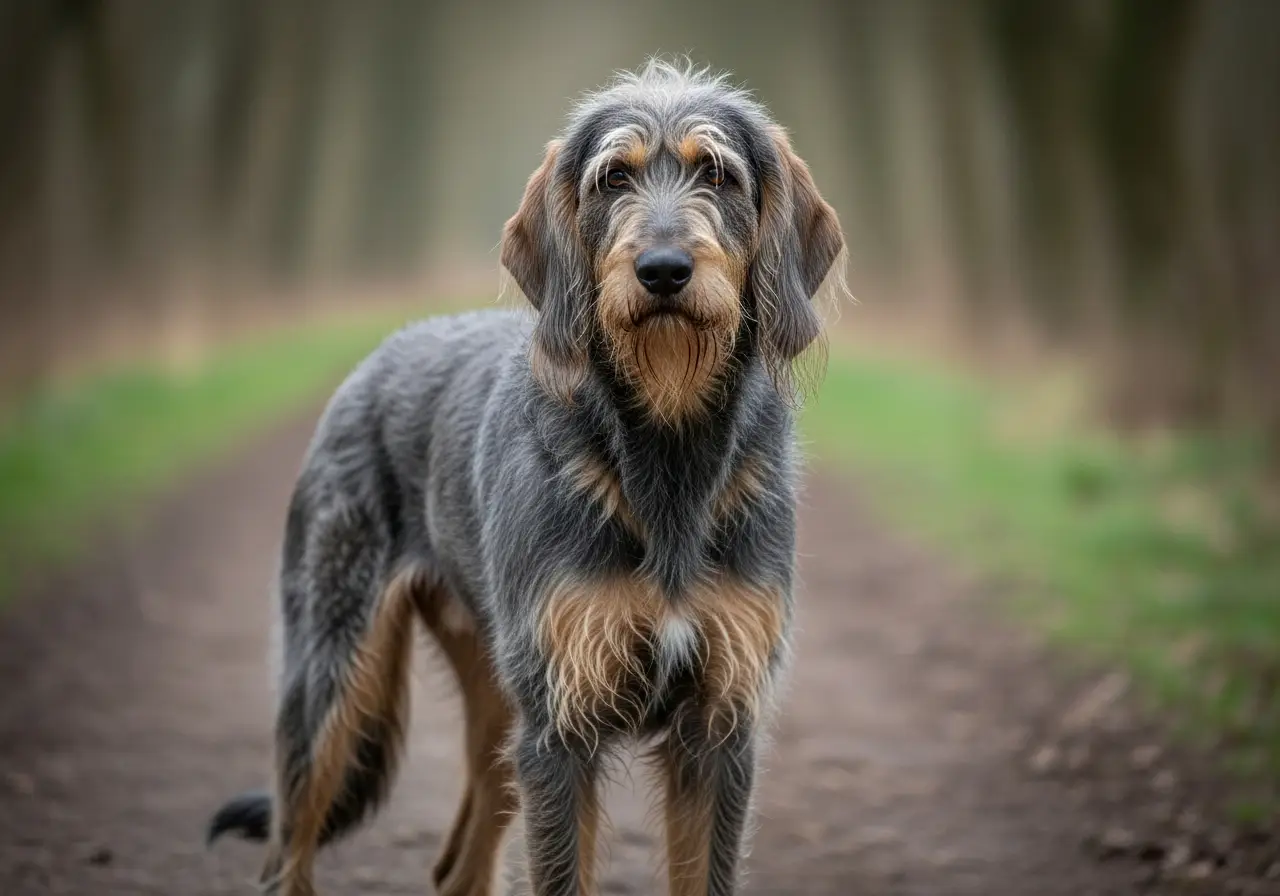
The Griffon Nivernais is a medium-sized, rough-coated scenthound from central France with a strongly pronounced prey drive. Its shaggy, scruffy coat and serious expression give it an archaic appearance. It is rarely encountered in the DACH region and is used almost exclusively for hunting.
Origin and History
The Griffon Nivernais originates from the eponymous region in central France. The medieval Chiens Gris de Saint-Louis, valued as boar hounds, are assumed to be its ancestors. With the French Revolution (1789), the original line largely disappeared. From the late 19th century onwards, breeders reconstructed the breed by crossbreeding with Otterhound, Foxhound, Griffon Vendéen and other rough-coated scenthounds. The breed club was founded in 1925. The FCI recognised it in 1959 under number 17 in Group 6, Section 1.2. The breed has been consistently bred as a working dog. Show or companion dog lines practically do not exist.
Appearance
Males reach a withers height of 55 to 62 cm, females from 53 to 60 cm. The weight is between 22 and 25 kg. The coat is rough, long and slightly shaggy, with dense undercoat. Typical colours are wolf grey, blue-grey or grey-brown, often with lighter markings on the legs and dewlaps. The tail is carried in a slight saber shape.
Nature and Character
The Griffon Nivernais is enduring, courageous and independent. In the pack it works cooperatively; individually it shows determination and assertiveness, particularly with wild boar. Towards its primary caregiver it is affectionate and loyal, initially reserved towards strangers. It usually gets along well with conspecifics due to its pack background. The prey drive is very strongly pronounced as typical for the breed. In non-hunting everyday life, this strength of drive cannot be meaningfully channelled.
Keeping and training
The daily exercise requirement is at least 120 minutes, ideally combined with nose work and terrain runs. Pure walks are not sufficient. Breed associations recommend against keeping without hunting guidance. Keeping in an apartment is unsuitable. Free running in areas usable for hunting is only possible under supervision. Training requires experience with scent hounds. Short signal phases, clear structures and motivation through substitute hunting work are effective. Harshness brings no success.
Care
The rough coat requires weekly brushing. Trimming once or twice a year is sensible to remove dead guard hairs. The drop ears should be checked regularly for inflammation. After field deployments, tick and injury checks are necessary.
Health
The life expectancy is between 12 and 14 years. The breed is considered robust, but population genetic data are limited due to the small breeding base. Known problem areas are ear inflammation due to the long drop ears and occasionally hip dysplasia. Eye examinations and HD X-rays are recommended.
Suitable for whom?
The Griffon Nivernais is suitable exclusively for active hunters or persons with access to demanding nose and tracking work in the terrain. It is not suitable for family or urban keeping. Anyone looking for a calm companion dog should choose a different breed. The Griffon Nivernais is a specialist with a clear working character.
10Line reality
Show line, working line, breeder market
The Griffon Nivernais knows practically no line differentiation in the sense of a show or companion dog line. All active breeding is oriented towards hunting performance. A separation between working and exhibition lines, as exists for example with the German Shepherd Dog or the Labrador Retriever, has never developed in this breed.
This has a simple reason: The breed is so rare in the DACH region that no independent exhibition market has emerged. In France, where the majority of puppies are bred, the Société de Vénerie dominates as the breeding-accompanying association, with a clear focus on hunting suitability.
Regional differences within the working line exist in nuances: Some breeders focus on classical pack hunting for wild boar, others on single handling or scent work. However, these differences are not formalised and are not reflected in official line designations.
For interested parties, this means: The Griffon Nivernais offered today is with high probability a working dog without compromises. A show-influenced variant with reduced drive does not exist as a reliable option. Anyone looking for a dog with mitigated prey drive will not find it in this breed.
11Health · Reality
What you need to plan for medically with your Griffon Nivernais
According to the FCI standard and consistent breeder information, the life expectancy of the Griffon Nivernais is 12 to 14 years. This places the breed in the upper range for medium-sized dogs.
As a robust working dog breed, the Griffon Nivernais is generally considered healthy. However, reliable population genetic data are lacking because the breeding base is very small and there is no systematic health data collection comparable to that of larger breeds.
Documented problem areas are hip dysplasia (HD) and ear infections. The long drop ears promote a moist environment in the ear canal, which encourages inflammation. Regular ear checks are necessary after field work. HD X-rays before breeding are recommended; specific rates for the breed are not available due to the low population numbers.
Eye examinations are sensible as a precaution, even though no breed-specific eye disease is documented as a major problem. Tick checks are mandatory after field work; the Griffon Nivernais works in dense undergrowth and is accordingly exposed.
Overweight is rarely a problem in sufficiently exercised individuals. However, with restricted activity, for example due to injury or a change in living conditions, weight can increase quickly, putting additional strain on the joints. The amount of food should be adjusted to the actual activity level. An annual veterinary check-up including a dental check and parasite prevention is standard.
12Structured data
Health by the numbers
Prone to diseases
Ear inflammation, hip dysplasia, eye problems (ectropion), injuries during hunting deployment
Recommended health tests
HD X-ray, eye examination (ED X-ray optional)
13Myths ↔ Reality
What is often said incorrectly about this breed
Five myths, five realities, five sources.
The Griffon Nivernais is also a calm housemate due to its calm appearance.
The shaggy, archaic-looking appearance deceives about the working pace. The Griffon Nivernais is an enduring scent hound with a high exercise requirement of at least two hours daily. In the house without sufficient stimulation, it develops pronounced behavioural problems such as destruction, vocalisation and restlessness.
A strong prey drive can be permanently suppressed through consistent training.
The prey drive of the Griffon Nivernais is genetically anchored and cannot be eliminated by training. Professional associations and breed clubs explicitly recommend hunting guidance or at least structured nose and tracking work as a minimum requirement. Without this stimulation, the drive persists and discharges uncontrollably.
As a pack hound, the Griffon Nivernais automatically gets along well with all other dogs.
The pack background means that the breed knows and generally tolerates living with conspecifics. However, this is no guarantee of compatibility with unknown dogs in uncontrolled situations. Socialisation and structured encounters remain necessary, particularly if the dog did not grow up in a pack.
The Griffon Nivernais is particularly healthy and free from hereditary diseases due to its rarity.
A small breeding population does not automatically reduce the health risk; it even increases it if genetic diversity is restricted. Hip dysplasia and ear infections are documented problem areas. Population genetic data are limited due to the low stock numbers, which makes a serious assessment of overall health difficult.
Those without a hunting licence can fully utilise the Griffon Nivernais through sports such as mantrailing.
Mantrailing and comparable dog sports can be meaningfully supplementary, but they do not replace hunting guidance in the field. The breed was selected over centuries for multi-hour pack hunts on wild boar. The intensity level and duration of this work cannot be fully replicated by leisure sport alone. Breed clubs recommend hunting guidance as a basic prerequisite.
14animal welfare
The animal welfare perspective
Breeder market, designer versions, animal shelter reality — what no one writes in the puppy ad.
The Griffon Nivernais is so rare in the DACH region that an organised market for backyard breeders hardly exists. This may sound positive at first, but it carries its own risk. Anyone looking for a puppy of this breed will quickly come across offers from abroad in Europe, whose origin is difficult to verify. Individual providers use the rarity of the breed as a sales argument without communicating the working characteristics transparently.
Designer versions or trend crosses do not yet exist for the Griffon Nivernais in any significant quantity. The breed is too unknown and too specialised to be marketed as a lifestyle dog. This protects it from certain excesses of the puppy market, but does not make it immune to inappropriate placements.
The central animal welfare-relevant problem with this breed is keeping without hunting-related stimulation. If a Griffon Nivernais ends up in a household without access to open terrain and no hunting guidance, behavioural problems are highly likely to arise: persistent vocalisation, destruction, escape attempts, displacement activities. These dogs then end up in shelters or rescue centres, not because the breed is difficult, but because the conditions for keeping have not been met.
Placement via animal shelters or breed protection organisations is an equally valid option for the Griffon Nivernais. Adult dogs from rescue bring the advantage of an already assessable temperament structure. Anyone with hunting experience can also provide a species-appropriate life for a rescued Griffon Nivernais. Specialised hound rescue centres in France regularly place dogs of this and related breeds into suitable hands.
15Costs · Transparency
What this breed realistically costs
The purchase price for a puppy from reputable breeding ranges between 800 and 1,500 euros depending on the breeder and origin. Offers significantly below this range without verifiable breeding documentation should be viewed with caution. Additional import costs from France (transport, entry documents) may apply.
Annual living costs consist of food (for an active dog of this size approx. 600–900 euros/year depending on food quality), care (stripping once or twice a year, approx. 80–150 euros per session), as well as accessories and equipment for field work.
Basic veterinary costs (annual vaccination, parasite prevention, routine examination) amount to approx. 200–400 euros annually. In addition, possible treatment costs for ear infections, which occur more frequently in this breed, as well as injuries from field work should be considered. Pet insurance is recommended; the annual premium ranges between 300 and 700 euros depending on the provider and scope of cover.
Additional costs arise for hunting dogs through gundog training and examination fees. Overall, realistic annual costs of 1,500 to 2,500 euros should be budgeted, excluding extraordinary veterinary costs.
16Puppy search
What you need to consider when choosing a breeder
- Reputable breeders of the Griffon Nivernais are almost exclusively based in France and are generally organised through the Société de Vénerie or the responsible French breed club.
- There are hardly any active breeders in the DACH region; waiting times for puppies are common.
- A reputable breeder asks questions about the planned keeping and the hunting background, and refuses to hand over a puppy if the prerequisites are not met.
- Puppies are not handed over without a prior conversation and inspection.
- Both parent dogs should be tested for HD; corresponding certificates should be provided.
- Caution is advised with offers that lack personal contact with the breeder, with puppies that are available immediately without a waiting period, and with advertisements that describe the breed as a family or companion dog.
- These descriptions contradict the breed character and indicate a lack of expertise or deliberate misinformation.
- Placement through specialised hound rescue stations in France is an equally valid alternative to buying a puppy.
- Adult dogs allow for a better assessment of their temperament structure than puppies.
- For experienced owners with a hunting background, this route is often more direct.
- No named breeder recommendations; for verified entries, the breeder section on rundum.dog is available.
FAQ
Frequently asked questions about the Griffon Nivernais
Is Griffon Nivernais suitable for beginners?
Griffon Nivernais is only suitable for first-time dog owners to a limited extent and is better suited to people with dog experience.
Is Griffon Nivernais a family dog?
Griffon Nivernais is only recommended as a family dog to a limited extent and is better suited to a household without small children.
How much exercise does Griffon Nivernais need?
At least around 120 minutes of exercise per day. As an active breed, more so — plus mental stimulation.
Does Griffon Nivernais suit an apartment?
Griffon Nivernais needs more space and plenty of exercise and feels less comfortable in an apartment.
What is the size and weight of Griffon Nivernais?
Fully grown, Griffon Nivernais reaches about 53–62 cm at the withers and weighs around 22–25 kg.
What is the life expectancy of Griffon Nivernais?
The life expectancy of Griffon Nivernais is approximately 12–14 years.
Which diseases are common in Griffon Nivernais?
Ear inflammation, hip dysplasia, eye problems (ectropion), injuries during hunting deployment
17Breed clubs
Official breed clubs in DACH
19Related
Similar breeds – and their differences
You might also be interested in
Participate
Do you have a good photo of your Griffon Nivernais?
We are looking for expressive images for our breed profiles. Submit yours; the editorial team reviews every submission before publication.
Does this breed suit you?
Specialised wild boar hunting dog with strong drive and endurance. Belongs in the hands of hunters with access to tracking and searching work. Clearly unsuitable as a pure family or urban dog.