
01Summary
In a paragraph
If you only have 30 seconds.
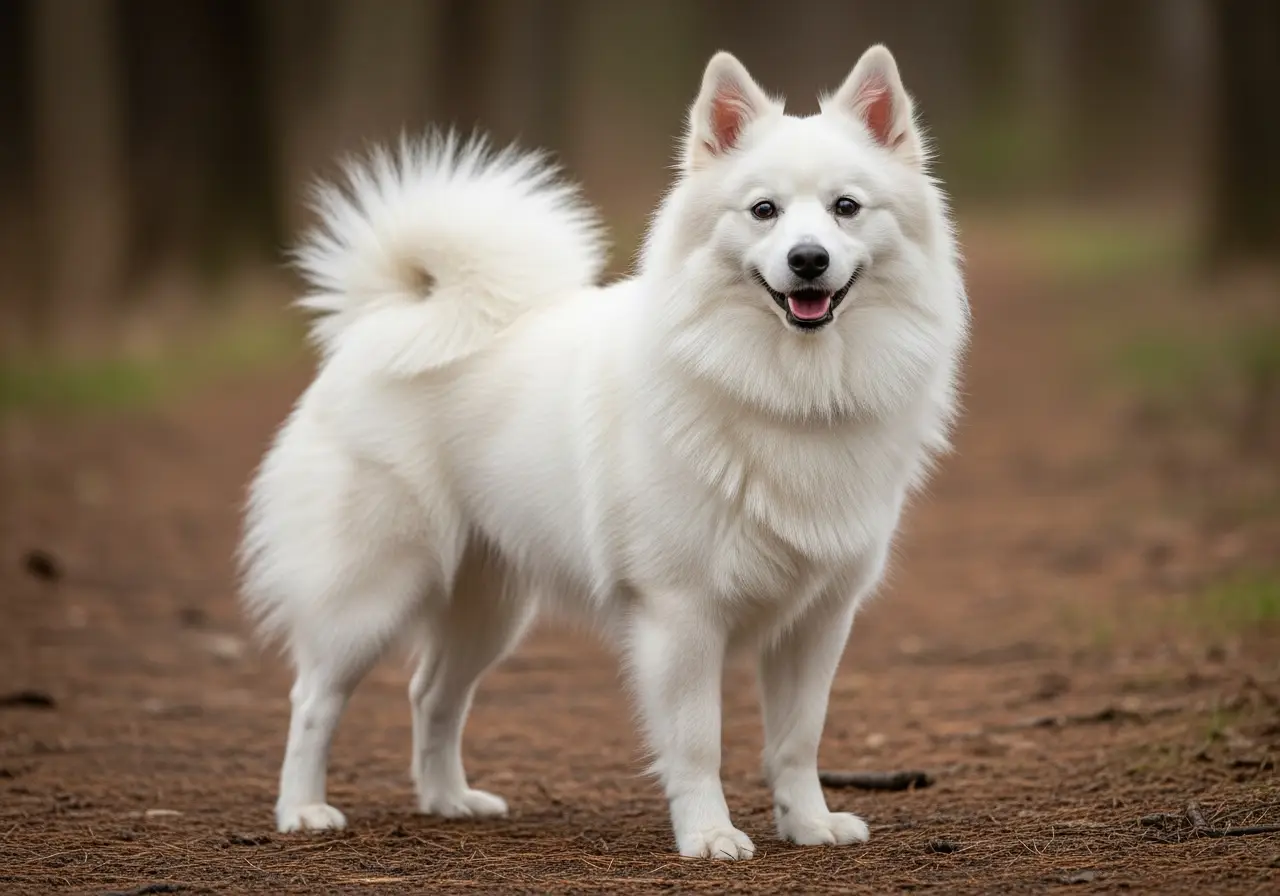
The American Eskimo Dog is a white Spitz-type dog from the USA, which exists in three size variants and is neither FCI-recognised nor a sled dog. It combines high willingness to learn with a pronounced guarding instinct, a combination that quickly leads to constant barking and controlling behaviour without clear daily structure. Anyone who brings time for training and consistent guidance receives a cooperative, long-lived companion.
02Introduction
What makes the American Eskimo Dog (Eskie) special
The American Eskimo Dog is a white Spitz-type from the USA, not FCI-recognised, in three sizes (Toy, Miniature, Standard), withers height 23–48 cm.
03Profile
Key facts and suitability
- Origin
- USA (deutsche Spitz-Abstammung)
- Original purpose
- Circus dog, companion dog
- height at the withers
- 23–48 cm
- Weight
- 3–16 kg
- Life expectancy
- 13–15 Years
- Coat type
- Doppel
- Minimum exercise
- 60 min/day
- Puppy price
- 800–1'800 CHF
- Waiting period
- 6 months
- Sports
- Agility · Obedience · Tricks
04Temperament
How the American Eskimo Dog (Eskie) shows up in everyday life
When you come home, the Eskie greets its primary caregiver with distinct volume and movement. This is not exuberance; this is guarding instinct reacting to your return. If you do not actively shape this behaviour, you reinforce it unintentionally.
In everyday life, the separation between internal need and external behaviour becomes particularly clear. Internal: The Eskie requires a close bond, mental stimulation and structured interaction with its primary caregiver; the need for social contact is high. External: It behaves reservedly to mistrustfully towards strangers, alerts visitors loudly and observes new situations from a distance. These two poles must not be confused. A dog with a high need for social contact is not automatically open to every person.
On the walk, the Eskie registers movement stimuli in its surroundings quickly and precisely. Birds, joggers, bicycles – the guarding instinct is active. A reliable recall requires training, not trust in obedience of its own accord.
At home, it seeks closeness without being intrusive. It follows its primary caregiver through the flat, observes routines and positions itself strategically. Boredom does not manifest as passivity but as vocalisation or self-occupation at the expense of furniture and objects.
It behaves compatibly towards children with early socialisation but sets boundaries when interactions become too loud or unpredictable. It accepts conspecifics with good socialisation but initially shows distance towards unknown dogs.
05Needs
What this breed needs daily
The American Eskimo Dog requires 60 to 90 minutes of active exercise daily. This includes not only walks but also structured activities such as fetching, scent work or lead training. Pure off-lead areas without a task are not sufficient to occupy the mind.
Mental stimulation has at least the same importance for the Eskie as physical exercise. Dog sports such as agility, obedience or trick training utilise its willingness to learn in a targeted manner. Nose work and search games are suitable as a supplement for rainy days or quieter phases. Without regular mental work, the Eskie develops independent occupation strategies, rarely to the advantage of the household.
The need for social contact is high. The Eskie requires several hours daily in the company of its primary caregiver or family. Being left alone must be built up gradually and should not regularly exceed four hours. Anyone who is absent for long periods due to work requires a reliable care solution.
Consistent handling is not an optional extra but a basic prerequisite. The Eskie tests boundaries and reacts to inconsistency with independent control behaviour. Clear rules that are adhered to daily create the basis for stable cooperation.
Barking behaviour requires active management from the start. If you do not deliberately shape alerting at strangers or noises, you reinforce it through unintentional reactions. A supporting dog training school with experience in Spitz types is particularly recommended in the first months.
Exercise
Medium
mental work
A lot
Social needs
High
training
Easy
07Quick Check
08Suitability
Who this breed is suitable for – and who it isn't
✓Matches
The American Eskimo Dog suits people who can plan 60 to 90 minutes of active exercise daily and enjoy structured training. Dog sports such as agility or obedience are a clear advantage. Anyone with experience of alert, eager-to-learn dogs will find a cooperative partner in the Eskie.
Families with children from about 8 years old are suitable if the handling of the dog is respectful and predictable. Loud, unstructured interactions overwhelm the Eskie and provoke distancing behaviour.
People who spend a lot of time at home or work from home benefit from the close bond of the Eskie. Anyone who regularly receives visitors requires a clear protocol for the greeting situation; the dog reliably and loudly alerts strangers. Anyone who values this as a sense of security and actively guides it will find an advantage in it.
First-time owners are possible if they use a dog training school from the beginning and actively avoid inconsistency. The breed does not silently forgive handling errors.
×Doesn't match
The American Eskimo Dog is not suitable for people who are regularly away from home for more than four hours a day and cannot organise care arrangements. The high need for social contact is not a trait that can be trained out of the dog.
Anyone who regards barking behaviour as trivial or lives in a rented flat with thin walls and little tolerance from neighbours underestimates the risk profile. The guarding instinct is genetically ingrained; it can be guided, but not switched off.
People looking for a calm, low-demand dog that occupies itself will not be happy with an Eskie. The combination of high mental stimulation needs and strong human bonding requires daily investment.
Anyone who chooses an Eskie because of its striking white coat without knowing the temperament profile is confusing appearance with suitability. Anyone who also assumes that an intelligent dog is automatically easy to handle will find that intelligence without structure works in the opposite direction. Households with very young children under 5 years old should realistically assess the high sensitivity to stimuli of the Eskie.
10Line reality
Show line, working line, breeder market
The American Eskimo Dog does not have a pronounced differentiation of lines in the sense of working and show lines, as is known for example with the Labrador or Border Collie. The breed is bred predominantly as a companion dog, without systematic separation according to performance or exhibition criteria.
Within the three size variants (Toy, Miniature and Standard), however, there are breeding differences in temperament and physique. Toy variants are more frequently bred for companion function and show standard, while Standard Eskies occasionally show even more pronounced guarding instincts. These differences are not systematically documented but are relevant in practice.
As the breed is hardly widespread in Europe and does not have FCI recognition, most animals in the DACH region come from US or Canadian breeding programmes. The quality of these breeding programmes varies considerably. Reputable breeders work with health tests for hip dysplasia, patellar luxation and eye diseases. Anyone looking for an Eskie in the DACH region needs patience when searching for a breeder and should consistently request health documents.
11Health · Reality
What you need to plan for medically with your American Eskimo Dog (Eskie)
The American Eskimo Dog is considered a robust breed with a life expectancy of 12 to 15 years. This places it in the upper range of comparable medium-sized dog breeds.
Documented health risks include hip dysplasia (HD), patellar luxation and progressive retinal atrophy (PRA). The Orthopedic Foundation for Animals (OFA) maintains databases on HD and patella results for the breed. According to OFA data as of 2023, approximately 9% of examined American Eskimo Dogs show a form of hip dysplasia, a moderate value in comparison with other breeds. Patellar luxation occurs more frequently in Toy and Miniature variants than in the Standard size.
Eye diseases, particularly progressive retinal atrophy, are known in the breed. Reputable breeders have breeding dogs examined ophthalmologically before mating. A CAER certificate (Companion Animal Eye Registry) is a minimum standard for responsible breeding.
The dense double coat requires intensive care, especially during the twice-yearly shedding periods. Mats form quickly and can promote skin problems. Regular brushing (at least twice a week, daily during shedding) is necessary.
Overweight poses a real risk for Eskies that are not sufficiently exercised. The breed tends to gain weight with reduced activity, which strains joints and heart health. Portion control and regular weight checks by the vet are recommended.
12Structured data
Health by the numbers
Prone to diseases
Progressive retinal atrophy, hip dysplasia, Legg-Calvé-Perthes disease
Recommended health tests
Eye examination, hip X-ray
13Myths ↔ Reality
What is often said incorrectly about this breed
Five myths, five realities, five sources.
The American Eskimo Dog comes from the Arctic and is related to sled dogs.
The breed developed in the USA from German Spitz types brought over by immigrants in the 19th century. There is no connection to the Arctic or sled dog breeds such as the Siberian Husky. The name arose for political reasons during the First World War, not from geographical origin.
The Eskie hardly barks and is a quiet housemate.
The American Eskimo Dog was bred as a guard dog and reacts to movement stimuli, noises and strangers with loud alerting. Without consistent training and clear guidance, this behaviour develops into permanent excessive barking. Guard instinct is a core element of the breed profile, not an isolated case.
The white fur of the Eskie is easy to care for and requires little effort.
The dense double coat of the Eskie undergoes seasonal shedding with significant hair loss. Regular brushing several times a week is necessary to avoid matting and maintain the coat structure. Care requirements increase significantly during the shedding season.
An Eskie gets along well on its own because it appears independent.
The American Eskimo Dog is highly people-oriented and develops separation stress if being left alone is not built up adequately. Its need for social contact is high. The apparent independence is deceptive: without gradual training, being alone can lead to vocalisation and destructive behaviour.
The Eskie is easy to train due to its intelligence and forgives mistakes in handling.
High intelligence means fast learning in both directions. An Eskie that experiences inconsistent handling develops independent control strategies such as territorial alerting or selective obedience. Clear rules and positive reinforcement must be applied consistently and permanently.
14animal welfare
The animal welfare perspective
Breeder market, designer versions, animal shelter reality — what no one writes in the puppy ad.
The American Eskimo Dog rarely appears in shelters in the DACH region; the breed is not widespread enough here to generate significant surrender numbers. However, this does not mean that there is no need for animal welfare protection. The main reasons for surrendering Spitz-type dogs in general are underestimated barking behaviour, lack of consistency in training and a need for social contact that was underestimated in everyday life.
The backyard breeder market for the Eskie is concentrated mainly in North America. In the DACH region, puppies are occasionally offered via international platforms or social media without proof of health documents or membership in a breeding association. Anyone importing an Eskie from abroad bears full responsibility for verifying its origin.
Designer versions or trend crosses with the Eskie are not yet a relevant phenomenon in the German-speaking region. The breed benefits from not having come into focus through viral social media trends, a circumstance that can change at any time.
Anyone looking for an Eskie should actively consider adoption through specialised rescue organisations. In the USA, several American Eskimo Dog rescue groups exist that occasionally also rehome internationally. A rehomed dog often comes with an assessment of its temperament by the foster family, an information advantage over an unknown puppy. The decision between breeder and adoption is not a moral question, but a practical one: both paths lead to a responsible outcome if they are pursued with care.
15Costs · Transparency
What this breed realistically costs
The acquisition costs for an Eskie puppy from reputable breeding in the DACH region are between 1,200 and 2,000 EUR, depending on size variant, country of origin, and health tests of the parent animals. Offers significantly below this range without proof of health indicate dubious origins.
The annual living costs consist of food (300–600 EUR depending on size variant and food quality), grooming (home care with accessories approx. 50–100 EUR/year, professional care 3–4 times a year at 60–100 EUR each), as well as basic equipment and accessories in the first year (approx. 300–500 EUR one-off).
Veterinary costs for routine examinations, vaccinations, and parasite prevention are approx. 200–400 EUR annually. Orthopaedic assessments for lameness or eye examinations are added as extra costs. Dog health insurance costs between 30–80 EUR monthly depending on provider and tariff and significantly reduces the financial risk in the event of unexpected illnesses.
Those who plan for dog sports or a supplementary dog training school should budget an additional 200–500 EUR annually. For the Eskie, this investment is not optional but part of species-appropriate keeping.
16Puppy search
What you need to consider when choosing a breeder
- Reputable breeders of the American Eskimo Dog provide health certificates for both parent dogs, at least for hip dysplasia (HD), patellar luxation and eye diseases.
- As the breed is not FCI-recognised, there is no central breeding association in Germany or Switzerland.
- Anyone looking for an Eskie should contact the American Kennel Club (AKC) or the United Kennel Club (UKC) for breeder directories and consistently check health documents.
- Puppy mills and disreputable suppliers can be identified by missing health records, early handover before the 8th week of life and willingness to ship puppies without personal contact.
- A reputable breeder asks questions about the living situation and takes the dog back in an emergency.
- Adoption through animal welfare organisations is an equally valid option.
- Eskies rarely appear in shelters in the DACH region, but Spitz-type dogs with a similar profile are regularly rehomed.
- Organisations such as Petfinder (USA) or specialised Spitz rescue groups occasionally also rehome Eskies to Europe.
- Preliminary advice from the adoption agency helps to assess the individual temperament of the animal.
FAQ
Frequently asked questions about the American Eskimo Dog (Eskie)
Is American Eskimo Dog (Eskie) suitable for beginners?
American Eskimo Dog (Eskie) is considered suitable for first-time dog owners.
Is American Eskimo Dog (Eskie) a family dog?
American Eskimo Dog (Eskie) is considered suitable for families with good socialisation and species-appropriate care.
How much exercise does American Eskimo Dog (Eskie) need?
At least around 60 minutes of exercise per day.
Does American Eskimo Dog (Eskie) suit an apartment?
With enough exercise and enrichment, American Eskimo Dog (Eskie) can also be kept in an apartment.
What is the size and weight of American Eskimo Dog (Eskie)?
Fully grown, American Eskimo Dog (Eskie) reaches about 23–48 cm at the withers and weighs around 3–16 kg.
What is the life expectancy of American Eskimo Dog (Eskie)?
The life expectancy of American Eskimo Dog (Eskie) is approximately 13–15 years.
Which diseases are common in American Eskimo Dog (Eskie)?
Progressive retinal atrophy, hip dysplasia, Legg-Calvé-Perthes disease
17Breed clubs
Official breed clubs in DACH
19Related
Similar breeds – and their differences
You might also be interested in
Participate
Do you have a good photo of your American Eskimo Dog (Eskie)?
We are looking for expressive images for our breed profiles. Submit yours; the editorial team reviews every submission before publication.
Does this breed suit you?
Intelligent, eager-to-learn Spitz for active owners. Not FCI-recognised, but UKC-registered. Factor in barking tendency and coat care.