
01Summary
In a paragraph
If you only have 30 seconds.
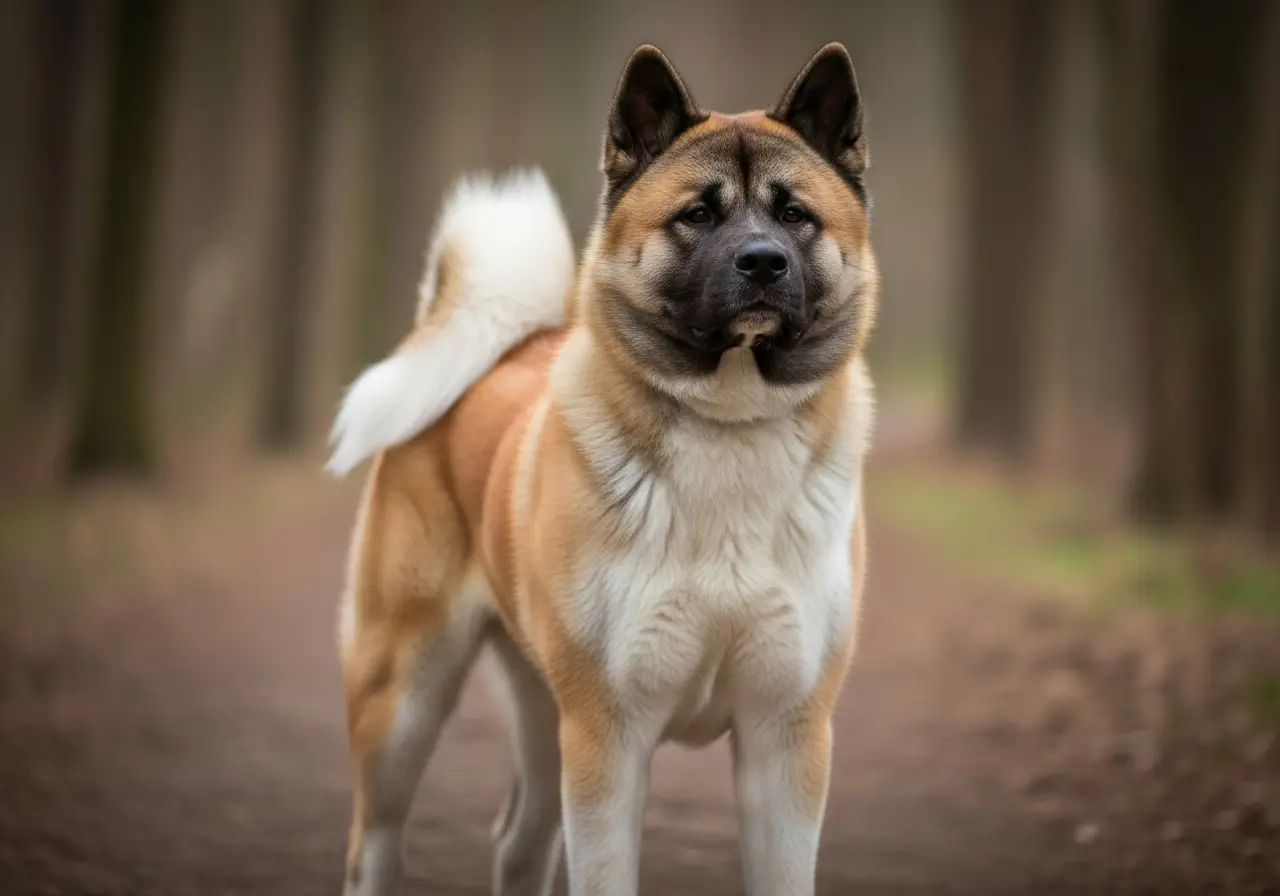
The American Akita is a massive, self-confident Spitz with pronounced territorial and protective behaviour. It builds a deep bond with its primary caregiver but remains independent at all times. It shows distance towards strangers and can be conflict-prone with conspecifics. Those who keep this breed need experience with character-strong dogs, clear structures and willingness for long-term socialisation.
02Introduction
What makes the American Akita special
The American Akita is an imposing Spitz from the USA, FCI Group 5, larger than its Japanese counterpart, with a withers height of 61–71 cm.
03Profile
Key facts and suitability
- Origin
- USA
- Original purpose
- Hunting, guard dog (derived from the Japanese Akita)
- FCI
- No. 344 · Group 5 · Section 5
- height at the withers
- 61–71 cm
- Weight
- 32–66 kg
- Life expectancy
- 10–15 Years
- Coat type
- Doppel
- Minimum exercise
- 60 min/day
- Puppy price
- 1'500–3'000 CHF
- Waiting period
- 12 months
- Sports
- Schutzhund · Scent work · Obedience
04Temperament
How the American Akita shows up in everyday life
When you come home, the American Akita does not greet you with frantic jumping. It stands there, observes and signals belonging through calm physical proximity. This restraint is not disinterest; it is an expression of its independence.
Internally, it needs daily mental enrichment and structured exercise. A walk without clear guidance is not enough. It reads body language precisely and tests whether rules are applied consistently. If you give in today and are consistent tomorrow, you will lose its cooperation.
Externally, i.e. towards strangers, it shows clear distance. An unknown visitor in the apartment does not trigger aggression if the owner communicates the situation clearly. Without this guidance, however, the Akita makes its own assessment. Its protective instinct is not a random product, but genetically anchored.
On the street, it stares at other dogs, especially those of the same sex, with an intensity that can signal escalation. Off-lead exercise in unsecured areas is not a realistic option due to its prey drive. It needs a safety lead and fenced terrain.
In family life, it thrives in calm, clearly structured households. It tolerates children if they treat it respectfully and it has opportunities to retreat. Hectic activity, loud arguments or unpredictable situations noticeably increase its stress level. These two axes (intense family bond internally, reserved to rejecting behaviour externally) must not be confused.
05Needs
What this breed needs daily
The American Akita needs 60 to 90 minutes of structured exercise daily. It is not just the distance that counts, but the quality of guidance. A dog that walks by your side and responds to your signals is mentally more stimulated than one that pulls uncontrollably for 90 minutes.
Off-lead exercise is only realistic in secured areas, such as a fenced garden or enclosed dog park. Open fields without visual barriers are not an option due to the prey drive. The lead is not just an aid in public spaces, but mandatory equipment.
Mentally, it needs tasks that match its instincts: nose work, search games, controlled carrying or pulling exercises. Classic fetching interests it selectively; it cooperates if the task makes sense to it. It rejects monotonous repetitions.
Social stimulation for this breed does not mean company at all costs. It needs a reliable primary caregiver, not sensory overload from changing visitors. Being left alone for up to five hours is possible if it has been built up early and gradually. Longer periods are problematic without a care solution.
Training requires patience, consistency and calm clarity. Loud corrections or physical pressure create resistance or withdrawal. Positive reinforcement works, but only if the relationship is right. Without trust in the leader, it simply refuses to cooperate. For newcomers to this breed, attending a dog training school with experience in strong-character breeds is not just a recommendation, but a necessity.
Exercise
High
mental work
Medium
Social needs
Medium
training
Demanding
06Sport & Mental and Physical Stimulation
What sports the American Akita is suited for
Realistic in terms of physiology and genetics – not every breed suits every sport.
Structurally and physiologically suitable: Suitable for mantrailing, dummy work and tracking.
07Quick Check
08Suitability
Who this breed is suitable for – and who it isn't
✓Matches
The American Akita suits owners with proven experience in handling independent, protection-driven breeds. Anyone who has already handled a dog with pronounced territorial behaviour and knows how to set boundaries calmly and consistently has the basic prerequisites.
A household with a clearly structured daily routine, few changing visitors and a securely fenced outdoor area makes keeping the dog considerably easier. Families with children from around ten years of age who are trained in dealing with dogs and respect its need for retreats come into question as owners, provided the parents take on the leadership role.
Those who devote at least 90 minutes daily to structured exercise and mental enrichment, who do not see dog training school as a one-off measure but as a permanent part of ownership, and who are willing to actively manage encounters with conspecifics create the framework conditions for a functional coexistence.
Individuals with a calm lifestyle, experience and sufficient time are also suitable owners, provided they accept that this dog is not a social all-purpose weapon but builds an intensive one-to-one relationship.
×Doesn't match
The American Akita is not suitable for people keeping a dog for the first time. Those who do not bring experience with independent, protection-drive-oriented breeds regularly underestimate how much leadership competence this breed demands daily.
Households in which the dog is alone for more than five hours a day and no care solution exists offer no adequate basis. Those who expect a companion dog that is approachable at all times, socially open, greets strangers friendly and gets along with every conspecific will be permanently overwhelmed by the American Akita.
Multi-dog households without experience in keeping dogs of the same sex are an increased risk scenario. Those who confuse the calm basic attitude of the Akita with compatibility, i.e. equate internal bonding intensity with external openness, make decisions on a false basis.
Families with very small children who cannot yet read dog boundaries, as well as dynamic households with frequently changing people and high stimulus frequency are also unsuitable environments. Those who rely on dominance training or physical corrections lose the cooperation of this dog, not through rebellion but through silent withdrawal.
10Line reality
Show line, working line, breeder market
A pronounced working-line breeding hardly exists for the American Akita today. The vast majority of dogs bred worldwide come from show lines focused on type, mass and coat. Protection work or utility dog sports play no significant role in the organised breeding of this breed.
However, there are clear regional differences within the show lines. American and European lines differ in head type, body mass and temperament. European lines, particularly from Eastern European countries, sometimes show stronger protection and guarding traits, suggesting selective breeding decisions beyond pure show criteria.
Anyone looking for a puppy should specifically ask about the breeding focus of the respective kennel: Are the parent dogs shown at exhibitions? Are temperament tests carried out? Is there information on the expression of protective instincts in the line? These questions provide more information than titles alone.
A field trial or hunting line in the classical sense does not exist. The prey drive is present as a breed-typical trait, but it is neither promoted nor systematically tested by breeders. Owners should still plan for it as a fixed behavioural characteristic, regardless of which line the dog comes from.
11Health · Reality
What you need to plan for medically with your American Akita
According to data from the Akita Club e.V. and international breeding associations, the life expectancy of the American Akita is on average 10 to 13 years. Larger dogs of this weight class reach the upper end of this range less often than smaller individuals.
Hip dysplasia (HD) is the most frequently documented orthopaedic disease of the breed. Reputable breeders provide X-ray findings of both parent animals; an HD evaluation according to the FCI scheme is mandatory in many breeding regulations. Without this documentation, an essential basis for the purchase decision is missing. Elbow dysplasia (ED) also occurs but is less systematically recorded.
Autoimmune diseases are more common in the American Akita than in the breed average. These include Vogt-Koyanagi-Harada-like syndrome (VKH), pemphigus foliaceus and immune-mediated haemolytic anaemia. A study by the University of Bern (2019) identified Akita breeds as overrepresented in immune-mediated dermatoses. Owners should have skin changes, pigment loss or eye symptoms checked by a vet at an early stage.
Eye problems — including progressive retinal atrophy (PRA) and entropion — are documented. Eye examinations of breeding animals by a specialist vet for ophthalmology are recommended.
Overweight poses a real risk: the American Akita tends to gain weight with insufficient exercise and uncontrolled feeding, which puts strain on joints and the cardiovascular system. Regular weight checks at the vet, at least once a year, are sensible. Preventive examinations on an annual cycle, vaccination boosters according to the vet plan and an annual blood test from the sixth year of life form the basis of preventive healthcare.
12Structured data
Health by the numbers
Prone to diseases
Hip dysplasia, autoimmune diseases, hypothyroidism, progressive retinal atrophy, pemphigus
Recommended health tests
Hip X-ray, eye examination, thyroid screening
13Myths ↔ Reality
What is often said incorrectly about this breed
Five myths, five realities, five sources.
"The American Akita is a calm family dog that suits beginners well.
Although the American Akita often displays a calm basic demeanour in everyday household life, this conceals its pronounced protective and territorial instincts. The FCI standard explicitly describes it as self-assured and dominant. Without consistent socialisation and experienced leadership, it can react conflictually towards strangers and conspecifics. It is not suitable for first-time owners.
"American Akitas get along effortlessly with other dogs.
Same-sex intolerance is widespread and breed-typical in this breed. The FCI standard states that the American Akita can appear dominant towards other dogs. Multi-dog households require careful planning, early socialisation and permanent management; there is no guarantee of compatibility.
"The dense coat protects it; heat does not affect it.
The dense double coat of the American Akita insulates in both directions: it protects against cold but significantly hinders heat dissipation. At temperatures above 25 °C, there is an increased risk of heat stress. Intensive exercise during the midday heat should be avoided. Shaded retreats and fresh water are not optional, but mandatory.
“An American Akita that appears calm is well socialised.
Calm behaviour in everyday life is not a reliable indicator of successful socialisation. The American Akita often shows stress and discomfort subtly, through body tension, staring or silent freezing rather than barking or growling. Those who do not read these signals underestimate the potential for escalation. Expert behavioural observation is essential.
“American Akita and Japanese Akita are the same breed.
Since 1999, the FCI has listed both as independent breeds with separate standards. The American Akita (FCI No. 344) is heavier, more massive and shows a wider colour spectrum. The Japanese Akita Inu (FCI No. 255) is lighter, fox-like and more strictly regulated in terms of colouration. Behaviour, type and breeding history differ significantly.
14animal welfare
The animal welfare perspective
Breeder market, designer versions, animal shelter reality — what no one writes in the puppy ad.
The American Akita ends up in animal shelters and rescue centres at an above-average rate, not because it is a difficult dog, but because it is regularly acquired by owners who underestimate its profile. Protective instincts, independence, and intolerance towards other dogs are not traits that can be trained away. They form the basic profile of the breed.
Backyard breeder market: The American Akita is a breed that is regularly offered on classifieds platforms without pedigree registration, without hip dysplasia findings for the parent dogs, and without socialisation. Puppies from such sources are cheaper to acquire, but the subsequent costs due to behavioural and health problems frequently far exceed the savings. A puppy without documented health checks of the parents is not a bargain, but a calculated risk.
Designer versions: Crossbreeds with the American Akita are occasionally marketed under fanciful names. These animals are subject to no regulated breeding; their health and temperament characteristics are unpredictable. Anyone who wants an American Akita should buy an American Akita, with FCI papers and traceable breeding documentation.
Breeding and husbandry-related problems: The breed does not show brachycephalic features, but is susceptible to autoimmune diseases and hip dysplasia. Breeding without consistent health checks exacerbates these problems over generations. Overweight conditions due to lack of exercise are a frequently underestimated husbandry problem that directly affects joints and life expectancy.
Adoption as an equally valid option: Specialised rescue organisations and breed-specific animal shelters regularly place adult American Akitas. An adult dog has a clear advantage: temperament and health status can be assessed. Anyone open to this option will find contacts with reputable placement agencies on platforms such as Petfinder or via the Akita Club e.V.
15Costs · Transparency
What this breed realistically costs
A puppy from serious VDH/FCI-recognised breeding costs between 1,500 and 2,500 EUR or CHF in Germany and Switzerland. Prices below that, especially on classifieds platforms without proof of breeding, signal missing health checks, no socialisation and often unclear origins.
The annual living costs for an American Akita realistically lie between 2,000 and 3,500 EUR. High-quality food for a dog of this size class (45–66 kg) costs 80 to 150 EUR monthly, depending on the feeding concept (dry food, BARF or wet food). Grooming (intensive brushing twice a year during moulting, occasional bathing) can be managed at home; professional grooming costs 60 to 120 EUR per session.
Veterinary costs on an annual average without illness: 300 to 600 EUR (preventative care, vaccinations, parasite prevention). In case of illnesses, particularly autoimmune diseases or orthopaedic problems, individual treatments can quickly reach 1,000 to 5,000 EUR. Pet health insurance with surgical cover costs 60 to 120 EUR monthly for this breed and size class and is a sensible safeguard given the breed-specific health risks. Dog liability insurance is mandatory in several federal states and cantons and costs 50 to 100 EUR annually.
16Puppy search
What you need to consider when choosing a breeder
- A reputable breeder of American Akitas is a member of a recognised breeding association, in Germany for example the Akita Club e.V.
- (VDH member), in Switzerland the Schweizer Klub Asiatische Spitze (SKAS).
- The breeding regulations of these associations stipulate minimum requirements for health examinations, socialisation and litter size.
- Concrete criteria for serious breeding: Both parent animals with HD X-ray findings (at least grade A or B), eye examination by a specialist vet, puppies raised with the breeder for at least eight weeks, vaccination passport, deworming certificate and chip.
- The breeder asks questions about the living conditions; whoever does not ask does not select.
- On-site inspections are mandatory.
- Those who sell puppies without inspection of the mother or offer delivery are not reputable breeders.
- Photos and videos do not replace a personal impression of the rearing environment.
- Placement via animal shelters and breed protection organisations is an equivalent option.
- Adult American Akitas from placement have an assessable temperament and known health history.
- has contacts with placement agencies.
- Those who are open to an adult dog often make a well-founded decision because they see what they get.
FAQ
Frequently asked questions about the American Akita
Is American Akita a family dog?
American Akita is considered suitable for families with good socialisation and species-appropriate care.
How much exercise does American Akita need?
At least around 60 minutes of exercise per day.
What is the size and weight of American Akita?
Fully grown, American Akita reaches about 61–71 cm at the withers and weighs around 32–66 kg.
What is the life expectancy of American Akita?
The life expectancy of American Akita is approximately 10–15 years.
Which diseases are common in American Akita?
Hip dysplasia, autoimmune diseases, hypothyroidism, progressive retinal atrophy, pemphigus
17Breed clubs
Official breed clubs in DACH
19Related
Similar breeds – and their differences
You might also be interested in
Participate
Do you have a good photo of your American Akita?
We are looking for expressive images for our breed profiles. Submit yours; the editorial team reviews every submission before publication.
Does this breed suit you?
Larger than the Japanese Akita, similarly dominant. Requires consistent leadership and early socialisation. Not a beginner's dog.