
01Summary
In a paragraph
If you only have 30 seconds.
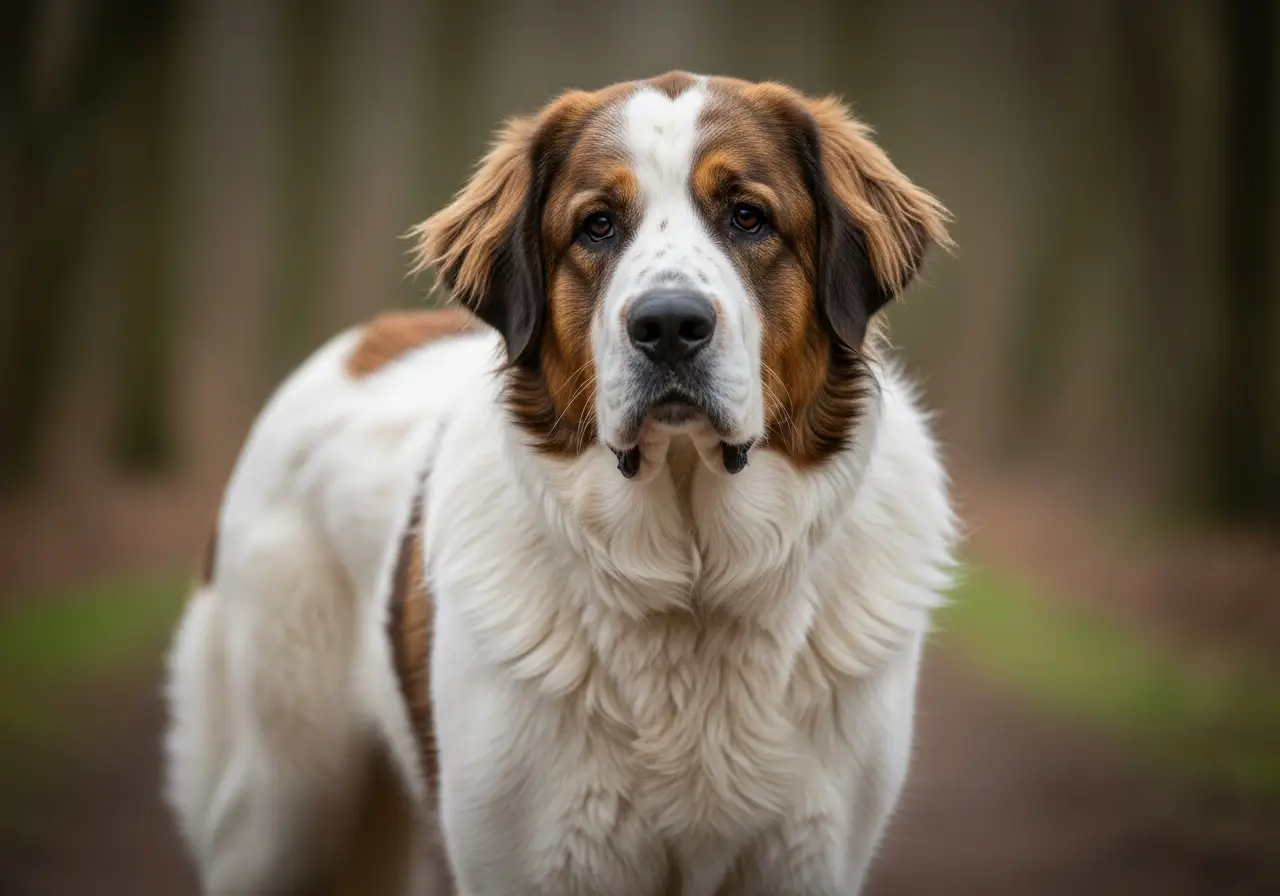
The Pyrenean Mastiff is a massive Spanish livestock guardian dog that independently made decisions against wolves and bears for centuries. This genetic imprinting for initiative and territorial protection is still fully present today. A calm temperament towards the family does not disguise the fact that this dog requires experienced owners, a secure property, and a clear leadership structure, without exception.
02Introduction
What makes the Pyrenean Mastiff special
Pyrenean Mastiff: massive Spanish livestock guardian Molosser, calm, loyal and geared towards independent initiative
03Profile
Key facts and suitability
- Origin
- Spanien
- Original purpose
- Livestock guarding
- FCI
- No. 92 · Group 2 · Sektion 2.2: Molossoide, Berghunde (ohne Arbeitsprüfung)
- height at the withers
- 77–81 cm
- Weight
- 55–100 kg
- Life expectancy
- 10–12 Years
- Coat type
- Doppel
- Minimum exercise
- 90 min/day
- Puppy price
- 2'000–3'000 CHF
- Waiting period
- 5 months
- Sports
- Hiking
04Temperament
How the Pyrenean Mastiff shows up in everyday life
When returning home, a Pyrenean Mastiff greets its primary caregiver calmly and without exuberant excitement. It stands up, sniffs briefly, lies down again. This composure is not disinterest; it is an expression of a deep, stable bond with the core family.
Internally, the Pyrenean Mastiff requires clear structure and a secured territory. Its need for social contact with the family is pronounced: It wants to be near its primary caregivers without demanding constant stimulation. Mental work in the classic sense (fetching, search games, obedience exercises) interests it little. What occupies it is observing, assessing and securing its environment.
Externally, the dog behaves reservedly to watchfully towards strangers. Visitors entering the property are initially announced with deep, voluminous barking. The Pyrenean Mastiff does not retreat; it holds its ground and observes. Only when the primary caregiver clearly assesses the situation does it relax gradually. These two poles, close family bond and clear reserve towards unknown persons, must not be confused. A calm dog in the house does not mean that it accepts strangers without problems.
With other dogs, it shows itself good-natured according to the FCI standard, as long as its territory is respected. Conflicts arise primarily when a strange dog enters the property or pressures the herd, in this case the family. Its barking is deep, resonant and audible from afar: In residential areas with dense building development, this regularly leads to neighbourhood conflicts.
05Needs
What this breed needs daily
The Pyrenean Mastiff requires 60 to 90 minutes of structured exercise daily. Calm walks on varying paths are in the foreground here, not speed, but territory exploration. Intensive endurance exertion is neither appropriate for its body structure nor its disposition.
A secured, large property is not an option, but a basic prerequisite. The fence must be stable, high and dig-proof: A fully grown male dog reaches a weight of up to 100 kg and develops considerable strength upon perceiving a threat. Pure apartment keeping is out of the question.
Mentally, this dog does not require classic mental work in the form of fetch or search games. Its mental stimulation arises from observing and assessing its territory, a task it takes on itself. What it needs instead is clear, calm guidance by an emotionally stable primary caregiver. Pressure, loudness or inconsistent behaviour lead to withdrawal or resistance.
Socialisation from the earliest youth onwards is decisive. The puppy must systematically and positively get to know people, vehicles, noises, other animals and changing environments; otherwise, the breed-typical reserve intensifies into difficult-to-manage shyness or aggressiveness. An accompanying dog training school with experience in livestock guardian dogs is recommended, but does not replace the daily guidance work of the owner.
Being alone is tolerated by the Pyrenean Mastiff in a stable environment for up to about six hours, provided it has sufficient space and its territory is secured.
Exercise
Medium
mental work
Something
Social needs
Medium
training
Experts
07Quick Check
08Suitability
Who this breed is suitable for – and who it isn't
✓Matches
The Pyrenean Mastiff suits owners who already have proven experience with large livestock guardian dogs or comparable molossoids. A calm, structured everyday life on a property with at least 500 m² of fenced area is a prerequisite, not a bonus.
Suitable are owners who plan 60 to 90 minutes for structured exercise daily and simultaneously understand that this dog does not aim for classic subordination. Families with older children from about ten years of age, who are socialised in dealing with large dogs, come into question, provided the parents clearly take on the leadership role and consistently supervise visits by children.
Owners who live in rural or small-town environments with low visitor density benefit from the fact that barking and reserve towards strangers create less potential for conflict. Anyone willing to invest time in early and consistent socialisation and attend a dog training school with experience in livestock guardian dogs lays the foundation for stable coexistence. Both axes must align: sufficient space and calm guidance internally, and an environment where guarding behaviour remains controllable externally.
×Doesn't match
The Pyrenean Mastiff is not suitable for owners keeping a dog for the first time or who have previously worked exclusively with small or medium-sized breeds without protective instincts. The size alone, up to 100 kg body weight, makes physical control impossible without solid guidance competence.
Anyone living in a city apartment, a terraced house with a small garden, or in an apartment building cannot provide this dog with the necessary framework conditions. The deep, far-hearing barking and pronounced territorial behaviour are unmanageable in densely populated areas.
Owners who regularly receive many visitors, have children's playgroups in the garden, or live in a social environment with frequently changing people underestimate the external axis of this breed: reserve towards strangers is not a training error, but genetically ingrained behaviour. Anyone who interprets this dog as a "calm cuddle dog" and infers openness towards strangers from this confuses internal family bonding with external reaction to unknown people. This misconception has regularly led to surrenders in the past with similar livestock guardian dogs.
10Line reality
Show line, working line, breeder market
The Pyrenean Mastiff is not bred into clearly separated working and show lines, as is the case with some other breeds. The total population is too small to establish pronounced line differentiation. Nevertheless, discernible type differences exist within the breeding.
Spanish breeders who work closely with the historical livestock guardian type place value on nerve calmness, threshold of irritation and physical robustness. These dogs are tendentially less selected for outward appearance and show a more pronounced independence in behaviour.
Breeders who are oriented towards international exhibition success prioritise body structure, coat structure and proportions according to FCI Standard No. 92. These dogs may appear more accessible in everyday life, as selection for a broad audience in the show ring favours a certain openness towards strangers, without the protective instinct completely receding.
For interested parties this means: A conversation with the breeder about the specific parent dogs, their use and temperament tests is indispensable. Anyone looking for a dog for active livestock guarding requires different criteria than someone aiming for a family dog with guardian qualities. Both requirements are fundamentally compatible with this breed, but only if the breeding selection is consciously oriented towards them.
11Health · Reality
What you need to plan for medically with your Pyrenean Mastiff
As a very large breed, the Pyrenean Mastiff carries an increased risk of hip dysplasia (HD) and elbow dysplasia (ED). Reliable breed-specific prevalence studies for the Pyrenean Mastiff are rare due to the small population size. For comparable large molossoids such as the Mastino Napoletano or the Kangal, HD rates in breeding samples lie between 20 and 40% (OFA database, status 2023). Reputable breeders provide X-ray findings for both parent animals; this is a minimum standard, not an additional service.
The risk of gastric torsion (Gastric Dilatation-Volvulus, GDV) is significantly increased in deep-chested large breeds. Studies show that dogs over 40 kg carry up to five times higher GDV risk than small breeds (Glickman et al., Veterinary Medicine 1994). Symptoms (distended abdomen, unsuccessful retching, restlessness) require immediate veterinary emergency care.
Life expectancy is between 9 and 12 years. During the growth phase up to the 18th month of life, intensive physical exertion should be avoided as the skeleton is not yet fully developed.
Recommended preventive examinations: HD/ED X-rays from the 12th month, annual weight checks (overweight significantly increases joint load), regular dental checks. Pet insurance with surgical coverage is financially sensible for this breed due to GDV risk and possible orthopaedic interventions.
12Structured data
Health by the numbers
Prone to diseases
Hip dysplasia Elbow problems Gastric torsion (bloat)
Recommended health tests
Hip X-rays Elbow X-rays
13Myths ↔ Reality
What is often said incorrectly about this breed
Five myths, five realities, five sources.
“The Pyrenean Mastiff is an uncomplicated dog for beginners because of its calmness.
The calm demeanour in a family setting masks the complexity of the breed. The Pyrenean Mastiff is genetically geared towards independent decision-making and territorial protection. Without experience with livestock guardian dogs and without consistent socialisation from puppyhood, serious handling problems arise. Specialist associations and breed club recommendations explicitly classify it as a breed for experienced owners.
“A large property replaces sufficient exercise and enrichment.
A secure property is a necessary prerequisite, but does not replace active guidance. The Pyrenean Mastiff requires daily structured exercise sessions as well as a clear human-dog relationship. Without these conditions, it develops undesirable behaviours such as excessive barking, territorial aggression towards visitors or ignoring owner signals.
“Pyrenean Mastiffs are naturally child-friendly because they guarded herds.
The historical livestock guarding instinct does not automatically mean compatibility with children in the household. The dog distinguishes between familiar family members and strangers, which can also include the children’s playmates. Careful, early socialisation and constant supervision during contact with children are mandatory. General statements about child-friendliness are professionally untenable for this breed.
“The breed is so rare that you cannot get one from animal welfare.
Although the Pyrenean Mastiff is indeed very rare in DACH countries, livestock guardian dogs of a similar type regularly appear in animal welfare organisations, often as crossbreeds or under incorrect breed names. Furthermore, specialised livestock guardian dog associations occasionally rehome purebred animals whose owners underestimated the requirements. Researching relevant animal welfare contacts is worthwhile before buying.
“Because he is so big, he needs a lot of sport.
The Pyrenean Mastiff is not an endurance athlete and not a companion dog for intensive physical activities such as canicross or agility. Its exercise requirement is moderate: 60 to 90 minutes of calm movement on structured paths daily are sufficient. Intensive exertion, particularly during the growth phase, significantly increases the risk of joint problems such as hip and elbow dysplasia.
14animal welfare
The animal welfare perspective
Breeder market, designer versions, animal shelter reality — what no one writes in the puppy ad.
The Pyrenean Mastiff is one of the rarest breeds in Germany, Austria, and Switzerland. This protects it from some problems of the mass market but creates its own risks.
Backyard breeders and disreputable providers exploit this rarity deliberately. A puppy offered without HD/ED documentation for the parents, without breed club affiliation, and without personal inspection most likely comes from breeding that does not systematically select for health and temperament. Especially for a breed where temperament instability or joint problems have serious consequences, this is no minor matter.
Designer versions or trend crosses hardly exist for the Pyrenean Mastiff; the breed is too unknown. However, there is another risk: confusion with similar livestock guardian dogs such as the Great Pyrenees, the Kangal, or the Caucasian Shepherd Dog. Anyone who buys one of these dogs under a false designation may receive a completely different behavioural and health profile.
Breeding and keeping-related problems with the Pyrenean Mastiff arise mainly from underestimated requirements. The most common reasons for surrendering comparable livestock guardian dogs are: excessive barking in residential areas, uncontrollable territorial behaviour towards visitors, and lack of space. These problems are generally not training errors; they are the result of a living situation that was unsuitable for the breed from the start.
Rehoming an adult Pyrenean Mastiff through animal welfare organisations or specialised clubs is a fully valid option. An adult dog shows its character openly, which makes it easier to assess whether it suits your specific living situation. Anyone who knows and meets the requirements of this breed will find just as reliable a partner in a rehomed dog as in a puppy from a breeder.
15Costs · Transparency
What this breed realistically costs
A puppy from a reputable breeder with breed club affiliation, HD/ED certificates for the parents, and complete initial care costs between 1,500 and 2,500 EUR in the DACH region. Offers significantly below this indicate missing health checks or insufficient socialisation conditions.
The annual food costs for an adult Pyrenean Mastiff weighing between 60 and 100 kg range from 1,200 to 2,400 EUR depending on the type of feeding. Quality dry food or BARF in appropriate quantities are costly at this body mass.
Routine veterinary costs (vaccinations, parasite prevention, annual check-ups) amount to 300 to 500 EUR per year. In addition, possible orthopaedic examinations (HD/ED X-rays: 150 to 300 EUR) and emergency surgical interventions must be considered. A GDV operation costs between 2,000 and 5,000 EUR depending on the clinic.
Pet insurance with surgical coverage costs 60 to 120 EUR per month for a giant breed in this weight class, representing a calculable safeguard given the risk of GDV. Dog liability insurance is mandatory in several German states and costs 50 to 150 EUR annually. Total costs in the first year including getting a dog: realistically 4,000 to 6,000 EUR.
16Puppy search
What you need to consider when choosing a breeder
- Reputable breeders of the Pyrenean Mastiff are exceptionally rare in DACH.
- Waiting times of a year or more are common; anyone offered a puppy immediately should regard this as a warning signal.
- Criteria for reputable breeding: Both parent animals have been X-rayed for hip and elbow dysplasia (HD/ED) and the results are documented in writing.
- The breeder allows visits to the litter and shows at least one parent on site.
- Puppies leave the litter no earlier than eight weeks of age, are chipped, vaccinated, and dewormed.
- The breeder asks questions about the living situation and rejects buyers without suitable prerequisites.
- Membership in a recognised breed club, such as the Club für Molosser e.V.
- or the Club Suisse du Chien de Montagne et Mâtin des Pyrénées, is a quality feature but does not replace independent assessment of breeding conditions.
- Placement through animal welfare organisations or specialised livestock guardian dog associations is an equally valid option.
- Dogs from surrenders often have a known history, enabling a realistic assessment of temperament.
- No breeder and no placement centre should appear by name as a recommendation on this platform; the research lies with the owner.
FAQ
Frequently asked questions about the Pyrenean Mastiff
Is Pyrenean Mastiff a family dog?
Pyrenean Mastiff is considered suitable for families with good socialisation and species-appropriate care.
How much exercise does Pyrenean Mastiff need?
At least around 90 minutes of exercise per day.
What is the size and weight of Pyrenean Mastiff?
Fully grown, Pyrenean Mastiff reaches about 77–81 cm at the withers and weighs around 55–100 kg.
What is the life expectancy of Pyrenean Mastiff?
The life expectancy of Pyrenean Mastiff is approximately 10–12 years.
Which diseases are common in Pyrenean Mastiff?
Hip dysplasia Elbow problems Gastric torsion (bloat)
17Breed clubs
Official breed clubs in DACH
19Related
Similar breeds – and their differences
You might also be interested in

Participate
Do you have a good photo of your Pyrenean Mastiff?
We are looking for expressive images for our breed profiles. Submit yours; the editorial team reviews every submission before publication.
Does this breed suit you?
One of the largest livestock guardian dogs – calm but independent and hardly suitable for first-time dog owners