
01Summary
In a paragraph
If you only have 30 seconds.
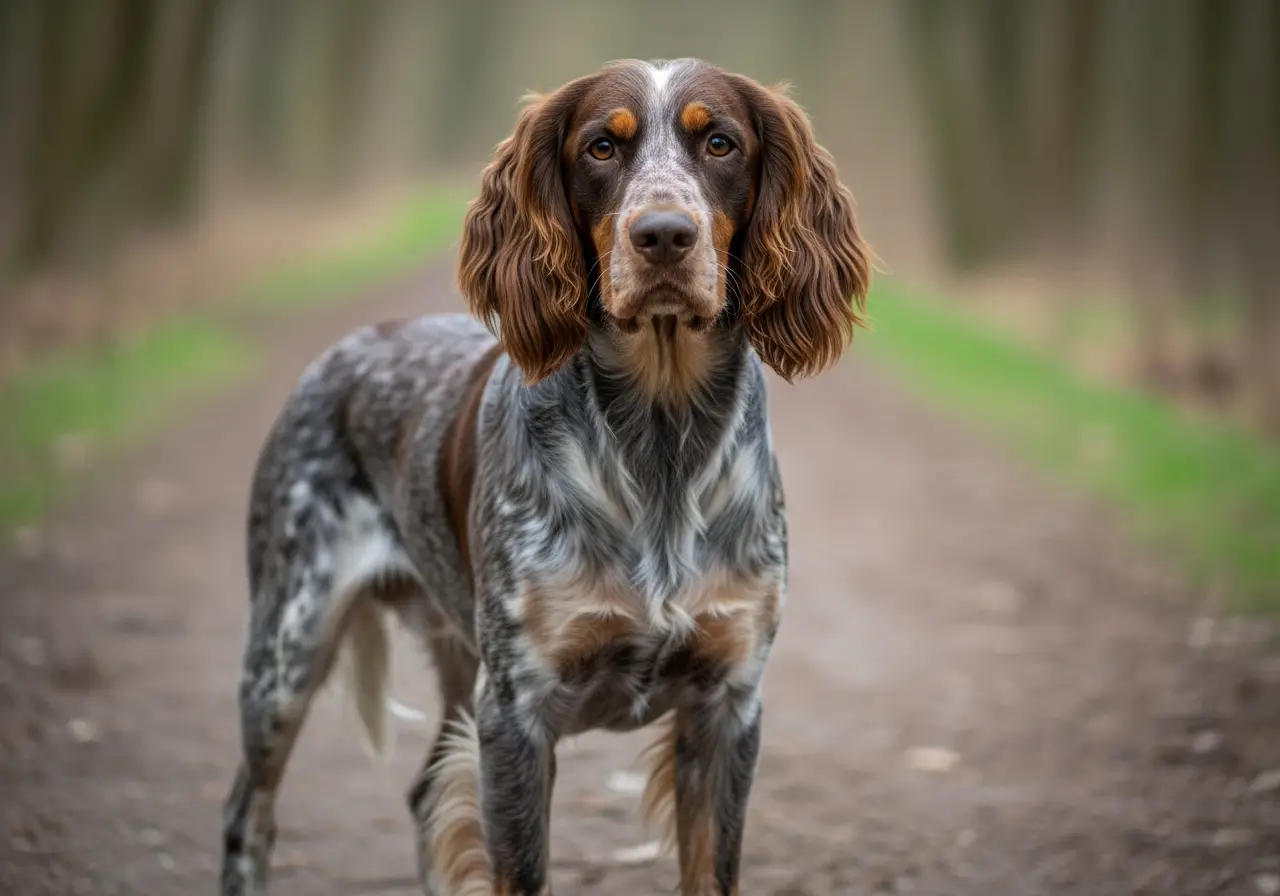
The Picardie Spaniel is a north French pointing dog with a calm temperament and deeply rooted work motivation. Owning one means taking on a dog that needs real tasks daily: nose work, retrieving, structured exercise. Its gentle appearance masks its endurance demands. For hunters and very active owners with training competence, it is a reliable partner. For everyone else, it becomes a daily challenge.
02Introduction
What makes the Picardy Spaniel special
Picardy Spaniel: rare French pointing spaniel with wavy coat, versatile and family-friendly
03Profile
Key facts and suitability
- Origin
- Frankreich
- Original purpose
- Bird hunting Retrieving
- FCI
- No. 108 · Group 7 · Sektion 1.2: Kontinentale Vorstehhunde, Typ Spaniel
- height at the withers
- 55–60 cm
- Weight
- 20–25 kg
- Life expectancy
- 13–15 Years
- Coat type
- Gelockt
- Minimum exercise
- 90 min/day
- Puppy price
- 1'500–2'500 CHF
- Waiting period
- 5 months
- Sports
- Retrieving Swimming Scent work
04Temperament
How the Picardy Spaniel shows up in everyday life
During morning exercise, the Picardie Spaniel does not wait passively; it signals readiness through calm attentiveness. No frantic jumping, no barking on the lead. As soon as its nose touches the ground and a scent becomes interesting, it switches to another mode: focused, enduring, hardly distractible.
These two states, cooperative calmness in the house and intense concentration in the field, characterise daily life with this breed. Internally, the Picardie Spaniel requires 90 to 120 minutes of active enrichment daily, a significant portion of which should be nose work or structured training. The need for social contact is high: the dog seeks closeness to its primary caregiver, wants to be included in activities, and shows signs of stress during prolonged isolation.
Externally, it behaves openly to neutrally towards strangers; there is no pronounced mistrust, but also no exuberant greeting. It acknowledges visitors in the household without being pushy. This openness towards strangers must not be confused with a low need for social contact: the dog is fixated on its primary caregiver, not equally on every person.
It generally shows social compatibility with other dogs, provided that socialisation was early and consistent. The prey drive is noticeable in everyday life; encounters with small animals require lead presence and clear guidance. Anyone who wants a relaxed dog next to them on the sofa in the evening will get that, provided the day was sufficiently stimulating. An under-stimulated Picardie Spaniel is not a calm dog.
05Needs
What this breed needs daily
The Picardie Spaniel requires at least 90 minutes of active exercise daily, a significant part of which should consist of structured work, not free running around. Fetch exercises, tracking work, dummy training or hunting-related enrichment cover both the need for movement and mental work.
The need for mental work is at a high level. Pure walks without mental stimulation are not sufficient. Nose work, whether in a hunting context or as a sport such as Mantrailing, is not an addition for this breed but a basic need. Anyone who plans 30 minutes of nose work daily will experience a noticeably more balanced dog than with pure running load.
The need for social contact is pronounced. The Picardie Spaniel is not a dog that can easily spend long periods alone. Being left alone for up to four hours is possible with established training, but should not become the norm. A dog that is regularly left alone for eight hours develops stress symptoms, regardless of physical workload.
A rural or at least suburban environment significantly facilitates keeping the dog, but is not an absolute prerequisite. Crucial is access to off-lead areas and terrain where nose work is possible. Keeping in an apartment works if daily enrichment is secured, not as a compromise, but as an actively planned routine.
Training requires consistency, calmness and hunting understanding or solid training competence. The dog reacts sensitively to tone of voice and mood; pressure and strictness undermine willingness to cooperate.
Exercise
High
mental work
A lot
Social needs
High
training
Medium
06Sport & Mental and Physical Stimulation
What sports the Picardy Spaniel is suited for
Realistic in terms of physiology and genetics – not every breed suits every sport.
Structurally and physiologically suitable: Suitable for mantrailing, dummy work and tracking · CaniCross / bikejoring possible.
07Quick Check
08Suitability
Who this breed is suitable for – and who it isn't
✓Matches
The Picardie Spaniel suits owners who can plan 90 to 120 minutes of structured enrichment daily, not as an occasional activity, but as a fixed daily routine. Hunters with active hunting operations find in it a versatile working partner for field, forest and water.
Non-hunting owners are also suitable if they are willing to seriously engage in nose work, dummy training or comparable dog sports. Families with children of school age, in which at least one person brings daily time for structured activity, are suitable owners, provided the children are introduced to handling and the dog still receives its quiet retreat options.
Anyone living in a rural or suburban environment with access to off-lead areas significantly eases daily life. Owners with experience working with pointing dogs or hunting dogs bring the best prerequisites. First-time owners are not fundamentally excluded, but they require a dog training school with experience in working with high-drive dogs from the start and should intensively engage with the breed before making the decision.
×Doesn't match
The Picardie Spaniel does not suit owners who are regularly away from home for eight or more hours during the week and cannot organise reliable care solutions. The high need for social contact and the bonding intensity of this breed are incompatible with prolonged isolation.
Those who interpret the dog's calm nature as a sign of low exercise requirements will be disappointed. The outward composure masks the actual need for physical activity and mental stimulation; those who fail to correct this misconception will end up with a dog exhibiting behavioural problems.
Urban owners without access to off-leash areas or terrain suitable for nose work face structural limitations. Owners seeking a dog that can reliably run off-leash near wildlife or small animals must also be realistic: the prey drive is genetically ingrained and requires consistent leash management in uncontrolled environments.
Those with little experience of high-drive dogs and no willingness to engage intensively with training methods should carefully weigh their decision. The dog forgives inconsistency less readily than its cooperative nature might suggest.
10Line reality
Show line, working line, breeder market
The Picardie Spaniel is bred almost exclusively in one line: the hunting-oriented working type. A pronounced show line, as observed in other breeds, practically does not exist for this rare breed. The low number of litters per year, which is in single figures in Germany and Switzerland, does not allow for a split into diverging breeding directions.
This means for prospective owners: the dog they acquire is highly likely to be descended from parents that have passed hunting tests. Working tests and hunting utility tests play a central role in breeding. The Association for French Pointing Dogs (VBBFL) and the Club Suisse de l'Épagneul Breton et autres chiens d'arrêt de France (CsEB) oversee the breed in the German-speaking region and place value on preserving the working type.
Regional differences within the line are minimal. French breeders, who produce the majority of puppies, closely follow the FCI standard and hunting performance traits. Anyone acquiring a Picardie Spaniel obtains a dog whose work motivation and drive structure have been deliberately preserved over generations, regardless of whether the owner hunts themselves or not.
11Health · Reality
What you need to plan for medically with your Picardy Spaniel
The Picardie Spaniel is considered a robust breed with a life expectancy of 12 to 14 years. Breed-typical diseases are less documented compared to more popular pointing breeds, an effect of the small, hunting-selected breeding population that left little room for fashionable over-typing.
Hip dysplasia (HD) occurs occasionally. Reliable breed-specific HD rates are not available due to the small population size; as a guideline, it is noted that HD prevalences of 10–20% are documented in medium-sized pointing dogs within non-systematically screened populations (OFA database, status 2023). Reputable breeders have parent dogs radiologically examined for HD; this proof should be requested when buying a puppy.
Ear infections are a known risk in dogs with floppy, hairy ears. The Picardie Spaniel is additionally exposed due to its use in wetlands and water bodies. Regular ear checks after every water contact and field work significantly reduce the risk of chronic inflammation.
The slightly wavy coat requires thorough checking for ticks, burrs, and dirt after field work. Weekly brushing is sufficient in everyday life; immediate inspection is recommended after intensive use.
Overweight is a real risk for well-provided pet dogs, even in this active breed. Weight should be monitored regularly; if activity is reduced (injury, age), the food quantity must be adjusted accordingly. Annual check-ups with the vet are standard.
12Structured data
Health by the numbers
Prone to diseases
Hip dysplasia Eye diseases
Recommended health tests
Hip X-ray Eye examination
13Myths ↔ Reality
What is often said incorrectly about this breed
Five myths, five realities, five sources.
“The Picardy Spaniel is an uncomplicated family dog without special demands due to its calm nature.
The calm temperament of the Picardy Spaniel conceals its actual stimulation needs. The breed was selected over centuries for intensive hunting work, pointing, retrieving, nose work in the field. Without this enrichment, the dog shows behavioural issues such as restlessness, destruction or excessive barking. Calm nature means willingness to cooperate, not low need.
“A large garden replaces daily active enrichment.
A garden offers the Picardy Spaniel freedom of movement, but does not replace structured work. The breed requires targeted nose work, retrieving exercises or hunting-related enrichment; free running in the garden does not meet cognitive and instinctual needs. Studies on the behavioural biology of pointing dogs show that unstructured exercise does not sufficiently channel the work drive.
“The pronounced prey drive makes the Picardy Spaniel uncontrollable in everyday life.
The prey drive of the Picardy Spaniel is genetically hard-wired, but can be well managed through consistent guidance and early training. Compared to other pointing dogs, the breed is considered cooperative and biddable. The prerequisite is clear structure from the start, not suppression of the drive, but its targeted channeling into permitted activities.
“Because the breed is so rare, you have to take any available puppy.
The rarity of the Picardy Spaniel increases pressure on interested parties to act quickly; exactly this is exploited by dubious providers. Reputable breeders carry out health tests, show both parent dogs and provide pedigrees. A long waiting time with a tested breeder is always preferable to immediate availability without transparency.
“The Picardy Spaniel is only suitable for hunters.
The breed was bred for hunting, but can also be stimulated in a non-hunting context, through mantrailing, dummy training, scent work or search and rescue dog work. The decisive factor is not the owner’s hunting licence, but the willingness to offer structured nose and exercise work daily. Without this offering, the dog suffers regardless of the context.
14animal welfare
The animal welfare perspective
Breeder market, designer versions, animal shelter reality — what no one writes in the puppy ad.
The Picardie Spaniel is hardly present in animal welfare circles in the German-speaking region. The breed is so rare that surrenders to shelters or via animal welfare organisations are exceptional cases. Anyone looking for a Picardie Spaniel through animal welfare channels needs plenty of patience and should actively use specialised adoption platforms and breed club contacts.
The low popularity has a protective effect: backyard breeders and mass production, as seen with fashionable breeds, play hardly any role for the Picardie Spaniel. The risk of acquiring a puppy from breeding for harmful traits (Qualzucht) or animal trade is lower than with trend breeds, but not zero. Even rare breeds have offers lacking transparency, health tests, and pedigrees. Price pressure due to rarity can tempt buyers to cut corners when vetting the provider. That is a mistake.
Designer variants or deliberate crosses of the Picardie Spaniel are not known in the DACH region. The breed has so far been spared from hybridisation trends, a circumstance linked to the small, club-affiliated breeder community.
Housing-related problems with the Picardie Spaniel arise almost exclusively from under-stimulation. A dog with high physical and mental exercise needs that ends up in a sedentary household develops stress symptoms, not because it is difficult, but because its basic needs are not met. This is not a character flaw of the dog, but a housing problem.
Anyone considering the breed should view rehoming via breed club contacts as an option equal to searching for a breeder. Even though current rehoming cases are rare, it is worth enquiring with the VBBFL or CsEB, where they have contacts for dogs looking for a new home.
15Costs · Transparency
What this breed realistically costs
A puppy from a reputable breeder costs between 1,200 and 1,800 EUR in the DACH region, depending on origin and breeding association. Offers significantly below this without papers and health certificates are a warning sign.
Annual living costs amount to 1,500 to 2,500 EUR. This includes food (400–700 EUR/year depending on quality and weight), grooming needs (brushing, occasional trimming, approx. 100–200 EUR/year), basic equipment and accessories, as well as dog tax (depending on the municipality 50–150 EUR/year).
Veterinary costs on an annual average (preventative check-ups, vaccinations, parasite prevention) amount to 300–500 EUR. Unforeseen treatments are added to this; for ear problems or orthopaedic assessments, individual costs of 200–800 EUR may arise.
Pet insurance costs between 40 and 90 CHF/EUR per month for a medium-sized dog of this class, depending on provider, excess and scope of cover. For a breed with a life expectancy of 12–14 years and a robust constitution, the assessment is individual; at least a comparison before buying the puppy is recommended.
16Puppy search
What you need to consider when choosing a breeder
- Anyone looking for a Picardie Spaniel must expect waiting periods of one to several years.
- Litter sizes in the German-speaking region are single-digit; most puppies come from France.
- Reputable contacts include the Verein für Französische Vorstehhunde (VBBFL) and the Club Suisse de l'Épagneul Breton et autres chiens d'arrêt de France (CsEB), both of which maintain breeder lists and facilitate introductions.
- A reputable breeder shows both parent dogs, provides hip dysplasia (HD) screening results, issues an FCI pedigree, and asks questions about the buyer's daily life.
- Anyone who does not meet these criteria is not a suitable contact, regardless of price or availability.
- Puppies without papers, from abroad with immediate release, or via classifieds portals without proof of breeding carry increased risks: lack of health tests, unclear origins, and possible early socialisation deficits.
- Adoption through breed club contacts is an equally valid option.
- Although active animal welfare cases involving this breed are rare, it is worthwhile to inquire with the breeding association, as returns or rehoming situations are known there before they become public.
FAQ
Frequently asked questions about the Picardy Spaniel
Is Picardy Spaniel suitable for beginners?
Picardy Spaniel is considered suitable for first-time dog owners.
Is Picardy Spaniel a family dog?
Picardy Spaniel is considered suitable for families with good socialisation and species-appropriate care.
How much exercise does Picardy Spaniel need?
At least around 90 minutes of exercise per day.
Does Picardy Spaniel suit an apartment?
With enough exercise and enrichment, Picardy Spaniel can also be kept in an apartment.
What is the size and weight of Picardy Spaniel?
Fully grown, Picardy Spaniel reaches about 55–60 cm at the withers and weighs around 20–25 kg.
What is the life expectancy of Picardy Spaniel?
The life expectancy of Picardy Spaniel is approximately 13–15 years.
Which diseases are common in Picardy Spaniel?
Hip dysplasia Eye diseases
17Breed clubs
Official breed clubs in DACH
19Related
Similar breeds – and their differences
You might also be interested in


Participate
Do you have a good photo of your Picardy Spaniel?
We are looking for expressive images for our breed profiles. Submit yours; the editorial team reviews every submission before publication.
Does this breed suit you?
Gentle hunting companion – good for families with access to nature