
01Summary
In a paragraph
If you only have 30 seconds.
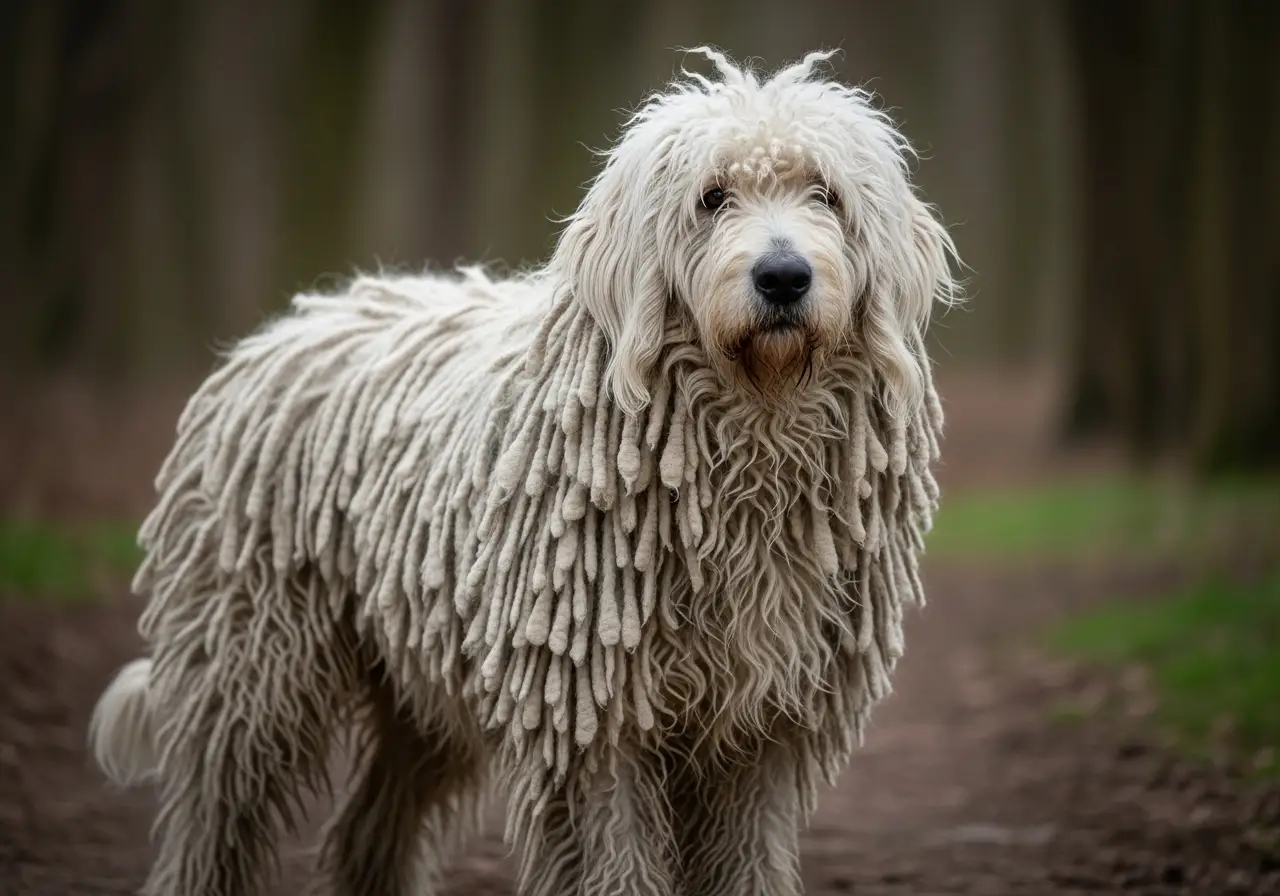
The Komondor is not a dog for everyday life with compromises. The Hungarian livestock guardian dog brings centuries of genetically anchored territorial behaviour and expects an owner who understands this, rather than fighting it. Its characteristic corded coat is not a style feature, but functional protective armour. Anyone bringing leadership strength, space, and experience receives a reliable, loyal protector.
02Introduction
What makes the Komondor special
The Komondor is a Hungarian livestock guardian dog, FCI Group 1, known for its white corded coat, withers height 65–76 cm.
03Profile
Key facts and suitability
- Origin
- Ungarn
- Original purpose
- Livestock guarding against wolves and bears on the Puszta
- FCI
- No. 53 · Group 1 · Sektion 1: Schäferhunde (ausgenommen Schweizer Sennenhunde).
- height at the withers
- 65–76 cm
- Weight
- 40–60 kg
- Life expectancy
- 10–12 Years
- Coat type
- Gelockt
- Minimum exercise
- 60 min/day
- Puppy price
- 1'500–3'000 CHF
- Waiting period
- 12 months
- Sports
- Schutzhund
04Temperament
How the Komondor shows up in everyday life
When a visitor enters the property, the Komondor does not react with barking and tail wagging. It positions itself. It observes. It decides. This sequence is not a behavioural problem; it is the result of centuries of selection for independent guarding behaviour.
Internally, i.e. in terms of what the dog needs from itself, the Komondor shows a moderate need for social contact. It bonds closely with its family but does not seek permanent proximity or confirmation. It prefers to lie where it can oversee its territory rather than sleep on the sofa. At night it is active, which corresponds to its historical working pattern as a nocturnal guardian.
Externally, i.e. in terms of reaction to stimuli from the environment, the picture is clear: towards strangers, the Komondor shows pronounced reserve up to open distrust. These two axes – close family bonding and rejection of strangers – run parallel in the Komondor, not in contradiction. A dog that is loyal to its family does not automatically have to be open to everyone. Anyone who confuses this fundamentally underestimates the breed.
In everyday life with the family, a well-socialised Komondor behaves calmly and sensibly. It does not impose itself, but also tolerates no boundary violations, neither from strangers nor from children it does not know. It generally gets along with dogs from its own household, but can appear dominant towards unknown dogs in its own territory.
It requires mental work to a moderate extent. Classic obedience exercises motivate it little. Tasks that correspond to its guarding instinct (a clearly defined territory, a herd or at least a property that it considers its own) provide it with the mental structure it needs.
05Needs
What this breed needs daily
The Komondor requires 60 to 90 minutes of moderate exercise daily. Marathon runs or intensive agility units do not correspond to its profile; it is not an endurance athlete, but a territorial guardian. Walks at a calm pace, combined with free movement on a secured property, meet its physical needs.
The property is not an option, but a basic prerequisite. A securely fenced area (fence height of at least 1.80 m, stable and without gaps that could be dug under) gives the Komondor the territory it needs genetically. Keeping it in an apartment is out of the question. A house without a garden is not a suitable environment for this breed.
Mentally, the Komondor does not require sensory overload, but clear structures. It processes its environment independently and makes decisions without seeking confirmation. This means: the owner must anticipate situations rather than correct them afterwards. If you expect visitors, secure the dog in good time, not because the Komondor is uncontrollable, but because its guarding reaction sets in quickly and decisively.
The Komondor can be left alone for up to six hours without pronounced separation issues, provided its territory is secure. It is not a breed that panics when the owner is absent; it patrols, observes, and waits.
Early, broad socialisation is not a recommendation, but an obligation. The puppy must encounter people, noises, vehicles, and other animals in controlled situations before its guarding instinct is fully developed. Omissions during this phase are difficult to correct later. A dog training school with experience in livestock guardian dogs is strongly recommended in the first months of life.
Exercise
Medium
mental work
Medium
Social needs
Low
training
Experts
07Quick Check
08Suitability
Who this breed is suitable for – and who it isn't
✓Matches
The Komondor suits owners with proven experience in handling independent or strongly guarding dogs. Anyone who has already handled a livestock guardian dog, a Molosser, or a similarly independent breed brings the necessary foundation.
A rural or at least suburban environment with your own house and a securely fenced property is suitable. Plan realistically for at least 90 minutes of active time per day for exercise, care, and structured interaction.
Families with older children from about ten years old, who are trained in handling large dogs, may be suitable if the parents clearly take on the leadership role and do not leave children unsupervised with the dog.
Owners who are prepared to check the legal situation in their canton or municipality and, if necessary, organise a certificate of competence or liability insurance with an increased coverage sum are on the right track. Anyone who views this as a bureaucratic hurdle should reconsider the breed.
People who enjoy intensive grooming (regularly separating the cords, checking for skin problems, patiently drying after bathing) will find in the Komondor a dog whose outward appearance genuinely demands and rewards care.
×Doesn't match
The Komondor does not suit owners without prior experience with large, independent dogs. Anyone keeping a dog for the first time will most likely underestimate the demands of this breed, not out of malice, but because the Komondor requires leadership competence that cannot be derived from books alone.
Anyone living in an apartment or a house without a fenced garden is unsuitable. This also applies to owners who are away from home for more than six hours daily and cannot organise reliable care.
Anyone wishing for a sociable, stranger-friendly dog that warmly greets visitors and plays without problems with conspecifics in the dog park will not be happy with the Komondor. The external reaction to strangers is genetically reserved; this can be mitigated by socialisation, but not reversed.
Anyone who views grooming as a tedious chore or does not plan time for regular checks through the coat risks skin problems and pain for the dog.
Owners living in densely populated urban areas with high visitor traffic should not choose this breed. The Komondor’s territorial behaviour is difficult to control in such environments and carries an increased potential for conflict, for the dog, the neighbours, and the owner alike.
10Line reality
Show line, working line, breeder market
The Komondor does not have a pronounced separation between working lines and show lines in the sense of Retriever or Spaniel breeds. The breeding population is small worldwide, which prevents strong differentiation into lines.
Nevertheless, regional differences exist: Hungarian breeding lines, which are close to the original working profile, tend to show a stronger guarding instinct and a more robust body structure. North American lines – the Komondor has been bred in the USA since the 1930s and gained some popularity there as a livestock guardian dog on sheep farms – were partly selected for exhibition suitability without completely abandoning the working profile.
In Germany and Austria, the breeding base is narrow. Breeders often work with international pairings to avoid inbreeding. This means for prospective owners: The lineage of a puppy can be traced through its pedigree, and a conversation with the breeder about the character of the parent dogs provides more insight than the coat appearance alone.
Anyone who wants to use a Komondor as an active livestock guardian dog on a sheep or goat farm should specifically look for breeders who document working suitability and keep parent dogs with proven guarding experience. For pure family keeping without a herd, the working profile is still present; it manifests itself in everyday life, not only in the pasture.
11Health · Reality
What you need to plan for medically with your Komondor
The Komondor is considered a robust breed, but as a large dog it is not free from breed-specific health risks. According to Hungarian breed club data, the life expectancy is 10 to 12 years, with well-kept dogs occasionally reaching 13 years.
Hip dysplasia (HD) and elbow dysplasia (ED) occur regularly in large breeds. No large-scale population-wide studies exist for the Komondor, but both the Hungarian breed club and the VDH-affiliated breeding association recommend mandatory hip X-ray examinations of both parent dogs before breeding. Owners should request corresponding reports from the breeder.
Gastric dilatation-volvulus (gastric torsion) is a serious risk in deep-chested large breeds. Symptoms such as a distended abdomen, unproductive retching and restlessness require immediate emergency veterinary care. As a preventive measure, vets recommend several small meals daily rather than one large portion, along with rest periods after eating.
The corded coat requires regular checks for skin infections, parasitic infestation and eczema. Moisture trapped between the cords promotes fungal infections. At least monthly coat checks should be realistically planned for.
Preventive examinations: Annual veterinary check-ups, weight monitoring (overweight places considerable strain on the joints), dental checks and eye examinations from the fifth year of life are recommended. Overweight is an underestimated risk in this breed; the dense coat reliably conceals weight gain visually.
12Structured data
Health by the numbers
Prone to diseases
Hip dysplasia, eye problems, skin problems (cord care)
Recommended health tests
Hip X-ray, eye examination
13Myths ↔ Reality
What is often said incorrectly about this breed
Five myths, five realities, five sources.
„The Komondor is an easy-to-care-for dog because of its coat.
The corded coat of the Komondor requires considerable care effort. The cords must be separated regularly to prevent clumping. When wet, the coat dries only slowly; incompletely dried cords promote skin infections and mould formation. An adult Komondor needs up to 24 hours drying time after bathing. Neglected coat sticks painfully to the skin.
„The Komondor is a family dog that warmly greets children and visitors.
The FCI standard explicitly describes the Komondor as naturally unaffectionate and fundamentally distrustful of strangers. It does not readily tolerate any foreign living creature in its territory. Visitors who enter the property without prior notice may be classified as a threat. Children from the immediate family are generally tolerated if socialisation was carried out early and consistently, but this is not automatic.
“A large dog requires a lot of exercise; the Komondor must walk for hours every day.
The Komondor is not an endurance athlete, but a guard dog with moderate exercise needs. Historically, it patrolled at night on a defined territory without covering long distances. What matters is a clearly demarcated territory, not kilometres on a treadmill. Excessive physical exertion, particularly during the growth phase, can damage the joints in this large breed.
“The Komondor obeys if you train it consistently.
Over centuries, the Komondor has been selected to make independent decisions without consulting humans. It questions instructions that contradict its own assessment of the situation. This is not a deficit in training, but a genetically anchored working principle. Classic obedience training alone falls short for this breed. Sovereign, calm leadership with clear structure is more effective than repeated command training.
“The Komondor can be kept without problems anywhere in Germany.
In several German federal states as well as in Austrian municipalities, the Komondor is subject to a registration or licensing requirement as a potentially dangerous breed. The regulations vary significantly by federal state and municipality. Before getting a dog, it is absolutely essential to check the current legal situation at your place of residence; ignorance does not protect against fines or bans on keeping the animal.
14animal welfare
The animal welfare perspective
Breeder market, designer versions, animal shelter reality — what no one writes in the puppy ad.
The Komondor is surrendered above average frequently in Germany and Austria. The main reasons are consistent: underestimated guarding instinct, lack of handling experience and underestimation of the grooming effort. Anyone who acquires a Komondor for aesthetic reasons – the corded coat is undoubtedly an eye-catcher – and does not check the keeping requirements in advance, puts the dog and themselves under pressure.
Backyard breeders and dubious suppliers exploit the rarity of the breed. Puppies are offered at inflated prices without health certificates, without socialisation and without viewing the parent animals, often via classifieds portals. A Komondor puppy from such sources carries an increased risk of health problems and behavioural difficulties because the formative phase in rearing was neglected.
Designer versions or crosses with the name "Komondor mix" exist on the market without reliably passing on the characteristic coat or the working profile of the breed. Anyone specifically looking for a Komondor should insist on FCI-recognised pedigree.
Problems related to keeping often arise from confinement that is too tight. A Komondor without a secured territory develops frustration and over-arousal behaviour; it seeks out its own territory, which leads to conflicts in urban environments. Neglected coat mats painfully with the skin and leads to chronic skin diseases that are complex to treat veterinarily.
Adoption is an equally valid option. Specialised breed protection organisations for livestock guardian dogs accompany the handover professionally and assess owners for suitability. An adult Komondor from adoption has an assessable character, an advantage over the puppy whose guarding instinct only fully shows with maturity. The decision for a dog from adoption is not a stopgap solution but an informed choice.
15Costs · Transparency
What this breed realistically costs
A Komondor puppy from reputable breeding affiliated with VDH or ÖKV costs between 1,500 and 2,500 EUR in Germany and Austria. Offers significantly below this, particularly under 1,000 EUR, indicate missing health tests, inadequate socialisation or backyard breeding.
The annual food costs for an adult Komondor (50–60 kg) range between 800 and 1,400 EUR depending on quality. High-quality dry food solutions or raw feeding (BARF) are at the upper end of this range.
Grooming is an independent cost factor. Professional groomers with experience in corded breeds charge 80 to 150 EUR per appointment. Anyone who takes care of the grooming themselves invests time, but also in care products and occasional checks by the vet for skin problems.
Basic veterinary costs (vaccinations, annual preventive care, parasite prevention) are between 300 and 600 EUR per year. Orthopaedic treatments for HD or ED can reach 1,500 to 4,000 EUR as a one-off cost. Pet insurance with surgical cover costs between 60 and 120 EUR monthly for a Komondor depending on provider and tariff, sensible coverage given the operation costs for gastric torsion or joint operations.
16Puppy search
What you need to consider when choosing a breeder
- Reputable Komondor breeders are members of a recognised breed club affiliated with the VDH, ÖKV, or SKG.
- They provide health certificates for both parent dogs, including at least hip and elbow dysplasia X-ray reports, and allow a visit to the litter in its familiar environment.
- Puppies offered without seeing the mother or without vaccination and deworming records are a clear warning sign.
- The Komondor is a rare breed.
- Waiting times of one year or longer are normal with reputable breeders.
- Anyone obtaining a puppy immediately or at short notice should scrutinise the origin particularly critically.
- Adoption as an equally valid option: Komondors end up in animal shelters or breed rescue organisations disproportionately often, usually because owners have underestimated the leadership effort and guarding instinct.
- An adult Komondor from adoption has the advantage that character and behaviour are already assessable.
- Specialised breed rescue organisations accompany the adoption process professionally and carefully assess the suitability of the new owner.
- No reputable platform recommends individual breeders by name.
- Points of contact for the search are the stud book offices of the national cynological associations and the breed club websites.
FAQ
Frequently asked questions about the Komondor
How much exercise does Komondor need?
At least around 60 minutes of exercise per day.
What is the size and weight of Komondor?
Fully grown, Komondor reaches about 65–76 cm at the withers and weighs around 40–60 kg.
What is the life expectancy of Komondor?
The life expectancy of Komondor is approximately 10–12 years.
Which diseases are common in Komondor?
Hip dysplasia, eye problems, skin problems (cord care)
17Breed clubs
Official breed clubs in DACH
19Related
Similar breeds – and their differences
You might also be interested in
Participate
Do you have a good photo of your Komondor?
We are looking for expressive images for our breed profiles. Submit yours; the editorial team reviews every submission before publication.
Does this breed suit you?
Hungarian national breed. White corded coat casing – care involves enormous effort. Only for absolute specialists.