
01Summary
In a paragraph
If you only have 30 seconds.
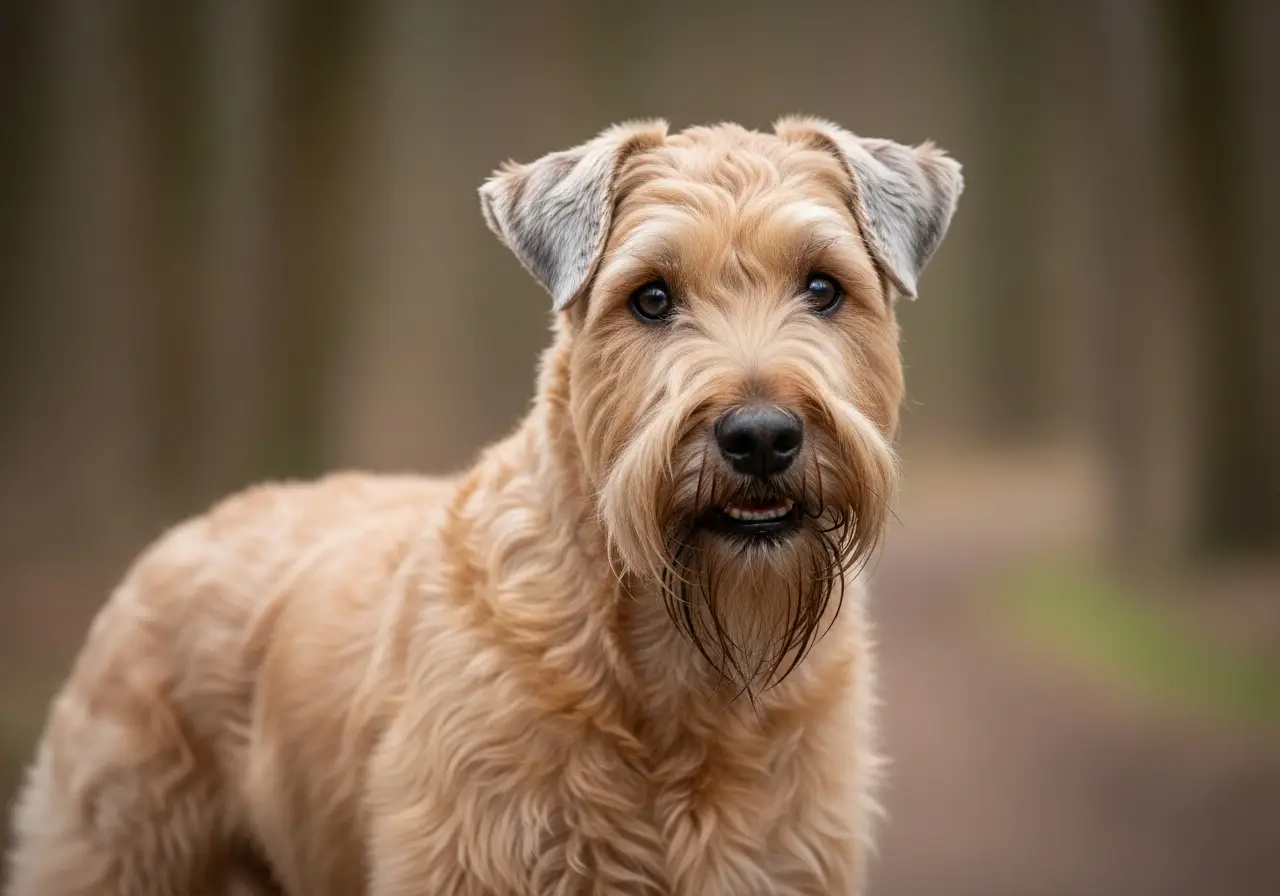
The Irish Soft Coated Wheaten Terrier is a versatile working terrier from Ireland with soft, wheaten-coloured fur and a pronounced prey drive. Its affinity for people easily masks the fact that it requires consistent leadership, daily mental and physical stimulation, and clear structures. Anyone who gets this dog without experience and without a plan for its mind will end up with a terrier that makes its own plans.
02Introduction
What makes the Irish Soft Coated Wheaten Terrier special
The Soft Coated Wheaten Terrier is an Irish all-rounder terrier, FCI Group 3, hypoallergenic and suitable as a family dog, withers height 46–49 cm.
03Profile
Key facts and suitability
- Origin
- Irland
- Original purpose
- All-round farm dog and hunting terrier
- FCI
- No. 40 · Group 3 · Sektion 1: Hochläufige Terrier
- height at the withers
- 46–49 cm
- Weight
- 14–20 kg
- Life expectancy
- 12–14 Years
- Coat type
- Long-haired
- Minimum exercise
- 60 min/day
- Puppy price
- 1'500–2'500 CHF
- Waiting period
- 9 months
- Sports
- Agility · Obedience · Earthdog work
04Temperament
How the Irish Soft Coated Wheaten Terrier shows up in everyday life
When you come home, a Wheaten Terrier awaits you who takes the greeting seriously, often with jumping, vocalisations and attempts to reach your face. This is not an isolated case, but everyday life. This energy belongs to the internal profile of the breed: the need for social contact is high, the bond with the primary caregiver is intense, and boredom quickly shows itself in undesirable behaviour.
On a walk, the Wheaten alternates between an attentive companion and an independent scent tracker. As soon as an interesting scent appears, the prey drive kicks in, and recall loses priority. This is not disobedience out of spite, but genetically anchored Terrier logic. Loose-leash walking and a reliable recall therefore require consistent, long-term training.
Internally and externally distinct: The Wheaten shows high warmth and playfulness towards known people well into adulthood. It generally meets strangers openly to curiously; the CCT axis for friendliness towards strangers is at 4 out of 5. This does not, however, mean that it is uncritical. Unfamiliar situations or loud environments can make it briefly attentive before it orients itself.
In a household with children, the Wheaten works well with clear structure and mutual respect. It does not tolerate being touched without announcement and sets boundaries, which is not a problem with appropriate training on both sides, but requires attention. Caution is advised with small animals in the household: the prey drive does not distinguish between wild animals and domestic rabbits.
05Needs
What this breed needs daily
The Wheaten Terrier needs at least 90 minutes of active exercise daily, divided into several sessions, not as a single outing. Pure walks are not enough. The breed benefits from activities with changes in direction, nose work and variable environments: forest runs, terrain training or structured search games engage both body and mind.
The need for mental work is high. The Wheaten was selected over centuries as an independently thinking working dog; it expects tasks, not just movement. Mantrailing, fetch training, agility or obedience offer meaningful formats for stimulation. It responds to monotonous repetitions with declining engagement; variety in training maintains its motivation.
Being left alone requires a structured build-up. Four hours are considered a realistic maximum for a well-conditioned adult Wheaten, provided it has received sufficient stimulation beforehand. Longer absences without preparation lead to stress behaviour.
Grooming is not an optional extra, but a fixed part of the weekly programme: brushing at least once a week, trimming or shearing several times a year. Anyone who does not do this themselves should plan regular appointments with a dog groomer.
Social integration into family life is not optional for the Wheaten. It needs closeness, interaction and the feeling of being part of what is happening. Isolation, even with sufficient exercise, leads to behavioural problems in this breed.
Exercise
High
mental work
A lot
Social needs
High
training
Demanding
06Sport & Mental and Physical Stimulation
What sports the Irish Soft Coated Wheaten Terrier is suited for
Realistic in terms of physiology and genetics – not every breed suits every sport.
Structurally and physiologically suitable: Suitable for mantrailing, dummy work and tracking · CaniCross / bikejoring possible.
07Quick Check
08Suitability
Who this breed is suitable for – and who it isn't
✓Matches
The Wheaten Terrier suits owners with prior experience in training willful dog breeds. Anyone who has already worked with a Terrier or another independently thinking breed brings the necessary foundation.
Suitable are active individuals or families who can plan at least 90 minutes of structured exercise and additional mental work daily. A garden is an advantage, but does not replace guided stimulation.
Families with children from about eight years old, who are trained in dealing with dogs and respect boundaries, get along well with the Wheaten, provided clear rules apply for all parties involved.
Owners who enjoy active training (whether nose work, agility or obedience) will find a willing-to-learn partner in the Wheaten, who appreciates variety and rejects monotony.
People who are prepared to plan grooming as a fixed weekly point and use professional support if needed are well positioned. Anyone who also brings the willingness to train recall and impulse control long-term and consistently gives this dog the basis it needs.
×Doesn't match
The Wheaten Terrier does not suit owners who are keeping a dog for the first time and do not plan accompanying dog training school or experienced support. Its willfulness and prey drive quickly become overwhelming without prior experience.
Anyone who is away from home for more than four hours daily and has not organised reliable care should not choose this breed. The high need for social contact is incompatible with permanent isolation.
Households with small animals such as rabbits, guinea pigs or birds take a real risk: the genetically anchored prey drive can be dampened by training, but not completely switched off.
Anyone looking for a calm, low-demand pet that is satisfied with occasional walks makes the wrong choice with the Wheaten. The breed demands active participation, daily, not situationally.
Anyone who equates the Wheaten's friendliness towards strangers with general approachability in every situation underestimates its Terrier character. Anyone who also considers grooming a negligible side issue will be confronted with a matted dog and vet costs that could have been avoided through regular care.
10Line reality
Show line, working line, breeder market
The Soft Coated Wheaten Terrier is kept primarily as a companion and show dog today. A pronounced working line in the sense of active utility dog breeding no longer exists; FCI classification occurs without a working test.
Within show breeding, there are regional differences: Irish and British lines are traditionally considered somewhat more robust in build and livelier in temperament. American lines have been partially selected for a more luxurious coat and a somewhat calmer baseline disposition, which may result in marginally lower activity drive in daily life, but this does not constitute a reliable rule.
For owners in the DACH region, the question of lineage is less decisive than the question of health tests for the parent animals and the socialisation of the litter. Anyone acquiring a Wheaten from Irish or British breeding should be prepared for a possibly slightly higher need for activity. A conversation with the breeder about the temperament and willingness to work of the parent animals provides more insight than geographical origin alone.
11Health · Reality
What you need to plan for medically with your Irish Soft Coated Wheaten Terrier
According to breed club data, the life expectancy of the Soft Coated Wheaten Terrier is 12 to 14 years, with considerable variation depending on genetic load and living conditions.
Two diseases are at the centre of breed health concerns: Protein Losing Enteropathy (PLE) and Protein Losing Nephropathy (PLN). A study by Cornell University (Littman et al., 2000, Journal of Veterinary Internal Medicine) documented that a significant proportion of the Wheaten population examined was affected by one of these diseases or carried genetic risk factors. Symptoms include weight loss, chronic diarrhoea, oedema, and reduced performance. Reputable breeders carry out appropriate health tests.
Hip dysplasia (HD) occurs in the breed but is less prevalent than in large breeds. Preventive X-rays of the parent animals are nevertheless standard in responsible breeding.
Skin problems, including allergic reactions and atopy, are known to be typical for the breed. Regular grooming and high-quality nutrition reduce the risk but do not replace veterinary assessment for persistent symptoms.
Overweight poses a lower risk in sufficiently exercised Wheaten than in less active breeds. If activity is reduced, for example after injuries or in old age, calorie intake should be adjusted.
Preventive examinations: annual general check-up, urine and blood tests from the fifth year of life for early detection of PLN, dental checks, and weight monitoring. Immediate veterinary attention is required in cases of symptoms such as diarrhoea lasting more than three days or visible oedema.
12Structured data
Health by the numbers
Prone to diseases
Protein-losing enteropathy (PLE), protein-losing nephropathy (PLN), hip dysplasia
Recommended health tests
Protein screening (urine/blood), hip X-rays
13Myths ↔ Reality
What is often said incorrectly about this breed
Five myths, five realities, five sources.
„The Wheaten Terrier is hypoallergenic; allergy sufferers can keep it without hesitation.
The soft, low-shedding coat of the Wheaten does indeed produce less loose hair than many other breeds. No dog is allergen-free: the main allergen Canis familiaris 1 (Can f 1) is found in saliva and skin flakes, not just in the coat. Allergy sufferers should consult an allergist before getting a dog and test the dog multiple times in their own home.
„Because the Wheaten looks so friendly, it is well-suited for dog beginners.
The Wheaten Terrier shows high sociability and often greets acquaintances enthusiastically. This masks its pronounced independence and genetically anchored prey drive. It responds to monotonous training with disinterest and exploits inconsistency consistently. Owners without prior experience frequently underestimate the training effort, leading to rehoming.
„A garden is sufficient exercise; the Wheaten occupies itself.
A garden gives the Wheaten space to dig and roam, but it does not replace structured exercise or mental stimulation. Without targeted enrichment, the breed develops boredom-related behaviours: excessive barking, digging, or destructive chewing. The daily activity requirement is at least 90 minutes of guided exercise plus mental work.
„The Wheaten gets along with all other dogs without problems.
With early and consistent socialisation, the Wheaten shows good basic tolerance towards conspecifics. However, its self-confidence and terrier-typical dominant behaviour can lead to conflicts when meeting unfamiliar dogs, especially if off-leash. Loose-leash walking and recall are therefore central training goals.
„The Wheaten's soft coat is easy to care for and requires little attention.
The characteristic silky coat grows continuously and mats without regular care. Weekly brushing and trimming or clipping several times a year are necessary. Neglected coats develop dense mats that can only be resolved by radical clipping. The care effort is higher than for many short-haired breeds.
„Protein-loss diseases are rare in Wheatens and not a real issue.
Protein-losing enteropathy (PLE) and protein-losing nephropathy (PLN) are among the breed-typical conditions of the Wheaten Terrier. Studies from the USA show that a significant proportion of the breed is affected or carries genetic risk factors. Reputable breeders test their breeding stock for these conditions. Symptoms such as weight loss, diarrhoea, or oedema require immediate veterinary investigation.
14animal welfare
The animal welfare perspective
Breeder market, designer versions, animal shelter reality — what no one writes in the puppy ad.
The Wheaten Terrier is regularly rehomed in the German-speaking area, not because the breed is difficult, but because expectations and reality diverge. Its friendly appearance and visually appealing coat lead owners to choose the breed without sufficient research. The prey drive, independence, and high need for stimulation then come as a surprise in everyday life.
On the backyard breeder market, the Wheaten occasionally appears as a "family-friendly terrier without aggression potential", a simplification that misleads buyers. Puppies from parents not health-tested carry an increased risk of PLE and PLN. Anyone buying a Wheaten without health certificates for the parents assumes a financial and emotional risk that can be avoided by careful breeder selection.
Designer versions or crosses with the Wheaten as a base exist but are not widespread in the DACH region. The breed itself is not a trend product, which protects it from some excesses of the puppy market but does not make it completely immune.
Problems related to keeping arise mainly from under-stimulation: A Wheaten that receives too little exercise and mental work daily develops behaviours regarded as "difficult", although they are simply expressions of unmet needs. This leads to rehoming that could be avoided with realistic prior information.
Adopting an adult Wheaten through breed rescue organisations or animal shelters is a fully valid option. Adult dogs already show their character, and health status and behaviour can be assessed. Anyone open to this option gives a dog a second chance and often makes a more informed decision than when buying a puppy.
15Costs · Transparency
What this breed realistically costs
A Wheaten puppy from reputable breeding with health certificates and the breeder's club membership costs between 1,400 and 2,200 EUR in the DACH region. Offers significantly below this (without certificates, without club affiliation) signal missing health tests and an increased risk of breed-typical diseases.
The annual living costs for an adult Wheaten realistically lie between 2,000 and 3,500 EUR. Included are: high-quality food (approx. 600–900 EUR/year), regular trimming or shearing by a dog groomer (approx. 300–600 EUR/year depending on frequency), basic equipment and accessories, and routine veterinary consultations.
Veterinary costs vary considerably: annual check-ups including vaccinations cost approx. 150–300 EUR. For breed-specific conditions such as PLE or PLN, diagnosis and long-term treatment can reach several thousand euros. Pet insurance with reimbursement for chronic conditions is advisable for this breed; annual premiums range between 400 and 900 EUR depending on the provider and scope of cover.
Dog training school and training are not optional items for this breed: a basic course plus advanced courses cost 300–600 EUR in the first two years. Those who shy away from this investment will later pay with greater effort for behaviour correction.
16Puppy search
What you need to consider when choosing a breeder
- Reputable Wheaten breeders are members of a recognised breed club, such as the Klub für Terrier (KfT) or the Schweizer Club für Terrier (SCFT) in the German-speaking area.
- They test their breeding stock for breed-typical diseases, particularly PLE and PLN, and provide proof thereof.
- A breeder who is unaware of these tests or rejects them is not a reliable contact.
- Before purchasing, you should observe the dam in everyday life, not just in photos.
- Puppies that grow up in an apartment and are exposed to various stimuli early on start with a socialisation advantage.
- Waiting lists at reputable breeders are common and not a disadvantage; they indicate that puppies are not produced on demand.
- Be wary of offers without waiting periods, without club membership, and without health certificates.
- Adopting an adult Wheaten through breed rescue organisations or animal shelters is an equally valid option.
- Adult dogs already show their character clearly, and the training effort can be assessed more realistically than with a puppy.
- Breed-specific rehoming centres often work closely with breed clubs.
FAQ
Frequently asked questions about the Irish Soft Coated Wheaten Terrier
Is Irish Soft Coated Wheaten Terrier suitable for beginners?
Irish Soft Coated Wheaten Terrier is considered suitable for first-time dog owners.
Is Irish Soft Coated Wheaten Terrier a family dog?
Irish Soft Coated Wheaten Terrier is considered suitable for families with good socialisation and species-appropriate care.
How much exercise does Irish Soft Coated Wheaten Terrier need?
At least around 60 minutes of exercise per day. As an active breed, more so — plus mental stimulation.
Does Irish Soft Coated Wheaten Terrier suit an apartment?
With enough exercise and enrichment, Irish Soft Coated Wheaten Terrier can also be kept in an apartment.
What is the size and weight of Irish Soft Coated Wheaten Terrier?
Fully grown, Irish Soft Coated Wheaten Terrier reaches about 46–49 cm at the withers and weighs around 14–20 kg.
What is the life expectancy of Irish Soft Coated Wheaten Terrier?
The life expectancy of Irish Soft Coated Wheaten Terrier is approximately 12–14 years.
Is Irish Soft Coated Wheaten Terrier suitable for allergy sufferers?
Irish Soft Coated Wheaten Terrier is considered relatively hypoallergenic. There’s never a guarantee — test direct contact beforehand.
Which diseases are common in Irish Soft Coated Wheaten Terrier?
Protein-losing enteropathy (PLE), protein-losing nephropathy (PLN), hip dysplasia
17Breed clubs
Official breed clubs in DACH
19Related
Similar breeds – and their differences
You might also be interested in


Participate
Do you have a good photo of your Irish Soft Coated Wheaten Terrier?
We are looking for expressive images for our breed profiles. Submit yours; the editorial team reviews every submission before publication.
Does this breed suit you?
Hypoallergenic, cheerful, eager to learn. Demand health screening from breeders – PLN/PLE are typical for the breed.