
01Summary
In a paragraph
If you only have 30 seconds.
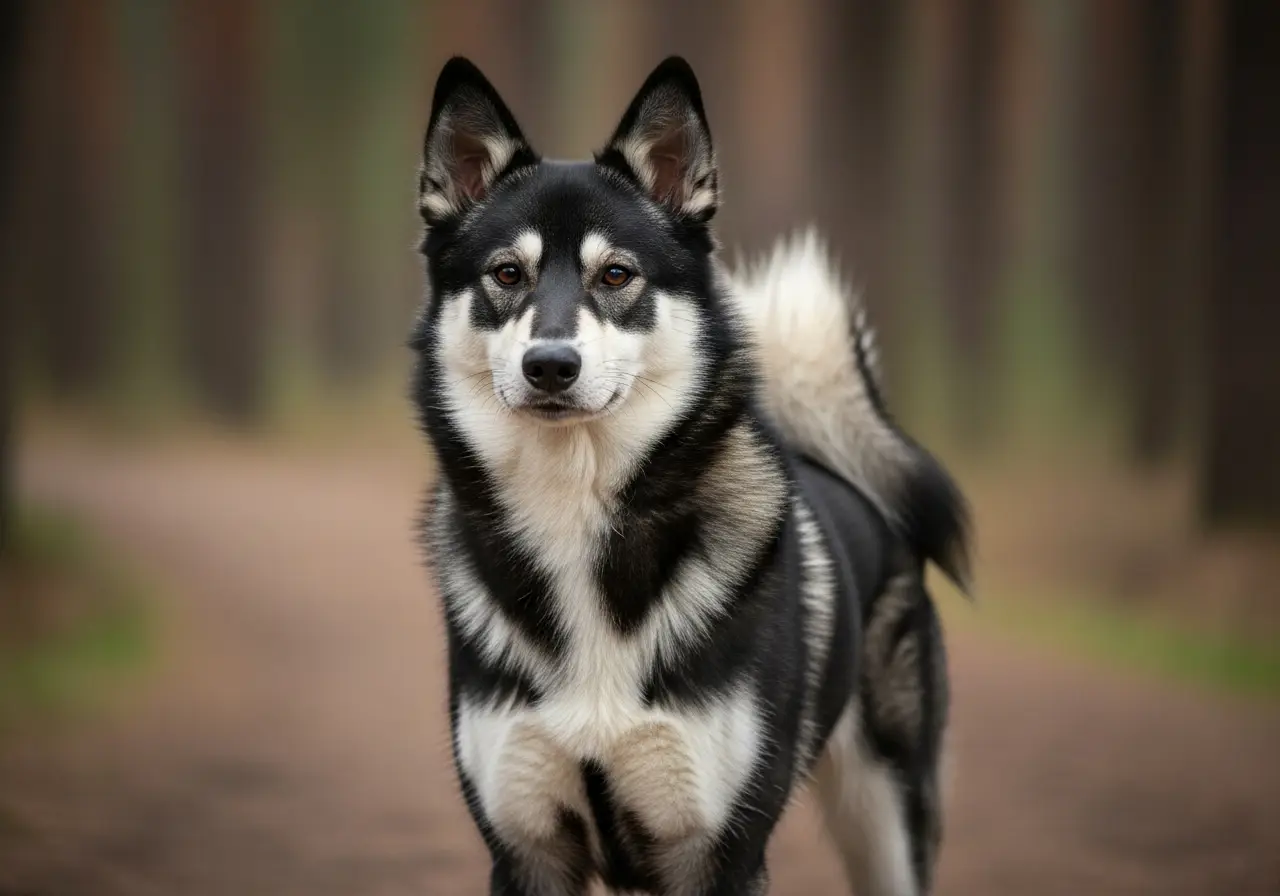
The Russian European Laika is a North Russian hunting spitz that has been selected for independent work in the forest over centuries. It points game, barks loudly at it and makes independent decisions in the terrain. Anyone who keeps this dog takes on a partner with clear genetic specifications: daily stimulation, hunting guidance and secure terrain are not recommendations, but minimum requirements.
02Introduction
What makes the Russian-European Laika special
Russian-European Laika: north Russian hunting spitz, sturdy and weather-resistant, closely tied to hunting work
03Profile
Key facts and suitability
- Origin
- Russland
- Original purpose
- Hunting large game
- FCI
- No. 304 · Group 5 · Sektion 2: Nordische Jagdhunde, mit Arbeitsprüfung
- height at the withers
- 48–58 cm
- Weight
- 20–23 kg
- Life expectancy
- 12–14 Years
- Coat type
- Doppel
- Minimum exercise
- 120 min/day
- Puppy price
- 800–1'500 CHF
- Waiting period
- 4 months
- Sports
- Scent work Mantrailing
04Temperament
How the Russian-European Laika shows up in everyday life
The morning walk reveals what distinguishes the Russian-European Laika from many other dogs: It does not work with the owner, but alongside them. The nose goes straight to the ground, the head turns into the wind, and attention is paid to the terrain, not to the human. This is not defiance, but genetically programmed behaviour of a dog that has been selected over generations for independent decision-making in the forest.
Internally, this dog requires intensive exercise of at least 90 to 120 minutes daily, as well as demanding nose work. Mental work in the form of search tasks, tracking, or hunting training noticeably relieves mental strain. The need for social contact with the primary caregiver is pronounced; it seeks closeness and orientation, yet remains independent in its decisions. Periods of being left alone exceeding four hours are problematic and must be built up gradually.
Externally, the Russian-European Laika reacts to strangers with reserve or a waiting attitude. It is not a dog that greets every visitor joyfully. This restraint is not a sign of insecurity, but an expression of its original nature as a hunting dog that initially assesses strangers. With other dogs, it can appear assertive, especially if it has not been sufficiently socialised.
At home, it is calm if its needs are met. A Laika that is challenged daily lies relaxed on its bed in the evening. A Laika without a task finds its own enrichment, and this rarely to the owner's delight.
05Needs
What this breed needs daily
The Russian-European Laika requires at least 90 to 120 minutes of intensive exercise daily. Walks at a walking pace are not sufficient. Suitable activities include extensive terrain runs, tracking, mantrailing or, in a hunting context, work in the hunting ground. The need for movement is at the highest measurable level and must be met even in bad weather.
Mental stimulation is just as important as physical exercise. The need for mental work in this breed is high. Nose work, search games, and structured tasks that channel its hunting instinct are necessary daily. Without this stimulation, frustration patterns arise: vocalisation, restlessness, destructive behaviour.
A securely fenced area is not an option, but a prerequisite. The fence height should be at least 180 cm, as the Laika is a good jumper and will overcome obstacles when stimulated by wildlife. Unsecured off-leash walking in areas rich in wildlife is permanently risky.
The primary caregiver must be present, consistent, and experienced in dealing with hunting-motivated dogs. The Laika responds to clear body language and consistent guidance. Inconsistency or uncertainty in handling reinforces its independent decision-making.
Being left alone is possible, but must be built up carefully and gradually. Four hours should be regarded as the upper limit. Regular longer periods of being left alone without preparation lead to stress symptoms.
Exercise
Very high
mental work
A lot
Social needs
Medium
training
Experts
06Sport & Mental and Physical Stimulation
What sports the Russian-European Laika is suited for
Realistic in terms of physiology and genetics – not every breed suits every sport.
Structurally and physiologically suitable: Suitable for mantrailing, dummy work and tracking · CaniCross / bikejoring possible.
07Quick Check
08Suitability
Who this breed is suitable for – and who it isn't
✓Matches
The Russian-European Laika suits hunters or active owners with solid experience in dealing with hunting-motivated dogs. Anyone who can devote at least two hours daily to intensive exercise and nose work and has secure terrain available meets the basic prerequisites.
The breed is suitable for owners who are willing to perform hunting-related handling or use a supporting dog training school with experience in hunting dogs. A rural or forest-adjacent environment is clearly advantageous. Families with older children from ten years upwards, in which all family members practise consistent handling of the dog, are conceivable, provided the necessary experience is present.
Owners who have already successfully handled a dog with a pronounced prey drive and know and appreciate the independence of Nordic dogs will find a robust, strongly bonded partner in the Russian-European Laika. The willingness to have realistic expectations regarding recall even when wildlife is present is absolutely necessary.
×Doesn't match
The Russian European Laika is not suitable for first-time owners or owners without experience with hunting-motivated dogs. Anyone looking for a dog that is reliably recallable and remains focused on the person in every situation will be permanently overwhelmed by this breed.
Urban keeping without daily access to extensive terrain is incompatible with the needs of this breed. Anyone who can devote less than 90 minutes a day to intensive exercise or does not have secure off-leash facilities available should not choose this breed.
Anyone who wants to keep the Laika as a family dog without a hunting task and assumes that its willingness to bond is synonymous with friendliness towards strangers misunderstands the dual-axis profile of this breed: A high need for social contact with the primary caregiver does not mean openness towards every person. Owners who regularly receive visitors and expect a socially uncomplicated dog will be surprised by its reserve towards strangers.
Households with small animals such as cats, rabbits or birds are fundamentally problematic with this breed; the pronounced prey drive makes safe coexistence without consistent management hardly possible.
10Line reality
Show line, working line, breeder market
In Central Europe, the Russian-European Laika is kept almost exclusively as a hunting dog. A pronounced differentiation between show and working lines, such as is known with the German Shepherd Dog, does not exist to a comparable extent in this breed; the population is too small and too closely tied to its use in hunting.
In Russia and the Baltic states, where the breed is more widespread, a distinction is made between dogs with an active hunting test and those without. Dogs that have passed a working test are considered breeding animals of first choice; the FCI requires a working test for this breed. This means: A Russian-European Laika without a hunting test does not formally correspond to the complete breeding goal.
In Central Europe, dogs from Russian or Finnish hunting lines are occasionally available. These animals generally have a more pronounced prey drive than dogs that have been bred over several generations without a hunting test. Anyone who acquires a puppy from an active hunting line must expect a particularly high level of stimulus and drive.
A pure show tradition without hunting selection hardly exists in this breed. This is a significant difference to more popular breeds, where show and working lines have been able to diverge over decades.
11Health · Reality
What you need to plan for medically with your Russian-European Laika
The Russian European Laika is considered a robust breed with a life expectancy of approximately 12 to 14 years. Breed-typical fad breeding traits such as brachycephaly or excessive coat volume do not exist in this breed; the FCI standard describes a functional, athletic dog without extreme proportions.
Systematic health data specifically for the Russian European Laika are limitedly available due to the small population size in Central Europe. For Nordic hunting dogs in general, hip dysplasia (HD) and elbow dysplasia (ED) are known risks. Reputable breeders have parent dogs radiologically examined for HD and ED before breeding; proof of these examinations should be requested when buying a puppy.
As an active hunting dog, the Laika is prone to injury during use: cuts, bruises and tick bites are part of the realistic risk profile of a dog that regularly works in undergrowth. Tick prophylaxis and regular checks after field work are necessary.
Overweight is not a typical problem for sufficiently stimulated individuals. However, it can arise with insufficient exercise and a constant food quantity, placing strain on joints and the cardiovascular system. Veterinary preventive examinations on an annual basis, dental checks and an age-appropriate adjustment of the food quantity from the eighth year of life are recommended.
12Structured data
Health by the numbers
Prone to diseases
Hip dysplasia Eye problems
Recommended health tests
Hip X-ray Eye examination
13Myths ↔ Reality
What is often said incorrectly about this breed
Five myths, five realities, five sources.
"The Russian-European Laika is like a Husky, sporty but easy to keep in everyday life.
The comparison is too simplistic. The Russian-European Laika was selected not as a sled dog, but as an independent hunting dog. Its drive to track down and bay game is genetically hard-wired. In everyday life without hunting-related stimulation, frustration and control problems arise that cannot be resolved by sporting activity alone.
"Laika dogs are loners and cope well on their own.
The Russian-European Laika forms a close bond with its primary caregiver. Its need for social contact is medium to high. Longer periods of being left alone beyond four hours are problematic for this breed and must be built up carefully and gradually. Uncontrolled being left alone often leads to vocalisation and restlessness.
"The strong prey drive can be fully controlled through consistent training.
The prey drive of the Russian-European Laika is a genetically hard-wired trait that can be regulated by training but not eliminated. Recall commands reach clear limits upon direct contact with game. Unsecured off-leash walking in areas rich in wildlife poses a permanent risk that even experienced owners must factor in.
"Because the breed is so rare, the few puppies automatically come from reputable breeding.
Rarity does not protect against irresponsible breeding. Especially with rare breeds, there is a risk that puppies are offered without health tests, working trials or socialisation. A reputable breeder provides proof of working trials, health examinations and pedigrees, regardless of how rare the breed is.
"The Russian-European Laika is a low-maintenance dog due to its robustness.
Robustness refers to physical resilience against cold and weather conditions. Mentally and in terms of husbandry, the breed places high demands: daily stimulation of 90 to 120 minutes, demanding nose work, secure terrain, and an experienced handler are absolutely necessary. Without these prerequisites, the animal suffers.
14animal welfare
The animal welfare perspective
Breeder market, designer versions, animal shelter reality — what no one writes in the puppy ad.
The Russian European Laika is one of the rarest hunting dog breeds in Central Europe. This rarity does not protect against problems; it shifts them.
Backyard breeders and disreputable suppliers exploit the low availability to sell puppies without working tests of the parent dogs, without health documentation and without socialisation. Anyone who acquires a puppy via online platforms without visiting the breeder risks getting a dog with an unknown health status and insufficient imprinting. The demand for exotic or rare breeds fuels this segment.
A specific animal welfare problem of this breed arises from misjudgement: hunters who underestimate the prey drive and independence of the Laika give up dogs when cooperation in the hunting ground does not work. These animals occasionally end up in adoption, usually with organisations specialising in Nordic dogs. They are not failed dogs, but dogs that did not fit the keeping situation.
Designer versions or trend crosses with the Russian European Laika hardly exist at present. This may change if the breed gains popularity through social media presence. The focus on working tests and health examinations then remains the decisive criterion.
Adopting an adult Laika from animal welfare is an equally valid option for experienced owners. An adult dog already shows its character clearly, which facilitates assessing the suitability. The prerequisite remains: hunting experience, secure terrain and sufficient time for building up work.
15Costs · Transparency
What this breed realistically costs
The acquisition costs for a puppy from reputable breeding with FCI papers and working tests of the parent dogs are around 800 to 1,500 EUR in Central Europe. Offers significantly below this range without proof of health checks and working tests are a warning sign.
The annual living costs consist of food (approx. 600 to 900 EUR/year for a medium-sized, active dog), grooming needs (grooming for the Laika is moderate, approx. 100 to 200 EUR/year), as well as basic equipment and accessories. Vet costs for routine examinations, vaccinations and parasite prevention are around 300 to 500 EUR/year. In the event of illness or injury, which is not uncommon for an active hunting dog, individual treatments can quickly reach 500 to 2,000 EUR.
Dog liability insurance is strongly recommended in the DACH region and costs around 60 to 150 EUR/year depending on the provider and coverage amount. Health insurance for the dog makes sense for an actively used hunting breed and costs between 400 and 800 EUR/year depending on the tariff. The total annual costs realistically amount to 1,500 to 3,000 EUR, excluding extraordinary vet costs.
16Puppy search
What you need to consider when choosing a breeder
- Reputable breeders of the Russian European Laika are very rare in Central Europe.
- Anyone looking for a puppy should contact the Swiss Club for Nordic Dogs (SKNH) or comparable national breeding associations committed to the FCI standard directly.
- A reputable breeder provides proof of working tests for the parent dogs, as the FCI standard mandates these for the breed.
- Health examinations of the parent dogs, a complete pedigree and the opportunity to inspect the rearing conditions on site are further minimum criteria.
- Puppies offered without this documentation or via animal markets and online platforms without visiting the breeder often come from backyard breeding.
- Adoption through animal welfare organisations is an equally valid option.
- The Russian European Laika occasionally enters adoption channels in Central Europe via hunters who have underestimated its prey drive.
- Such dogs require experienced owners with clear structure, but can lead a fulfilled life under appropriate keeping conditions.
- Waiting lists at reputable breeders ranging from several months to over a year are normal for this rare breed.
FAQ
Frequently asked questions about the Russian-European Laika
Is Russian-European Laika a family dog?
Russian-European Laika is considered suitable for families with good socialisation and species-appropriate care.
How much exercise does Russian-European Laika need?
At least around 120 minutes of exercise per day. As an active breed, more so — plus mental stimulation.
What is the size and weight of Russian-European Laika?
Fully grown, Russian-European Laika reaches about 48–58 cm at the withers and weighs around 20–23 kg.
What is the life expectancy of Russian-European Laika?
The life expectancy of Russian-European Laika is approximately 12–14 years.
Which diseases are common in Russian-European Laika?
Hip dysplasia Eye problems
17Breed clubs
Official breed clubs in DACH
19Related
Similar breeds – and their differences
You might also be interested in
Participate
Do you have a good photo of your Russian-European Laika?
We are looking for expressive images for our breed profiles. Submit yours; the editorial team reviews every submission before publication.
Does this breed suit you?
Enduring hunting spitz – very independent and unsuitable for apartment keeping