
01Summary
In a paragraph
If you only have 30 seconds.
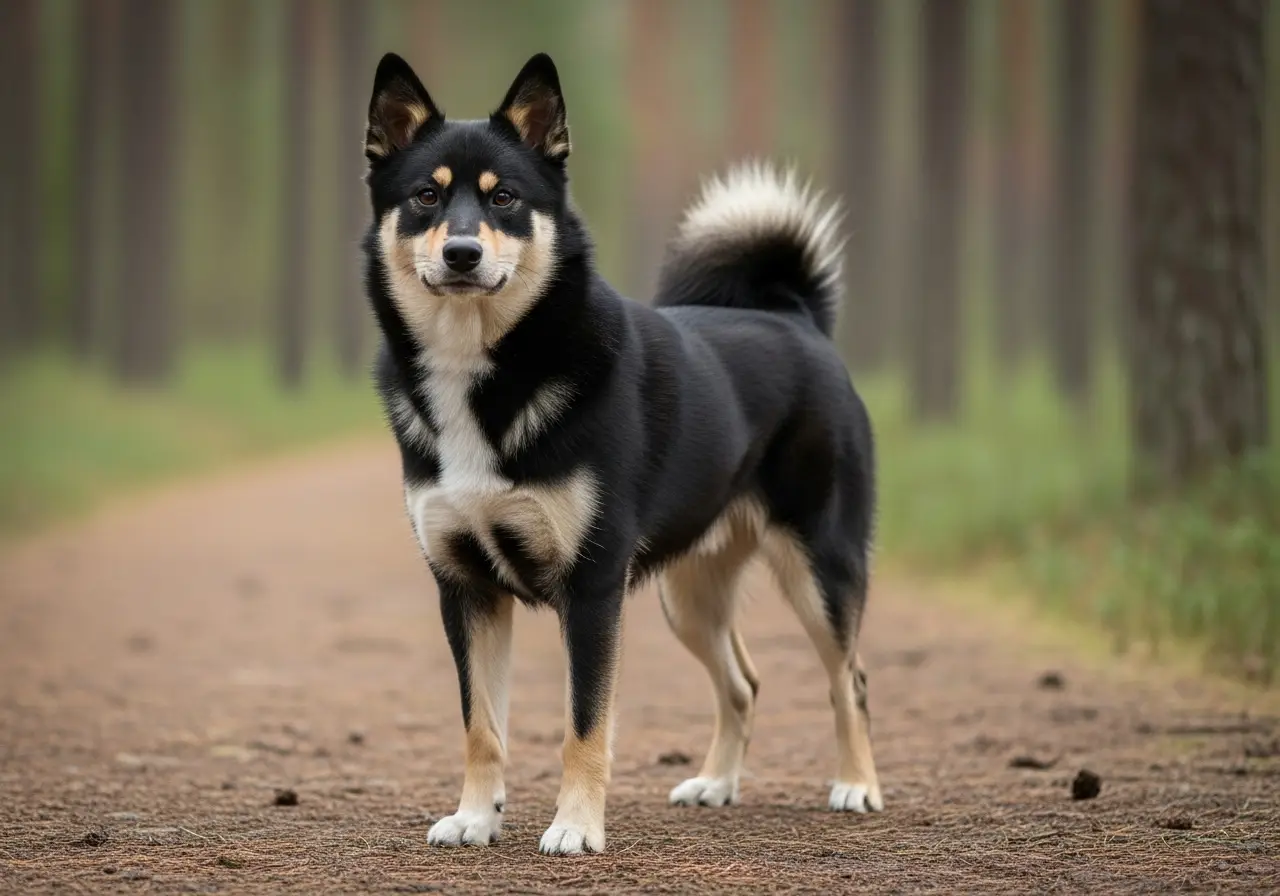
The Karelian Bear Dog is Finland’s most widespread hunting dog, bred for bear and moose, not for the city park. Anyone keeping this breed takes on a dog with extreme prey drive, high independence, and an exercise requirement that must be met daily. Without hunting use or structured substitute work, a dog emerges that pursues its own plan, consistently and enduringly.
02Introduction
What makes the Karelian Bear Dog special
The Karelian Bear Dog is Finland's most popular hunting dog, FCI Group 5, bred for bear and moose hunting, cold-resistant, shoulder height 54–60 cm.
03Profile
Key facts and suitability
- Origin
- Finnland
- Original purpose
- Bear and moose hunting in Karelia
- FCI
- No. 48 · Group 5 · Sektion 2: Nordische Jagdhunde
- height at the withers
- 49–60 cm
- Weight
- 20–23 kg
- Life expectancy
- 11–13 Years
- Coat type
- Doppel
- Minimum exercise
- 120 min/day
- Puppy price
- 1'000–2'000 CHF
- Waiting period
- 9 months
- Sports
- Hunting
04Temperament
How the Karelian Bear Dog shows up in everyday life
The following happens during the morning run in the forest: The Karelian Bear Dog picks up a scent trail, decides independently to follow it, and is gone. Not out of spite, but because its entire nervous system is geared towards exactly this moment. This is not an exception. This is everyday life with this breed.
Internally, the Karelian Bear Dog requires intensive exercise of at least two hours daily as well as mental stimulation through hunting-related tasks. Its need for mental work is high; it wants to solve problems, follow tracks, assess situations. Without this stimulation, no calm house-dog character develops, but rather a dog that seeks its own occupation.
Externally, it behaves reservedly towards strangers. It does not greet unknown people joyfully, but observes them attentively. This behaviour is typical of the breed and not a sign of fear or lack of socialisation. Towards its primary caregiver, it builds a close, loyal bond; however, this bond shows itself less in demonstrative attachment than in concentrated cooperation.
It can display territorial behaviour towards other males. In a household with other dogs, cohabitation works if the constellation is right and leadership is clear. Due to its pronounced prey drive, it is not reliably compatible with cats or small animals.
In the house, it is calmer than its working profile suggests, provided it receives sufficient stimulation. Anyone who provides this stimulation daily experiences a focused, resilient dog with a clear character. Anyone who does not provides the flip side: endurance, independence and prey drive without an outlet.
05Needs
What this breed needs daily
The Karelian Bear Dog requires at least two hours of active exercise daily, not a walk, but work. Guided tracking, nose work, trailing or hunting practice cover its need most directly. Anyone without a hunting licence requires structured alternatives: Mantrailing, scent work according to SchH/IPO or comparable nose work with a clear task profile.
Free running without a secured environment is not realistic with this breed. The prey drive kicks in situationally and overrides any recall conditioning as soon as a scent trail is picked up. The terrain must either be fenced or the exercise must take place on a long line.
Mental work is equal to physical stimulation. A Karelian Bear Dog that is physically tired but mentally under-stimulated remains restless. Nose work, search tasks and structured training with clear tasks are necessary daily, not as a bonus, but as basic provision.
Being left alone must be built up gradually. A maximum of four hours is realistic if the dog has been sufficiently stimulated beforehand. Longer absences without preparation and stimulation lead to stress behaviour.
A rural environment with access to forest and terrain is not a recommendation, but a practical necessity. Urban keeping is hardly compatible with this breed, not because of space, but because of the lack of access to suitable working terrain and sensory overload in urban environments.
Exercise
Very high
mental work
A lot
Social needs
Medium
training
Experts
06Sport & Mental and Physical Stimulation
What sports the Karelian Bear Dog is suited for
Realistic in terms of physiology and genetics – not every breed suits every sport.
Structurally and physiologically suitable: Suitable for mantrailing, dummy work and tracking · CaniCross / bikejoring possible.
07Quick Check
08Suitability
Who this breed is suitable for – and who it isn't
✓Matches
The Karelian Bear Dog suits owners with active hunting practice and access to suitable terrain. Anyone who regularly hunts large game or wild boar and is looking for an independently working flushing dog finds a functional partner in this breed, with centuries of selection for exactly this task.
They are also suitable for experienced dog owners without a hunting licence who are prepared to offer at least two hours of structured nose work or tracking work daily, with a clear understanding that substitute work must be consistent and permanent, not occasional.
The owner profile includes: prior experience with high-drive, independent dogs; a rural living environment with securely fenced land or access to woodland; willingness to provide daily stimulation even in bad weather; clear, calm leadership without confrontation; understanding of the breed-typical reserve towards strangers and territorial behaviour towards other males.
Households with older children from ten years upwards, who respect the dog and do not treat it as a playmate, are also suitable if the adults take on leadership and ensure hunting-related stimulation.
×Doesn't match
The Karelian Bear Dog is not suitable for owners keeping a dog for the first time. The combination of high prey drive, independence, and physical workload requirements structurally overwhelms people without prior experience with high-drive breeds, regardless of motivation or commitment.
The breed is not suitable for urban living situations: anyone living in the city, who does not have regular access to woodland and terrain, or who relies on public green spaces, cannot meet the exercise and work requirements of this breed.
Anyone who assesses the reserve towards strangers as temporary shyness that will completely resolve with socialisation underestimates the fundamental nature of this breed. The same applies to owners looking for a family-friendly all-rounder that fits seamlessly into any daily routine.
Households with small animals, cats, or very small dogs should also be viewed critically, as the prey drive makes reliable compatibility difficult to calculate. Anyone who is away from home for more than four hours a day and cannot organise reliable care should not choose this breed.
10Line reality
Show line, working line, breeder market
The Karelian Bear Dog does not show a pronounced separation between show and working lines; the breed remained strongly functionally oriented in its development. In Finland, where the breed is most widespread, hunting selection dominates. Working tests according to FCI standard take place exclusively in the Nordic countries Sweden, Norway and Finland, which underlines the close bond with active hunting operations.
In Central Europe (Germany, Austria, Switzerland), the breed is rare. The few litters per year are produced predominantly by breeders with a hunting background. An independent show line with a deviating character type has not established itself in Central Europe.
Anyone acquiring a Karelian Bear Dog in Germany or Switzerland receives, with high probability, a dog from a line that has been tested for hunting suitability. This means: the prey drive is not reduced, the character is not selected for family-friendliness. Anyone looking for a dog with reduced drive will not find it in this breed, regardless of the breeder.
11Health · Reality
What you need to plan for medically with your Karelian Bear Dog
The Karelian Bear Dog is considered a robust, resilient breed with a life expectancy of approximately 11 to 13 years. As a Nordic hunting dog that has been selected primarily for working capability over decades, it benefits from a comparatively low inbreeding burden, at least in the Nordic countries of origin.
Hip dysplasia (HD) occurs in the breed but is not as prevalent as in large Retriever breeds. Concrete population-wide HD statistics for the Karelian Bear Dog are not widely available for Central Europe. Reputable breeders X-ray parent dogs and disclose results; this should be actively requested when buying.
Elbow dysplasia (ED) is also known but occurs less frequently than in heavy breeds. Eye examinations according to ECVO standards are recommended, as Nordic spitzes can generally be susceptible to hereditary eye diseases.
Preventive examinations that an owner should plan for: annual weight check and musculoskeletal check-up with the vet, HD/ED X-rays of parent dogs before purchase, ECVO eye examination of parent dogs. Overweight is a real risk for this breed if the exercise requirement is not met; a dog with reduced stimulation gains weight even on a normal amount of food.
Vaccination protection, parasite prophylaxis, and dental care correspond to the standard for medium-sized dogs. No special breed-typical diseases with high prevalence are currently documented; however, the state of research is limited as the breed is rare in Central Europe.
12Structured data
Health by the numbers
Prone to diseases
No known breed-specific hereditary diseases, very robust
Recommended health tests
No specific mandatory examinations
13Myths ↔ Reality
What is often said incorrectly about this breed
Five myths, five realities, five sources.
"The Karelian Bear Dog is like any other spitz, easy to train with some patience."
The Karelian Bear Dog has been selected over decades for independent decision-making in the terrain. It learns quickly but acts situationally based on its own assessment, especially when hunting stimuli are present. Classic obedience exercises only have limited effect when the prey drive is activated. Experience with high-drive, independent dogs is not an option but a prerequisite.
"Anyone without a hunting licence can stimulate the dog with dog sports."
Dog sports can supplement hunting-related stimulation but do not fully replace it. The Karelian Bear Dog needs nose work, tracking and situations that are close to its genetic working profile. Pure obedience sports or agility only partially cover the mental workload needs of this breed. Without hunting use or very structured alternative work, chronic under-stimulation occurs.
"The dog is reserved towards strangers; this improves with socialisation.
Reserve towards strangers is typical of the Karelian Bear Dog and explicitly described in the FCI standard. It is not a gap in training, but a genetically anchored character trait. Good socialisation prevents overreactions, but does not change the fundamental nature. Anyone expecting an open, stranger-friendly dog chooses the wrong breed.
"In the garden, the dog can occupy itself and burn off energy.
A garden does not replace structured stimulation. The Karelian Bear Dog requires guided exercise with a task, not free-standing around on a plot of land. Without active enrichment, behavioural issues such as excessive barking, digging or escape attempts develop. The fence must also be very secure, as the prey drive creates motivation to escape.
"He gets along well with other dogs because he is a pack dog.
The FCI standard describes that the Karelian Bear Dog can display territorial behaviour towards other males. Same-sex conflicts are typical of the breed. Harmonious cohabitation with other dogs is possible, but requires early socialisation and consistent management, and is not realistic for every combination.
14animal welfare
The animal welfare perspective
Breeder market, designer versions, animal shelter reality — what no one writes in the puppy ad.
The Karelian Bear Dog ends up in animal welfare almost exclusively for the same reason: the prey drive was underestimated. Typical reasons for surrender are unmanageability on the lead, poaching, escape attempts, and owners being overwhelmed who cannot permanently meet the daily exercise and work requirements. This is not a failure of individual people; it is the result of a decision made without sufficient prior information.
On the backyard breeder market, the Karelian Bear Dog is less prominent in Central Europe than fashion dog breeds. This reduces the problem but does not eliminate it. Those searching online for puppies occasionally come across offers without proof of working tests, without hip dysplasia findings for the parent dogs, and without a hunting background for the breeder. Such dogs are not inherently worse, but the probability that temperament and drive profile do not meet the standard increases.
Designer versions or hybridisations are hardly widespread in this breed. The risk lies less in breeding trends than in the buyer's incorrect assessment of keeping requirements.
Keeping-related problems almost always arise from under-stimulation: A Karelian Bear Dog without hunting-based workload develops behaviours that are difficult to manage in the household, excessive barking, destructiveness, escape attempts. These dogs are not broken. They are under-stimulated.
Adoption via animal welfare organisations or breed rescues is an equally valid option. Adult dogs from adoption come with a known temperament profile, which is a genuine advantage for a breed with this drive profile. The German Club for Nordic Dogs and the Swiss Club for Nordic Dogs can help in the search for adoptable dogs.
15Costs · Transparency
What this breed realistically costs
The purchase price for a Karelian Bear Dog from reputable breeding in Central Europe is between 1,200 and 1,800 EUR, depending on pedigree and availability. Offers significantly below this should be critically examined; missing health checks of the parent dogs save money at purchase but cause higher subsequent costs.
Annual living costs include: food for a medium-sized, active dog (approx. 600–900 EUR/year depending on quality), basic grooming (claws, ears, occasional bathing: approx. 100–200 EUR/year), basic vet care (vaccinations, parasite prophylaxis, annual check-up: approx. 300–500 EUR/year). In addition, there are equipment costs for hunting work or nose work (long line, tracking equipment: one-off approx. 150–300 EUR).
Pet insurance costs for this breed between 40 and 90 CHF/EUR per month depending on provider and scope of cover. For a breed with a robust health profile, surgery insurance is sensible as minimum cover. Total costs in the first year including getting a dog: realistically 3,500–5,000 EUR.
16Puppy search
What you need to consider when choosing a breeder
- A reputable breeder of Karelian Bear Dogs voluntarily provides X-ray results (HD/ED) for both parent dogs, proves working tests or hunting performance records, and asks questions about the planned use of the dog.
- Anyone selling a puppy without asking counter-questions is not a reliable contact.
- On-site visits are mandatory, not optional.
- The litter should grow up in an environment that corresponds to its later purpose: contact with woodland, terrain, and hunting stimuli.
- Puppies from pure household breeding without a hunting context are less well prepared for use as hunting dogs.
- In Central Europe, the breed is rare.
- Waiting times of one year or more are realistic.
- Anyone who does not want to wait is searching under pressure and makes poorer decisions.
- The rehoming of adult dogs via the German Club for Nordic Dogs (dcnh.de) or the Swiss Club for Nordic Dogs (sknh.ch) is an equally valid alternative.
- Adult dogs from rehoming come with a known character profile, which is a concrete advantage for this breed.
- No named breeder recommendations; the breed club websites list current breeders.
FAQ
Frequently asked questions about the Karelian Bear Dog
How much exercise does Karelian Bear Dog need?
At least around 120 minutes of exercise per day. As an active breed, more so — plus mental stimulation.
What is the size and weight of Karelian Bear Dog?
Fully grown, Karelian Bear Dog reaches about 49–60 cm at the withers and weighs around 20–23 kg.
What is the life expectancy of Karelian Bear Dog?
The life expectancy of Karelian Bear Dog is approximately 11–13 years.
Which diseases are common in Karelian Bear Dog?
No known breed-specific hereditary diseases, very robust
17Breed clubs
Official breed clubs in DACH
19Related
Similar breeds – and their differences
You might also be interested in
Participate
Do you have a good photo of your Karelian Bear Dog?
We are looking for expressive images for our breed profiles. Submit yours; the editorial team reviews every submission before publication.
Does this breed suit you?
Finland's most popular hunting dog. Confronts bears. Extremely keen to work. Unsuitable as a pure companion dog.