
01Summary
In a paragraph
If you only have 30 seconds.
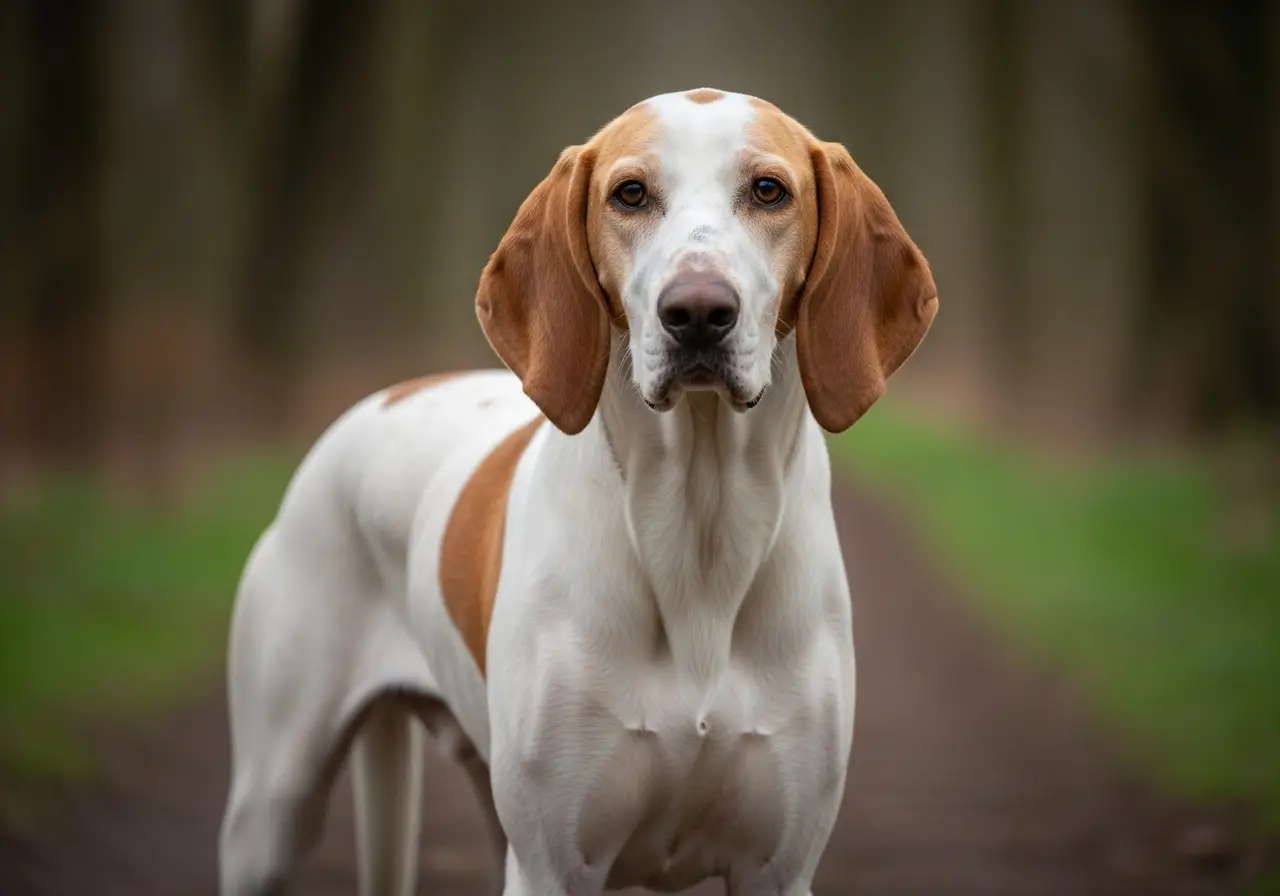
The Grand Anglo-Français Blanc et Orange is a uncompromising working dog bred for big game hunting in pack. Its prey drive is genetically deeply rooted, and its exercise requirement is at least two hours daily. Anyone who keeps this dog without a hunting background and without extensive terrain fundamentally underestimates it. The breed is rare and hardly widespread in the DACH region.
02Introduction
What makes the Grand Anglo-Français Blanc et Orange special
The Grand Anglo-Français Blanc et Orange is a rare French pack hound, FCI Group 6, white-and-orange marked, withers height 60–72 cm.
03Profile
Key facts and suitability
- Origin
- Frankreich
- Original purpose
- Pack hunting
- FCI
- No. 324 · Group 6 · Sektion 1.1: Große Laufhunde. Mit Arbeitsprüfung.
- height at the withers
- 60–72 cm
- Weight
- 30–40 kg
- Life expectancy
- 11–13 Years
- Coat type
- Short-haired
- Minimum exercise
- 120 min/day
- Puppy price
- 800–1'400 CHF
- Waiting period
- 12 months
- Sports
- Hunting · Scent work
04Temperament
How the Grand Anglo-Français Blanc et Orange shows up in everyday life
On the morning walk, what makes this breed special becomes apparent: The dog immediately puts its nose to the ground, follows a scent trail and ignores everything else. A recall at this moment requires consistent pre-training and remains situationally unreliable. This is not a training deficit, but the result of centuries of selection for scent work.
In a pack with other dogs, the Blanc et Orange scenthound shows pronounced social compatibility. It was bred for the pack and feels comfortable in the company of conspecifics. Kept alone, it develops restlessness and vocalisation more quickly.
Towards people, it is generally friendly and approachable (friendliness towards strangers: 4 out of 5). However, this does not mean that it builds a close bond with key persons like a classic companion dog. Its attention outdoors is primarily directed to its nose, not to humans.
In the house, it is calmer than in the field, but needs sufficient rest periods after intense stimulation. It tolerates being alone only to a limited extent, for a maximum of two to three hours. Longer leads to stress behaviour.
The need for social contact is high, but is directed more towards conspecifics than towards humans. Anyone who expects this dog to stick closely to humans and react to every glance will be disappointed. Anyone looking for an enduring, independent working partner for hunting tasks will find a reliable dog with enormous willingness to perform in it.
05Needs
What this breed needs daily
The Grand Anglo-Français Blanc et Orange needs at least 120 to 180 minutes of active movement daily. Pure walks on paved paths do not meet this need. The dog requires field work with scent stimuli: hunting guidance, blood tracking, mantrailing or structured nose work on natural ground.
The need for mental work is high. Without mental stimulation, frustration arises, which manifests itself in vocalisation, restlessness or destructive behaviour. Nose work is the most effective form of enrichment here, as it corresponds to the genetic profile of the dog.
A securely fenced area is not an option, but a must. The drive to follow a scent trail is so strongly pronounced that off-leash activity without security represents an incalculable risk. The fence should be at least 1.80 metres high and also prevent the dog from digging.
The need for social contact with conspecifics is pronounced. Keeping the dog with at least one other dog is advisable. Single-dog keeping significantly increases the care effort.
Being left alone should be limited to a maximum of two to three hours. Anyone who is regularly away from home for longer periods needs a reliable care solution.
In summary, this dog requires: daily field work with scent trails, an enclosed outdoor area, companionship with conspecifics or intensive care, an experienced primary caregiver with knowledge of handling scenthounds, and a rural or at least strongly rural environment.
Exercise
Very high
mental work
A lot
Social needs
Medium
training
Demanding
06Sport & Mental and Physical Stimulation
What sports the Grand Anglo-Français Blanc et Orange is suited for
Realistic in terms of physiology and genetics – not every breed suits every sport.
Structurally and physiologically suitable: Suitable for mantrailing, dummy work and tracking · CaniCross / bikejoring possible.
07Quick Check
08Suitability
Who this breed is suitable for – and who it isn't
✓Matches
The Grand Anglo-Français Blanc et Orange is suitable for people with a hunting licence and active hunting operations who use the dog in pack hunting or as a single dog on the trail. A prerequisite is a rural environment with securely fenced land of at least 500 square metres.
The breed is also suitable for very active people without a hunting licence who have solid experience with highly motivated scenthounds and can offer 150 to 180 minutes of structured nose work or field work daily. A household with at least one other dog makes keeping the dog considerably easier.
Anyone who already has experience with FCI Group 6 breeds understands the drive structure and can formulate realistic expectations regarding recall and impulse control. This prior knowledge is crucial.
Families with older children from twelve years of age, who are actively involved in care and live on a farm or in a rural area, can keep this breed if the adults take over the hunting leadership. Keeping the dog in a house with direct access to an enclosed outdoor area is a basic prerequisite.
×Doesn't match
The Grand Anglo-Français Blanc et Orange is not suitable for people keeping a dog for the first time. The drive structure of this breed requires prior understanding that cannot be built up solely through books or courses.
The breed is not suitable for households in urban or densely populated areas without access to extensive terrain. Anyone who can devote less than two hours daily to active field work fundamentally underestimates the needs of this breed.
Anyone who expects a friendly dog to automatically be easily recallable and safe off-lead confuses the external axis (friendliness towards strangers) with the internal axis (prey drive, independence on the trail). These two characteristics run in opposite directions in the Blanc et Orange Scenthound.
People who are regularly away from home for more than three hours daily and cannot organise reliable dog care should not choose this breed. Households without the possibility of keeping another dog also face a significant additional burden. Anyone looking for a calm, bond-intensive companion dog will not find the right profile in this breed.
10Line reality
Show line, working line, breeder market
The Grand Anglo-Français Blanc et Orange does not have a pronounced show line in the sense of exhibition breeding decoupled from the working dog. The breed is too rare and too specialised for independent breeding lines with different performance profiles to have developed.
All active breeding is oriented towards the working profile: drive to follow a scent trail, endurance, volume on the trail and suitability for pack hunting are in the foreground. Working tests are prescribed according to the FCI standard, which ensures an orientation towards function rather than appearance.
Regionally, there are differences between French hunting areas where the dog is used for deer or wild boar. However, these differences do not reflect in formally separated lines, but in the selection of individual breeders for specific hunting suitability.
In the German-speaking region, the breeding base is so small that line differentiation is practically irrelevant. Anyone looking for a puppy will usually have to rely on French breeders and should specifically ask about the working test results of the parent animals there.
11Health · Reality
What you need to plan for medically with your Grand Anglo-Français Blanc et Orange
There are no extensive breed-specific health studies for the Grand Anglo-Français Blanc et Orange, which is due to the small population size. According to the Club des Chiens Français et Suisses, the life expectancy is approximately 10 to 12 years.
As a large, active scenthound, it carries an increased risk of hip dysplasia (HD). Reliable breed quotas are not available because the breeding population is too small for statistical surveys. Reputable breeders nevertheless submit HD X-ray findings of the parent dogs. This should be insisted upon when choosing a puppy.
Ear infections are structurally more common in drop-eared breeds. The long, slightly twisted ears according to the FCI standard favour a humid microclimate in the ear canal. Regular ear checks, at least once a week, reduce the risk of chronic inflammation.
Gastric dilatation and volvulus (bloat) is a serious risk in large, deep-chested dogs. Prophylactic measures include several small meals daily instead of one large portion and a rest period of at least 60 minutes after eating.
Overweight is rare in sufficiently exercised working dogs but can arise from keeping errors. Body weight should be checked regularly, as overweight puts strain on joints and the cardiovascular system.
Preventive examinations: HD screening of parent dogs, annual ear check by the vet, dental check from the 5th year of life.
12Structured data
Health by the numbers
Prone to diseases
Hip dysplasia, ear problems
Recommended health tests
Hip X-ray
13Myths ↔ Reality
What is often said incorrectly about this breed
Five myths, five realities, five sources.
Despite its hunting background, the Grand Anglo-Français Blanc et Orange is an amiable family dog that can easily integrate into city life.
The breed was bred exclusively for pack hunting in the field. Its drive to follow a scent trail is genetically hardwired and cannot be fundamentally changed through training. An urban life without hunting-related stimulation leads to behavioural problems and chronic stress in the dog.
Scenthounds of this size are calm and relaxed if they get enough exercise.
Pure exercise in the form of walks does not meet the needs of this breed. The dog requires structured nose work, hunting guidance or comparable scent tracking. Without this mental stimulation, the dog remains restless and frustrated even after long walks.
Recalling a scenthound on a trail is a matter of consistent training.
Scenthounds from FCI Group 6 have been selected over centuries for independent work on the scent trail. Recall upon contact with game is not a question of obedience, but a deeply ingrained working instinct. Safe management through leashes, visual barriers and fenced areas is not an addition, but a basic requirement.
The breed is particularly healthy and free from hereditary diseases due to its rarity.
Rarity does not automatically protect against hereditary diseases. In small breeding populations, there is even an increased risk of inbreeding effects. No extensive health studies are available for this breed, which makes careful selection of the breeder and transparent health documentation all the more important.
Anyone without a hunting licence can still easily keep this dog as a sport dog.
Without hunting knowledge, understanding of the dog's drive structure is lacking. Mantrailing or nose work in the hobby sector can supplement, but do not fully replace hunting guidance. The breed is not suitable for people without experience with highly motivated scenthounds.
14animal welfare
The animal welfare perspective
Breeder market, designer versions, animal shelter reality — what no one writes in the puppy ad.
The Grand Anglo-Français Blanc et Orange is practically absent from animal welfare circles in the German-speaking region. The breed is too rare to appear regularly in shelters. However, this does not mean that surrenders do not occur.
The most common reason for surrender is underestimating the need for movement and stimulation. Owners who acquire the dog without a hunting background and find that simple walks are insufficient quickly become overwhelmed. The dog vocalises, shows restlessness or becomes a safety risk when off-lead. These situations often end in surrender.
Another risk arises from the trend towards rare and exotic breeds. Anyone who acquires a dog because of its rarity or noble appearance without knowing its working profile makes a decision on false grounds. The Blanc et Orange is not a status symbol, but a specialist with clearly defined needs.
Backyard breeders in the sense of uncontrolled breeding are rare for this breed due to low demand. The risk lies more with imports from France without adequate health documentation and without knowledge of the parent dogs.
Anyone wishing to take on a hound of this group should also consider rehoming organisations for hunting dogs and hounds. Occasionally, dogs from France or Spain are rehomed that come from dissolved hunting packs. These dogs are often well-socialised and trained for hunting, but require a primary caregiver with appropriate experience. Rehoming is not a compromise solution, but an equally valid option for experienced owners.
15Costs · Transparency
What this breed realistically costs
A puppy from a reputable breeder with FCI papers, health documentation and proof of working tests for the parent dogs usually costs between 1,200 and 2,000 euros. Offers significantly below this without papers and without transparency regarding the parent dogs are a warning sign.
Based on experience, the annual living costs for a dog of this size and activity level lie between 2,500 and 4,000 euros. This includes high-quality food (approx. 600 to 900 euros/year), care, accessories and basic equipment.
Veterinary costs for routine care (vaccinations, parasite treatment, annual examination) amount to 300 to 600 euros annually. In addition, possible treatment costs for ear infections or orthopaedic problems can quickly reach 500 to 1,500 euros per incident.
Dog liability insurance is strongly recommended and costs between 60 and 150 euros annually depending on the provider and coverage amount. Health insurance for the dog is sensible for this breed due to active use in the terrain and costs between 400 and 900 euros annually.
16Puppy search
What you need to consider when choosing a breeder
- Reputable breeders of this breed are rare in Germany and Switzerland.
- The Club des Chiens Français et Suisses (CCFS, laufhunde.eu) is the first point of contact in the DACH region.
- Breeders listed via the CCFS or the VDH are subject to breeding regulations with minimum standards for health and keeping.
- The following criteria characterise a reputable breeder: submission of HD findings for both parent dogs, proof of working test results, possibility to view the mother with puppies in the rearing environment, no handover before the eighth week of life, willingness to provide advice and aftercare.
- Anyone who cannot find a puppy should check rescue organisations for hunting dogs and scenthounds.
- Dogs from disbanded hunting operations in France are occasionally offered through specialised intermediaries.
- This option is equivalent for experienced owners and often associated with a better assessment of the dog, as the working profile is already known.
- Offers without papers, without the possibility of viewing, or with unusually low prices should be consistently rejected.
FAQ
Frequently asked questions about the Grand Anglo-Français Blanc et Orange
How much exercise does Grand Anglo-Français Blanc et Orange need?
At least around 120 minutes of exercise per day. As an active breed, more so — plus mental stimulation.
What is the size and weight of Grand Anglo-Français Blanc et Orange?
Fully grown, Grand Anglo-Français Blanc et Orange reaches about 60–72 cm at the withers and weighs around 30–40 kg.
What is the life expectancy of Grand Anglo-Français Blanc et Orange?
The life expectancy of Grand Anglo-Français Blanc et Orange is approximately 11–13 years.
Which diseases are common in Grand Anglo-Français Blanc et Orange?
Hip dysplasia, ear problems
17Breed clubs
Official breed clubs in DACH
19Related
Similar breeds – and their differences
You might also be interested in
Participate
Do you have a good photo of your Grand Anglo-Français Blanc et Orange?
We are looking for expressive images for our breed profiles. Submit yours; the editorial team reviews every submission before publication.
Does this breed suit you?
Very rare large pack hound. White-and-orange variety. Almost exclusively used for hunting in France.