
01Summary
In a paragraph
If you only have 30 seconds.
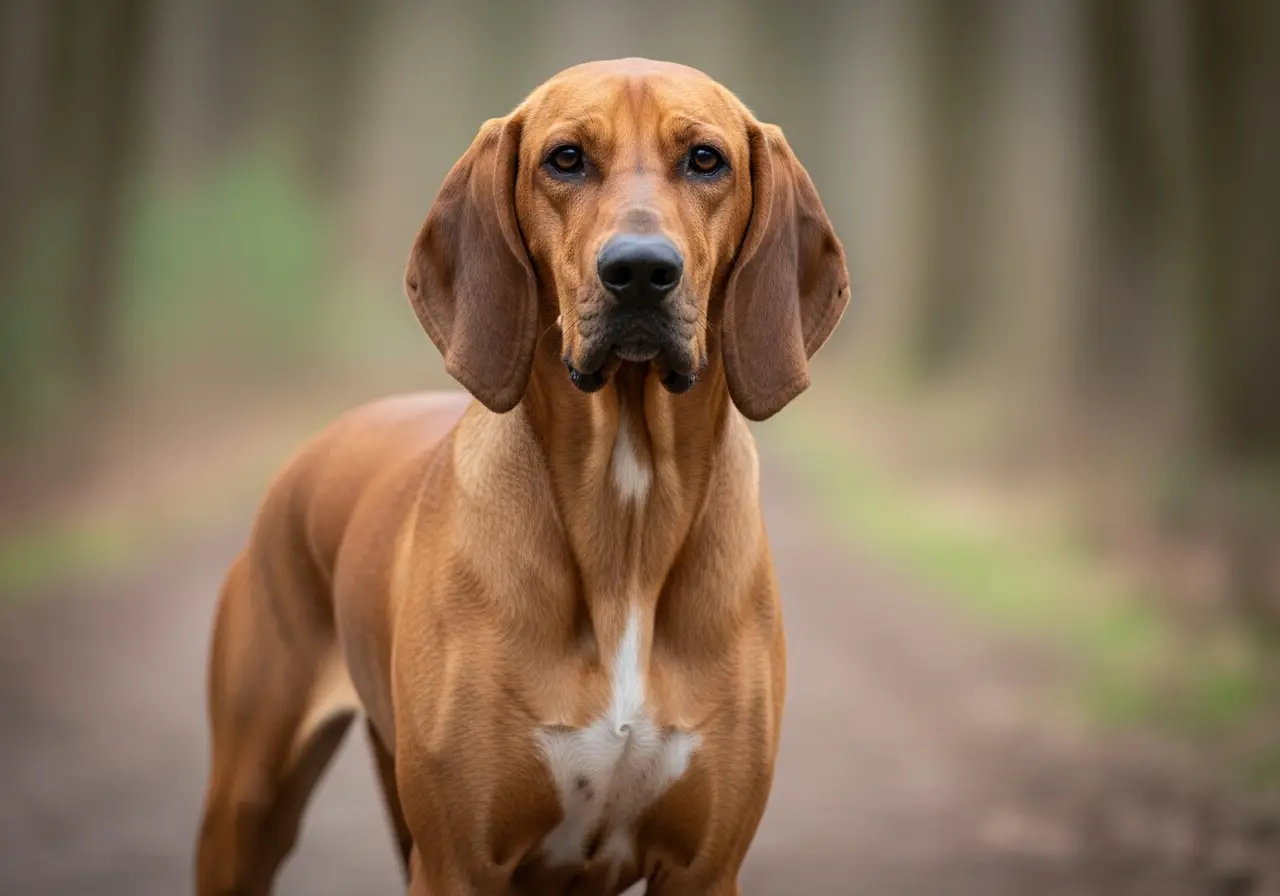
The Hanoverian Hound is one of the most specialised hunting dogs in Germany. Its entire character (the calm concentration, the close bond with the handler, the pronounced scent drive) was created for a single purpose: tracking shot game. Anyone who keeps this dog without a hunting task fundamentally misunderstands its profile. The breed is rare, demanding, and not an everyday companion.
02Introduction
What makes the Hanoverian Bloodhound special
The Hanoverian Bloodhound is a German bloodhound specialist, FCI Group 6, bred for tracking shot game, withers height 50–60 cm.
03Profile
Key facts and suitability
- Origin
- Deutschland
- Original purpose
- Blood-tracking work (tracking shot game)
- FCI
- No. 213 · Group 6 · Sektion 2: Schweisshunde
- height at the withers
- 48–55 cm
- Weight
- 25–40 kg
- Life expectancy
- 12–14 Years
- Coat type
- Short-haired
- Minimum exercise
- 60 min/day
- Puppy price
- 1'000–1'800 CHF
- Waiting period
- 9 months
- Sports
- Hunting · Scent tracking · Mantrailing · Blood-tracking
04Temperament
How the Hanoverian Bloodhound shows up in everyday life
Anyone who gets up in the morning with a Hannover Scenthound does not experience an overexcited greeting ritual. The dog waits calmly, observes, and orients itself towards its primary caregiver, concentrated, not distant. This calmness is not a sign of indifference, but of focus.
Internally, what the dog needs: The need for social contact is high, but specific. The Hannover Scenthound bonds closely with one person, not with a group. It requires daily structured nose work; pure exercise is not enough. Anyone who takes it through the forest for two hours without laying a scent trail has not engaged its mind. Mental work scores 5 on a scale of 1–5, which is the highest value. It tolerates being left alone for a maximum of three hours before stress arises.
Externally, how the dog reacts: It behaves reservedly towards strangers. When unknown people visit, it tends to withdraw rather than actively seek contact. This is not a lack of socialisation, but breed character. With conspecifics, it is compatible with good socialisation, but prefers working alone with its handler. The prey drive is pronounced, not broad, but deep: it applies to the scent trail, not to chasing.
In everyday life, this means: a Hannover Scenthound in an urban household without hunting involvement is a dog in the wrong place. In a rural environment, with daily scent tracking work and a calm, experienced primary caregiver, it shows what it is: a concentrated, loyal specialist that performs its job with a seriousness that impresses.
05Needs
What this breed needs daily
The Hannover Scenthound requires at least 90 to 120 minutes of exercise daily, a significant portion of which must be structured nose work. Pure walks do not meet its needs. Scent tracking work on a lead is its genetic core programme; anyone who does not provide this leaves the most important part of its nature unused.
Mental work takes top priority. This means concretely: regular laying and following of blood trails, ideally within the framework of hunting searches or structured scent tracking tests. The Hirschmann e.V. association offers corresponding performance tests, which also serve as a prerequisite for breeding.
The need for social contact is high, but focused on one person. The Hannover Scenthound develops an intense bond with its handler; this relationship is the foundation of its willingness to work. Changes in primary caregiver or frequent absences burden it considerably. Being left alone is limited to a maximum of three hours; longer periods demonstrably cause stress.
A rural environment with access to forest and hunting grounds is almost obligatory. Keeping the dog in an urban apartment without hunting involvement fundamentally contradicts its purpose. A kennel is possible, but does not replace daily individual work with the handler.
Training and education require patience, calmness, and hunting expertise. The dog learns concentratedly and accepts corrections, provided they come from a person it trusts. Loud, pressure-heavy training methods are counterproductive. Its strength lies in specialist work, not in classic obedience exercises.
Exercise
High
mental work
A lot
Social needs
High
training
Demanding
06Sport & Mental and Physical Stimulation
What sports the Hanoverian Bloodhound is suited for
Realistic in terms of physiology and genetics – not every breed suits every sport.
Structurally and physiologically suitable: Suitable for mantrailing, dummy work and tracking · CaniCross / bikejoring possible.
07Quick Check
08Suitability
Who this breed is suitable for – and who it isn't
✓Matches
The Hannover Scenthound suits experienced hunters who actively conduct searches for game and can offer the dog a concrete working task. Anyone who manages a hunting ground or is regularly called to searches will find in it a reliable, highly specialised partner.
Suitable owners are those who already have experience with hunting dogs, ideally with scent hounds or other breeds that work by baying. A calm, structured handling style is a prerequisite. Anyone who brings patience, understands scent tracking work as the core task, and is prepared to invest 90 to 120 minutes daily in exercise and nose work will be rewarded with an exceptionally focused working dog.
A rural environment with forest access is obligatory. A household with little visitor traffic suits the reserved nature of the dog. Families in which one person takes on the role of primary caregiver and is involved in hunting can keep the breed, provided the other family members respect the dog's independence and do not expect high social openness.
×Doesn't match
The Hannover Scenthound is not suitable for owners without a hunting background. Anyone who does not conduct searches and cannot offer scent tracking work will not do justice to the dog, regardless of how much time and affection are available.
Those who mistake the calm temperament for sociability towards strangers underestimate the external axis: the dog is reserved, not open. Households with frequent visitor traffic, children seeking active contact, or multiple dogs without clear structure do not fit its profile.
Urban owners without access to a territory, people who are away from home for more than three hours daily and have no dog care plan, as well as first-time owners without hunting dog experience should not choose this breed. Those looking for a social, versatile dog that behaves flexibly in various everyday situations will also not find the right profile in the Hanoverian Hound. Its specialisation is its strength, and at the same time the clear limit of its usability outside the hunting context.
10Line reality
Show line, working line, breeder market
The Hannover Scenthound has been bred exclusively for working ability since 1894. A split into show and working lines, which is frequently observed in other breeds, does not exist in this breed. The Hirschmann e.V. association only permits dogs that have passed hunting performance tests to be used for breeding; this is structurally embedded and not a voluntary standard.
In practice, this means: every purebred Hannover Scenthound from recognised breeding carries the genetic potential for concentrated scent tracking work. Nevertheless, individual differences exist in intensity, endurance, and bond with the handler, which are influenced by rearing, early imprinting, and consistent training.
Regional differences in breeding are minimal, as the breed is organised under a single umbrella association in Germany and the German-speaking region. The Swiss Scenthound Club SSC looks after the breed in Switzerland and aligns itself with the same performance standards.
A differentiation into field trial lines in the international sense does not exist. The Hannover Scenthound is and remains a working dog of one piece, without dilution through show breeding, which has led to significant differences in temperament and health between lines in other breeds.
11Health · Reality
What you need to plan for medically with your Hanoverian Bloodhound
The Hanoverian Hound is considered a comparatively robust breed. Consistent performance breeding with mandatory tests reduces the prevalence of dogs with health restrictions, as animals with reduced performance are not allowed to breed. Nevertheless, breed-specific risks are known.
Hip dysplasia (HD) is fundamentally relevant in medium to large dogs. Reliable breed-specific HD rates for the Hanoverian Hound are not publicly available in sufficient quantity; however, Verein Hirschmann e.V. maintains studbooks with health data that should be reviewed when choosing a puppy. As a guide: In comparable hound breeds, the HD rate in performance-bred populations is below 10% (Source: VDH Health Database, status 2023).
Life expectancy is between 10 and 13 years, depending on living conditions, weight management, and veterinary preventive care. Overweight is a real risk, particularly in dogs that receive sufficient food but perform too little nose work; the energy expenditure during scent work is significantly higher than during simple walks.
Recommended preventive examinations include: HD X-rays before breeding (mandatory in Verein Hirschmann e.V.), annual weight checks, ear inspections (droopy ears increase infection risk), and dental status from the 5th year of life. In case of performance decline, lameness, or behavioural changes, veterinary clarification is indicated without delay.
12Structured data
Health by the numbers
Prone to diseases
Hip dysplasia, ear problems
Recommended health tests
Hip X-ray
13Myths ↔ Reality
What is often said incorrectly about this breed
Five myths, five realities, five sources.
‘The Hanoverian Bloodhound is a calm dog; it also fits well into an active household without hunting.’
The calm temperament of the Hanoverian Bloodhound is not a trait that discharges itself on walks. It is functionally geared towards concentrated scent-tracking work. Without hunting or equivalent nose work, mental under-stimulation arises, which can manifest as restlessness, destructiveness or apathy. The FCI standard explicitly describes high concentration ability during hunting tracking work as the core of its character.
‘As a bloodhound it has a general prey drive; like other hunting dogs it can also be used for fetching or agility.’
The Hanoverian Bloodhound is highly specifically specialised in scent-tracking work on a leash. Its prey drive is not broadly based as in pointing dogs or retrievers, but geared towards following blood trails. Fetching work or agility do not correspond to its genetic profile and do not replace species-appropriate enrichment.
‘Bloodhounds are robust and healthy, so you don’t need to worry.’
Although the breed is considered comparatively robust, medium-sized to large dogs inherently carry a risk of hip dysplasia (HD). Performance breeding with mandatory testing reduces genetic defects but does not exclude them. Regular veterinary checks, particularly in cases of lameness or decline in performance, are also obligatory for the Hanoverian Bloodhound.
‘Because it is so rare, you have to wait a long time for a reputable breeder; a puppy from abroad is a good alternative.’
The rarity of the breed is no argument for buying from unverified providers. The Verein Hirschmann e.V. places puppies exclusively with owners who have a proven hunting background and a specific work assignment. Puppies from non-performance-tested lines, even from abroad, often do not meet the breed standard and cannot fulfil the specialised working profile.
‘It is reserved towards strangers, so it is a good guard dog.’
Reserve towards strangers is a character trait of the Hanoverian Bloodhound explicitly described in the FCI standard; however, it is not equivalent to guarding instinct. The dog was not bred for protection or guarding tasks. Use as a guard dog contradicts its purpose and character.
14animal welfare
The animal welfare perspective
Breeder market, designer versions, animal shelter reality — what no one writes in the puppy ad.
The Hanoverian Hound is one of the rarest hunting dog breeds in the German-speaking area. This rarity is no coincidence; it is the direct result of a consistent breeding philosophy that places puppies exclusively with owners who have a proven hunting background and a specific working task. Verein Hirschmann e.V. has maintained a strict breeding regime since 1894, which structurally excludes backyard breeders and casual breeders.
Backyard breeder market: Because the breed is hardly known and not trend-driven, there is no significant backyard breeder market. This protects the breed from the fate of popular breeds where demand and profit interest undermine breeding quality. Anyone offering a Hanoverian Hound via classifieds portals or from abroad without performance records is generally not selling a purebred dog from recognised breeding.
Designer versions: Crosses with the Hanoverian Hound as a base exist occasionally but are not established as independent designer breeds. The risk of acquiring a mixed-breed male as a "Hound" is real, especially with offers lacking VDH/FCI papers.
Breeding and keeping-related problems: The biggest animal welfare challenge for this breed is not breeding but ownership. A Hanoverian Hound without a hunting task is chronically under-stimulated. Mental under-stimulation in a dog with a mental workload requirement of 5/5 leads to stress, which manifests as behavioural issues, not because the dog is difficult, but because its basic needs are not met.
Placement as an option: Surrenders to animal shelters are extremely rare for this breed. When dogs are surrendered, it happens almost exclusively through Verein Hirschmann e.V. or the Swiss Hound Club SSC, which coordinate further placement with suitable hunters. Anyone taking on an adult Hanoverian Hound generally receives an already trained working dog, an option that should be seriously considered before buying a puppy.
15Costs · Transparency
What this breed realistically costs
The acquisition costs for a puppy from reputable breeding are typically between 1,200 and 2,000 EUR for the Hanoverian Scent Hound. As the breed is rare and breeders apply strict criteria, waiting periods of one year or more are not uncommon. Offers significantly below 1,000 EUR without club membership and performance records of the parents are a clear warning sign.
The annual living costs consist of: food (high-quality, for a working dog weighing 25–40 kg) approx. 800–1,400 EUR/year, care (ear cleaning, nail trimming, occasional bathing after tracking work) approx. 100–200 EUR/year, and equipment for scent tracking (scent belt, tracking shoe, GPS tracker) one-off approx. 300–800 EUR.
Basic veterinary costs (vaccinations, parasite prevention, annual check-up) are approx. 300–500 EUR/year. In the event of orthopaedic problems or injuries in the tracking area, individual treatments can reach 500–2,000 EUR. Dog health insurance for this size class costs approx. 50–120 EUR/month (depending on provider and scope of benefits) and is recommended for a working dog with exposure to tracking terrain.
16Puppy search
What you need to consider when choosing a breeder
- Reputable puppies of the Hanoverian Hound come exclusively from breeds affiliated with the Verein Hirschmann e.V.
- or the Swiss Hound Club SSC.
- Both clubs maintain studbooks, require performance tests for parent animals, and only hand over puppies to owners with a hunting background.
- A breeder who cannot prove club membership and does not provide performance records of the parents is not a reputable contact.
- Concrete criteria for choosing a puppy: Both parent animals should be verifiable personally or through performance books.
- Hip dysplasia findings for the parents should be available.
- The breeder should actively conduct tracking searches or be in close contact with hunting practice.
- Puppies are not given away before the 8th week of life.
- The placement of an adult, already trained dog through the club is an equally valid option, especially for hunters who need a ready-to-use tracking hound immediately.
- Contact Verein Hirschmann e.V.
- (www.verein-hirschmann.de) or SSC (www.schweisshundclub.ch) to inquire about current placement opportunities.
- No named breeder recommendation; the clubs maintain current breeder lists.
FAQ
Frequently asked questions about the Hanoverian Bloodhound
Is Hanoverian Bloodhound a family dog?
Hanoverian Bloodhound is considered suitable for families with good socialisation and species-appropriate care.
How much exercise does Hanoverian Bloodhound need?
At least around 60 minutes of exercise per day.
What is the size and weight of Hanoverian Bloodhound?
Fully grown, Hanoverian Bloodhound reaches about 48–55 cm at the withers and weighs around 25–40 kg.
What is the life expectancy of Hanoverian Bloodhound?
The life expectancy of Hanoverian Bloodhound is approximately 12–14 years.
Which diseases are common in Hanoverian Bloodhound?
Hip dysplasia, ear problems
17Breed clubs
Official breed clubs in DACH
19Related
Similar breeds – and their differences
You might also be interested in
Participate
Do you have a good photo of your Hanoverian Bloodhound?
We are looking for expressive images for our breed profiles. Submit yours; the editorial team reviews every submission before publication.
Does this breed suit you?
Specialist in blood-tracking work (locating shot game). Requires less exercise than other hunting dogs, but concentrated scent-tracking work.