
01Summary
In a paragraph
If you only have 30 seconds.
The American Bully emerged in the USA in the 1990s from the American Staffordshire Terrier, American Pit Bull Terrier, and other bully types. It is not FCI-recognised, shows a human-oriented, balanced temperament with reputable breeding, and requires 60–90 minutes of moderate exercise daily as well as clear leadership structures. Extreme breeding forms carry significant health risks; this is not a marginal phenomenon but a structural problem of the market.
02Introduction
What makes the American Bully special
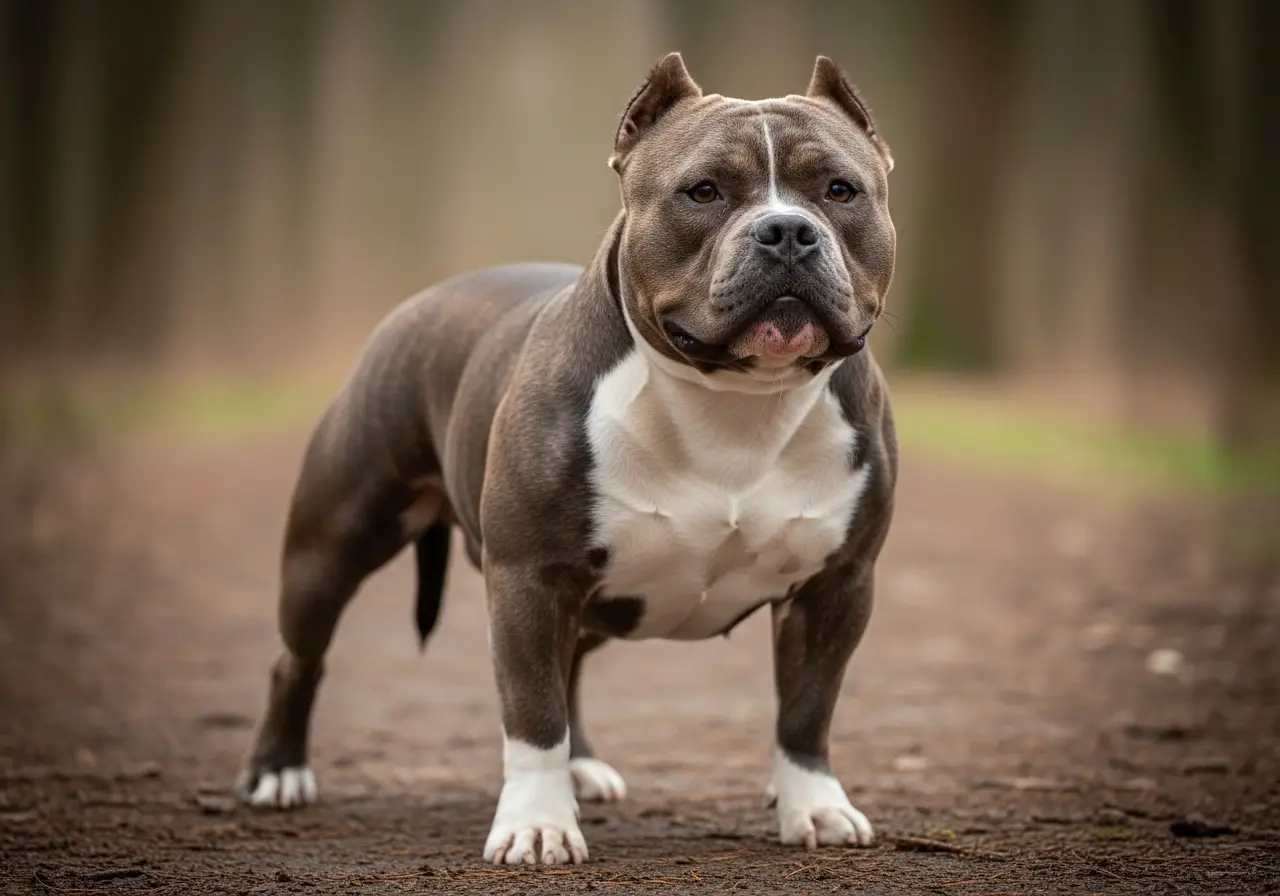
The American Bully is a muscular US companion dog, not FCI-recognised, with a withers height of 33–53 cm depending on class (Pocket, Standard, Classic, XL).
03Profile
Key facts and suitability
- Origin
- USA
- Original purpose
- Companion dog (bred from AmStaff, APBT and others)
- height at the withers
- 33–53 cm
- Weight
- 18–45 kg
- Life expectancy
- 10–13 Years
- Coat type
- Short-haired
- Minimum exercise
- 60 min/day
- Puppy price
- 2'000–10'000 CHF
- Waiting period
- 3 months
- Sports
- Obedience · Weight Pulling
04Temperament
How the American Bully shows up in everyday life
When you come home, a well-socialised American Bully shows pronounced joy; it actively seeks physical contact, follows its primary caregiver through the apartment, and only calms down after several minutes of greeting rituals. This high need for social contact (internal axis) is genetically anchored: the breed was selected for human bonding, not for independence.
Towards strangers, the American Bully generally behaves openly and sociably; the external axis shows a comparatively high friendliness towards unknown persons. This distinguishes it from many other large breeds with protective instincts. Anyone who keeps this dog as a guard or watchdog fundamentally misunderstands the breeding goal.
Compatibility with other dogs in everyday life varies considerably depending on the line and early socialisation. Some lines show pronounced dominance towards other dogs, while others are unproblematic in a pack. A general statement is not possible here; the choice of line and consistent socialisation from puppyhood are decisive.
This dog needs daily mental stimulation: nose work, search games, or structured training keep it balanced. Without mental work, boredom symptoms such as destructiveness or excessive barking develop. The need for mental work is in the medium range; it is not a Border Collie, but neither is it a dog that is content with just a walk.
The American Bully tolerates heat poorly, especially with a broad head shape. On warm days, shorter sessions in the morning and evening are more sensible than long midday walks. Anyone who underestimates this risks heat collapse; this is not a theoretical scenario but a documented risk for brachycephalic types.
05Needs
What this breed needs daily
The American Bully needs 60–90 minutes of moderate exercise daily, divided into several sessions. High-intensity endurance sports (jogging over long distances, accompanying a bicycle) are contraindicated, particularly for broad-headed types. Joint-friendly activities such as swimming, controlled play, and sniffing walks on varying terrain are more suitable.
Mental stimulation is not an optional extra. The dog needs daily mental work: food-hiding games, nose work, short training sequences with tasks. Without this component, under-stimulation arises, which manifests in undesirable behaviour.
The need for social contact is high. Being left alone for more than four hours represents a strain for most individuals and should be trained gradually. A dog that regularly spends eight hours alone will develop stress symptoms with high probability, regardless of how calm it appeared in puppyhood.
Structured training from the first day is not a recommendation but a basic prerequisite. The combination of physical strength and human bonding requires an owner who sets clear boundaries and maintains them consistently. Positive reinforcement combined with calm consistency yields the best results; harshness destabilises the relationship and fosters insecurity.
Heat management is part of everyday life: in summer, the dog needs access to cool rooms, fresh water, and shade. Walks in the early morning or late evening hours protect against overheating. For brachycephalic types, an emergency plan for heat phases is sensible.
Exercise
Medium
mental work
Medium
Social needs
High
training
Medium
06Sport & Mental and Physical Stimulation
What sports the American Bully is suited for
Realistic in terms of physiology and genetics – not every breed suits every sport.
Structurally and physiologically suitable: not an endurance sport (brachycephaly / BOAS).
07Quick Check
08Suitability
Who this breed is suitable for – and who it isn't
✓Matches
The American Bully suits owners who can plan 60–90 minutes of active exercise time daily and are prepared to implement this consistently, even in bad weather. A structured daily routine with fixed training and rest phases caters to the dog’s needs.
Experienced owners with knowledge of positive reinforcement and clear leadership are clearly at an advantage. First-time owners are not fundamentally excluded, but they must plan for a supporting dog training school from the start, not as an option but as a fixed component of ownership.
Families with children of school age, where clear rules for interacting with the dog apply and supervision is ensured, are suitable owners. The physical strength of the dog requires that children do not lead the dog without control.
Anyone living in a canton without restricted breed regulations for this breed or who is prepared to undergo a temperament test and obtain a keeping permit creates the legal basis. Checking the current legal situation before purchase is mandatory.
Owners with experience in handling muscular, human-oriented breeds, such as American Staffordshire Terriers or Boxers, bring good prerequisites. Anyone who experiences the high human bonding as an enrichment rather than a burden will find a loyal companion in this breed.
×Doesn't match
The American Bully does not suit owners who are away from home for more than four hours daily and cannot organise reliable care. The high need for social contact is not a character trait that dissolves through habituation; it is genetically anchored.
Anyone who chooses the breed primarily because of its appearance and considers health checks, lineage research, and breathing function tests to be excessive effort underestimates the responsibility structurally. Muscular appearance and health suitability are not synonymous.
Owners who lack readiness for consistent, structured training or consider a dog training school unnecessary should not choose this breed. Physical strength without leadership is a safety risk, regardless of the friendly basic temperament.
If you live in a federal state with strict restricted breed regulations and are not prepared to go through approval procedures, temperament tests, and keeping requirements, you will not create a legally secure basis.
If you experience the high human bond as a restriction (for example, because you prefer an independent dog with low bonding intensity), you will be permanently dissatisfied with the American Bully. If you also bring only experience with small, lightweight breeds as your sole reference, you will significantly underestimate the physical presence of this dog in everyday life.
10Line reality
Show line, working line, breeder market
The American Bully exists in four official size classes according to the ABKC standard: Pocket, Standard, Classic and XL. These classes differ not only in size, but also in body mass, head shape and, consequently, health risks.
The Classic line shows the lowest body mass at a similar withers height to the Standard and is considered functionally the most balanced. Pocket lines with extreme head width and very compact body structure are most frequently associated with breathing problems and orthopaedic findings. XL lines carry an increased risk of heart strain due to their high body weight.
Outside the ABKC standards, unofficial variants such as "Micro" and "XXL" exist, which are not recognised by any reputable association and arise particularly frequently in backyard breeding. These types show a disproportionately high number of health problems and are to be viewed critically from an animal welfare perspective.
A distinction between show lines and working lines, as seen in FCI-recognised breeds, does not exist for the American Bully in this form. The differences primarily run along the size classes and the intensity of selection for extreme physical traits. Anyone looking for an American Bully should know the lineage of the parent dogs, request health certificates, and assess the build of the parents for functionality, not just appearance.
11Health · Reality
What you need to plan for medically with your American Bully
The life expectancy of the American Bully ranges from 8 to 13 years, depending on size class and breeding line. XL types often only reach the lower end of this range, as the high body weight places a permanent strain on the heart and joints.
Hip dysplasia (HD) and elbow dysplasia (ED) are widespread in the breed. Reliable breed-specific screening data are lacking due to the absence of FCI studbook management, but vets report from practice an increased prevalence of HD, particularly in heavy lines. The Orthopedic Foundation for Animals (OFA) lists HD rates of over 20% for related bully types in unselected populations (OFA database, status 2023).
Brachycephaly is clinically relevant in broad head shapes. Brachycephalic Obstructive Airway Syndrome (BOAS) can cause breathing difficulties, heat intolerance, and sleep apnoea. A BOAS grading by a vet before purchase is strongly recommended for Pocket and extreme Standard types.
Heart problems — particularly dilated cardiomyopathy (DCM) — occur with increased frequency in XL lines. Regular cardiological check-ups from the 4th year of life are advisable.
Skin diseases (Demodex, allergies, fold eczema) are typical for the breed and require regular checking of skin folds. Overweight significantly exacerbates all the aforementioned risks; weight control is no minor matter for this breed. Preventive examinations: HD/ED X-rays in the 12th–18th month of life, BOAS screening, annual heart auscultation from the 3rd year of life.
12Structured data
Health by the numbers
Prone to diseases
Hip dysplasia, heart problems, eye problems, breathing problems (Extreme Pocket/Micro lines), skin allergies
Recommended health tests
Hip X-ray, heart examination, eye examination
13Myths ↔ Reality
What is often said incorrectly about this breed
Five myths, five realities, five sources.
"The American Bully is automatically a dangerous dog because of its muscle mass.
Muscle mass and readiness to aggress are not genetically linked. The American Bully was selectively bred for low aggression towards people. Socialisation, training and choice of line are decisive for behaviour, not body weight. Studies on dog biting show no significant correlation between body mass and frequency of biting.
"American Bullies require little exercise because they are so massive.
The American Bully requires 60–90 minutes of moderate exercise daily as well as mental and physical stimulation. Lack of exercise promotes overweight, which additionally stresses joints and the heart in this breed. Controlled, joint-friendly activity is particularly important for Pocket and XL lines – not high-performance sport, but also no inactivity.
"All American Bullies have breathing problems.
Not every American Bully is brachycephalic in the clinically relevant sense. Moderate lines with less extreme head shape show breathing restrictions significantly less often. Problematic are above all Micro and extreme Pocket types with a strongly shortened skull. A breathing function test before purchase and choosing a breeder with BOAS screening are crucial protective measures.
"The American Bully is the same as a Pit Bull.
The American Bully is an independent breed that was selectively bred in the 1990s. Although it shares genetic starting material with the American Pit Bull Terrier, it differs considerably in body structure, breeding goal and temperament selection. Equating the two leads to false expectations and, in some federal states, to legal misjudgements regarding restricted breed status.
"An American Bully from abroad is not subject to any regulations in Germany.
Restricted breed status depends on the federal state of residence, not on the country of origin of the dog. In Bavaria, Hamburg, Thuringia and other federal states, keeping requirements, leash requirement or approval obligations apply for certain bully types. A check of the current legal situation in the respective federal state before purchase is mandatory.
14animal welfare
The animal welfare perspective
Breeder market, designer versions, animal shelter reality — what no one writes in the puppy ad.
The American Bully belongs to the breeds with a particularly high proportion of breeders on the German-speaking market. The lack of FCI recognition means that no binding breeding health regulations exist. If you buy a puppy without demanding health certificates for the parent animals, you are financing breeding without selection pressure on health with high probability.
Extreme types, particularly Micro and XXL variants, arise outside any association standard. For these animals, breathing operations, caesarean sections, and orthopaedic interventions are not exceptions but statistically expected events in their life course. This is not a moral judgement on owners, but an objective description of breeding consequences.
The surrender market for American Bullies is above average in size. Animal welfare organisations and rescue centres report a structural oversupply caused by image purchases and underestimated keeping requirements. An American Bully from adoption is not a stopgap solution; it is a fully valid option that often offers already socialised dogs whose character can be assessed.
If you buy a puppy, you should demand the following minimum requirements: HD/ED certificates for both parent animals, BOAS screening of the mother animal if it has a broad head shape, insight into rearing conditions, and a socialisation protocol. Breeders who offer puppies without prior enquiry, without return rights, and below market price do not meet these criteria structurally.
Designer variants such as "Tri-Color Micro Exotic Bully" are marketing terms without an association standard. If you pay a premium for such designations, you are paying for appearance, not for health or character.
15Costs · Transparency
What this breed realistically costs
The purchase price for an American Bully from reputable breeding in Germany and Austria lies between 1,500 and 3,500 euros. For extreme types with designer designations, prices of 5,000–10,000 euros are sometimes asked, without higher prices correlating with better health.
Annual living costs range from €2,000 to €4,000 depending on the size class. Food for an adult Standard or XL Bully costs €80–150 per month with high-quality nutrition. Care (fold cleaning, nail trimming, occasional bathing) is less expensive compared to long-haired breeds, but not negligible.
Veterinary costs are structurally higher for this breed than for healthier breeds. An HD/ED X-ray examination costs €150–300. A BOAS operation, if required, ranges from €1,500 to €3,500 depending on the procedure. Pet insurance with surgical coverage costs €60–120 per month for this breed and is recommended due to the increased risk profile.
In states with restricted breed status, additional costs apply for temperament tests (€100–300), liability insurance (often mandatory, €150–400/year) and possibly proof of expertise. These costs should be planned for before purchase.
16Puppy search
What you need to consider when choosing a breeder
- A reputable breeder of the American Bully works with a recognised association (ABKC, UKC or a national partner association) and provides HD/ED certificates for both parent animals as well as a BOAS screening result upon request.
- Puppies leave the breeding facility no earlier than at eight weeks of age, are microchipped, dewormed, and examined by a vet.
- A visit on site is indispensable.
- If you cannot or are not allowed to view the litter, you should not finalise the purchase.
- The mother of the litter should be visible on site and in good general condition.
- Prices under 1,000 euros for an American Bully are a warning signal, not because inexpensive dogs are inherently problematic, but because reputable health examinations and rearing come at a cost.
- Very high prices for "Exotic" or "Micro" variants are not a quality indicator.
- Adoption through animal welfare organisations is an equally valid option.
- Many American Bullies in rescue centres are young, socialised, and their character can be assessed.
- A pre-adoption assessment by the organisation protects both parties.
- The restricted breed status in the respective federal state must be checked before purchase, not afterwards.
- The responsible authorities are the local regulatory offices or the state authorities.
FAQ
Frequently asked questions about the American Bully
Is American Bully a family dog?
American Bully is considered suitable for families with good socialisation and species-appropriate care.
How much exercise does American Bully need?
At least around 60 minutes of exercise per day.
Does American Bully suit an apartment?
With enough exercise and enrichment, American Bully can also be kept in an apartment.
What is the size and weight of American Bully?
Fully grown, American Bully reaches about 33–53 cm at the withers and weighs around 18–45 kg.
What is the life expectancy of American Bully?
The life expectancy of American Bully is approximately 10–13 years.
Which diseases are common in American Bully?
Hip dysplasia, heart problems, eye problems, breathing problems (Extreme Pocket/Micro lines), skin allergies
17Breed clubs
Official breed clubs in DACH
19Related
Similar breeds – and their differences
You might also be interested in


Participate
Do you have a good photo of your American Bully?
We are looking for expressive images for our breed profiles. Submit yours; the editorial team reviews every submission before publication.
Does this breed suit you?
Type not recognised by the FCI. Extreme variants (Micro, Pocket) raise animal welfare concerns – only choose healthy, normally built dogs.