
01Summary
In a paragraph
If you only have 30 seconds.
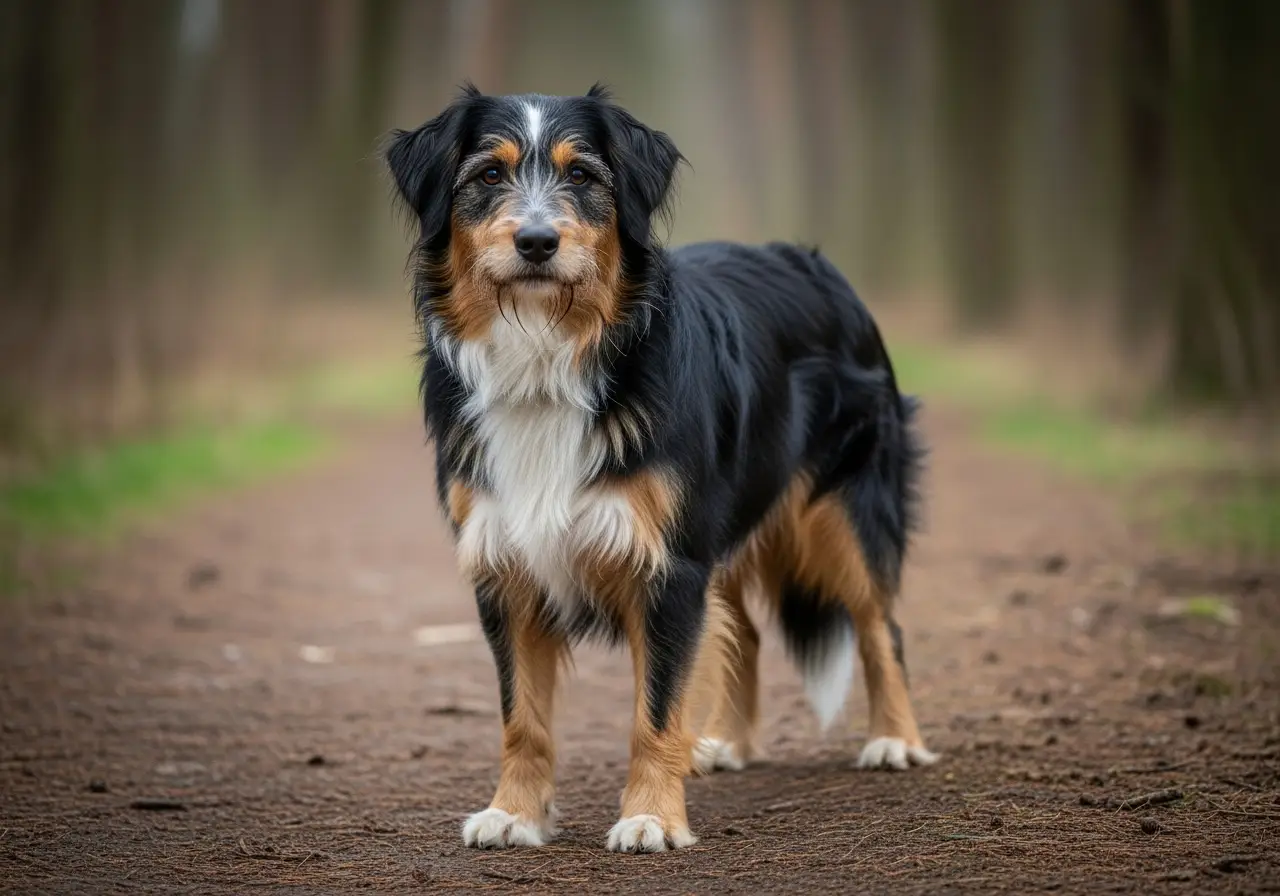
The Wäller is a German working dog breed from the 1990s, developed from Australian Shepherd and Bearded Collie, without FCI recognition but with its own breeding association. Anyone who expects a shaggy family dog and underestimates the pronounced herding instinct will be surprised. Daily exercise of 90 to 120 minutes plus mental stimulation are not a recommendation; they are the minimum.
02Introduction
What makes the Wäller special
Wäller: regional German new breed from the Westerwald, designed as a family and herding dog without FCI status
03Profile
Key facts and suitability
- Origin
- Deutschland
- Original purpose
- Herding and accompanying
- height at the withers
- 40–55 cm
- Weight
- 15–30 kg
- Life expectancy
- 12–15 Years
- Coat type
- Long-haired
- Minimum exercise
- 60 min/day
- Puppy price
- 1'000–1'800 CHF
- Waiting period
- 4 months
- Sports
- Agility Herding work
04Temperament
How the Wäller shows up in everyday life
When you come home, the Wäller registers every change in the room; whoever puts the shoes away differently or brings a new bag will receive immediate comment. This attentiveness is no coincidence: The Wäller is genetically designed to observe and control its environment.
Internally, meaning what the dog needs from within itself, there is a high need for social contact. The Wäller does not just want to be near its primary caregiver; it wants to work with them. Passive existence is not enough for it. Whoever sits on the sofa in the evening and expects the dog to lie down and sleep will experience a Wäller that looks for alternatives, and finds them.
Externally, meaning how the dog reacts to stimuli, it shows cautious reserve towards strangers. It is not a dog that immediately greets every visitor. This reserve is not a deficiency, but herding instinct: observe first, then assess. With good socialisation, it remains friendly, but it does not actively seek contact with unknown people.
On a walk in the city, this means: The Wäller registers bicycles, prams and joggers with heightened attention. Its herding instinct is activated by moving stimuli. Without a clear signal from the owner, it begins to "order" these stimuli, which can manifest as nudging, circling or barking.
It gets along well with children who know clear rules and act calmly. Toddlers who run and scream uncontrollably activate its herding instinct in a way that adults must consistently interrupt. These two poles, intense family bond and watchful control behaviour, must not be confused.
05Needs
What this breed needs daily
The Wäller needs at least 90 to 120 minutes of active exercise daily, specifically structured exercise with a task, not just free running. A walk where the dog walks beside the owner and occasionally sniffs does not fully cover this need.
Suitable forms of exercise are agility, obedience, search and rescue work, nose work, tracking or guided herding. The Wäller shows a high willingness to learn and endurance in these disciplines. Whoever does not participate in dog sports must compensate for the exercise need through varied training sessions, daily, not just at weekends.
The mental workload requirement is at least as high as the physical exercise requirement. Search games, trick training, impulse control exercises and complex tasks are part of the daily programme. A mentally under-stimulated Wäller develops behaviours that are difficult to manage in everyday life: excessive barking, herding family members, destroying objects.
Being left alone is possible, but must be built up in a structured way. The Wäller is strongly bond-oriented; abrupt leaving alone leads to stress. With gradual training, it tolerates four to five hours of being alone. More than that is not species-appropriate in the long term.
A rural environment with opportunities for exercise is advantageous. Keeping a dog in the city works if the owner brings daily time and energy for sufficient stimulation. A garden does not replace guided enrichment; it complements it.
Exercise
High
mental work
A lot
Social needs
High
training
Medium
06Sport & Mental and Physical Stimulation
What sports the Wäller is suited for
Realistic in terms of physiology and genetics – not every breed suits every sport.
Structurally and physiologically suitable: Suitable for herding work, treibball and coursing · CaniCross / bikejoring possible.
07Quick Check
08Suitability
Who this breed is suitable for – and who it isn't
✓Matches
The Wäller suits owners who can plan at least two hours daily for exercise and training, not as an exception, but as a fixed everyday structure. Dog sport enthusiasts who actively practice agility, obedience or nose work will find in the Wäller a learning-eager partner with high endurance.
Families with children from about eight years old, who are trained in dealing with dogs and act calmly, get along well with the Wäller, provided that the adults take the lead consistently. A garden or regular access to extensive terrain is a clear advantage.
Experienced owners who have already lived with herding dogs or other working dogs understand the Wäller's signals faster and react appropriately. Whoever is willing to use a supporting dog training school with herding dog expertise can also be successful with this breed without prior experience, if there is a willingness for continuous further education.
People who work from home or have flexible working hours benefit from integrating the Wäller into their daily routine. Short training sessions distributed throughout the day cover the mental workload requirement more effectively than one long session in the evening.
×Doesn't match
The Wäller does not suit owners who are away from home for eight or more hours daily and cannot organise reliable care. Strong bond orientation and high need for social contact make long hours alone a stress factor, for the dog and for the neighbours.
Whoever is looking for a calm companion dog that lies down satisfied on its place after a short walk makes the wrong choice with the Wäller. The dog needs tasks, not passivity.
Households with toddlers under six years old should realistically assess the pronounced herding instinct: Uncontrolled running and screaming activates control behaviour that requires consistent interruption by adults. Whoever cannot or does not want to make this effort is better off choosing a breed with a lower herding instinct.
Anyone who buys a Wäller as a "friendly family dog" while ignoring the external axis (watchful reserve towards strangers, herding instinct triggered by moving stimuli) will experience disappointment. Friendliness towards the family does not mean openness to every visitor. Anyone who frequently hosts guests and expects an uncomplicated interaction with strangers must plan for intensive socialisation work or choose a different breed.
10Line reality
Show line, working line, breeder market
The Wäller does not have a classic line differentiation in the sense of show and working lines, as is common with FCI-recognised breeds. Since the breeding population remains manageable and the breeding association pursues a uniform standard, there are no diverging types with fundamentally different temperamental traits.
Nevertheless, differences within the breeding emerge that interested parties should know. Breeders focusing on dog sports and working dog tasks breed for high drive, endurance, and trainability. Breeders focusing on family keeping place more emphasis on balance and threshold of irritation. These differences are not formalised but recognisable in conversation with the breeder, and relevant for choosing the puppy.
A Wäller from sport-oriented breeding has more drive and accordingly requires more structured stimulation. A Wäller from family-oriented breeding tends to show a lower baseline activation, but remains a working dog with a herding instinct. Knowing the breeding line enables a more informed decision. The conversation with the breeder about the parent dogs and their areas of use provides the most reliable indication here.
11Health · Reality
What you need to plan for medically with your Wäller
The Wäller is considered a comparatively robust breed, as both foundation breeds, Australian Shepherd and Bearded Collie, do not exhibit extreme morphological traits. Nevertheless, there are breed-specific health risks that prospective owners must be aware of.
Hip dysplasia (HD) is documented in both foundation breeds. For the Australian Shepherd, the OFA database (Orthopedic Foundation for Animals, as of 2023) shows an HD rate of approximately 6.7%. Comparable figures apply to the Bearded Collie. Reputable Wäller breeders X-ray both parent dogs and disclose the findings; an HD-free parent dog reduces the risk but does not eliminate it.
Eye diseases are also relevant. The Australian Shepherd carries an increased prevalence for Collie Eye Anomaly (CEA) and Progressive Retinal Atrophy (PRA). Genetic tests for these conditions are available and should be documented for parent dogs. A reputable breeder provides these test results without being asked.
Life expectancy is 12 to 15 years, a range that depends heavily on keeping, nutrition and preventive care. Overweight is an underestimated risk for this breed: a Wäller that is not exercised sufficiently tends to gain weight, which puts strain on joints and the cardiovascular system.
Regular veterinary check-ups, annual eye examinations and weight monitoring are recommended. In cases of lameness, changes in vision or sudden loss of performance, prompt veterinary assessment is required.
12Structured data
Health by the numbers
Prone to diseases
Hip dysplasia Eye problems
Recommended health tests
Hip X-ray Eye examination
13Myths ↔ Reality
What is often said incorrectly about this breed
Five myths, five realities, five sources.
„The Wäller is a low-maintenance family dog because it comes from two friendly breeds.
Both parent breeds, the Australian Shepherd and Bearded Collie, are working dogs with high drive. The Wäller reliably inherits this drive. Without daily stimulation of at least 90 to 120 minutes plus mental enrichment, it exhibits control and herding behaviour that becomes a burden in family life. Friendliness and low demands are two different traits.
„Because the Wäller is not an FCI breed, there are no breeding standards and no control.
The Wäller breeding association maintains its own studbook and mandatorily requires health examinations of parent animals as well as temperament tests. The lack of FCI recognition does not mean a lack of breeding control; it merely means that no international FCI pedigree is issued. Reputable breeders document lineage and health findings transparently.
„The Wäller is well-suited for first-time owners because it is eager to learn and people-oriented.
Eagerness to learn and people-orientation are traits that make a dog more demanding, not easier. The Wäller registers inconsistency immediately and actively tests boundaries. First-time owners without experience with herding dogs regularly underestimate the training effort. A supporting dog training school with herding dog experience is not an option, but a necessity.
„The herding instinct in the Wäller is harmless and only shows itself with sheep.
Herding instinct is a genetically anchored behavioural pattern that can direct itself at all movable stimuli, children, bicycles, other dogs, joggers. Without targeted training and clear impulse control, this behaviour can lead to conflicts in everyday life. The instinct does not disappear through ignoring; it must be actively channelled.
„A large garden replaces daily exercise for the Wäller.
A garden offers space but does not replace structured stimulation. The Wäller requires guided exercise with a task; free running without interaction leads to self-occupation that manifests in undesirable behaviour. Studies on herding dogs consistently show that physical exhaustion without mental stimulation does not reduce behavioural problems.
14animal welfare
The animal welfare perspective
Breeder market, designer versions, animal shelter reality — what no one writes in the puppy ad.
The Wäller is rarely found in traditional animal welfare contexts. As a supervised breeding line with a manageable population and breeder oversight, it seldom ends up in shelters, at least not as a puppy or adolescent dog. Older Wällers occasionally appear in rehoming programmes when owners have underestimated the breed's demands.
This is precisely where the central animal welfare issue lies: not breeding for harmful traits (Qualzucht) or the backyard breeder market in the classical sense, but misplacement due to lack of education. The Wäller appears visually accessible: shaggy, friendly, medium-sized. This appearance leads people to assess it as an uncomplicated companion dog. When confronted with the actual herding instinct, exercise needs and intensity of bonding, they give up the dog, often after six to twelve months.
Designer versions of the Wäller exist on the fringes of the market. Casual breeders who cross Australian Shepherds and Bearded Collies without temperament tests and health examinations and market the result as "Wäller" must be clearly distinguished from reputable breeders. A puppy without a breeding book entry, without health certificates for the parent dogs and without breeder affiliation to a breeding association is not a Wäller in the sense of the supervised breeding line, even if it is labelled as such.
Anyone looking for a Wäller should consider rehoming adult dogs as an equally valid option. An adult Wäller shows its temperament openly; herding instinct, activity level and social behaviour are assessable. This significantly reduces the risk of misplacement. Contacting the breeding association or rescue organisations for herding dogs is a sensible first step.
15Costs · Transparency
What this breed realistically costs
A Wäller puppy from a reputable breeder with breeding book entry and health certificates typically costs between 1,200 and 1,800 euros. Offers significantly below this often come from uncontrolled crosses without breeder support.
Annual living costs range from 1,500 to 2,500 euros depending on keeping conditions and region. This includes food (400–700 euros/year for a medium-sized dog with quality food), coat care (regular brushing, occasional trimming: 100–300 euros/year), basic equipment, dog tax and accessories.
Veterinary costs vary considerably. Annual check-ups, vaccinations and parasite prevention cost an average of 200 to 400 euros. Unforeseen illnesses or operations can quickly reach 1,000 to 3,000 euros. A dog health insurance policy or a health account with monthly savings (50–100 euros/month) is recommended.
Dog sports and training costs are not an optional item for the Wäller: a dog training school with herding dog expertise costs 15 to 30 euros per session. Anyone who involves the Wäller in organised dog sports should budget for club fees of 100 to 300 euros annually.
16Puppy search
What you need to consider when choosing a breeder
- A reputable Wäller breeder is a member of the Wäller breeding association and provides breeding book entries for both parent dogs.
- Health examinations, HD X-rays and eye tests for CEA and PRA must be available for both parent dogs and are shown without being asked.
- Temperament tests of the parent dogs are standard with a reputable breeder, not an exception.
- Anyone who offers a puppy without these certificates at a conspicuously low price is breeding outside the controlled breeding line.
- The result is a dog of unknown health and unknown temperament, not a Wäller in the sense of supervised breeding.
- Waiting periods of several months are common with reputable breeders.
- This waiting period is not a disadvantage, but a quality feature: it shows that the breeder does not produce on demand.
- Rehoming an adult Wäller is an equally valid alternative.
- Adult dogs show their temperament openly; herding instinct, activity level and social behaviour can be assessed before a decision is made.
- Rescue organisations for herding dogs and the breeding association itself can help with rehoming.
- No named breeder recommendation; the rundum.dog platform refers to the breeding association as the first point of contact.
FAQ
Frequently asked questions about the Wäller
Is Wäller suitable for beginners?
Wäller is considered suitable for first-time dog owners.
Is Wäller a family dog?
Wäller is considered suitable for families with good socialisation and species-appropriate care.
How much exercise does Wäller need?
At least around 60 minutes of exercise per day.
Does Wäller suit an apartment?
With enough exercise and enrichment, Wäller can also be kept in an apartment.
What is the size and weight of Wäller?
Fully grown, Wäller reaches about 40–55 cm at the withers and weighs around 15–30 kg.
What is the life expectancy of Wäller?
The life expectancy of Wäller is approximately 12–15 years.
Which diseases are common in Wäller?
Hip dysplasia Eye problems
17Breed clubs
Official breed clubs in DACH
19Related
Similar breeds – and their differences
You might also be interested in



Participate
Do you have a good photo of your Wäller?
We are looking for expressive images for our breed profiles. Submit yours; the editorial team reviews every submission before publication.
Does this breed suit you?
Regional German breeding without FCI recognition – character highly variable