
01Summary
In a paragraph
If you only have 30 seconds.
The Sheepadoodle combines the working history of the Old English Sheepdog with the versatility of the Poodle, without a recognised standard and without guaranteed traits. What remains is a dog with high exercise and mental work requirements, a pronounced herding instinct, and a coat that demands consistent care. Those who underestimate these three factors quickly end up overwhelmed, as evidenced by rising surrender numbers in DACH animal shelters.
02Introduction
What makes the Sheepadoodle special
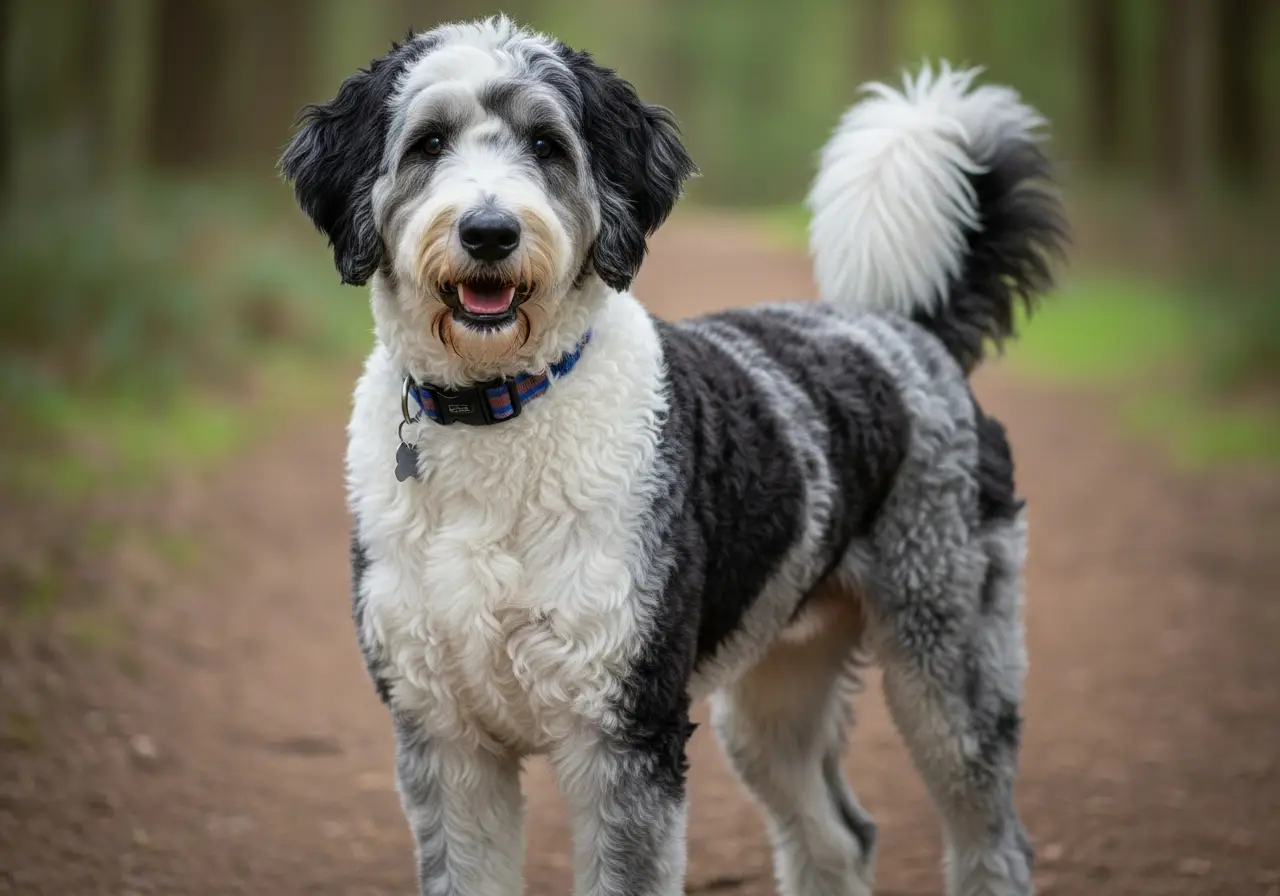
Sheepadoodle: cross between Old English Sheepdog and Poodle, friendly and good with children, with high-maintenance coat
03Profile
Key facts and suitability
- Origin
- USA
- Original purpose
- Companion dog
- height at the withers
- 51–68 cm
- Weight
- 27–42 kg
- Life expectancy
- 12–15 Years
- Coat type
- Gelockt
- Minimum exercise
- 60 min/day
- Puppy price
- 1'000–2'500 CHF
- Waiting period
- 3 months
- Sports
- Agility Obedience
04Temperament
How the Sheepadoodle shows up in everyday life
The morning run reveals what lies within the Sheepadoodle: it does not simply run alongside you, but observes, anticipates, and reacts to every change in direction. The herding instinct of the Old English Sheepdog is clearly perceptible in many individuals; children running in the garden are circled, cyclists on the roadside are fixedly stared at. This is not misbehaviour, but genetically anchored programming.
Internally, meaning what the dog needs from itself, the need for social contact is high. A Sheepadoodle left alone for hours builds up stress that discharges through vocalisation, destruction or exaggerated greeting behaviour. It requires a primary caregiver who is present, reliable and consistent, not someone who occasionally has time.
Externally, meaning how the dog reacts to its environment, a differentiated picture emerges. Towards known persons, it is generally open and approachable. Towards strangers, it often reacts with caution or vigilance; the extent depends heavily on socialisation during the first weeks of life. These two poles (high internal need for social contact, not automatically open externally) must not be confused. A dog that intensely needs its family is not necessarily a dog that joyfully greets every visitor.
In everyday life, this means that training sessions are part of the daily routine, not an exception. Nose work, fetching, obedience exercises or dog sports such as agility cover the need for mental work. Anyone who wants to sit on the couch in the evening without having invested beforehand will have a restless, demanding dog beside them.
05Needs
What this breed needs daily
The Sheepadoodle requires at least 90 minutes of active exercise daily, divided into several sessions, not as a single evening walk. Free running on secure terrain, swimming or fetching work cover the physical needs better than loose-leash walking alone.
Mental work is not an optional addition, but an equally important part of the daily routine. Nose work, search games, structured obedience training or dog sports such as agility and rally-obedience are suitable formats. A Sheepadoodle that is physically exercised but mentally under-stimulated will develop substitute activities, often at the expense of furniture, fences or household peace.
The herding instinct requires active management. Running children, cyclists or other dogs can trigger herding impulses. Impulse control training should therefore be included in the training plan from the start, not as a correction, but as a preventive foundation.
Being left alone must be built up gradually and consistently. Four hours are the realistic maximum for a well-conditioned Sheepadoodle; more than that leads to stress reactions in most individuals. Anyone who is regularly away from home for longer periods needs a reliable care solution.
Grooming represents a separate time commitment: at least three to four brushing sessions per week, supplemented by professional clipping every eight to twelve weeks. Anyone who underestimates this effort risks painful matting, which may necessitate a complete shave under anaesthesia.
Exercise
High
mental work
A lot
Social needs
High
training
Medium
06Sport & Mental and Physical Stimulation
What sports the Sheepadoodle is suited for
Realistic in terms of physiology and genetics – not every breed suits every sport.
Structurally and physiologically suitable: Suitable for herding work, treibball and coursing · CaniCross / bikejoring possible.
07Quick Check
08Suitability
Who this breed is suitable for – and who it isn't
✓Matches
The Sheepadoodle suits owners who can plan at least 90 minutes of active exercise and additional training time daily, not as an occasional offer, but as a fixed daily routine. Active individuals or couples with an affinity for dog sports, hiking or structured training will find in it a performance-ready partner.
Families with children from about eight years of age are suitable if adults take on the main responsibility for training and stimulation and the herding instinct is actively addressed. A garden facilitates daily management, but does not replace structured activities.
Anyone who already has experience with high-drive or sensitive dogs is clearly at an advantage. The Sheepadoodle reacts to inconsistency in training with uncertainty or stubbornness; an owner who brings clear body language and long-term willingness to train will achieve significantly better results.
Households where at least one person is predominantly at home or where reliable daytime care can be organised provide the prerequisites for a balanced animal. Those who are prepared to plan grooming as a regular time commitment and finance professional clipping meet another basic requirement.
×Doesn't match
The Sheepadoodle is not suitable for owners who are away from home for more than four hours daily and cannot organise a care solution. Those who view exercise and training as occasional leisure activities will come into conflict with this dog.
Households looking for a calm, independent dog that is content with little enrichment should not choose this breed. The misconception that a large, fluffy dog is automatically laid-back leads to the most frequent misplacements.
Those who equate the high need for social contact of the Sheepadoodle with general friendliness towards strangers underestimate the external behavioural axis: a dog that intensely needs its family does not necessarily react openly to unknown persons. Without consistent socialisation during the puppy phase, watchfulness towards strangers can increase.
Families with very small children under five years of age should realistically assess the pronounced herding instinct; circling and pushing running toddlers is not a sign of aggression, but a burden in everyday life that requires active management. Those who do not have the time or knowledge for this are overwhelmed by this breed. First-time owners without guidance from an experienced dog training school should carefully examine the requirements.
10Line reality
Show line, working line, breeder market
The Sheepadoodle has no established breeding lines in the sense of working lines, show lines, or field trial lines, as exist for FCI-recognised breeds. Differentiation is instead based on the crossbreeding generation and the proportion of Poodle.
F1 Sheepadoodles (50% Old English Sheepdog, 50% Poodle) show the greatest variance in coat, temperament and instinct structure. F1b backcrosses (75% Poodle, 25% OES) are often marketed with the argument that they shed less, but tend to show stronger Poodle characteristics such as a more pronounced willingness to retrieve and higher sensitivity to stimuli.
Multigenerational Sheepadoodles (F2, F3) are even harder to predict in their distribution of traits. Breeders who select for certain characteristics, such as a calmer temperament or specific coat structure, work without binding studbook documentation, making external verification of their selection goals impossible.
Buyers should therefore not rely solely on generational designations, but personally assess both parent animals: the temperament, joy of movement and instinct structure of the parents provide the most reliable indication of the expected profile of the puppy.
11Health · Reality
What you need to plan for medically with your Sheepadoodle
No cross-breed health statistics exist for the Sheepadoodle, as no breeding association collects systematic data. The health data of the parent breeds serve as a guide.
For the Old English Sheepdog, the OES breeding health study by the VDH (status 2020) shows HD prevalences of around 20 to 25%. For the Poodle (Standard Poodle), HD rates are approximately 10 to 15% according to evaluations of the VDH breeding health report. A Sheepadoodle can inherit predispositions from both sides; without parental X-ray findings, the individual risk cannot be assessed.
Progressive retinal atrophy (PRA) is documented in both parent breeds. For the Poodle, an established genetic test exists (prcd-PRA); for the Old English Sheepdog, several forms of PRA are known. Puppies whose parent animals have not been tested for PRA carry a non-calculable risk of blindness.
Based on the parent breeds, life expectancy is approximately 12 to 15 years. Overweight is a relevant risk: both parent breeds tend towards obesity when lacking exercise, which strains joints and heart health.
Preventive examinations that a responsible owner should plan for: annual eye examination by an ophthalmologist, hip X-rays at the age of 12 to 18 months, and regular weight checks. Grooming-related skin problems, pyoderma under felt mats, are a frequent reason for vet visits and are avoidable.
12Structured data
Health by the numbers
Prone to diseases
Hip dysplasia Eye problems
Recommended health tests
Hip X-ray Eye examination
13Myths ↔ Reality
What is often said incorrectly about this breed
Five myths, five realities, five sources.
"The Sheepadoodle is hypoallergenic and does not cause allergies.
No dog is completely hypoallergenic. Allergic reactions are primarily triggered by the protein Can f 1 in saliva and skin flakes, not solely by coat hairs. Poodle crosses tend to shed less hair, but produce the same allergens. Whether a specific dog is tolerable for a particular allergy sufferer can only be tested through direct, prolonged contact with the individual, not by the breed name.
"As a crossbreed, the Sheepadoodle is automatically healthier than purebred dogs.
The so-called heterosis effect (hybrid vigour) does not occur automatically and does not protect against hereditary diseases shared by both parent breeds. Old English Sheepdogs and Poodles are both known for hip dysplasia, progressive retinal atrophy (PRA) and certain heart conditions. A Sheepadoodle puppy can inherit these predispositions from both sides. Without health tests on both parent dogs, no statement about the risk profile is possible.
"The Sheepadoodle is a calm, relaxed family dog.
Both parent breeds were selected for intensive work. The herding instinct of the Old English Sheepdog and the retrieving and working readiness of the Poodle result in a dog with high activity needs. Without sufficient stimulation – at least 90 minutes of exercise plus mental work daily – many Sheepadoodles develop behavioural issues such as excessive barking, herding children or destructive behaviour.
"The curly coat of the Sheepadoodle is easy to care for and rarely mats.
Curly or wavy coats that shed little are particularly prone to matting because dead hairs remain in the coat instead of falling out. Without daily brushing, or at least every two days, painful mats can form that reach down to the skin. Professional clipping every 8 to 12 weeks is necessary for most Sheepadoodles and incurs ongoing costs.
"Sheepadoodle puppies from the internet are just as reputable as those from a local breeder.
Online trade in designer dog puppies is a well-known entry point for backyard breeding and puppy mills. Sheepadoodles without an FCI standard are particularly vulnerable, as no breed club controls apply. Missing health certificates for the parent animals, no right to inspect the premises, and delivery via courier services are clear warning signs. Studies by the German Animal Welfare Federation document that puppies from such sources arrive sick disproportionately often.
14animal welfare
The animal welfare perspective
Breeder market, designer versions, animal shelter reality — what no one writes in the puppy ad.
The Sheepadoodle stands as an example of a development that has occupied animal welfare in DACH since around 2015: the demand for designer dogs, fuelled by social media, without buyers knowing the actual requirements.
Backyard breeder market: As no breeding association regulates the Sheepadoodle, the market for backyard breeding is particularly open. Puppies are sold without health tests, without a socialisation concept, and without buyer advice, often via classifieds platforms or Instagram profiles. The lack of association control makes it harder for buyers to distinguish between reputable and disreputable offers.
Designer versions and trend dynamics: In addition to the standard Sheepadoodle (F1), mini-Sheepadoodles, micro-Sheepadoodles, and multiple crosses are increasingly offered. The smaller the desired size, the higher the risk that health and temperament are subject to further variables. Buyers expecting a "mini" dog with an identical temperament often receive an animal with different instinct structures.
Problems related to keeping: Sheepadoodles kept in households without sufficient mental and physical stimulation demonstrably develop behavioural issues. Animal shelters in Germany and Switzerland have reported rising surrender rates of this crossbreed since 2018, with a consistent reason: the effort required for exercise, training and grooming was underestimated. This is not a failure of the breed, but an information problem at the point of purchase.
Adoption as an option: A Sheepadoodle from an animal shelter or foster home is not a stopgap solution. Adult dogs from rehoming organisations come with an assessable temperament, are often already basic-socialised and need a home that understands their needs. Anyone who informs themselves about rehoming organisations before buying a puppy makes a well-founded decision, regardless of which path they ultimately choose.
15Costs · Transparency
What this breed realistically costs
A Sheepadoodle puppy from a reputable breeder with health tests costs between 1,800 and 3,500 euros (CHF) in Germany and Switzerland. Offers significantly below this usually signal a lack of investment in health checks or socialisation.
The ongoing annual costs consist of: food (quality dry food or fresh meat for a dog of this size) approx. 600 to 1,200 euros/year; professional grooming every 8 to 12 weeks at 80 to 150 euros results in 400 to 900 euros/year; basic veterinary cost allowance (vaccinations, parasite prophylaxis, annual check-up) approx. 300 to 500 euros/year.
In addition, there are one-off costs: basic equipment (lead, collar, transport box, bed) approx. 300 to 600 euros and dog training school for at least one year approx. 400 to 800 euros.
A third-party liability insurance for dogs is recommended in Germany for dogs of this size and costs 60 to 150 euros/year depending on the provider and coverage amount. A health insurance for dogs is 50 to 200 euros/month, a calculable safeguard against possible hip dysplasia or eye operations. Total costs in the first year: realistically 4,000 to 7,000 euros including getting a dog.
16Puppy search
What you need to consider when choosing a breeder
- As the Sheepadoodle is not an FCI-recognised breed, no breeding association controls apply.
- This means: the quality of breeding depends exclusively on the individual breeder, and the range is considerable.
- Reputable breeders provide health certificates for both parent animals: X-ray findings for hip dysplasia (HD) and elbow dysplasia (ED), eye examinations for progressive retinal atrophy (PRA), and cardiac examinations if necessary.
- They allow an on-site inspection, show the mother with the puppies, and answer questions without sales pressure.
- Puppies delivered by courier services or whose parent animals cannot be inspected are a clear warning signal.
- Prices under 1,000 euros for a Sheepadoodle puppy indicate a lack of health investments, not a good offer.
- Adoption via animal shelters or rescue organisations is an equally valid option.
- Sheepadoodles are increasingly being surrendered because owners have underestimated the effort involved.
- An adult dog from adoption has the advantage that temperament and energy level can already be assessed.
- Organisations such as DACH animal welfare associations or specialised Doodle rescues facilitate adoption with preliminary discussions and aftercare.
FAQ
Frequently asked questions about the Sheepadoodle
Is Sheepadoodle suitable for beginners?
Sheepadoodle is considered suitable for first-time dog owners.
Is Sheepadoodle a family dog?
Sheepadoodle is considered suitable for families with good socialisation and species-appropriate care.
How much exercise does Sheepadoodle need?
At least around 60 minutes of exercise per day.
Does Sheepadoodle suit an apartment?
With enough exercise and enrichment, Sheepadoodle can also be kept in an apartment.
What is the size and weight of Sheepadoodle?
Fully grown, Sheepadoodle reaches about 51–68 cm at the withers and weighs around 27–42 kg.
What is the life expectancy of Sheepadoodle?
The life expectancy of Sheepadoodle is approximately 12–15 years.
Is Sheepadoodle suitable for allergy sufferers?
Sheepadoodle is considered relatively hypoallergenic. There’s never a guarantee — test direct contact beforehand.
Which diseases are common in Sheepadoodle?
Hip dysplasia Eye problems
17Breed clubs
Official breed clubs in DACH
19Related
Similar breeds – and their differences
You might also be interested in


Participate
Do you have a good photo of your Sheepadoodle?
We are looking for expressive images for our breed profiles. Submit yours; the editorial team reviews every submission before publication.
Does this breed suit you?
Cross between Old English Sheepdog and Poodle – large, lovable, grooming-intensive