
01Summary
In a paragraph
If you only have 30 seconds.
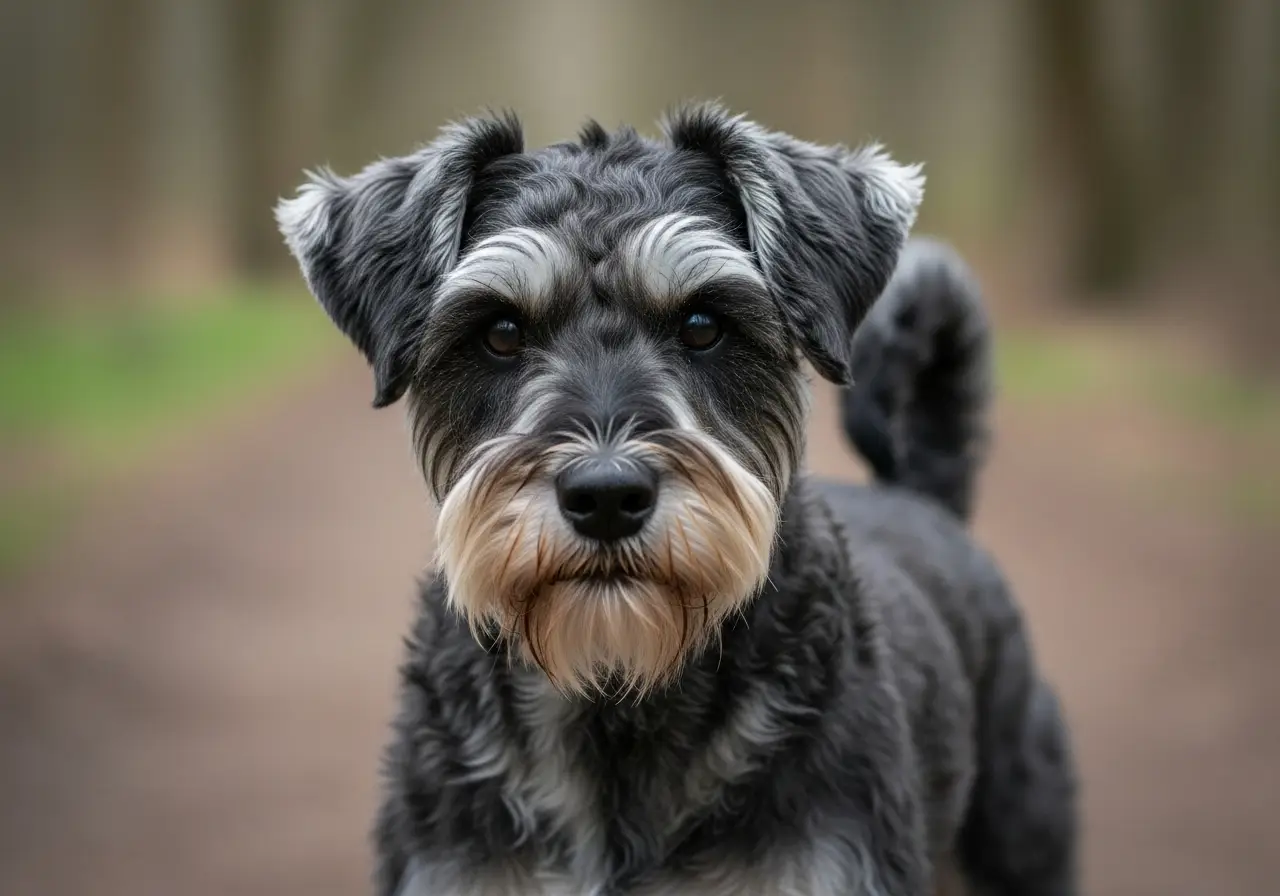
The Schnoodle is a designer crossbreed of Schnauzer and Poodle without FCI recognition. The combination of alertness and pronounced learning ability makes it a demanding companion that requires clear guidance, daily stimulation, and regular grooming. Those who underestimate this will end up with a dog that seeks its own entertainment, usually noisily.
02Introduction
What makes the Schnoodle special
Schnoodle: crossbreed of Schnauzer and Poodle, eager to learn and often more allergy-friendly than purebred dogs
03Profile
Key facts and suitability
- Origin
- USA
- Original purpose
- Companion dog
- height at the withers
- 25–66 cm
- Weight
- 3–30 kg
- Life expectancy
- 10–15 Years
- Coat type
- Gelockt
- Minimum exercise
- 60 min/day
- Puppy price
- 800–2'000 CHF
- Waiting period
- 3 months
- Sports
- Agility Obedience
04Temperament
How the Schnoodle shows up in everyday life
When you come home, a Schnoodle reacts attentively and presently; it registers every change in the household, every visitor, every unfamiliar noise. This is no coincidence but Schnauzer heritage: vigilance is genetically ingrained and cannot be trained away. What can be trained is the reaction to it.
Internally, the Schnoodle requires a lot of mental work. A walk without a task is not enough. Nose work, search games, structured fetching or trick training fill its head and prevent it from seeking out its own enrichment. If you want to sit on the couch in the evening, you must have invested in the morning.
Externally, it behaves reservedly to expectantly towards strangers. This is not aggression but caution, typical for guard dog lines. A Schnoodle that greets every visitor joyfully is more the exception than the rule. Early socialisation with various people, places and situations is therefore not a recommendation but a duty.
The Schnoodle works well with children if clear rules apply to both sides. It does not tolerate unpredictable behaviour without reaction. Children who learn to respect dog boundaries and a Schnoodle that has learned to process stimuli result in a stable combination.
It stays alone for a maximum of four hours if this has been built up gradually. Longer leads to restlessness or barking behaviour in many dogs of this crossbreed. A fixed daily routine stabilises it significantly more than spontaneous variety.
05Needs
What this breed needs daily
The Schnoodle requires 60 to 90 minutes of active exercise daily, depending on size. It is not just the distance that counts but the quality: free running, sniffing phases and structured tasks are more effective than a uniform walk in step.
Mental stimulation is equal to physical exercise. Nose work, search games, fetching tasks or obedience training in short units of 10 to 15 minutes cover the need for mental work. The Poodle share makes it quick and differentiated in learning ability; this is an advantage if used and a risk factor if ignored.
The need for social contact is high. The Schnoodle orients itself strongly towards its primary caregiver and requires regular, active contact, not just spatial proximity. Passive coexistence is not enough. If you are away all day, you must plan a reliable care solution.
The coat requires professional grooming or clipping every six to eight weeks, depending on the coat type, as well as weekly brushing at home. If neglected, tangles form that are painful and labour-intensive to resolve. The care effort is a fixed cost factor that should be calculated before getting a dog.
Guarding behaviour, excessive barking at noises or visitors, requires early guidance through training. Without clear impulse control, this behaviour intensifies over time. An accompanying dog training school from puppyhood is recommended.
Exercise
Medium
mental work
A lot
Social needs
High
training
Medium
07Quick Check
08Suitability
Who this breed is suitable for – and who it isn't
✓Matches
The Schnoodle suits owners who can plan at least 60 to 90 minutes of active exercise daily and are willing to invest additional time for training sessions and mental work. Specifically: people with a structured everyday life, interest in positive reinforcement training and joy in a close human-dog relationship.
Families with children from about eight years old are suitable if the children are guided in dealing with dogs and the dog receives sufficient opportunities to withdraw. It is important that at least one adult person takes main responsibility for training and stimulation.
Owners in city apartments can keep a Schnoodle if daily excursions to green areas or parks are guaranteed and barking behaviour is structured early through training. A garden is helpful but does not replace active enrichment.
Experienced dog owners who have already worked with vigilant or highly trainable breeds find a quick-reacting, cooperative companion in the Schnoodle. Owners who wish to practise dog sports such as Agility, Obedience or Nosework also benefit from its learning motivation. The prerequisite in every case is the willingness to plan regular grooming and cover it financially.
×Doesn't match
The Schnoodle does not suit owners who are looking for a calm, independent dog with low care effort. If you expect the dog to entertain itself or stay alone for eight hours without problems, you will not be happy with this crossbreed type.
People who have little experience with dogs and do not wish to use a dog training school or professional guidance often underestimate the combination of vigilance and learning strength. A Schnoodle that does not receive clear leadership develops its own solutions; barking behaviour, resource guarding or displacement activities are typical consequences.
If you expect an uncomplicated lap dog based on the external appearance (curly coat, compact size), you confuse the external effect with the internal profile. Vigilance and high need for social contact are not characteristics that can be balanced out by cuddling.
Households with very small children under five years old should carefully weigh the decision: the Schnoodle reacts sensitively to unpredictable stimuli, and the care capacity for child and dog simultaneously is often limited in this life phase.
Owners who cannot or do not want to plan regular grooming effort, temporally and financially, should consider another breed or crossbreed. Matted fur is an animal welfare problem, not an aesthetic one.
10Line reality
Show line, working line, breeder market
The Schnoodle has no official breeding lines in the sense of FCI-recognised working tests or show standards. Nevertheless, there are clear differences in practice that owners should know about.
The size variant is the most decisive factor: a Miniature Schnoodle from a Miniature Schnauzer and Toy Poodle behaves differently than a Giant Schnoodle from a Giant Schnauzer and Standard Poodle. The latter requires significantly more exercise, space and experience in handling large, powerful dogs.
Within the crossbreed, the proportion of parent breeds also varies. F1 dogs (first generation, one parent per breed) show the greatest variance in coat, size and character. F2 dogs or multigenerational litters, where Schnoodles are already bred together, can be more stable in certain traits, but this is not guaranteed either, as there is no uniform selection pressure.
Breeders who selectively breed for a calmer temperament or stronger Poodle components exist, but are difficult to identify, as no overarching authority verifies these claims. Anyone looking for a specific size or temperament profile should compare several litters and specifically ask about the parent dogs and their temperament tests.
11Health · Reality
What you need to plan for medically with your Schnoodle
The life expectancy of the Schnoodle is between 10 and 15 years depending on size. Smaller variants often reach the upper end of this range, larger variants rather the lower end.
Since no central health database for Schnoodles exists, risks are derived from the parent breeds. In Poodles, progressive retinal atrophy (PRA) is a known hereditary disease; according to a study by the University of Veterinary Medicine Hannover (2018), certain Poodle lines are affected with a prevalence of up to 15%. Lens luxation and arrhythmias are documented in Schnauzers. Hip dysplasia (HD) occurs in both parent breeds and can be passed on to the Schnoodle.
Preventive examinations that should be requested from the breeder before purchase: eye examination of both parent dogs (CAER certificate), HD X-ray, DNA test for PRA. During the dog's life, an annual veterinary check-up including an eye check is recommended.
The Schnoodle's coat, curly to wavy depending on the parentage, tends to mat and can promote skin problems if care is lacking. Regular checking of the ears is important, as the curly fur can narrow the ear canal and predispose to ear infections.
Overweight is a real risk for under-stimulated Schnoodles. A structured feeding plan and avoiding an inflation of treats during training help to keep the weight stable.
12Structured data
Health by the numbers
Prone to diseases
Hip dysplasia Eye problems
Recommended health tests
Hip X-ray Eye examination
13Myths ↔ Reality
What is often said incorrectly about this breed
Five myths, five realities, five sources.
The Schnoodle is hypoallergenic and suitable for all allergy sufferers.
No dog is completely allergen-free. Allergic reactions are not triggered solely by hair, but by the protein Can f 1 in saliva, urine and skin flakes. Poodle and Schnauzer components can reduce hair amounts, but do not eliminate the allergen risk. Before getting a dog, an allergological test and contact with the specific dog are recommended.
As a mixed-breed dog, the Schnoodle is more robust and healthier than purebred dogs.
The so-called heterosis effect does not occur automatically with every crossbreed. If both parent breeds are tested for the same hereditary diseases, the risk can decrease. If they are not, diseases from both breeds can accumulate. In Schnoodles, hip dysplasia, progressive retinal atrophy and epilepsy are known from both parent lines.
The Schnoodle is a calm, low-maintenance lap dog.
Both parent breeds are working dogs with a high need for stimulation. The Schnoodle usually inherits pronounced alertness from the Schnauzer and a high drive to learn from the Poodle. Without sufficient mental and physical stimulation, it often develops excessive barking behaviour, frustration or destructive behaviours.
Because the Schnoodle is not an FCI dog, origin does not matter.
Especially without a breed standard and kennel club control, origin is decisive. Reputable breeders test both parent dogs for hereditary diseases and socialise the puppies in a structured manner. Without this foundation, the risk of behavioural and health problems increases considerably.
The Schnoodle gets along effortlessly with all other dogs.
The Schnauzer line brings pronounced territoriality. Without early and consistent socialisation, the Schnoodle can be reactive or selective towards conspecifics. Good compatibility does not arise automatically, but through targeted habituation from puppyhood.
14animal welfare
The animal welfare perspective
Breeder market, designer versions, animal shelter reality — what no one writes in the puppy ad.
The Schnoodle belongs to the designer dogs that have been in high demand in recent years, and simultaneously to the breeds that land disproportionately often in animal shelters and adoption agencies. The reason is almost always the same: the actual keeping requirements were not sufficiently researched before getting a dog.
The backyard breeder market is particularly active for Schnoodles. As no breeding association control exists, litters can be produced without health tests, without structured socialisation, and without aftercare. Platforms such as eBay Kleinanzeigen or international puppy placement sites offer Schnoodle puppies at prices that simply do not cover reputable rearing. The risk of behavioural and health problems thereby increases considerably.
Designer versions such as the Teddy-Schnoodle or the Mini-Schnoodle are deliberately marketed for a specific appearance. In doing so, the temperament profile (alertness, high need for social contact, learning strength) is often omitted in marketing. Anyone who selects a dog primarily based on looks does not make an informed decision.
Breeding and keeping-related problems with the Schnoodle arise less from anatomical features than from the behavioural level: a dog with a high need for enrichment kept in a stimulus-poor environment develops problem behaviour. This is not a character flaw of the dog, but a keeping problem.
Adopting an adult Schnoodle from animal welfare is a serious alternative to buying a puppy. Many of these dogs are basically socialised, their character traits are assessable, and the need is real. Animal welfare organisations such as the German Animal Welfare Federation or cross-breed adoption platforms offer advice and pre-selection.
15Costs · Transparency
What this breed realistically costs
The purchase price for a Schnoodle puppy from reputable breeding in Germany and Austria is between 1,200 and 2,000 euros. Offers significantly below this often come from backyard breeders without health tests. In Switzerland, prices between 1,500 and 2,500 CHF are customary.
The annual living costs vary greatly depending on the size of the dog. For a medium-sized Schnoodle, the following items should be realistically planned for: food 600 to 1,200 euros per year, grooming at the groomer every six to eight weeks at 60 to 120 euros (i.e. 400 to 900 euros annually), basic equipment in the first year around 300 to 500 euros.
Basic veterinary care (vaccinations, parasite prevention, annual check-up) costs on average 200 to 400 euros per year. Unforeseen treatments can quickly exceed 500 to 2,000 euros. Pet insurance costs between 30 and 80 euros monthly depending on the provider and scope of benefits and is recommended for this crossbreed.
Dog training school and training in the first year: 200 to 500 euros for basic courses. Those who focus on dog sports or advanced training should budget more. Overall, total costs of 3,000 to 5,000 euros are realistic in the first year of ownership, and 1,500 to 3,000 euros annually from the second year onwards.
16Puppy search
What you need to consider when choosing a breeder
- As the Schnoodle is not an FCI-recognised breed, there is no breeding association that controls breeding facilities or enforces minimum standards.
- This makes the selection of the breeder particularly important.
- Reputable breeders test both parent dogs for breed-typical hereditary diseases, particularly eye conditions and heart problems in the Schnauzer lineage, and progressive retinal atrophy, hip dysplasia, and epilepsy in the Poodle lineage.
- Corresponding certificates should be presented before purchase.
- A breeder who cannot or will not provide these proofs is not a reputable contact.
- The puppies should have grown up with their mother for at least eight weeks and been socialised in a home environment, exposed to various everyday noises, people, and situations.
- A visit on-site is indispensable.
- If a meeting is refused or the puppy is presented without its mother, caution is advised.
- Prices significantly below 800 euros are a warning sign.
- Reputable rearing with health tests, socialisation, and basic veterinary care is costly.
- Adoption via animal shelters or Schnoodle-specific rescue organisations is an equally valid option.
- Many surrendered Schnoodles are young and healthy; they were given up because the keeping requirements were underestimated.
- Preliminary advice from the adoption agency helps to find the right dog.
FAQ
Frequently asked questions about the Schnoodle
Is Schnoodle suitable for beginners?
Schnoodle is considered suitable for first-time dog owners.
Is Schnoodle a family dog?
Schnoodle is considered suitable for families with good socialisation and species-appropriate care.
How much exercise does Schnoodle need?
At least around 60 minutes of exercise per day.
Does Schnoodle suit an apartment?
With enough exercise and enrichment, Schnoodle can also be kept in an apartment.
What is the size and weight of Schnoodle?
Fully grown, Schnoodle reaches about 25–66 cm at the withers and weighs around 3–30 kg.
What is the life expectancy of Schnoodle?
The life expectancy of Schnoodle is approximately 10–15 years.
Is Schnoodle suitable for allergy sufferers?
Schnoodle is considered relatively hypoallergenic. There’s never a guarantee — test direct contact beforehand.
Which diseases are common in Schnoodle?
Hip dysplasia Eye problems
17Breed clubs
Official breed clubs in DACH
19Related
Similar breeds – and their differences
You might also be interested in

Participate
Do you have a good photo of your Schnoodle?
We are looking for expressive images for our breed profiles. Submit yours; the editorial team reviews every submission before publication.
Does this breed suit you?
Crossbreed of Schnauzer and Poodle – size and character variable depending on parent dogs