
01Summary
In a paragraph
If you only have 30 seconds.
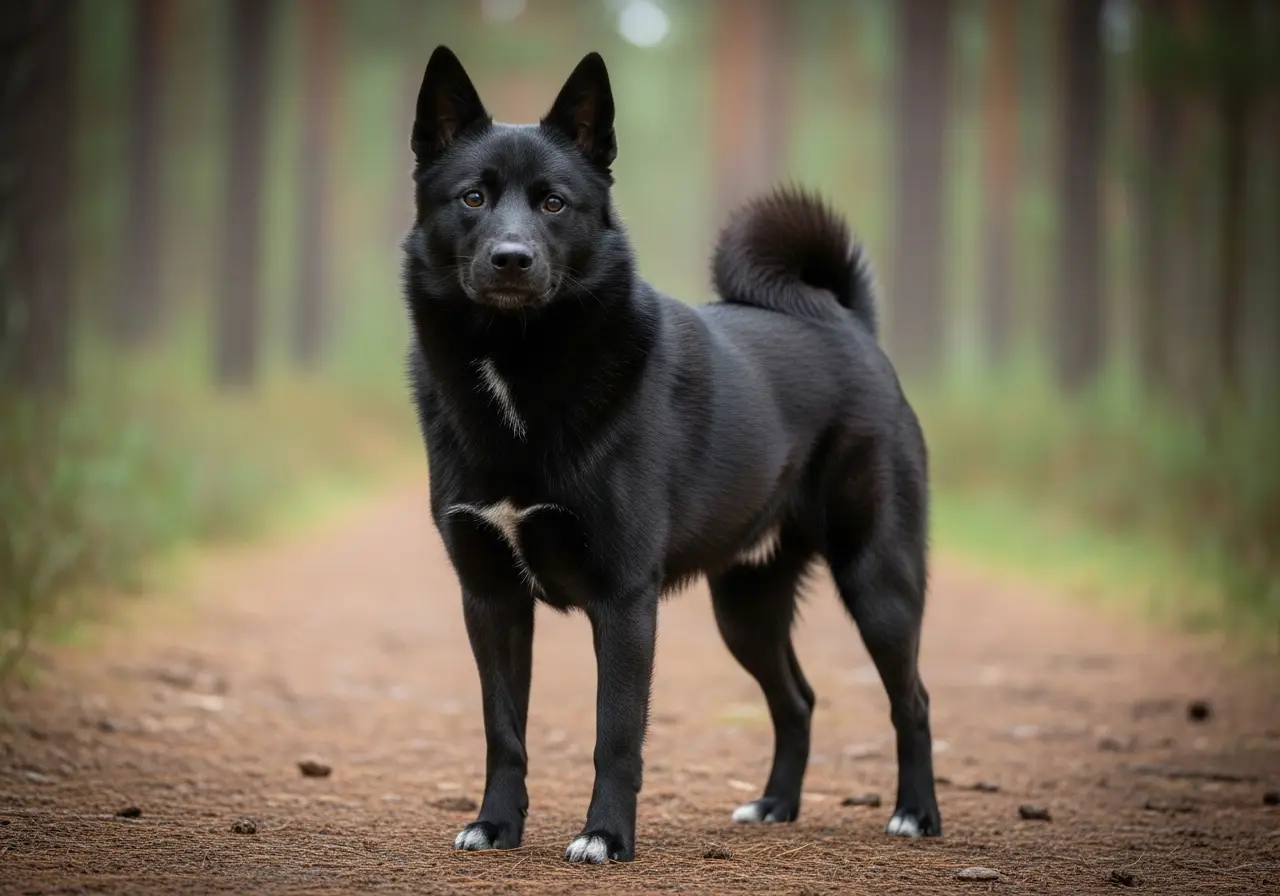
The Norwegian Elkhound (black) is a Nordic hunting spitz bred for independent moose hunting in Scandinavia. It comes with high exercise needs, pronounced initiative and a strong prey drive. Anyone keeping this breed requires experience with independently working dogs, a structured daily routine and at least 90 to 120 minutes of active exercise daily.
02Introduction
What makes the Norwegian Elkhound (black) special
Norwegian Elkhound black (Sort Norsk Elghund): black variant of the Grå Norsk Elghund, robust, independent and bred for elk hunting
03Profile
Key facts and suitability
- Origin
- Norwegen
- Original purpose
- Elk hunting
- FCI
- No. 268 · Group 5 · Sektion 2: Nordische Jagdhunde
- height at the withers
- 43–49 cm
- Weight
- 17–20 kg
- Life expectancy
- 12–15 Years
- Coat type
- Doppel
- Minimum exercise
- 90 min/day
- Puppy price
- 1'200–2'000 CHF
- Waiting period
- 5 months
- Sports
- Scent work Mantrailing
04Temperament
How the Norwegian Elkhound (black) shows up in everyday life
The morning walk shows what makes this breed special: the Norwegian Elkhound (black) immediately puts its nose to the wind, registers every movement in the undergrowth and makes independent decisions about which trail is worth pursuing. This is not disobedience; it is the result of thousands of years of breeding for independent hunting work.
Internally, this dog requires high mental and physical stimulation daily. The need for mental work is significantly above average: pure walks without a task are not sufficient. Search games, nose work, mantrailing or enrichment close to hunting such as tracking fill the tank. Whoever does not provide this receives a dog that seeks its own occupation, usually in a way that the owner does not like.
Externally, the dog behaves reservedly to expectantly towards strangers. A visitor entering the apartment is initially observed, not greeted. This reserve is not a sign of fear, but of watchfulness, a hunting dog instinct that keeps an eye on the territory. This trait differs fundamentally from the high need for social contact within one's own family: within the family unit, the dog seeks closeness, contact and inclusion in everyday life.
It tolerates being left alone at home for up to five hours, provided it has a defined territory and sufficient prior stimulation. Longer absences without a care plan lead to stress-related behaviour. A house with a secure garden suits its nature significantly better than a city apartment without the possibility of retreat.
05Needs
What this breed needs daily
The Norwegian Elkhound (black) requires at least 90 to 120 minutes of active exercise daily, not as a leisurely walk, but as physically demanding activity. Cross-country runs, extended hikes or bikejoring on paved paths match its endurance potential. A short lap around the block is insufficient.
In addition to physical exercise, it needs daily mental stimulation. Its need for cognitive work is high: nose work, tracking, search tasks or structured mantrailing offer meaningful alternatives to hunting work. Without this enrichment, it develops behavioural patterns that indicate under-stimulation, such as excessive barking, restlessness or destructive behaviour.
The prey drive is strongly genetically ingrained. Off-leash activity without secured terrain is permanently risky. A securely fenced garden or a secure open area is not a comfort solution, but a basic prerequisite for safe keeping.
Socially, the dog needs to be integrated into family life. It is not a kennel dog and tolerates isolation poorly. At the same time, the owner should understand that a high need for social contact within the family does not mean that the dog is open or approachable towards strangers; these two axes diverge significantly in this breed.
Training and guidance require consistency without harshness. The dog reacts sensitively to pressure, but needs reliable boundaries. A dog training school with experience in Nordic hunting dogs is recommended for newcomers to this breed.
Exercise
High
mental work
A lot
Social needs
Medium
training
Demanding
06Sport & Mental and Physical Stimulation
What sports the Norwegian Elkhound (black) is suited for
Realistic in terms of physiology and genetics – not every breed suits every sport.
Structurally and physiologically suitable: Suitable for mantrailing, dummy work and tracking · CaniCross / bikejoring possible.
07Quick Check
08Suitability
Who this breed is suitable for – and who it isn't
✓Matches
The Norwegian Elkhound (black) suits owners who already have experience with independently working or Nordic dogs. Those who can plan at least 90 to 120 minutes of active exercise in nature and terrain daily (through hiking, cross-country runs or bikejoring) meet the basic physical requirement.
The breed is suitable for nature-oriented people with a structured routine who are willing to actively organise hunting-related enrichment or nose work. A house with a secure garden is not a luxury, but a sensible basis for keeping the dog. Families with children from around 10 years of age, in which all family members understand how to handle an independent dog, may be suitable, provided that sufficient exercise budget and guidance competence are present.
Owners who rarely receive visitors or whose daily routine involves few encounters with strangers benefit from the fact that the dog's reserve towards strangers remains manageable in everyday life. Those who wish to handle the breed for hunting will find an enduring, courageous partner in it, provided they are familiar with the relevant test requirements of the Nordic countries.
×Doesn't match
The Norwegian Elkhound (black) does not suit owners who are keeping a dog for the first time. Its independence and pronounced prey drive demand guidance experience that cannot be acquired from books alone.
Those who are away from home for more than five hours daily and do not have a reliable care plan should not choose this breed. Owners who live exclusively in a city apartment without access to nature and secured open areas also significantly underestimate the keeping requirements.
A common misconception: those who interpret the dog's high need for social contact within the family as a sign of general approachability will be surprised by its reserve towards strangers. These two axes diverge significantly in this breed; those who do not plan for this will quickly find themselves in conflicts in everyday situations with visitors, children from the neighbourhood or unfamiliar dogs.
Owners who hope for a calm, adaptable companion dog that effortlessly adapts to the human lifestyle will not find what they are looking for in this breed. The Norwegian Elkhound (black) imposes demands; it does not fulfil them.
10Line reality
Show line, working line, breeder market
The Norwegian Elkhound (black) is traditionally kept in Scandinavia in two functional contexts: as an active hunting dog for moose and big game hunting, and as a show dog in the FCI conformation area. A formalised separation into working and show lines, as known for example with the German Shepherd Dog, does not exist for this breed to a comparable degree; the breeding population is too small.
Working tests take place in Norway, Sweden and Finland, which are provided exclusively for these Nordic countries according to the FCI standard. Dogs from lines tested for hunting generally show a more pronounced drive and higher initiative than dogs bred solely for conformation.
Outside Scandinavia (i.e. in Germany, Austria and Switzerland), most dogs come from breeds primarily oriented towards FCI conformation. This does not mean that the prey drive is absent: it is genetically deeply rooted and also manifests clearly in dogs without hunting test pedigree. Interested parties should specifically ask the breeder about the pedigree and working test results of the parent animals to obtain a realistic picture of the expected drive profile.
11Health · Reality
What you need to plan for medically with your Norwegian Elkhound (black)
The Norwegian Elkhound (black) is considered a robust breed with a life expectancy of 12 to 15 years. This range is realistic for a medium-sized Nordic hunting dog and is confirmed by information from the German Club for Nordic Dogs.
Hip dysplasia (HD) occurs in the breed but is controllable with consistent breeding selection. Reputable breeders X-ray both parent dogs and provide HD findings. Without this proof, no puppy should be reserved. Exact population-wide HD rates for the black variant are not published due to the small breeding population; interested parties should explicitly ask the breeder about the findings of the last two to three generations.
Hereditary eye diseases, including Progressive Retinal Atrophy (PRA), are documented in Nordic spitz breeds. A current eye examination of both parent dogs by a specialist vet for ophthalmology is the minimum standard for reputable breeding.
The dense double coat requires intensive care, especially during the twice-yearly shedding periods. Matting in the undercoat can lead to skin irritation if not combed out in time.
Overweight is a lower risk for sufficiently exercised dogs of this breed than for less active breeds, but with lack of exercise, the risk of joint wear and metabolic problems increases. Regular weight checks at the vet, at least once a year, are recommended.
12Structured data
Health by the numbers
Prone to diseases
Hip dysplasia Eye problems
Recommended health tests
Hip X-ray Eye examination
13Myths ↔ Reality
What is often said incorrectly about this breed
Five myths, five realities, five sources.
„The black elkhound is like a large Spitz, easy to care for and family-friendly for everyone.
The Norwegian Elkhound (black) was bred for independent hunting work, not as a companion dog. It requires 90–120 minutes of active exercise daily and enrichment close to hunting. Without sufficient stimulation, it develops behavioural problems such as excessive barking, destructive behaviour or attempts to escape.
„Nordic dogs are robust and require little veterinary preventive care.
The Norwegian Elkhound (black) can also develop breed-typical health problems, including hip dysplasia and hereditary eye diseases. Regular preventive examinations, particularly eye and hip screenings, are standard in reputable breeding and should be actively requested by owners.
„Its strong prey drive can be completely eliminated through consistent training.
The prey drive is genetically deeply rooted and can be channelled through training, but not eliminated. Off-leash exercise without secure terrain remains permanently risky for this breed. Recall training requires above-average time and consistency according to experience reports from Nordic dog clubs.
„The black variant is rarer, thus particularly exclusive and healthier than the grey one.
Rarity is not a health characteristic. A small breeding population increases the risk of inbreeding and limited genetic diversity. Interested parties should explicitly ask breeders about inbreeding coefficients and health tests before reserving a puppy.
„He is reserved towards strangers, which makes him an ideal guard dog.
Reserve towards strangers is a breed characteristic, not a protective instinct in the sense of a trained guard dog. The Norwegian Elkhound (black) is not a protection dog and should not be used or promoted as such. Uncontrolled watchfulness without training can lead to undesirable behaviour.
14animal welfare
The animal welfare perspective
Breeder market, designer versions, animal shelter reality — what no one writes in the puppy ad.
The Norwegian Elkhound (black) is a pronounced rarity in the German-speaking region. The small breeding population makes it susceptible to two opposing problems: On the one hand, there is a risk of inbreeding with too few active breeding dogs; on the other hand, the rarity tempts some providers to demand inflated prices without corresponding breeding quality.
Breeding operations that rely on the exclusivity of rare Nordic breeds are active in online trade. Identifying features: no club membership, no health certificates for the parent dogs, immediate availability without waiting time, sale via classifieds portals without prior discussion. Anyone offered a puppy of this breed for under 1,500 euros without complete health documentation should question the offer critically.
Keeping-related problems arise in this breed almost exclusively through underestimating the need for exercise and mental stimulation. A dog that needs 90 to 120 minutes of active workload daily but is instead kept in a city apartment with two short walks will develop behavioural problems, excessive barking, restlessness, and escape attempts. These dogs then end up in animal welfare shelters, not because the breed is problematic, but because the keeping requirements were not met.
Adoption via animal welfare organisations is a fully valid option. Specialised rescue stations for Nordic dogs occasionally place adult elkhounds whose character and health status are already known. An adult dog from animal welfare needs a settling-in period but offers the advantage of predictability. Anyone open to this option should contact Nordic dog clubs that maintain corresponding adoption networks.
15Costs · Transparency
What this breed realistically costs
A puppy from a reputable breeder with club affiliation, health certificates and FCI papers costs between 1,500 and 2,500 euros in the German-speaking region. Offers significantly below this without complete documentation are a warning signal.
Annual living costs range from 2,000 to 3,500 euros depending on the form of keeping. This includes high-quality food (approx. 600–1,000 euros/year for a medium-sized active dog), care needs (brushing, occasional professional trimming, approx. 100–200 euros/year) and basic equipment.
Basic vet costs (annual preventive examination, vaccinations, parasite prevention) amount to approx. 300–500 euros per year. Possible costs for eye and hip screenings are added; these are mandatory for breeding dogs but remain recommended for pet dogs as well.
A dog liability insurance costs between 60 and 150 euros annually depending on the provider and canton/federal state. A health insurance for dogs is optional but can be sensible for a breed with potential eye or joint problems; annual premiums start at approx. 400 euros. Anyone calculating the total costs over a life expectancy of 12–15 years comes to a five-figure sum.
16Puppy search
What you need to consider when choosing a breeder
- Reputable breeders of the Norwegian Elkhound (black) are very rare in the German-speaking region.
- The German Club for Nordic Dogs e.V.
- (DCNH) and the Swiss Club for Nordic Dogs (SKNH) maintain breeding lists and facilitate contact with tested breeding facilities.
- Waiting periods of one to several years are not an exception, but the norm.
- A reputable breeder provides health certificates for both parent dogs, including at least hip X-rays and eye examinations.
- They ask questions about the planned keeping conditions, refuse to sell to unsuitable owners and allow multiple visits to the litter.
- Puppies available without a waiting period and without prior discussion most likely do not come from responsible breeding.
- Adoption through animal welfare organisations is an equally valid option.
- Although adult dogs of this breed rarely appear in German-speaking animal welfare, specialised rescue stations for Nordic dogs exist that occasionally rehome Elkhounds.
- An adult dog has the advantage that its character and health status are already assessable.
FAQ
Frequently asked questions about the Norwegian Elkhound (black)
Is Norwegian Elkhound (black) a family dog?
Norwegian Elkhound (black) is considered suitable for families with good socialisation and species-appropriate care.
How much exercise does Norwegian Elkhound (black) need?
At least around 90 minutes of exercise per day. As an active breed, more so — plus mental stimulation.
What is the size and weight of Norwegian Elkhound (black)?
Fully grown, Norwegian Elkhound (black) reaches about 43–49 cm at the withers and weighs around 17–20 kg.
What is the life expectancy of Norwegian Elkhound (black)?
The life expectancy of Norwegian Elkhound (black) is approximately 12–15 years.
Which diseases are common in Norwegian Elkhound (black)?
Hip dysplasia Eye problems
17Breed clubs
Official breed clubs in DACH
19Related
Similar breeds – and their differences
You might also be interested in
Participate
Do you have a good photo of your Norwegian Elkhound (black)?
We are looking for expressive images for our breed profiles. Submit yours; the editorial team reviews every submission before publication.
Does this breed suit you?
Rarer black variant of the Elkhound – with identical character but even rarer occurrence